Looking for specific financial advice?
This blog provides general educational content. For personalized advice tailored to your unique situation, book a free consultation with our team of ASIC-licensed financial advisers.
What If Your Tax Return Is More Complicated Than a Standard Employee's, and You've Been Filing It Like One Anyway?
St Lucia and Taringa sit in the shadow of the University of Queensland, and that proximity shapes the local demographic in a genuinely distinctive way: a significant population of university staff (academics, researchers, professional staff), postgraduate students on scholarships or stipends, and a strong overlay of rental property investors drawn to the area's reliable student and staff rental demand. Each of these groups has tax considerations that don't fit a standard "salary and deductions" template, and getting them wrong (or simply not knowing they apply) is a common, avoidable cost.
TL;DR
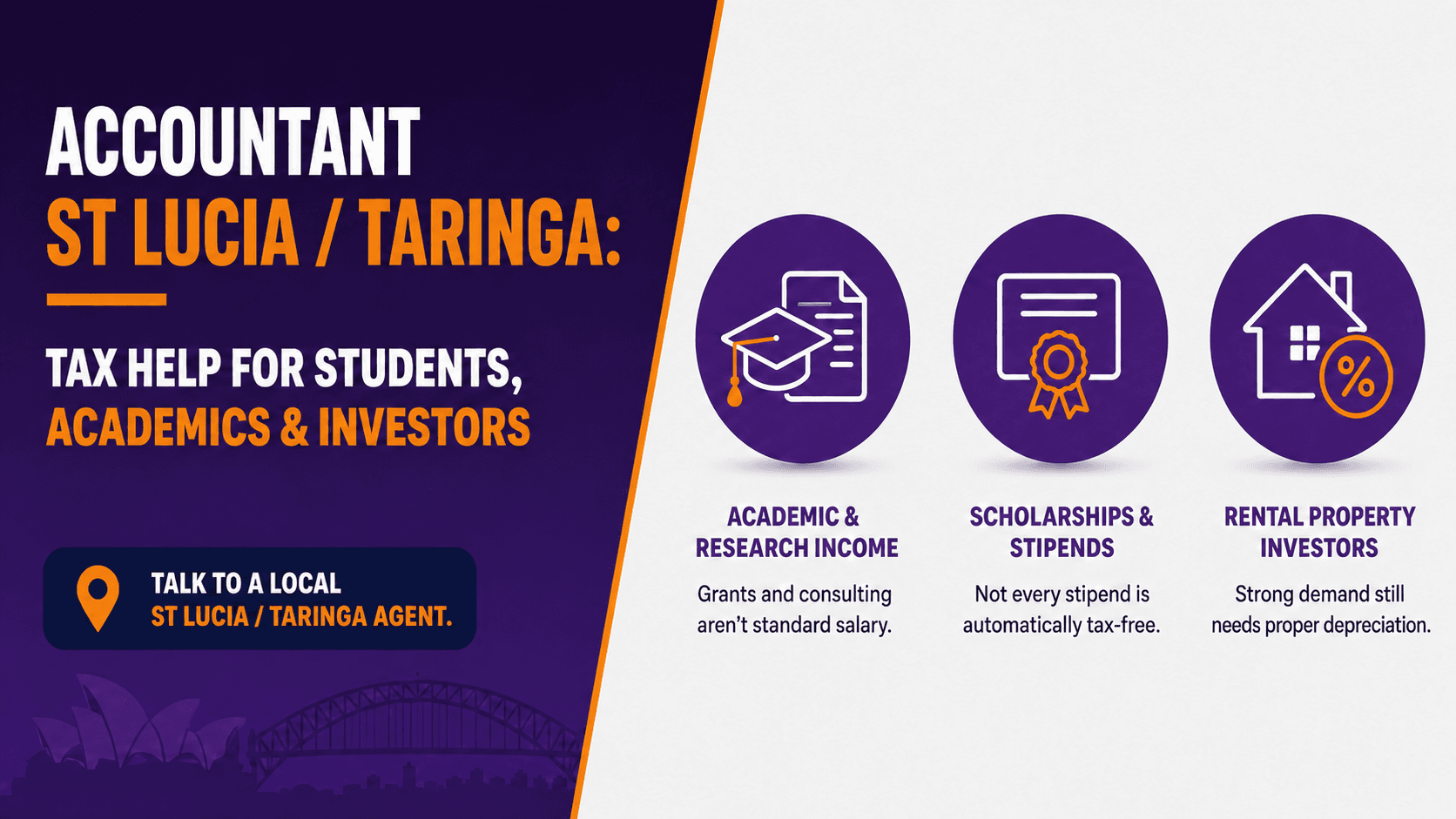
University academic and research staff often have income that includes research grants, consulting income, or overseas visiting appointments, each carrying specific tax treatment that differs from standard employment income.
Postgraduate students receiving scholarships or stipends need to understand which of these payments are tax-exempt and which aren't, since this isn't automatic or uniform across all scholarship types.
Rental property investors in St Lucia and Taringa benefit from the area's strong, reliable UQ-driven rental demand, but still need proper depreciation, expense, and capital gains tax management like any investment property.
Overseas researchers or visiting academics temporarily based in Australia may have specific tax residency considerations that affect how their Australian and overseas income is treated.
Taringa's slightly more family and professional-commuter demographic, alongside St Lucia's university-driven population, means the suburb pair genuinely spans a wide range of tax and accounting needs, not a single uniform profile.
Our Toowong office is a short trip from both St Lucia and Taringa, generally 10 to 15 minutes by car, making in-person tax advice genuinely convenient for the area.
Bottom line: if your income involves a university in any way, as staff, student, or researcher, or you own rental property in the area, there's a genuine chance your tax return needs more attention than a standard template provides.
On This Page
Academic and Research Income: More Complex Than a Standard Payslip
Scholarships and Stipends: What's Actually Tax-Exempt
Rental Property Investors in a Strong Student Rental Market
Overseas Researchers and Visiting Academics
Taringa's Family and Commuter Population
Getting to WIAA's Toowong Office From St Lucia/Taringa
Worked Example: Three Different Tax Situations, One Suburb Pair
Common Mistakes
FAQ
Academic and Research Income: More Complex Than a Standard Payslip
University academic and research staff often have income streams beyond a standard salary, research grant funding, external consulting work, royalties from published work, or income from visiting positions at other institutions, whether within Australia or overseas. Each of these can carry different tax treatment, deduction eligibility, and reporting requirements than standard salaried employment, and a generic tax return approach can miss legitimate deductions (like specific research-related expenses) or misreport income types that need to be handled differently.
Have research income, consulting work, or grant funding alongside your university salary and want it handled properly? A free 15-minute chat at our nearby Toowong office can help. Call 1800 942 843.
Bottom line: if your university income is more varied than a single salary line, your tax return probably needs to be too. Treating it as a standard employee return risks missing genuine complexity worth addressing properly.
Scholarships and Stipends: What's Actually Tax-Exempt
Postgraduate students receiving scholarships or stipends face a genuinely common point of confusion: not all scholarship income is automatically tax-exempt. Whether a specific scholarship or stipend payment is exempt generally depends on factors like whether it's genuinely a scholarship (as opposed to payment for services rendered), the specific conditions attached, and whether recipients are also required to work as an employee for the institution as part of the arrangement. Getting this wrong in either direction, assuming exemption that doesn't apply, or missing an exemption that does, is a common, avoidable tax return error for this group.
Not sure whether your specific scholarship or stipend is actually tax-exempt? Email tax@whatifadvice.com.au and we'll help you work through the actual conditions of your payment.
Bottom line: "it's a scholarship" isn't automatically the same as "it's tax-free." The actual conditions of the specific payment determine the tax treatment, and this is worth checking properly rather than assuming either way.
Rental Property Investors in a Strong Student Rental Market
St Lucia and Taringa's proximity to UQ creates genuinely strong, reliable rental demand from students and university staff, making the area a popular choice for investment property buyers. That said, the strength of the local rental market doesn't change the fundamentals of good investment property tax management, accurate depreciation schedules, properly categorised expenses (repairs versus improvements, in particular), and capital gains tax planning if considering a future sale all remain just as important here as for any other investment property. Our accounting team handles depreciation schedule preparation and CGT planning as a standard part of investment property tax work, this isn't something that needs to be figured out separately from your regular return.
Bottom line: a reliable rental market doesn't reduce the need for proper tax management of an investment property. If anything, a well-performing asset deserves equally careful tax handling to make sure you're capturing its full value.
Overseas Researchers and Visiting Academics
UQ's international academic community means St Lucia and Taringa have a meaningful population of overseas researchers and visiting academics on temporary appointments. This group often faces specific tax residency questions, whether they're considered an Australian tax resident for the period of their appointment, how this affects the treatment of both their Australian and overseas income, and whether any tax treaty provisions between Australia and their home country are relevant to their specific situation.
Bottom line: tax residency status for a temporary visiting position isn't always straightforward, and getting it wrong can have meaningful consequences for how your total income is taxed. This is worth confirming properly rather than assuming based on general expectations.
Taringa's Family and Commuter Population
While St Lucia is heavily shaped by the university, Taringa carries a somewhat broader mix, including families and professionals commuting into the city or to UQ for work, alongside the same strong rental investment appeal given its proximity to the university and train line. This means Taringa households often combine standard family financial planning considerations (mortgage, school costs, super) with the area's broader investment property appeal, rather than fitting neatly into either the "university" or "standard family suburb" category alone.
Bottom line: Taringa genuinely spans both worlds, university-adjacent investment appeal and standard family financial planning needs, and a good adviser should be comfortable addressing either, depending on your specific situation.
Getting to WIAA's Toowong Office From St Lucia/Taringa
Both St Lucia and Taringa are a short, easy trip from our Toowong office, generally around 10 to 15 minutes by car, with train line access from Taringa station also making the journey straightforward without a car. Virtual consultations remain available for university staff or students with limited flexibility around teaching, research, or study schedules.
Bottom line: proximity to Toowong makes in-person tax advice genuinely convenient for the area, with virtual options well-suited to the often irregular schedules of academic and student life.
Worked Example: Three Different Tax Situations, One Suburb Pair
Dr. Chen (academic staff): A UQ senior lecturer with a standard salary, plus additional research grant income and occasional paid consulting work for an industry partner. Her previous tax returns had treated all income as standard salary, missing the different reporting requirements and available deductions specific to her research and consulting income streams.
Amara (PhD candidate): Receiving a university stipend, uncertain whether the full amount is tax-exempt given she's also required to complete a small amount of paid tutoring work as part of her scholarship conditions, a genuine grey area worth clarifying properly rather than guessing either way.
The Farrows (Taringa investors): A family who purchased an investment property in Taringa specifically for its strong UQ-driven rental demand, but had never had a proper depreciation schedule prepared, missing legitimate deductions available on their relatively new build.
Bottom line: three genuinely different tax situations, all within the same suburb pair, each needed a different kind of attention, which is exactly why a one-size-fits-all approach doesn't serve this particular area well.
Common Mistakes
Treating research grant or consulting income the same as standard salary. These often carry different reporting requirements and deduction eligibility.
Assuming all scholarship or stipend income is automatically tax-exempt. The specific conditions of the payment determine this, not the general label "scholarship."
Not getting a proper depreciation schedule for an investment property. A strong rental market doesn't reduce the value of capturing legitimate depreciation deductions.
Assuming tax residency status for a visiting academic position without checking. This can have meaningful consequences for how total income is taxed and deserves proper confirmation.
Treating Taringa and St Lucia as identical for tax planning purposes. The demographic mix genuinely differs between the two, and the right advice reflects that.
FAQ
Is my PhD scholarship stipend taxable? It depends on the specific conditions of the scholarship. Genuine scholarship payments without a service obligation are often tax-exempt, but this isn't automatic, and it's worth confirming for your specific scholarship's terms.
Do I need a specialist accountant if I have university research income? It's worth seeking an accountant familiar with academic and research income specifically, given the different reporting requirements compared to standard salaried employment.
How far is St Lucia/Taringa from WIAA's nearest office? Both suburbs are generally a 10 to 15 minute trip by car from our Toowong office, with train access from Taringa station also making the journey easy without a car.
Is Taringa or St Lucia a good area for rental property investment? Both benefit from strong, reliable rental demand given proximity to UQ, though as with any investment property, proper tax management (depreciation, expense categorisation) matters regardless of how strong the local rental market is.
Do overseas visiting academics need to pay Australian tax on their overseas income? This depends on their Australian tax residency status during their appointment, which isn't always straightforward to determine and is worth confirming properly rather than assuming.
Can WIAA help with a tax return that includes research grants and consulting income? Yes. This is exactly the kind of more complex income situation our accounting team can help properly categorise and report.
Is tutoring or casual work income taxable on top of a stipend? Generally yes, casual or paid work income is assessable, and understanding how it interacts with any scholarship exemption is worth clarifying for your specific arrangement.
Does WIAA offer virtual tax consultations for university staff or students with irregular schedules? Yes. Virtual consultations are available and often suit academic or student schedules better than fixed in-person appointments.
What's a common tax mistake for investment property owners near UQ? Not obtaining a proper depreciation schedule is a common, easily avoidable missed deduction, particularly for relatively newer builds in the area.
Can WIAA help family clients in Taringa alongside investment property clients? Yes. Our advisers and accountants work with both standard family financial planning needs and investment property tax matters, which suits Taringa's genuinely mixed demographic.
Ready to Get Your Tax Situation Handled Properly?
Ready to make sure your university-related income, scholarship, or investment property tax situation is being handled properly, not just filed like a standard return? A quick conversation at our nearby Toowong office (or virtually, around your schedule) is a good place to start.
Call us: 1800 942 843
Email: tax@whatifadvice.com.au
Book online: free 15-minute chat, no cost, no pressure
Still asking what if your tax return is more complicated than it looks? If a university's involved anywhere in your income, there's a good chance it is.
WIAA has filed 2,000+ tax returns across our Toowong, Grange, and Melbourne CBD offices, operating under AFSL 528250 as an Authorised Representative of Beryllium Advisers Pty Ltd.
General Advice Disclaimer: This article contains general information only and does not take into account your personal objectives, financial situation, or needs. It does not constitute personal tax advice, and should not be relied upon as such. Tax treatment of scholarships, research income, and residency status is fact-dependent and should be verified with a registered tax agent based on your specific circumstances.