Looking for specific financial advice?
This blog provides general educational content. For personalized advice tailored to your unique situation, book a free consultation with our team of ASIC-licensed financial advisers.
When you’re starting or growing a business, it’s tempting to choose the simplest option (usually sole trader) and “sort the rest later”.
But your business structure is more than paperwork, it affects:
how much tax you pay
how much personal risk you carry
how you pay yourself
how easy it is to bring in partners or investors
how your profits can be distributed
your accounting, admin and compliance
your long-term wealth and asset protection
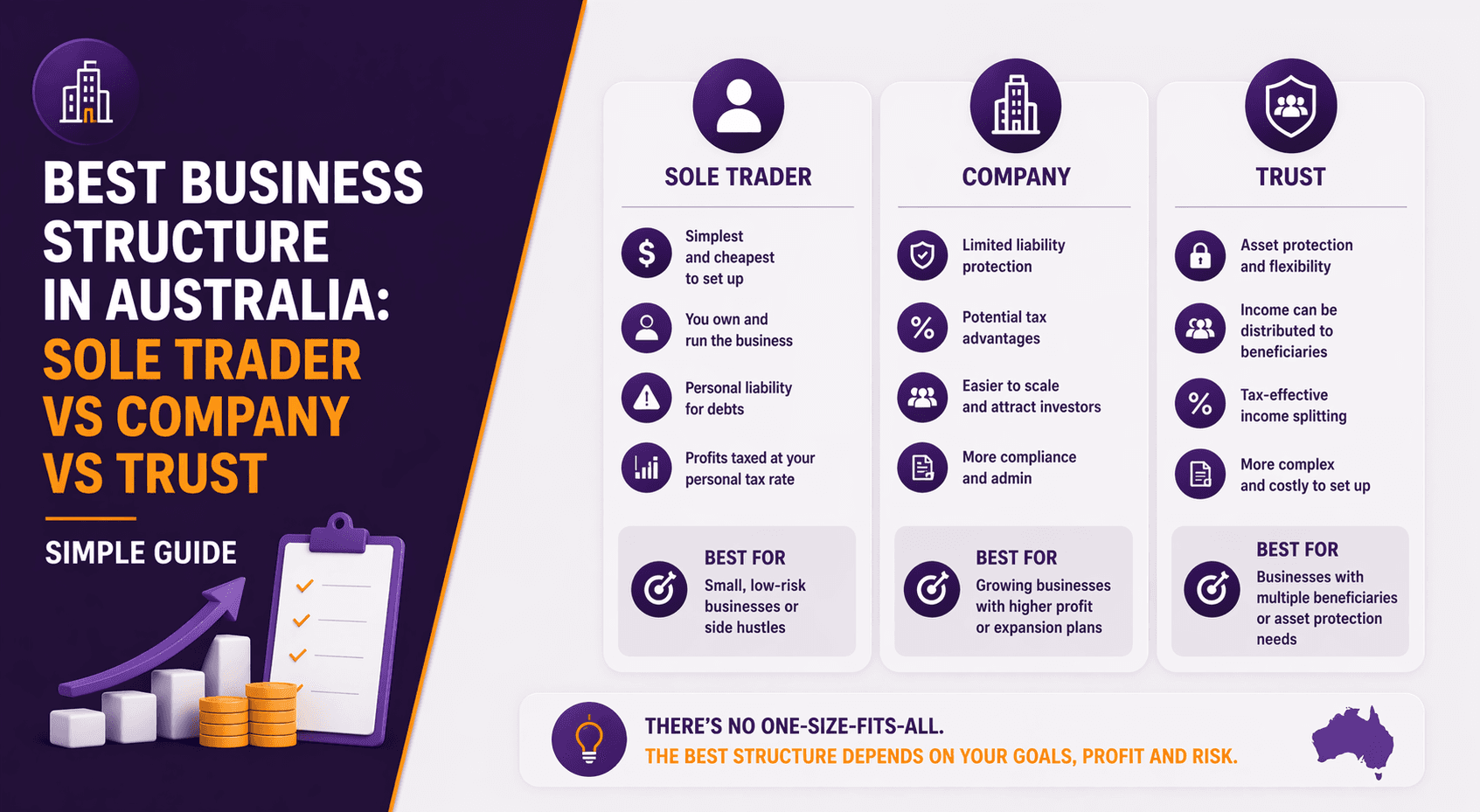
In Australia, the most common structures are:
Sole trader
Company (Pty Ltd)
Trust (usually a discretionary/family trust)
There’s no single “best” structure for everyone. The best option depends on your income level, risk, growth plans, and personal circumstances.
Let’s break it down clearly, without jargon.
Quick Snapshot: Which Structure Suits Who?
Sole trader is often best if:
you’re starting out or testing an idea
income is still modest or unpredictable
you want low cost and minimal admin risk is low (e.g., service-based work with low liabilities)
Company is often best if:
you’re earning consistent profits
you want limited liability protection
you want better separation between business and personal
you plan to hire staff or scale
you want flexibility in paying yourself (salary/dividends)
Trust is often best if:
you want flexibility to distribute profits to different beneficiaries
you want asset protection (in the right setup)
you want long-term family wealth planning
you have strong profits and professional support
you’re comfortable with extra admin and compliance
What Is a Sole Trader Structure?
A sole trader is the simplest structure. You operate the business as an individual.
How tax works
You declare business income in your personal tax return, and you pay tax at individual marginal tax rates.
Pros of being a sole trader
Cheap to set up
Minimal admin (compared to company/trust)
Full control over decisions
Simple bookkeeping and tax reporting
Good for side hustles and early-stage businesses
Cons of being a sole trader
You are personally liable for business debts and legal issues
Harder to separate personal assets from business risk
Profit taxed at personal rates (can become expensive as income rises)
Harder to bring in partners/investors
Some lenders and suppliers may prefer dealing with a company for larger arrangements
Example: sole trader may suit
A freelance designer or consultant earning under (say) mid-six figures, with minimal business debt and low legal risk.
What Is a Company Structure (Pty Ltd)?
A company is a separate legal entity registered with ASIC. It can own assets, borrow money, and enter contracts in its own name.
How tax works
A company pays tax at the company tax rate, which is different from individual tax rates. The full rate is 30%, and a lower rate may apply to “base rate entities” (depending on current ATO rules).
Then, when you take profits out (via salary or dividends), tax is assessed depending on how it’s paid and your personal situation.
Pros of a company
Limited liability (your personal assets are generally more protected)
Clear separation between business and personal finances
Perceived as more “established” by clients, lenders and suppliers
Can be more tax-effective once profits are high
More flexible for growth, staff, investors and future sale
Cons of a company
Higher setup and ongoing costs
More admin: ASIC obligations, director duties, extra reporting
Must keep good records and run properly (minutes, compliance, accounts)
Director obligations can still create personal risk if mismanaged
Example: company may suit
A trades business, agency, or product business earning strong profits consistently, hiring staff, and taking on risk/contracts.
What Is a Trust Structure?
A trust is a legal structure where a trustee holds and manages assets on behalf of beneficiaries.
Most business owners who use a trust use a discretionary (family) trust, which can distribute income to different beneficiaries (within the trust deed rules).
How tax works
A trust generally doesn’t pay tax as a separate entity if it distributes income to beneficiaries. The beneficiaries pay tax at their own marginal rates on the distributions they receive.
If the trust retains income (or does not distribute properly), tax outcomes can become less favourable.
Pros of a trust
Flexibility to distribute profits among family members (where appropriate)
Can support long-term family wealth planning
Potential asset protection (depending on design and how it’s used)
Useful for investment income and holding assets
Can be combined with a company (“bucket company”) for planning (with correct advice)
Cons of a trust
More complex and more expensive than sole trader
Requires ongoing accounting support and documentation
Distributions must be done correctly and on time
Trust losses generally can’t be distributed like income, losses stay in the trust and are carried forward subject to rules
Trust arrangements and distribution strategies are an area of ATO scrutiny documentation and “doing it right” is essential
Example: trust may suit
A business with strong profits where the owner wants flexibility to distribute income to a spouse/adult beneficiaries (where appropriate), and wants asset protection and long-term wealth strategy.
Key Comparison: Sole Trader vs Company vs Trust
1) Liability (personal risk)
Sole trader: You are personally liable
Company: Limited liability (but directors still have responsibilities)
Trust: Liability depends on trustee structure (corporate trustee is common for protection)
2) Tax flexibility
Sole trader: Taxed at your personal marginal rates
Company: Taxed at company tax rate, then taxed again when profits are paid out (depending on method)
Trust: Income can be distributed to beneficiaries for potentially flexible tax outcomes (within rules)
3) Setup + ongoing admin
Sole trader: Lowest cost, simplest
Company: More admin and ASIC obligations
Trust: Complex, requires careful compliance and documentation
4) Paying yourself
Sole trader: drawings (not a wage)
Company: salary and/or dividends
Trust: distributions to beneficiaries (and potentially salary if employing you)
5) Growth and investment
Sole trader: harder to scale and bring in investors
Company: easier to scale, sell, bring in shareholders
Trust: can be very effective for holding assets and long-term wealth, but not as simple for investors
“Best Structure” Depends on Your Stage of Business
If you’re starting out (low income, testing ideas)
Sole trader is usually the simplest and cheapest.
But it’s worth reviewing if:
profit grows quickly
risk increases (contracts, staff, debt, legal exposure)
your personal tax bracket climbs
you begin investing profits
If you’re growing (profits increasing and consistent)
A company often becomes attractive because of:
limited liability
professionalism
flexibility in reinvesting profits
scalability and sale potential
If you’re profitable and planning long-term wealth
A trust (or trust + company) can make sense when:
you want income distribution flexibility
you want asset protection layers
you’re building investments
you want intergenerational wealth planning
you can afford the setup and admin
Common “Best Practice” Structures Australians Use
1) Sole trader (basic)
Good for early stage. Often evolves later.
2) Company only
Good for growth, limited liability, strong profits, simple reinvestment.
3) Family trust (with corporate trustee)
Good for asset protection and flexibility, but must be managed properly.
4) Trust + Company (“bucket company”)
Common for higher-profit businesses and families where:
trust earns income
distributes to a company beneficiary (within rules)
company retains profits at company tax rates
cash and documentation are managed properly
This is powerful but complex and needs professional advice because trusts are a focus area for ATO compliance and documentation standards.
Mistakes to Avoid When Choosing a Structure
1) Choosing based on “tax savings” only
Tax matters, but so do:
risk exposure
admin costs
your lifestyle and exit plans
personal borrowing needs
industry requirements
2) Setting up a structure you can’t maintain
A trust or company structure is pointless if:
records are messy
distributions aren’t documented properly
BAS and tax are always late
business and personal spending are mixed
3) Ignoring liability
If your business has contracts, staff, equipment, debt, or public-facing risk, a sole trader structure may expose your personal assets more than you realise.
4) Not planning “how you’ll pay yourself”
Different structures change whether you use:
wages
dividends
trust distributions
drawings
Your pay strategy affects tax, super, and compliance.
Practical Checklist: How to Choose the Right Structure
Ask yourself:
Income & profitability
How much profit do I expect this year?
Will I reinvest profits or withdraw most of it?
Risk & liability
Am I exposed to legal claims?
Do I have debt, staff, or contracts?
Growth plans
Do I plan to scale, hire, or sell?
Do I want to bring on partners/investors?
Personal and family planning
Do I want to distribute income to family beneficiaries (where appropriate)?
Am I building investments or assets outside the business?
Admin tolerance
Am I willing to maintain higher compliance requirements?
Key Takeaways
Sole trader is simple and cheap but offers little liability protection
Company structures offer limited liability and flexibility for growth, but have higher admin costs Trusts can provide distribution flexibility and wealth planning benefits, but require strong compliance and documentation
The best structure depends on your profits, risk, growth plans and long-term goals
Many businesses evolve from sole trader → company → trust/company combination as they grow
The wrong structure can cost you in tax, risk and admin time
FAQ
1) What is the best business structure in Australia?
There isn’t one best structure for everyone. The best structure depends on your income, risk exposure, growth goals, and need for tax and asset protection strategies.
2) Should I start as a sole trader or a company?
Many people start as a sole trader because it’s cheaper and simpler. If profit becomes consistent or risk increases, a company may be worth considering.
3) Is a trust better than a company for tax?
A trust can offer flexibility in distributing income to beneficiaries, but it’s not automatically “better”. Trusts are complex and need correct documentation and compliance.
4) Can a trust run a business in Australia?
Yes. A trust can operate a business, with the trustee responsible for running the trust’s affairs.
5) Can I change business structure later?
Yes, but changing structures can trigger tax and legal consequences (for example, transferring assets). It’s best to plan before switching and get advice.
Still asking “what if” about your finances?
That’s exactly where clarity begins.
Whether you’re planning ahead, growing wealth, or simply want confidence in your financial decisions, the advisers at What If Advice can help you turn questions into a clear, personalised plan.
👉 Book a free 15-minute strategy session or get in touch today at
whatifadvice.com.au
General Advice Disclaimer
This information is general in nature and does not take into account your personal financial situation, needs, or objectives. You should consider whether it is appropriate for you and seek personal financial advice before making any decisions. You should seek professional tax and legal advice before establishing or changing a business structure.