Looking for specific financial advice?
This blog provides general educational content. For personalized advice tailored to your unique situation, book a free consultation with our team of ASIC-licensed financial advisers.
What If the Cheaper Home on Paper Ends Up Costing You More?
A house and land package advertised at $820,000 looks cheaper than an established home at $850,000. Then you add site costs, driveway, fencing, landscaping, window coverings, and a year of rent while you wait for the keys. Our worked example shows the two can end up within about $9,000 of each other once everything is counted. For first home buyers in Queensland, grants and stamp duty concessions can tip the result firmly the other way. Building isn’t automatically cheaper, and established isn’t automatically safer. The real comparison needs every cost on the table.
For first home buyer grants and loan options in more detail, see our First Home Buyer Guide. For renovating an older home, see our Annerley and Highgate Hill guide on renovation and construction loans.
TL;DR
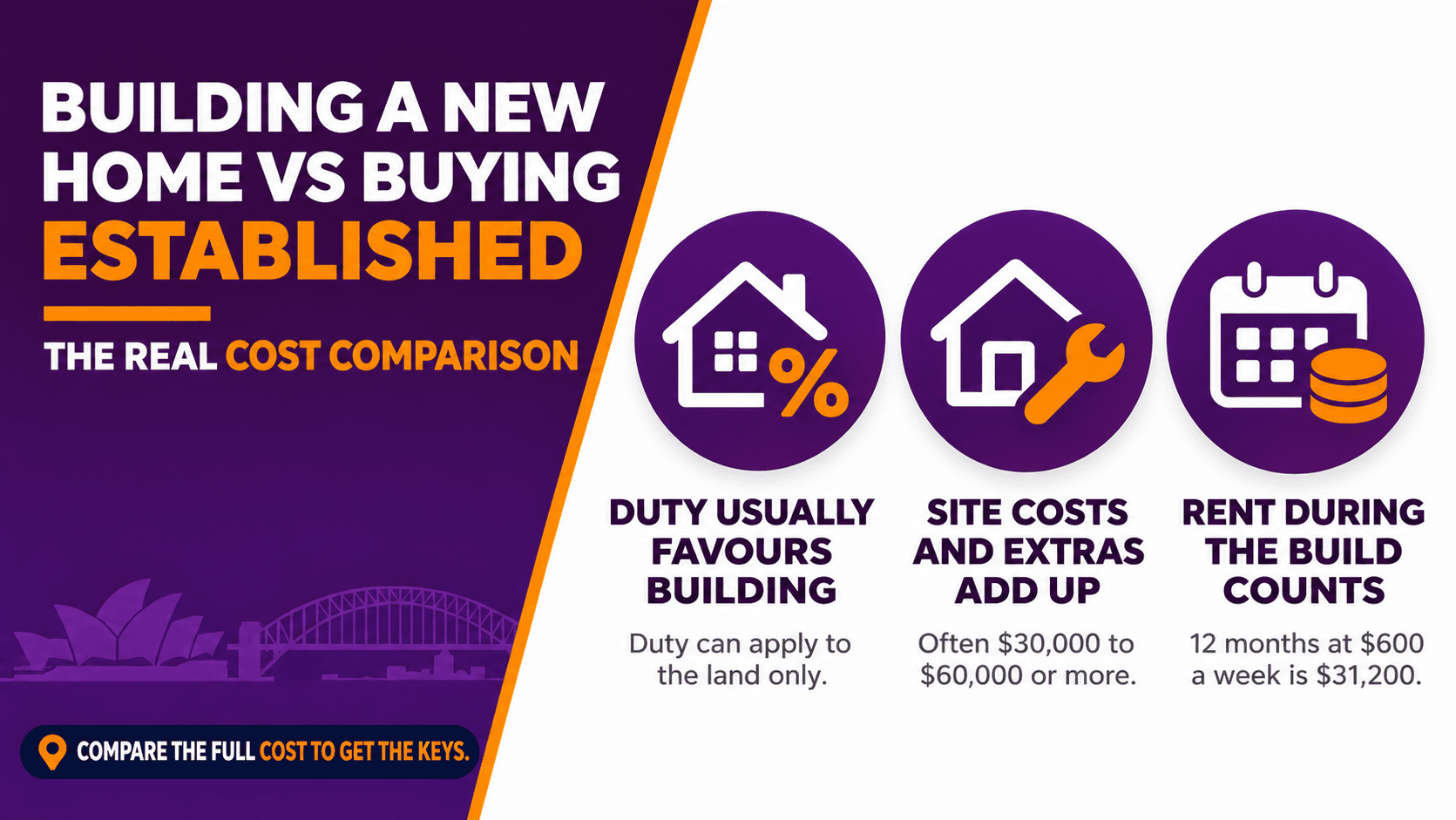
Stamp duty usually favours building. In Queensland, duty generally applies to the land only when land and construction are bought under separate contracts.
Queensland first home buyers building a new home can generally pay no transfer duty, and may receive a $30,000 First Home Owner Grant on new homes valued under $750,000.
Base build prices often exclude site costs, driveways, fencing, landscaping, and window coverings, which can add $30,000 to $60,000 or more.
Rent during the build is a real cost. Twelve months at $600 a week is $31,200.
Construction loans draw funds in stages, and you generally pay interest only on what’s been drawn. If the build runs over budget, you fund the gap.
Established homes cost more in duty and maintenance, but you move in immediately and usually buy more land value, which tends to drive long-term growth.
New builds suit investors seeking depreciation. Construction deductions on a $420,000 build can be around $10,500 a year.
Bottom line: the right answer depends on your situation, especially whether you qualify for first home concessions, so compare the full cost to get the keys, not the advertised price.
On This Page
Why the Advertised Price Misleads
Stamp Duty: Where Building Usually Wins
Grants and Concessions in 2026
The Hidden Costs of Building
How Construction Loans Work
Time and Builder Risk
The Hidden Costs of Buying Established
Long-Term Costs: Maintenance, Energy, and Depreciation
Capital Growth: Why Land Does the Heavy Lifting
Worked Example 1: Upgraders Comparing an $850,000 Purchase
Worked Example 2: First Home Buyers in Queensland
Common Mistakes
FAQ
Why the Advertised Price Misleads
Building new | Buying established | |
What the advertised price includes | Often land plus a base build only | The finished home and land |
Stamp duty | Usually on the land only (separate contracts) | On the full purchase price |
Extras to budget | Site costs, driveway, fencing, landscaping, blinds, upgrades | Building and pest inspection, repairs, updates |
When you move in | Often 9 to 18 months or more after buying land | Usually at settlement |
Housing costs while waiting | Rent or current home costs during the build | None after settlement |
Ongoing maintenance | Lower in early years | Higher, especially for older homes |
Depreciation for investors | Significant | Limited |
Land value share | Often smaller, especially on outer estates | Often larger, especially in established suburbs |
Bottom line: building and buying include different things in their headline prices, so they can’t be compared on sticker price alone.
Stamp Duty: Where Building Usually Wins
In Queensland, when you buy vacant land and sign a separate building contract, transfer duty generally applies to the land only, not the construction cost. When you buy an established home, duty applies to the full price.
As an illustration, using general and home concession rates for buyers who aren’t first home buyers:
Duty on $400,000 of vacant land (general rate): about $12,425
Duty on an $850,000 established home (home concession rate): about $24,100
That’s a difference of about $11,675. Duty rates and concessions change, and the right rate depends on your circumstances. Use the Queensland Revenue Office estimator or ask your conveyancer before relying on these figures.
Bottom line: building generally avoids duty on the construction cost, which is often the biggest single upfront saving.
Grants and Concessions in 2026
Queensland (first home buyers):
The First Home Owner Grant of $15,000 or $30,000 applies to buying or building a new home, valued at less than $750,000 including land. There’s no grant for established homes.
The 2026-27 Queensland Budget said the $30,000 grant would be continued for eligible contracts signed from 1 July 2026. Details are subject to legislation passing, so confirm the current amount before you sign.
No duty on new homes or land to build on. First home buyers purchasing a new home or vacant land to build continue to receive a 100% transfer duty exemption, regardless of price.
Established first homes: full duty relief applies up to $700,000, with partial concessions available up to $800,000.
New residency requirement: from 1 August 2026, buyers must be Australian citizens, permanent residents, or specified foreign retirees to be eligible for a transfer duty home concession.
Victoria: first home buyer grants, duty exemptions, and off-the-plan concessions also favour new homes, with different values and thresholds. Check the State Revenue Office Victoria for current settings.
Federal: the Home Guarantee Scheme can allow eligible buyers to purchase with a smaller deposit without lenders mortgage insurance, subject to property price caps. It applies to both new and established homes.
All grants, concessions, thresholds, and eligibility rules change regularly. Verify current settings with the relevant revenue office before relying on them.
First home buyer weighing up building vs established? WIAA’s mortgage broking team can help you understand which grants and concessions apply. Call 1800 942 843 or book a free 15-minute chat online.
Bottom line: for Queensland first home buyers, the combination of no duty and the grant can make building the clearly cheaper path, but only within the eligibility limits.
The Hidden Costs of Building
Base build prices and house and land packages often leave out items you’ll need before the home is liveable:
Item | Indicative cost range (varies widely) |
Site costs: excavation, retaining walls, rock removal, slab upgrades | $10,000 to $50,000+ |
Driveway and paths | $8,000 to $20,000 |
Fencing | $5,000 to $15,000 |
Landscaping and turf | $5,000 to $20,000 |
Window coverings | $3,000 to $10,000 |
Clothesline, letterbox, TV antenna, and other basics | $1,000 to $5,000 |
Upgrades and variations | Highly variable |
Provisional sums and prime cost items in your contract are estimates, and the final cost can be higher. Variations after signing can add significantly to the price. Ask the builder for a written list of what’s excluded, and get a detailed site assessment before you commit.
Bottom line: budget for the home you’ll actually live in, not the base price on the brochure.
How Construction Loans Work
A construction loan releases funds in stages as the build progresses, rather than all at settlement:
Land purchase, often funded first.
Deposit to the builder.
Base or slab.
Frame.
Lock-up.
Fixing.
Practical completion.
Key points:
You generally pay interest only on the amount drawn, often on interest-only terms during construction.
The lender usually inspects or requires invoices before each payment.
The lender generally values the home “as if complete”. If the build costs more than expected, you usually need to fund the difference yourself.
You may be paying rent and loan interest at the same time.
Need a construction loan, or comparing it with a standard home loan? WIAA’s mortgage broking team can help. Email clientservices@whatifadvice.com.au for a free 15-minute chat.
Bottom line: construction loans keep interest lower during the build, but cost overruns usually come out of your pocket.
Time and Builder Risk
Building takes time, and time creates risk:
Builds commonly take 9 to 18 months or longer once land is settled, depending on approvals, weather, trades, and supply.
Delays extend rent and holding costs.
Builder insolvency can leave a home unfinished. Queensland has had a number of builder collapses in recent years. The Queensland Home Warranty Scheme provides some protection for eligible residential work, but limits apply.
Fixed-price contracts give more certainty than cost-plus contracts, but variations and provisional sums can still increase the price.
Check the builder’s licence, financial health where possible, and reviews. Read the contract with a construction lawyer before signing.
Bottom line: building trades certainty of timing for a new home, so budget for delays and choose your builder carefully.
The Hidden Costs of Buying Established
Established homes come with their own extra costs:
Higher stamp duty, because duty applies to the full price.
Building and pest inspections before you buy, often around $500 to $800.
Immediate repairs or updates, such as a new hot water system, roof work, or electrical upgrades.
Higher ongoing maintenance, especially for older homes.
Lower energy efficiency, which can mean higher power bills and comfort costs.
Renovation costs if the home doesn’t suit your needs. See our Annerley and Highgate Hill guide for renovation finance.
But you can move in at settlement, see exactly what you’re buying, and generally buy in an established suburb with mature infrastructure.
Bottom line: established homes cost more upfront and over time to maintain, but there’s no wait, no build risk, and you can see exactly what you get.
Long-Term Costs: Maintenance, Energy, and Depreciation
Maintenance: new homes generally need little major maintenance in their early years, and builders’ warranties cover some defects. Older homes need more ongoing work.
Energy efficiency: newer homes are built to more recent energy efficiency standards. That can lower running costs compared with an older, uninsulated home.
Depreciation for investors:
Capital works deductions are generally 2.5% a year of the construction cost. On a $420,000 build, that’s about $10,500 a year.
Plant and equipment deductions (such as appliances, carpet, and blinds) are generally available on new items. For established residential properties bought since 2017, deductions on existing plant and equipment are generally not available.
At a 37% marginal rate plus Medicare, $10,500 a year in capital works deductions could reduce tax by about $4,095 a year.
Depreciation rules can change and depend on the property and when it was built. Get a quantity surveyor’s depreciation schedule, and verify the rules with a registered tax agent.
Bottom line: new builds generally win on maintenance, energy efficiency, and depreciation for investors.
Capital Growth: Why Land Does the Heavy Lifting
Over time, the building itself generally depreciates, while land tends to drive capital growth. Two things often work against new builds:
Land as a share of value. In a house and land package, the land may be a smaller share of the total price. In an established suburb, the land is usually a larger share.
Location. New estates are often further from city centres, with infrastructure still developing. Established suburbs often have mature schools, transport, and amenities.
That doesn’t mean new homes can’t grow in value, or that every established home will. Growth depends on location, demand, and supply, and past performance isn’t a reliable guide to future results.
Bottom line: if long-term growth is your main goal, look closely at the land value you’re buying, not just the house.
Worked Example 1: Upgraders Comparing an $850,000 Purchase
Liam and Priya are selling their unit and buying a family home in Brisbane. They’re not first home buyers, so first home concessions don’t apply. They’ll rent during any build at $600 a week.
Building new | Buying established | |
Purchase price | Land $400,000 + build $420,000 | $850,000 |
Transfer duty (illustrative) | $12,425 (land only, general rate) | $24,100 (home concession rate) |
Site costs, driveway, fencing, landscaping, blinds | $45,000 | – |
Building and pest inspection | – | $600 |
Immediate repairs and updates | – | $25,000 |
Rent during a 12-month build | $31,200 | – |
Total cost to move in | ≈ $908,625 | ≈ $899,700 |
Outcome: the two options end up about $8,925 apart. The established home is slightly cheaper to get into, and they can move in immediately. The new home costs a little more and arrives a year later, but comes with lower maintenance, better energy efficiency, and a builder’s warranty. If the build runs three months late, the rent alone adds about $7,800. Duty figures are illustrative, so use the QRO estimator for your actual transaction. Mortgage interest is excluded because they’d pay it under either option. These figures are simplified and illustrative only.
Bottom line: for upgraders without first home concessions, the full cost can be very similar, so the decision often comes down to location, timing, and what each home gives you.
Worked Example 2: First Home Buyers in Queensland
Jake and Mel are first home buyers in Brisbane, renting at $550 a week. They’re comparing a house and land package with an established home of similar value. They’re Australian citizens and assume they qualify for the grant and concessions. They’ll confirm eligibility before signing.
Building new | Buying established | |
Purchase price | Land $320,000 + build $380,000 = $700,000 | $695,000 |
Transfer duty | $0 (first home vacant land concession) | $0 (full first home concession, under $700,000) |
First Home Owner Grant | −$30,000 (if eligible and continued) | Not available for established homes |
Site costs and extras | $40,000 | – |
Building and pest inspection | – | $600 |
Immediate repairs and updates | – | $25,000 |
Rent during a 12-month build | $28,600 | – |
Total cost to move in | ≈ $738,600 | ≈ $720,600 |
Outcome: at this price point, both options attract no duty, so the grant mostly offsets the extra rent and site costs. The established home is about $18,000 cheaper to move into. The picture changes at higher prices. An established first home at $850,000 is outside the first home concession and could attract around $24,100 in duty under home concession rates. A new home at the same price would attract $0, but would also be above the $750,000 grant cap. Eligibility, grant amounts, and concessions must be confirmed before signing. These figures are simplified and illustrative only.
Bottom line: Queensland’s first home settings strongly favour building above $800,000, but at lower prices the advantage can shrink to close to nothing.
Want to run these numbers on a real property? WIAA can help with the loan side and the full cost comparison. Book a free 15-minute chat online or call 1800 942 843.
Common Mistakes
Comparing the base build price with an established home’s price. Site costs and extras can add tens of thousands.
Forgetting rent during the build. It’s a real cost, and delays make it bigger.
Assuming grants and concessions apply. Eligibility rules, price caps, and residency requirements apply, and settings change.
Not stress-testing for cost overruns. Construction lenders generally won’t cover the gap if the build costs more than expected.
Skipping a building and pest inspection on an established home. Hidden defects can wipe out any saving.
Ignoring builder risk. Check licences, contracts, and warranty cover before signing.
Focusing only on the house, not the land. Long-term growth is generally driven by land value and location.
Signing a build contract before finance is approved. Construction loans have specific requirements, and lenders assess the build.
FAQ
Is it cheaper to build or buy an established home?
It depends. Building often has lower stamp duty and may attract first home grants, but site costs, extras, and rent during the build can close the gap. Compare the full cost to move in.
Do I pay stamp duty on the construction cost of a new home?
In Queensland, when land and construction are under separate contracts, transfer duty is generally payable on the land only. Rules vary by state.
Can I get the First Home Owner Grant for an established home?
No. In Queensland, the grant applies only to new homes valued at less than $750,000, including land.
Is the $30,000 Queensland First Home Owner Grant still available?
The 2026-27 Queensland Budget said the $30,000 grant would continue for eligible contracts signed from 1 July 2026, subject to legislation. Confirm the current amount before you sign.
Do first home buyers pay stamp duty on new homes in Queensland?
Eligible first home buyers purchasing a new home or vacant land to build on can receive a full transfer duty concession, regardless of price.
How does a construction loan work?
Funds are released in stages as the build progresses, and you generally pay interest only on what’s been drawn. Lenders usually value the home as if complete, and overruns are generally your responsibility.
How long does it take to build a house?
Commonly 9 to 18 months or more after the land settles, depending on approvals, weather, trades, and supply.
What costs aren’t included in a house and land package?
Often site costs, driveways, fencing, landscaping, window coverings, and some fixtures. Ask the builder for a written list of exclusions.
Is a new home better for investors?
New homes generally offer larger depreciation deductions, but established homes in well-located suburbs may offer stronger land value and growth. It depends on your goals.
Do established homes grow in value faster than new homes?
Not always, but land tends to drive long-term growth, and established suburbs often have a larger land component. Location matters most.
Ready to Compare Building and Buying on Real Numbers?
The cheapest option on the brochure isn’t always the cheapest to live in. A free 15-minute chat can help you compare the full costs, check which grants and concessions apply, and find the right loan.
Call us: 1800 942 843
Book online: free 15-minute chat, no cost, no pressure
Still asking what if?
WIAA helps home buyers and investors compare property options and arrange home and construction loans across Toowong, Grange, and Melbourne CBD. WIAA operates under AFSL 528250 as an Authorised Representative of Beryllium Advisers Pty Ltd and is a registered tax agent practice with the Tax Practitioners Board.
General Advice Disclaimer: This article contains general information only and does not take into account your personal objectives, financial situation, or needs. It is not personal financial, credit, tax, or legal advice and should not be relied upon as such. Stamp duty rates, first home grants and concessions, eligibility requirements, price caps, interest rates, lending criteria, and depreciation rules change and vary by state. Verify current settings with the relevant state revenue office, your lender, or a qualified adviser. Building costs vary significantly by site, builder, and location. Worked examples are illustrative and simplified. Seek professional advice for your own circumstances.