Looking for specific financial advice?
This blog provides general educational content. For personalized advice tailored to your unique situation, book a free consultation with our team of ASIC-licensed financial advisers.
What If Your Business Survives the Disaster But Not the Months Afterward?
A fire, flood, or major equipment failure doesn't just damage property, it can shut a business down entirely for weeks or months while repairs happen, all while rent, wages, and loan repayments keep coming due regardless. Standard building and contents insurance covers the physical damage. It does nothing for the income a business loses while it can't actually operate. That's the specific, often overlooked gap business interruption insurance is designed to fill, and it's a gap that's put genuinely viable businesses under within months of an otherwise insured event. This pairs naturally with our Landlord Insurance guide (what a policy assumes to cover versus what it actually does) and our Key Person Insurance guide (business-continuity risk, though triggered by a person rather than a property event).
TL;DR
Business interruption insurance covers lost income and ongoing fixed costs while a business can't operate normally following an insured event, generally the same kind of event covered under the business's property insurance.
WIAA does not sell general insurance directly, but understanding how this cover works is a genuinely important part of broader small business risk planning.
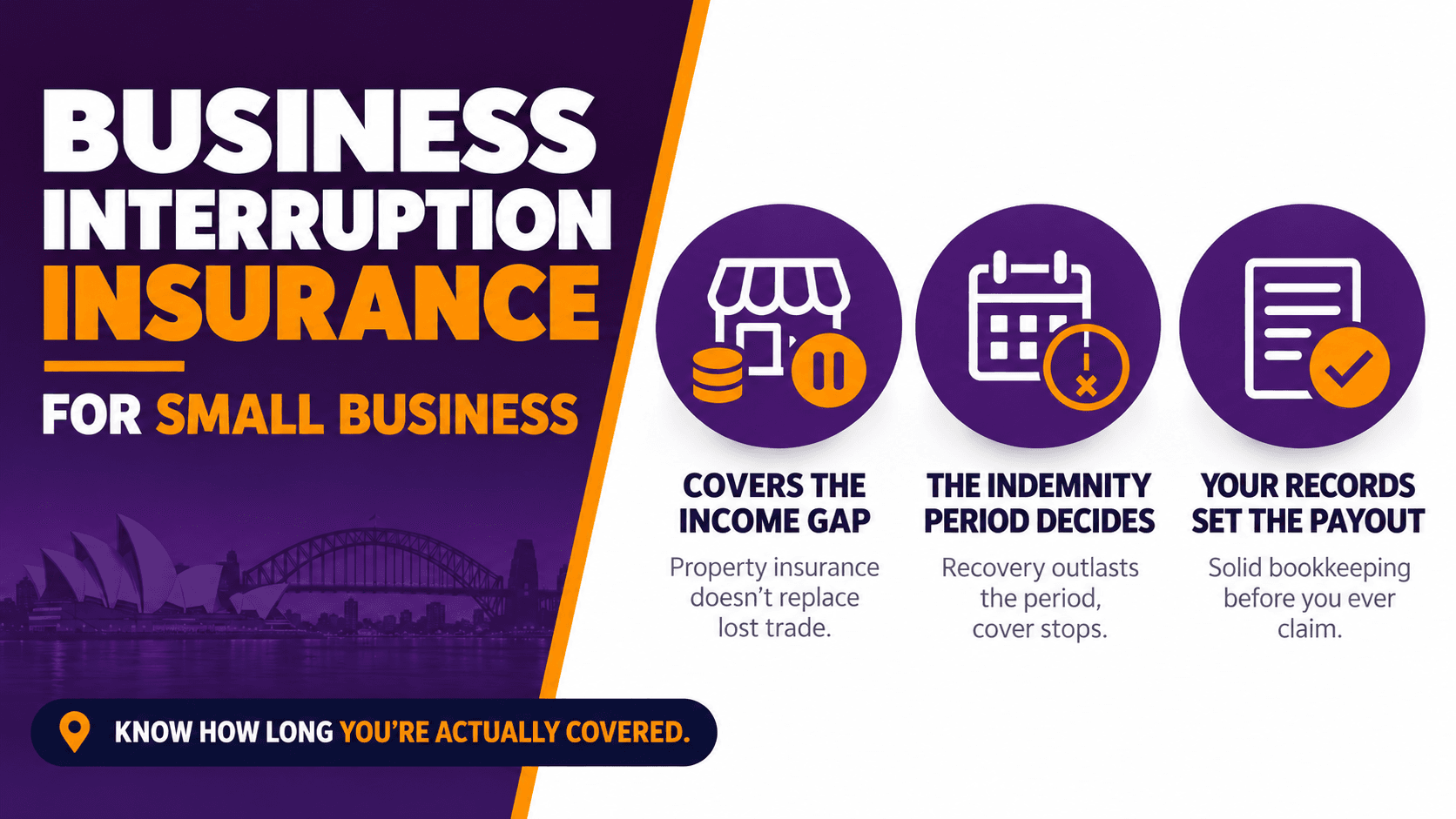
The indemnity period, the maximum length of time a payout can cover, is one of the most important and most commonly underestimated settings in a policy, a recovery taking longer than the chosen period leaves the business unsupported for the remainder.
Payouts are generally calculated against historical financial records, meaning accurate, accessible bookkeeping directly determines how smoothly and accurately a claim can be assessed and paid.
Common exclusions include certain pandemic-related business interruptions (following well-publicised disputes over this exact issue), and interruptions not directly tied to physical damage covered under the underlying property policy.
Underinsurance is a genuine risk if the policy's sum insured doesn't reflect a realistic worst-case recovery timeline and the business's actual fixed cost base.
This cover works alongside, not instead of, standard property insurance. Business interruption cover is generally triggered by, and calculated against, an insured property damage event, not a standalone product addressing any revenue loss.
Bottom line: business interruption insurance addresses a genuinely different risk to property damage itself, the income lost while a business can't operate, and getting the indemnity period and sum insured right is what determines whether that cover actually sees a business through to full recovery.
On This Page
What Business Interruption Insurance Actually Covers
The Indemnity Period: Why This Setting Matters So Much
How a Payout Is Actually Calculated
Common Exclusions, Including the Pandemic Question
Why Good Financial Records Matter Before You Ever Need to Claim
Worked Example: A Fire, a Nine-Month Recovery, and a Six-Month Policy
Common Mistakes
FAQ
What Business Interruption Insurance Actually Covers
Business interruption insurance generally compensates a business for lost income and continuing fixed costs, rent, loan repayments, certain wages, during a period when the business can't operate normally following an insured event, typically the same category of event (fire, storm, certain other damage) covered under the business's underlying property insurance policy. WIAA does not sell general insurance directly, but understanding this cover's role alongside standard property insurance is a genuinely important part of broader small business risk planning.
Not sure whether your current business insurance includes business interruption cover, or how it's structured? A free 15-minute chat with WIAA can help you think through what to check. Call 1800 942 843 or book online.
Bottom line: business interruption cover addresses the income gap that property insurance alone doesn't touch, the money lost while a business can't actually trade, not just the cost of repairing the physical damage itself.
The Indemnity Period: Why This Setting Matters So Much
The indemnity period is the maximum length of time a business interruption policy will pay out for, commonly offered in standard options like 12, 18, or 24 months, chosen when the policy is set up. This is one of the single most important, and most commonly underestimated, decisions in the entire policy. If a business's actual recovery, rebuilding premises, re-establishing supply chains, rebuilding customer trust and revenue, takes longer than the chosen indemnity period, the cover simply stops at that point, regardless of whether the business has genuinely recovered yet.
Bottom line: the indemnity period isn't just an administrative detail, it's the single figure that determines whether a policy actually sees a business through its full recovery, or cuts off support partway through.
How a Payout Is Actually Calculated
A business interruption payout is generally calculated against the business's historical financial performance, comparing actual trading results during the interruption period against what the business would reasonably have been expected to achieve had the interruption not occurred, based on prior financial records and often factoring in any genuine growth trajectory the business was already on. This calculation depends heavily on the quality and accessibility of a business's financial records, a business with clear, well-maintained accounts generally has a considerably smoother and more accurate claims process than one relying on incomplete or disorganised records.
The quality of your financial records directly affects how smoothly a business interruption claim gets assessed and paid. A free 15-minute chat can help review whether your current bookkeeping would support a claim if you ever needed one. Email tax@whatifadvice.com.au or book online.
Bottom line: a payout calculation is only as accurate and defensible as the financial records behind it, which is exactly why solid, ongoing bookkeeping matters well before any interruption ever occurs.
Common Exclusions, Including the Pandemic Question
Like any insurance product, business interruption policies carry specific exclusions worth understanding clearly. A particularly relevant one in recent years has been the treatment of pandemic-related business interruption, following well-publicised disputes and test cases about whether certain policy wordings covered pandemic-driven closures, many insurers have since specifically clarified or excluded this scenario in current policy wordings. Beyond this, interruptions not directly tied to a physical damage event covered under the underlying property policy are also generally excluded, meaning a general downturn in trade unrelated to an insured event typically isn't covered at all.
Bottom line: pandemic-related exclusions and the requirement for interruption to stem from a genuinely insured physical event are two of the most important exclusions to understand clearly in current business interruption policies.
Why Good Financial Records Matter Before You Ever Need to Claim
Given that a payout is calculated against historical financial performance, the records a business keeps well before any interruption occurs directly determine how smoothly, and how accurately, a future claim gets assessed. This means genuinely solid bookkeeping, clear separation of business and personal expenses, accurate and up-to-date profit and loss records, isn't just good general business practice, it's a direct, practical input into how well a business interruption claim would actually perform if it were ever needed.
Bottom line: solid financial record-keeping is effectively a form of insurance preparation in its own right, directly shaping how accurately and smoothly a future claim could be assessed.
Worked Example: A Fire, a Nine-Month Recovery, and a Six-Month Policy
Mark's café suffers a significant kitchen fire, requiring a full rebuild of the kitchen and dining area. His business interruption policy, set up several years earlier with a 6-month indemnity period chosen at the time to keep premiums lower, begins paying out based on his historical trading figures, covering his lost income and ongoing lease payments while the rebuild takes place.
The rebuild itself, delayed by supply chain issues and council approval processes, ultimately takes 9 months before Mark can reopen, 3 months beyond his policy's indemnity period. For those final three months, Mark receives no further business interruption payout at all, despite still being unable to trade, leaving him personally covering ongoing lease payments and other fixed costs out of savings during that final stretch.
Outcome: Mark's policy performed exactly as designed for the first six months, but the gap between his actual nine-month recovery and his policy's six-month indemnity period left him financially exposed for the final quarter of his closure, a gap a longer indemnity period, chosen upfront, would have avoided.
Bottom line: Mark's shortfall wasn't a failure of the insurance itself, it was a mismatch between a realistic recovery timeline and the indemnity period actually chosen when the policy was set up.
Common Mistakes
Choosing a shorter indemnity period purely to reduce premium cost, without considering a realistic worst-case recovery timeline. This is exactly the gap that leaves a business unsupported partway through an actual recovery.
Assuming business interruption cover applies to any revenue downturn. It's generally tied specifically to an insured physical damage event, not a general decline in trade.
Not maintaining clear, accurate financial records. This directly affects how smoothly and accurately a claim gets assessed and paid.
Assuming pandemic-related closures are automatically covered under a current policy. Many policies have specifically clarified or excluded this following recent test cases, worth checking the current wording directly.
Treating business interruption and property insurance as the same thing. They address genuinely different risks, physical damage versus lost income, and both are generally needed together, not as substitutes for each other.
Choosing the right indemnity period and sum insured for business interruption cover is worth getting right before you need it, not discovering the gap during an actual claim. A free 15-minute chat can help you think through what to review. Call 1800 942 843.
FAQ
What's the difference between business interruption insurance and property insurance? Property insurance covers physical damage to the business premises and assets, while business interruption insurance covers the lost income and ongoing fixed costs while the business can't operate as a result of that damage, they're complementary, not interchangeable.
What is an indemnity period and why does it matter? It's the maximum length of time a policy will pay out, and it matters because if actual recovery takes longer than this period, the cover stops regardless of whether the business has genuinely recovered yet.
How is a business interruption payout actually calculated? Generally against the business's historical financial performance, comparing actual trading results during the interruption against what would reasonably have been expected, which is why accurate financial records matter significantly.
Does business interruption insurance cover a pandemic-related closure? This varies and has become a specifically scrutinised area following recent test cases, many current policies have clarified or excluded pandemic-related interruption, worth checking the specific current policy wording directly.
Can I claim business interruption insurance for a general downturn in business, unrelated to any specific event? Generally not, cover is typically tied to an insured physical damage event under the underlying property policy, not a general decline in trade.
Does WIAA sell business interruption insurance? WIAA does not sell general insurance directly, but can help you think through how this cover fits into your broader small business risk and financial planning.
What happens if my indemnity period runs out before my business has fully recovered? The payout stops at that point, regardless of the business's actual recovery status, which is why choosing a realistic indemnity period upfront matters considerably.
Do I need good bookkeeping specifically for a business interruption claim, or is that separate from insurance? They're directly connected, since a payout calculation relies on historical financial records, solid bookkeeping genuinely improves how smoothly and accurately a future claim would be assessed.
Is business interruption insurance only relevant for businesses with physical premises? It's most commonly relevant for businesses with physical premises and operations that could be disrupted by property damage, the relevance for a purely online or remote business may differ and is worth discussing specifically.
How often should I review my business interruption cover? Periodically, and particularly after any significant change in the business's revenue, fixed costs, or operational setup, since these directly affect whether the current sum insured and indemnity period remain appropriate.
Ready to Check Whether Your Business Interruption Cover Would Actually See You Through?
The indemnity period and sum insured are the two settings that determine whether this cover genuinely protects your business through a real recovery. A free 15-minute chat can help you think through what to review.
Call us: 1800 942 843
Book online: free 15-minute chat, no cost, no pressure
Still asking what if.
WIAA has helped Australian small business owners think through business interruption risk as part of a broader financial and operational plan, across Toowong, Grange, and Melbourne CBD. WIAA operates under AFSL 528250 as an Authorised Representative of Beryllium Advisers Pty Ltd.
General Advice Disclaimer: This article contains general information only and does not take into account your personal objectives, financial situation, or needs. It is not personal financial advice and should not be relied upon as such. WIAA does not sell general insurance directly. Specific policy terms, exclusions, indemnity periods, and claims calculations vary significantly between insurers and should be reviewed directly with the relevant insurer or a qualified insurance broker.