Looking for specific financial advice?
This blog provides general educational content. For personalized advice tailored to your unique situation, book a free consultation with our team of ASIC-licensed financial advisers.
What If the Franchise Fee You're About to Pay Is Buying You Something You Could Have Built Yourself for Less?
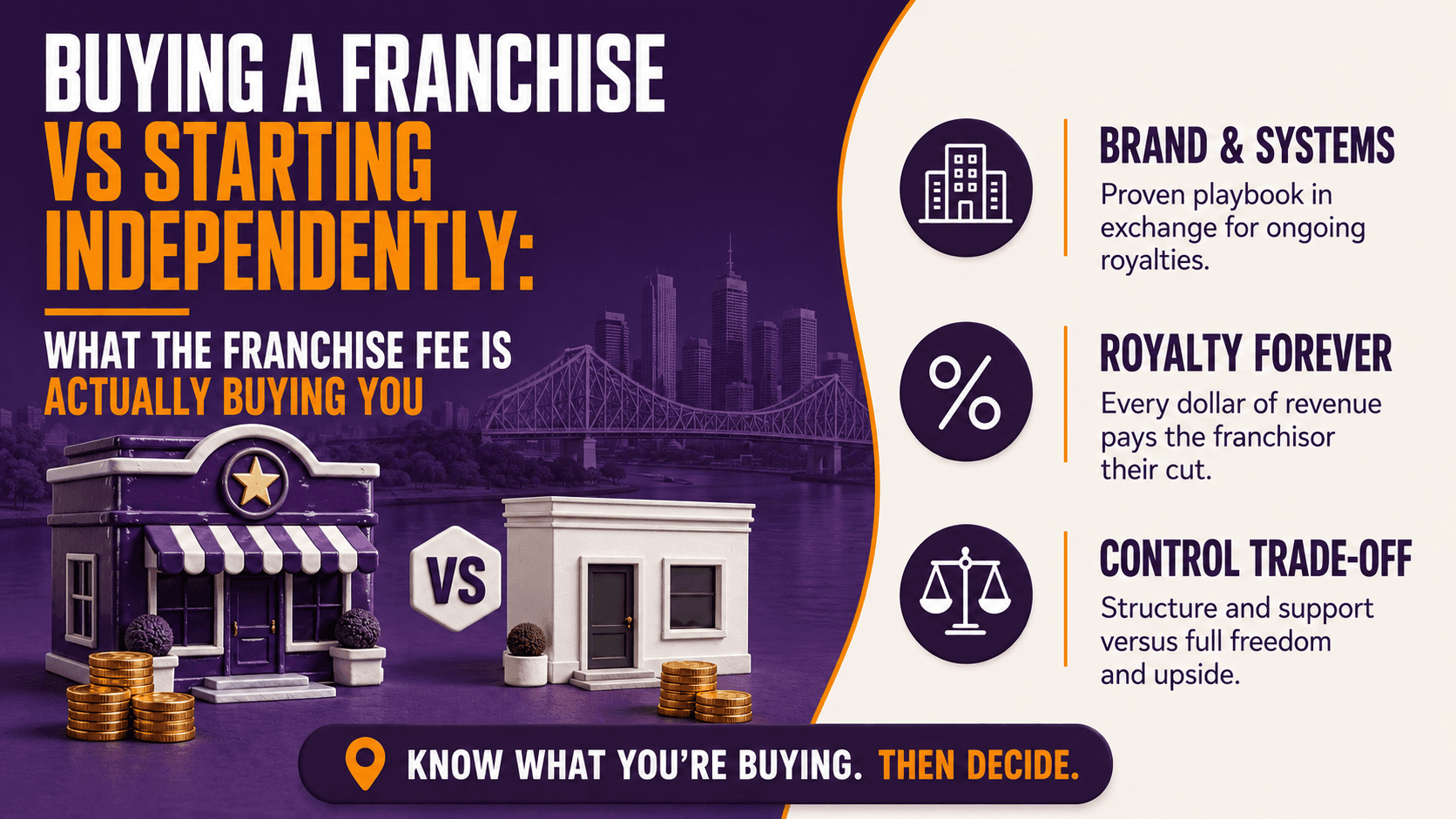
Buying into a franchise and starting an independent business solve the same underlying goal, owning a business, through genuinely different trade-offs. A franchise sells you a proven system, brand recognition, and structured support in exchange for upfront fees and ongoing royalties that reduce your margin indefinitely. Starting independently keeps all the upside and control, at the cost of building everything, brand, systems, supplier relationships, customer trust, from nothing, with a materially higher risk of getting fundamentals wrong along the way. Neither is objectively better. The right answer depends on what you're actually capable of building versus what you're willing to pay someone else to have already built.
TL;DR
Franchises typically involve a significant upfront franchise fee, plus ongoing royalty payments (often a percentage of revenue) for the life of the agreement. This is the core financial trade-off against independence.
In exchange, franchisees generally get an established brand, proven operating systems, supplier relationships, training, and ongoing support, reducing (though not eliminating) execution risk compared to building all of this from scratch.
Independent businesses keep full control and full profit margin, but carry the entire burden of building brand recognition, systems, and supplier relationships without a template to follow.
Franchise agreements impose real restrictions, territory limitations, mandated suppliers, pricing guidelines, and operational rules that limit flexibility a fully independent owner wouldn't face.
The franchise disclosure document is where the real financial picture lives. Historical performance data, total costs, and existing franchisee experiences matter more than the glossy pitch.
Exit and resale value differ meaningfully between the two. A franchise can sometimes be resold within the network's established value framework, while an independent business's resale value depends entirely on what's actually been built.
Neither option guarantees success. Franchise systems reduce certain risks but don't eliminate market, location, or operator-specific risk, and independent businesses succeed regularly without any franchise support at all.
Bottom line: the franchise fee is effectively the price of a shortcut. Whether that shortcut is worth the ongoing cost depends on how much of the "shortcut" you'd genuinely struggle to build yourself, and how much you're paying for things you don't actually need.
Jump to a Section
The Real Cost Structure of a Franchise
What the Franchise Fee Is Actually Buying
What You Give Up: Control and Flexibility
Reading the Franchise Disclosure Document Properly
Exit Strategy: Selling a Franchise vs Selling an Independent Business
Worked Example: Same Industry, Two Paths
Common Mistakes
FAQ
The Real Cost Structure of a Franchise
Franchise costs come in layers that are easy to underestimate if you only look at the headline franchise fee. There's typically an upfront franchise fee covering the right to operate under the brand and system, separate setup costs (fit-out, equipment, initial stock, often to a mandated standard), and then ongoing costs for the life of the agreement, usually a royalty fee calculated as a percentage of revenue, and often a separate marketing/advertising levy contributing to brand-wide campaigns.
The ongoing royalty is the part people most often underweight when comparing options, because it's a permanent reduction in margin. Every dollar of revenue for the life of the business pays that percentage to the franchisor, regardless of how the specific outlet is performing.
Weighing up a specific franchise opportunity and want an honest read on the real total cost picture? A free 15-minute chat can help you see past the pitch deck. Call 1800 942 843.
Bottom line: the upfront fee is just the entry ticket. The ongoing royalty and levy structure is the part that affects your margin for as long as you own the business, and it deserves at least as much scrutiny as the initial cost.
What the Franchise Fee Is Actually Buying
In exchange for those costs, a franchisee typically receives a genuinely valuable package: an established brand with existing customer recognition (reducing the marketing burden of building awareness from zero), proven operating systems and processes refined across many locations, training for the owner and often staff, supplier relationships and buying power that an independent operator would need years to build, and ongoing support from the franchisor's head office for operational questions and challenges.
For someone without prior business ownership experience in that specific industry, this package can meaningfully reduce the learning curve and the risk of avoidable early mistakes, genuine value, not just marketing language, when the system is a good one.
Bottom line: the fee is buying a shortcut past the trial-and-error phase most independent businesses go through. Whether that shortcut is worth its ongoing cost depends heavily on how much trial-and-error you'd realistically face without it.
What You Give Up: Control and Flexibility
The other side of the franchise trade-off is a genuine loss of control. Franchise agreements typically impose territory restrictions (limiting where you can operate or how close another franchisee can be), mandated suppliers (sometimes at prices you can't negotiate independently even if a cheaper option exists elsewhere), standardised pricing and menu/product guidelines, and operational rules covering everything from branding to opening hours to staff uniforms.
For some owners, this structure is a relief, fewer decisions to make, a proven playbook to follow. For others, particularly those with strong ideas about how they'd want to run things differently, this can feel restrictive in ways that become frustrating over time, especially if the franchisor's system doesn't evolve as quickly as the owner would like.
If flexibility and full control matter a lot to you personally, that's a genuine factor worth weighing honestly, not just financially. Email clientservices@whatifadvice.com.au and we'll talk through the trade-offs for your specific situation.
Bottom line: a franchise system removes both the burden and the freedom of deciding how things get done. Which side of that trade-off appeals to you personally matters as much as the financial comparison.
Reading the Franchise Disclosure Document Properly
Australian franchise law requires franchisors to provide a disclosure document to prospective franchisees, and this document is where the real financial and operational picture lives, well beyond what a sales presentation or website typically covers. It generally includes historical financial performance information (where provided), details of existing franchisee turnover and disputes, the full fee structure, and franchisor obligations. (This area has seen reform activity in recent years, so confirm the current disclosure document requirements under the Franchising Code with a solicitor rather than relying on a general description alone.)
Prospective franchisees benefit enormously from speaking directly with existing (and ideally, former) franchisees in the network, not just relying on the disclosure document or the franchisor's own representations. Existing franchisees can offer a genuinely different picture of day-to-day reality, ongoing support quality, and whether the numbers in the pitch actually hold up in practice.
Want a second set of eyes on a disclosure document before you sign anything? Book a free 15-minute chat online and we'll help you know what to actually look for.
Bottom line: the disclosure document and independent conversations with current and former franchisees are where the real due diligence happens. The sales pitch is designed to sell you, not to give you the full picture.
Exit Strategy: Selling a Franchise vs Selling an Independent Business
Exit value differs meaningfully between the two paths. A franchise can often be sold within an established framework, the franchisor may have a say in (or right of first refusal over) who buys it, and buyers benefit from stepping into a known system, which can support a more predictable valuation process. An independent business's resale value depends entirely on what's actually been built, brand reputation, systems, customer base, staff, and financial performance, with no external framework guiding the valuation, meaning it can be harder to sell (or attract a lower price) if the business hasn't been deliberately built with resale value in mind.
Bottom line: a franchise's exit process tends to be more structured and predictable; an independent business's exit value is a direct reflection of how deliberately (or accidentally) it was built to be sellable in the first place.
Worked Example: Same Industry, Two Paths
Path A, Chen (buys a franchise): Chen buys into an established food franchise, paying a substantial upfront fee plus fit-out costs, and commits to an ongoing royalty percentage of revenue plus a marketing levy for the length of the agreement. In exchange, she receives a proven menu, supplier relationships already negotiated at scale, staff training programs, and site selection guidance from the franchisor. Her first-year performance closely tracks the franchisor's disclosed average for comparable outlets, giving her a reasonably predictable trajectory, though her net margin is permanently reduced by the royalty and levy compared to running the same concept independently.
Path B, Wallace (starts independently): Wallace opens a similar concept independently, avoiding any franchise fee or ongoing royalty, keeping full control over menu, pricing, and branding. He spends considerably more time and money in the first year building supplier relationships, refining his systems through trial and error, and establishing brand recognition from nothing, with a wider range of possible outcomes, from outperforming a comparable franchise outlet once established, to struggling with early mistakes a proven system would have avoided.
Bottom line: the franchise route traded margin for predictability; the independent route traded predictability for full upside and full control. Both are legitimate paths, and the right one depends on the owner's risk tolerance, experience, and appetite for building versus following a system.
Common Mistakes
Focusing only on the upfront franchise fee, ignoring the ongoing royalty's long-term cost. The royalty affects margin for the life of the business, not just at entry.
Not speaking to existing or former franchisees before committing. The disclosure document and sales pitch don't always reflect the full day-to-day reality.
Assuming a franchise guarantees success. Franchise systems reduce certain risks but don't eliminate location, market, or operator-specific risk entirely.
Underestimating how restrictive the operational rules will feel over time. What seems like helpful structure during the sales process can feel limiting once you're actually running the business day to day.
Starting independently without adequately budgeting for the learning curve. Building systems, supplier relationships, and brand recognition from nothing takes real time and money that's easy to underestimate.
Not considering exit strategy from the outset, regardless of which path is chosen. Both franchise and independent business owners benefit from thinking about resale value early, not just at the point of wanting to sell.
FAQ
Is a franchise generally lower risk than starting independently? Often, yes, in the sense that a proven system reduces certain execution risks, but it's not risk-free, and poor site selection, market conditions, or a struggling franchise network can still lead to a failed franchise outlet.
Can I negotiate the terms of a franchise agreement? Some terms may have limited flexibility, but core elements like fee structure and territory are often set at a network-wide level with little room for individual negotiation. This varies by franchisor and should be clarified early in discussions.
How do I know if the historical performance figures in a disclosure document are reliable? Cross-referencing with direct conversations with existing franchisees, and understanding exactly how the figures were calculated (average vs median, gross vs net, which locations were included), helps assess reliability beyond taking the headline numbers at face value.
Do I need a lawyer to review a franchise agreement before signing? Strongly advisable. Franchise agreements are legally binding, often lengthy, and contain terms with long-term financial and operational consequences that benefit from professional review before commitment.
Can I switch from an independent business to a franchise model later, or vice versa? Generally not directly. These are different business structures from the outset, though an independent business could theoretically become a franchisor itself if the concept proves successful and scalable, which is a different (and much larger) undertaking.
Is buying an existing franchise resale different from buying a brand-new franchise territory? Yes. Buying an existing outlet typically means inheriting its existing customer base, staff, and track record (positive or negative), while a new territory means building from zero within the franchise system's support structure.
Do franchisors ever go into administration, and what happens to franchisees if they do? It can happen, and the consequences for franchisees depend on the specific circumstances and agreement terms. This is a genuine risk worth understanding as part of due diligence, not something to assume won't happen.
How much ongoing support can I realistically expect from a franchisor? This varies significantly between franchise networks. Some offer substantial, hands-on ongoing support, others considerably less than advertised, which is exactly why speaking with existing franchisees about their actual experience matters.
Is starting independently always cheaper than buying a franchise? Not necessarily upfront. Some franchises have relatively modest entry costs, while some independent business setups (particular sectors requiring significant equipment or premises fit-out) can be expensive regardless of the ownership model chosen.
What financing options are available for buying a franchise versus starting independently? Both paths generally require finance, and lenders sometimes view established franchise systems more favourably given historical performance data, though this varies by lender and the specific franchise's track record.
Ready to Compare the Real Numbers?
Ready to properly compare a specific franchise opportunity against building the same idea independently? This is exactly the kind of decision worth running through with real numbers, not just the pitch deck, before committing to either path.
Call us: 1800 942 843
Book online: free 15-minute chat, no cost, no pressure
Still asking what if the franchise fee is worth it? Sometimes you're paying for a system you genuinely need, sometimes you're paying ongoing royalties for one you could have built yourself.
WIAA has advised 200+ business clients across our Toowong, Grange, and Melbourne CBD offices, operating under AFSL 528250 as an Authorised Representative of Beryllium Advisers Pty Ltd.
General Advice Disclaimer: This article contains general information only and does not take into account your personal objectives, financial situation, or needs. It does not constitute legal, financial, or business advice, and should not be relied upon as such. Franchise agreements, costs, and disclosure requirements vary by franchisor and should be reviewed with a qualified solicitor and accountant before entering into any agreement.