Looking for specific financial advice?
This blog provides general educational content. For personalized advice tailored to your unique situation, book a free consultation with our team of ASIC-licensed financial advisers.
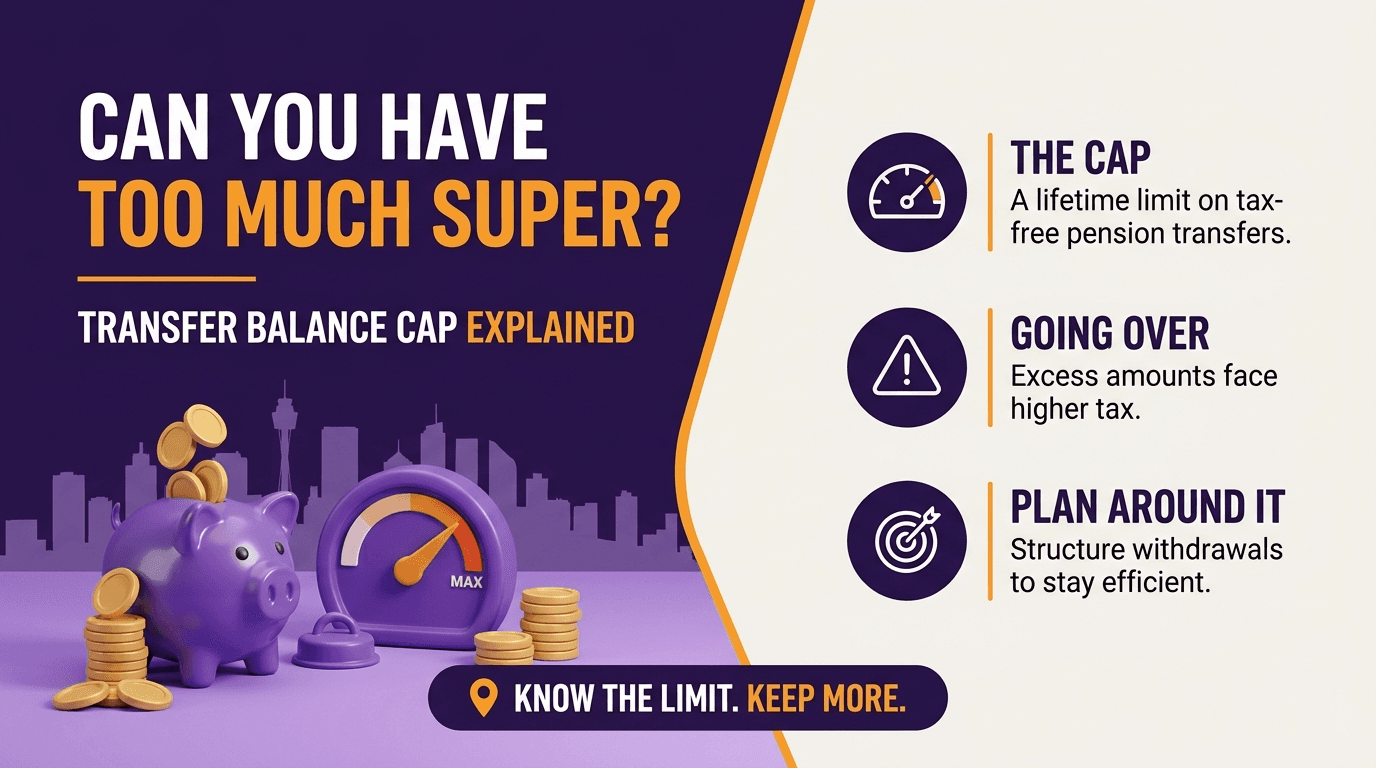
Can You Have Too Much Super? Transfer Balance Cap Explained
For decades, the conventional wisdom in Australia was simple: contribute as much as possible to super and let it compound. The system rewarded discipline, and high balances were a sign of good planning rather than a problem.
That view no longer holds. From 1 July 2026, two structural caps shape what high-balance Australians can do with super: the transfer balance cap at $2.1M and the new Division 296 tax on balances above $3M. For the first time, having more super can mean paying more tax rather than less.
This guide explains both rules, what they mean for high-balance members, and the strategies advisers are now using to manage them.
Quick Answer
Here is what every Australian with a substantial super balance needs to know in 2026:
The general transfer balance cap rises from $2M to $2.1M from 1 July 2026
Only amounts up to your personal cap can be moved into the tax-free retirement phase
Division 296 tax applies an additional 15% tax on earnings attributable to total super balances above $3 million
Division 296 is law and commences from 1 July 2026
High-balance members face increasingly complex planning around contributions, withdrawals, and estate transfer
Bottom line: Super is still the most tax-effective wealth structure in Australia for most members. But for balances above $2 to $3 million, active planning is now essential to manage the new rules.
What Is the Transfer Balance Cap?
The transfer balance cap (TBC) is the maximum amount of super that can be transferred into the tax-free retirement phase, where investment earnings are not taxed.
Key features in 2026-27:
The general TBC is $2.1 million from 1 July 2026 (up from $2.0 million)
Each individual has a personal TBC based on the highest balance they have ever held in retirement phase
Indexation increases occur in $100,000 increments based on CPI movements
Individuals starting a retirement-phase pension for the first time on or after 1 July 2026 receive the full $2.1M personal cap
Amounts above your personal TBC remain in the accumulation phase, where earnings are taxed at 15% (10% for capital gains held over 12 months).
The cap is per person, not per couple. A couple can have up to $4.2 million combined in tax-free retirement phase, provided each has accumulated their full $2.1M cap.
Bottom line: The transfer balance cap is a per-person limit on tax-free retirement phase super. Above it, the money stays in accumulation and earnings are taxed at 15%.
What Happens If You Exceed Your Cap?
If your retirement-phase balance exceeds your personal transfer balance cap, the excess must be commuted (returned to accumulation phase or withdrawn) and you become liable for excess transfer balance tax.
The tax is calculated on the notional earnings of the excess amount, escalating over time:
Initial period: tax at 15%
Continued non-compliance: tax escalates to 30%
Most members rectify excess amounts quickly to avoid escalating penalties.
The cap operates on a highest-ever-balance basis, which is critical to understand:
Your personal cap is set by the highest balance you have ever held in retirement phase
Indexation only flows through proportionally based on unused cap space
Members who used their full cap pre-indexation receive no further indexation
Bottom line: Exceeding the cap creates real tax. Manage it actively rather than reactively.
What Is Division 296?
Division 296 is a new tax measure passed into law in 2026 and commencing from 1 July 2026. It applies an additional tax on earnings attributable to the portion of an individual's total super balance that exceeds $3 million.
Key features:
Additional 15% tax on earnings attributable to the portion of super above $3M
Applies to total super balance, not just retirement phase
Combined with existing super taxation, the effective rate on earnings above $3M can reach 30%
The tax is assessed on the individual personally, not paid by the super fund
Calculated based on the change in total super balance over the year, with adjustments for contributions and withdrawals
The methodology has generated significant debate. Critics highlight:
The $3M threshold is not indexed, meaning more Australians will be captured over time
The calculation includes unrealised gains, creating tax liabilities on paper increases that may not be available as cash
Liquidity concerns, particularly for SMSFs holding illiquid assets like property
For Australians with super balances approaching $3M, Division 296 has become a central planning consideration.
Bottom line: Division 296 is law and commences 1 July 2026. It changes the calculation for whether additional super contributions remain advantageous for very high-balance members.
Strategies for High-Balance Super Members
Australians with balances near or above the relevant thresholds have several strategic options. The right approach depends on age, income, marital status, and other assets.
1. Maximise the Lower-Tax Spouse's Balance
For couples, balancing super between partners can keep both below relevant thresholds. Strategies include:
Spouse contributions with matching tax offset
Contribution splitting of concessional contributions each year
Recontribution strategies to redirect balance toward the lower-balance partner
Spouse super splitting in the context of separation or estate planning
2. Consider Withdrawals After Age 60
For members over 60, super withdrawals are typically tax-free. Withdrawing amounts above $3M and either holding outside super or gifting to family can manage Division 296 exposure, though personal investment income tax still applies.
3. Review Investment Strategy
For balances approaching $3M, lower-yielding or growth-focused investments may produce smaller annual Division 296 liabilities than high-income investments. This is a counterintuitive but increasingly relevant consideration.
4. Plan Around the Transfer Balance Cap
Members near $2.1M should consider:
Timing pension commencement to maximise indexation benefit
Commuting and recommencing pensions carefully to manage cap usage
Reversionary pension nominations for couples to optimise cap usage on death
5. Estate Planning and Recontribution
For high-balance members with adult children as ultimate beneficiaries, recontribution strategies can convert the taxable component into the tax-free component, reducing the death benefit tax payable.
Bottom line: Strategy depends on the specific situation. Most high-balance members benefit from professional advice given the rules' complexity and the cost of mistakes.
How the Numbers Stack Up
Total Super Balance | Tax Treatment in 2026-27 | Planning Considerations |
Under $1.84M | Standard rules, full bring-forward eligibility | Maximise contributions, including non-concessional |
$1.84M to $1.97M | 2-year bring-forward maximum applies | Standard concessional contributions, partial NCC |
$1.97M to $2.1M | 1-year non-concessional cap only | Final NCC opportunities, monitor TBC |
$2.1M to $3M | TBC limit reached, surplus stays in accumulation | Earnings on surplus taxed at 15% |
Above $3M | Division 296 applies on portion above $3M | Active strategy required, including possible withdrawals |
Bottom line: Once balances reach $2M+, the planning shifts from accumulation to active management. The right structure can save tens of thousands per year in tax.
Practical Examples
Example 1: Robert, 65, with $2.4M in Super
Robert has $2.4M in super, all in accumulation phase. He is retiring on 1 August 2026.
His position:
Personal TBC of $2.1M (he has not previously held a retirement phase pension)
He can transfer $2.1M to a tax-free account-based pension
The remaining $300,000 stays in accumulation, taxed at 15% on earnings
His total super balance is below $3M, so Division 296 does not apply
Robert decides to draw 5% from his pension annually ($105,000 per year tax-free) and let the accumulation portion continue until he needs it.
Example 2: Helen, 68, with $4.1M in Super
Helen has $4.1M in super, $2.1M in retirement phase pension and $2.0M in accumulation phase. From 1 July 2026, Division 296 applies.
Her position:
The portion above $3M is $1.1M
Notional earnings on this portion attract an additional 15% tax personally
Combined with the 15% in-fund tax on the accumulation portion, the effective rate on earnings attributable to the excess reaches approximately 30%
Her strategy:
Consider withdrawing $1.1M tax-free (she is over 60) to bring her balance to $3M
Reinvest withdrawn funds outside super in a structure with comparable tax efficiency
Implement a recontribution to her spouse if eligible to balance their combined position
Continue to draw the maximum from her account-based pension to gradually reduce balance
After implementation, her ongoing Division 296 exposure is eliminated and her after-tax retirement income is preserved.
Common Mistakes High-Balance Members Make
Ignoring the transfer balance cap until pension commencement. The cap operates on a highest-ever-balance basis, so timing of pension commencement materially affects long-term cap eligibility.
Treating Division 296 as a future problem. The tax commences 1 July 2026 and applies based on current balances. Members near $3M should be planning now.
Continuing to maximise contributions without modelling outcomes. Above certain balance thresholds, additional contributions may produce after-tax outcomes worse than alternative structures.
Failing to balance super between partners. Couples with significant differences in super balances often miss simple splitting and contribution strategies that improve overall tax efficiency.
Holding illiquid assets in SMSFs at high balances. Division 296 creates tax liabilities on paper gains. SMSFs with property or other illiquid assets can face cashflow strain when tax falls due.
Assuming the rules will be relaxed. Both the TBC and Division 296 have passed parliament and are law. Planning on the assumption of repeal is risky.
Avoiding professional advice. The interactions between TBC, Division 296, contribution caps, and estate planning are complex. Mistakes are expensive.
FAQ
What is the current transfer balance cap? The general transfer balance cap is $2.0 million in 2025-26, rising to $2.1 million from 1 July 2026. Each individual has a personal cap based on their highest-ever retirement phase balance.
Is the $3 million Division 296 threshold indexed? No. The $3 million threshold is not indexed in the current legislation, meaning more Australians will be captured by the rules over time as balances grow with inflation and contributions.
Does Division 296 apply to my entire super balance? No. Division 296 applies only to earnings attributable to the portion of your total super balance above $3 million. The first $3M is taxed under standard rules.
Can I avoid Division 296 by holding super in different funds? No. The threshold is based on total super balance across all funds, including SMSFs and APRA-regulated funds combined. Spreading super across funds does not reduce the threshold.
What happens to my super if I exceed the transfer balance cap? Excess amounts must be commuted (returned to accumulation phase or withdrawn) and excess transfer balance tax applies on the notional earnings of the excess. Most members rectify quickly to avoid escalating penalties.
Should I withdraw super to stay below $3M? For some members, yes. For others, no. The decision depends on age, marginal tax rate, alternative investment options, and estate planning goals. Professional advice is typically warranted for amounts above $2.5M.
Will the rules change? The TBC and Division 296 are both law. Future indexation of the TBC is automatic. Future changes to Division 296 are possible but cannot be assumed. Planning on current law is the prudent approach.
Ready to Plan for the New Super Caps?
The transfer balance cap and Division 296 represent the most significant structural change to Australian super in over a decade. Book a free 15-minute consultation with the team at What If Advice to understand how the new rules affect your situation.
Visit whatifadvice.com.au to book.
General Advice Disclaimer: This information is general in nature and does not take into account your personal financial situation, needs, or objectives. You should consider whether it is appropriate for you and seek personal financial advice before making any decisions.