Looking for specific financial advice?
This blog provides general educational content. For personalized advice tailored to your unique situation, book a free consultation with our team of ASIC-licensed financial advisers.
What If Your Business Outgrew Renting, But the Loan to Buy Isn't Like Your Home Loan?
Buying a commercial property, whether an owner-occupied business premises or a standalone commercial investment, runs on a genuinely different lending framework to a standard residential mortgage. Higher deposit requirements, shorter loan terms, and lease income playing a direct role in serviceability all change the calculation. This guide covers what actually differs about commercial property lending, and what to expect going in. For business lending that isn't secured against property at all, our guide comparing business loans and equity funding covers that ground, and if timing between a property purchase and sale is the issue rather than the loan type itself, our bridging loans guide covers that specific mechanic.
TL;DR
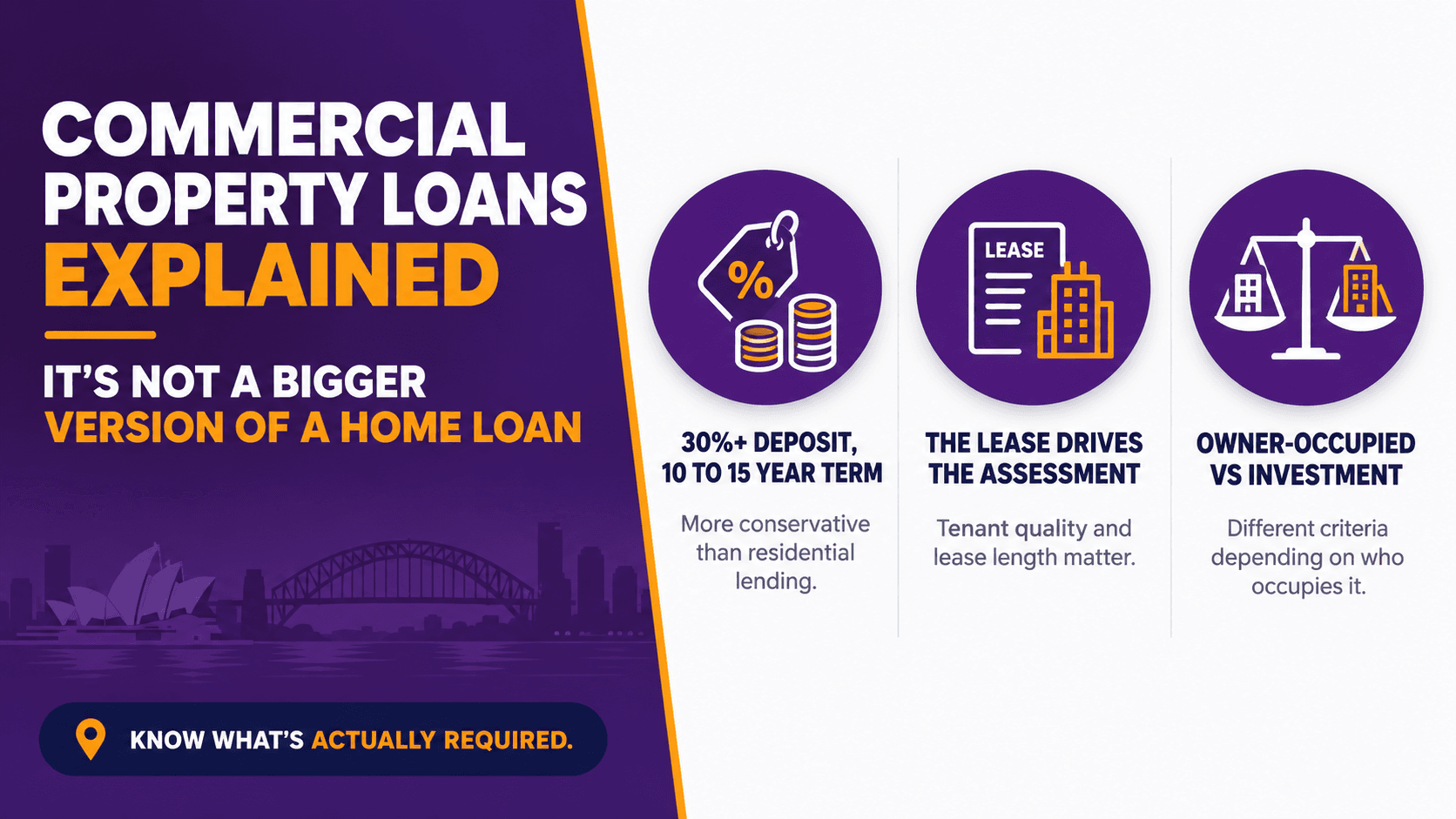
Commercial property loans typically require a larger deposit than residential lending, commonly in the region of 30% or more, though this varies by lender, property type, and borrower profile.
Loan terms are generally shorter than the standard 30-year residential term, often 10 to 15 years, meaning higher monthly repayments relative to loan size.
Interest rates are typically higher than equivalent residential rates, reflecting the higher risk profile lenders assign to commercial lending.
Lease income plays a direct role in serviceability for an investment commercial property, with lenders assessing rental income, lease length, and tenant quality as part of the lending decision.
Owner-occupied commercial property (where a business buys the premises it operates from) is assessed differently to a pure investment purchase, generally factoring in the business's own financials and trading history.
Non-bank and specialist commercial lenders are more commonly used in this space than for standard residential lending, sometimes offering more flexible terms at a different cost trade-off.
This is a different structure entirely from an SMSF buying commercial property through a limited recourse borrowing arrangement, which carries its own specific rules and is a genuinely separate topic worth its own dedicated conversation.
Bottom line: commercial property lending runs on different assumptions than residential lending at almost every stage, deposit, term, rate, and serviceability, and treating it like "a bigger version of a home loan" is the fastest way to be caught off guard by the actual requirements.
On This Page
Why Commercial Lending Is a Different Framework
Deposit and Loan Term Expectations
How Lease Income Affects Serviceability
Owner-Occupied vs Investment Commercial Property
Bank vs Non-Bank and Specialist Lenders
Worked Example: An Owner-Occupier vs an Investor
Common Mistakes
FAQ
Why Commercial Lending Is a Different Framework
Lenders generally treat commercial property as a higher-risk asset class than residential property, reflecting factors including lower liquidity (commercial properties often take longer to sell), greater sensitivity to economic conditions, and a wider variation in property quality and location desirability. This higher risk profile flows through to nearly every part of the lending assessment: how much deposit is required, how long the loan term can run, what rate is charged, and how serviceability is calculated, all generally more conservative than the equivalent residential lending framework.
Not sure what a lender would actually require for your specific commercial property purchase? A free 15-minute chat with WIAA can help map out realistic expectations. Call 1800 942 843 or book online.
Bottom line: commercial lending starts from a more conservative risk position than residential lending, and that shows up in the deposit, term, rate, and serviceability requirements all at once, not just one of them.
Deposit and Loan Term Expectations
Commercial property loans generally require a larger deposit than residential lending, commonly in the region of 30% or more of the purchase price, though this varies meaningfully by lender, the specific property type, and the borrower's overall financial position. Loan terms are also typically shorter, often structured over 10 to 15 years rather than the 25 to 30-year terms common in residential lending, which generally means higher monthly repayments relative to the loan size compared to an equivalent residential loan.
Specific deposit requirements, loan terms, and rates vary considerably by lender and should be confirmed directly for the current lending environment rather than assumed from a general benchmark.
Bottom line: expect to need a meaningfully larger deposit and to repay over a shorter term than residential lending, both of which materially affect the actual affordability calculation for a commercial purchase.
How Lease Income Affects Serviceability
For a commercial property purchased as an investment (rather than for the buyer's own business use), lenders generally assess serviceability heavily around the property's lease income, factoring in the rental amount, the remaining length of the lease term, and the quality and stability of the tenant. A property with a long-term lease to a strong, established tenant is generally viewed more favourably than a similar property with a short remaining lease term or a weaker tenant, since the lease directly underpins the income the loan repayments depend on.
Lease terms and tenant quality can materially affect what a lender is willing to offer on a commercial investment property. A free 15-minute chat can help assess how a specific property's lease profile might be viewed. Email clientservices@whatifadvice.com.au or book online.
Bottom line: for an investment commercial property, the lease itself is almost as important to the lending decision as the property, since it's the lease income the serviceability calculation actually relies on.
Owner-Occupied vs Investment Commercial Property
A meaningful distinction in commercial lending is between an owner-occupied purchase, where a business buys the premises it operates from, and a pure investment purchase, where the property is bought specifically to lease to a tenant. For an owner-occupied purchase, lenders generally assess the borrowing business's own financials, trading history, and profitability as part of the serviceability calculation, similar in some respects to a business loan assessment, rather than relying primarily on third-party lease income. This can mean different lending criteria and sometimes different loan products entirely between the two scenarios.
Bottom line: whether the borrower will occupy the property themselves or lease it to a tenant changes what the lender actually assesses, the borrowing business's own financial position in one case, third-party lease income in the other.
Bank vs Non-Bank and Specialist Lenders
While major banks do lend for commercial property, non-bank and specialist commercial lenders play a larger role in this space than they typically do in standard residential lending, sometimes offering more flexible assessment criteria, faster turnaround, or a better fit for a specific property type or borrower situation, generally at a different cost trade-off (which can include a higher rate or different fee structure than a major bank might offer). Comparing options across both bank and non-bank lenders, rather than defaulting only to a borrower's existing bank, is generally worth doing given how much lending criteria can vary in this space.
Bottom line: commercial property lending has a genuinely broader lender landscape than residential lending, and it's worth comparing beyond the major banks given how much terms and criteria can vary.
Worked Example: An Owner-Occupier vs an Investor
Business A operates a small manufacturing business and wants to buy the warehouse it currently leases, moving from tenant to owner-occupier. The lender assesses the business's own trading financials, profitability, and history, alongside a deposit requirement in the region of 30%, and structures the loan over a 15-year term. Serviceability is calculated based on the business's own income, similar in approach to a business lending assessment, since there's no external tenant or lease involved.
Investor B purchases a separate commercial property specifically to lease out, with an existing tenant on a long-term lease already in place. The lender assesses serviceability heavily around that lease, the rental income, the tenant's profile, and the remaining lease term, alongside a similar deposit requirement, structuring the loan over a comparable term but basing the lending decision primarily on the third-party lease rather than Investor B's own business financials.
Outcome: both purchases fall under "commercial property lending," but the actual assessment criteria differ substantially, Business A's own financials drove the decision, while Investor B's tenant and lease drove theirs.
Bottom line: "commercial property loan" isn't a single, uniform product, the actual lending assessment depends heavily on whether the borrower will occupy the property or lease it out to someone else.
Common Mistakes
Assuming commercial lending works like a bigger residential loan. Deposit requirements, loan terms, rates, and serviceability assessment all differ meaningfully.
Underestimating the deposit required. Commercial property deposits are commonly meaningfully higher than residential, and this needs to be planned for well in advance.
Not accounting for a shorter loan term when assessing affordability. A shorter term means higher repayments relative to loan size than an equivalent residential loan.
Overlooking lease quality and remaining term when buying a commercial investment property. A short remaining lease or a weaker tenant can materially affect both the lending outcome and the property's own risk profile.
Only approaching a single major bank instead of comparing across bank and non-bank lenders. Commercial lending criteria and terms can vary considerably across the broader lender market.
Commercial lending runs on genuinely different assumptions to a standard home loan, and it's worth understanding the specific requirements before committing to a purchase. A free 15-minute chat can help set realistic expectations. Call 1800 942 843.
FAQ
How much deposit do I need for a commercial property loan? Commonly in the region of 30% or more of the purchase price, though this varies by lender, property type, and borrower profile, and should be confirmed directly for a specific situation.
Are commercial property loan terms shorter than home loans? Generally, yes, commercial loan terms are often structured over 10 to 15 years, compared to the 25 to 30-year terms common in residential lending.
Does lease income matter if I'm buying the property for my own business to use? Less so, for an owner-occupied purchase, lenders generally assess the borrowing business's own financials and trading history rather than relying on third-party lease income.
Is a commercial property loan the same as an SMSF buying commercial property? No, these are genuinely different structures, an SMSF purchasing commercial property generally uses a limited recourse borrowing arrangement with its own specific rules, distinct from a standard commercial property loan outside super, and worth a separate, dedicated conversation given how different the mechanics are.
Are commercial property interest rates higher than residential rates? Generally, yes, reflecting the higher risk profile lenders assign to commercial lending compared to residential property.
Should I use a major bank or a non-bank lender for a commercial property loan? Both are worth considering, non-bank and specialist lenders play a larger role in commercial lending than in residential lending, sometimes offering different terms or criteria worth comparing directly.
Does the quality of the tenant affect my ability to get a commercial property loan? Yes, generally, for an investment commercial property, tenant quality and lease terms are a significant part of how a lender assesses serviceability and risk.
Can I get a commercial property loan with a smaller deposit if I have other assets? This depends on the specific lender and overall financial position, and is worth discussing directly, since commercial lending criteria can be more flexible or more conservative depending on the full picture presented.
What happens if my tenant's lease ends soon after I buy a commercial investment property? A short remaining lease term is generally viewed as higher risk by lenders and can affect both the loan terms offered and the property's ongoing income certainty, worth factoring into the purchase decision itself.
Is it harder to get approved for a commercial property loan than a residential one? Not necessarily harder, but the assessment criteria are different and generally more conservative, meaning the deposit, documentation, and serviceability requirements are usually more demanding than for a standard residential purchase.
Ready to Understand What a Commercial Property Purchase Would Actually Require?
Commercial lending runs on different rules to a standard home loan, deposit, term, rate, and serviceability all work differently. A free 15-minute chat can help map out what's realistic for your situation.
Call us: 1800 942 843
Book online: free 15-minute chat, no cost, no pressure
Still asking what if.
WIAA has helped Australian business owners and investors understand what commercial property lending actually requires, across Toowong, Grange, and Melbourne CBD. WIAA operates under AFSL 528250 as an Authorised Representative of Beryllium Advisers Pty Ltd.
General Advice Disclaimer: This article contains general information only and does not take into account your personal objectives, financial situation, or needs. It is not personal financial advice and should not be relied upon as such. Commercial lending deposit requirements, rates, and terms vary considerably by lender and are subject to change, and should be verified directly with a lender or mortgage broker for your specific circumstances.