Looking for specific financial advice?
This blog provides general educational content. For personalized advice tailored to your unique situation, book a free consultation with our team of ASIC-licensed financial advisers.
What If the Structure That's Perfect for Holding Property Is the Wrong One for Building It?
Property investment and property development are often lumped together in structuring conversations, but they're genuinely different activities with different tax treatment, different risk profiles, and often different ideal structures as a result. A trust that makes perfect sense for holding a long-term rental property can be a poor fit for a development project, where profit is treated as trading income rather than a capital gain, and where the scale of risk on a single project changes the liability conversation entirely. This guide covers what's actually different about structuring for development specifically.
TL;DR
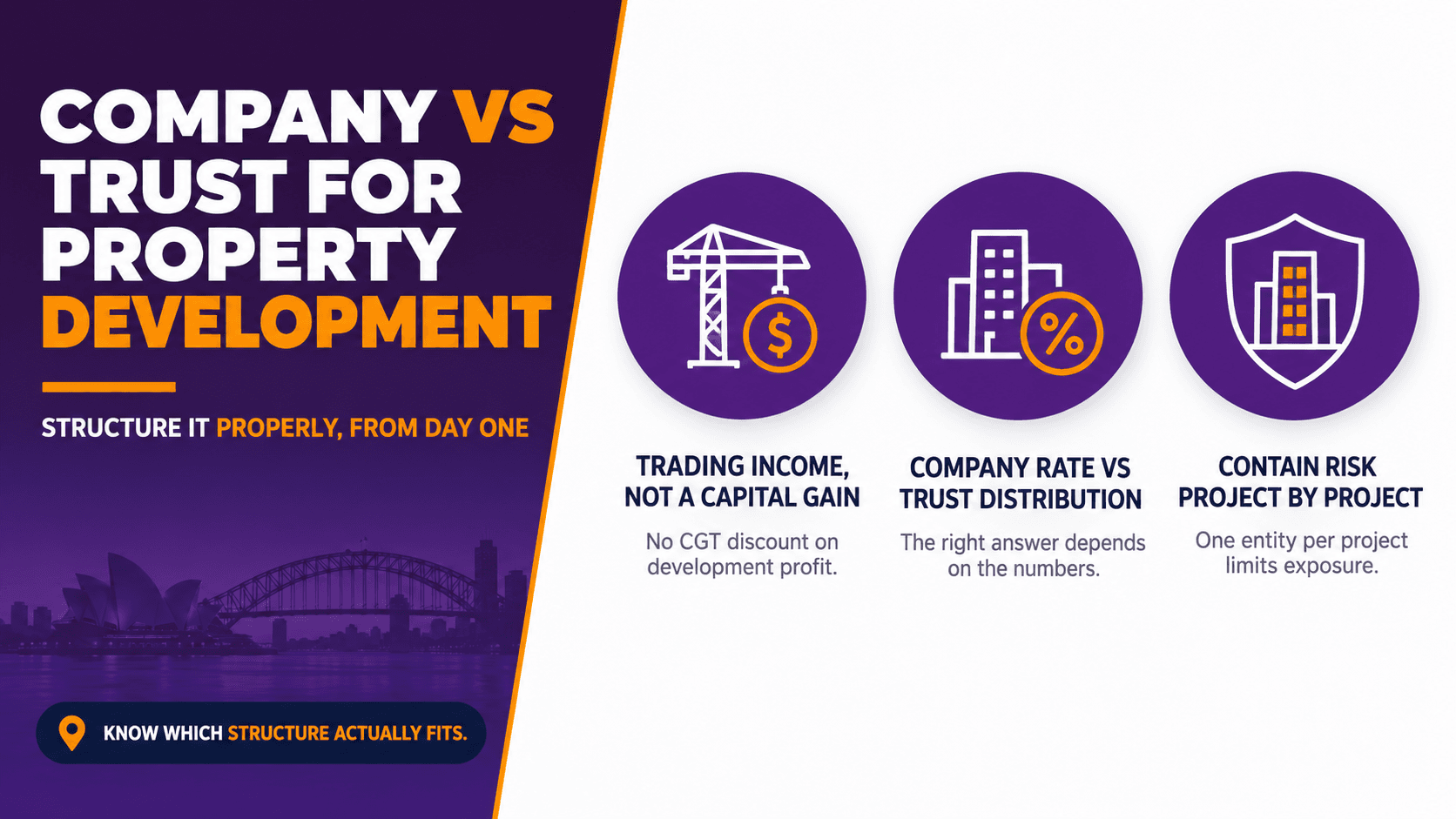
Property held for development and resale is generally treated as trading stock, with profit taxed as ordinary income, not a capital gain eligible for the CGT discount, a fundamentally different tax treatment to a standard investment property
Companies are commonly used for development projects specifically because the flat company tax rate can suit a trading-income profile better than a trust structure passing profit through to individual marginal rates
Trusts can still play a role, particularly discretionary trusts distributing development profit to beneficiaries on lower marginal rates, though this needs to be weighed against the trading stock tax treatment and Division 7A considerations if a corporate trustee or related company is involved
The GST margin scheme can apply to property development sales, potentially reducing the GST payable compared to standard GST treatment, though eligibility depends on how and when the property was originally acquired
Single-purpose vehicles, a separate company or trust established for one specific development project, are a common structuring approach to contain risk to that individual project rather than exposing a broader business or other assets
Development finance lenders often have specific requirements or preferences around structure, which can influence, and sometimes constrain, the ideal structure from a purely tax-driven perspective
Joint venture development structures, where multiple parties contribute land, capital, or expertise to a single project, add further structuring complexity beyond a standalone company or trust decision
Bottom line: development profit is generally trading income, not a capital gain, which changes the entire structuring calculation compared to a standard investment property, and it's this distinction, not just company versus trust in the abstract, that should drive the decision.
On This Page
Why Development Profit Is Taxed Differently to Investment Property
Company Structures for Development
Where Trusts Still Fit
The GST Margin Scheme and Why Acquisition Method Matters
Single-Purpose Vehicles: Containing Risk Project by Project
Joint Venture Considerations
Worked Example: Two Structures, Same Development Profit
Common Mistakes
FAQ
Why Development Profit Is Taxed Differently to Investment Property
This is the foundational distinction that changes everything downstream. Property acquired and held for long-term rental income is generally treated as a capital asset, meaning profit on eventual sale is a capital gain, potentially eligible for the 12-month CGT discount. Property acquired with the genuine intention of developing and selling for profit is generally treated as trading stock, meaning the profit is ordinary trading income, taxed in full at the applicable rate, with no CGT discount available regardless of how long the project takes.
This distinction isn't simply a matter of choice or labelling, it depends on the genuine facts and intention behind the acquisition and activity, and getting it wrong, either by assuming CGT treatment applies to what's genuinely a trading activity, or vice versa, carries real tax consequences.
Not sure whether your specific project would be treated as trading stock or a capital asset? A free 15-minute chat with WIAA can help assess it before structuring decisions are locked in. Call 1800 942 843 or book online.
Bottom line: development profit taxed as trading income rather than a capital gain is the starting point that should shape every structuring decision from here, not an afterthought once the structure is already chosen.
Company Structures for Development
A company structure is commonly used for property development specifically because the flat company tax rate can produce a more favourable outcome on trading income than passing that same profit through a trust to individuals on higher marginal rates, particularly for larger or more profitable projects. A company also provides limited liability protection at the entity level, though this doesn't eliminate personal guarantee exposure commonly required by development lenders. Profit retained in a company for future projects can also be a genuinely efficient way to fund ongoing development activity without the profit first flowing out to individuals and being taxed at marginal rates.
Bottom line: a company's flat tax rate and retained-profit flexibility make it a commonly preferred vehicle for development trading income specifically, though liability protection at the entity level doesn't remove personal guarantee risk on development finance.
Where Trusts Still Fit
Trusts, particularly discretionary trusts, can still play a meaningful role in development structuring, generally by distributing development profit to beneficiaries on lower marginal tax rates than the flat company rate would otherwise apply, in years where that comparison genuinely favours the trust. This needs to be weighed carefully against the trading stock tax treatment (no CGT discount is available regardless of the entity type) and against Division 7A considerations if a corporate trustee or related company is involved in funding or distributing profit within the same broader structure. A trust and company are also sometimes used together, rather than as a strict either-or choice, such as a company undertaking the development with profit ultimately distributed through a connected trust structure.
Whether a trust, company, or a combined structure suits a specific development project depends heavily on projected profit and the beneficiaries' individual tax positions. A free 15-minute chat can model this out. Email tax@whatifadvice.com.au or book online.
Bottom line: trusts aren't automatically ruled out for development, but the comparison against a flat company rate needs to be run on the actual numbers, not assumed in either direction.
The GST Margin Scheme and Why Acquisition Method Matters
The GST margin scheme allows GST on the sale of new residential property to be calculated on the margin, generally the difference between the sale price and the original purchase price, rather than on the full sale price, potentially reducing the GST payable. Eligibility for the margin scheme depends on specific conditions, including how the property was originally acquired, and isn't automatically available for every development project. This is a genuinely significant consideration in development structuring and project feasibility, since the GST treatment can materially affect the project's overall margin and should be assessed early, not discovered at the point of sale.
Bottom line: margin scheme eligibility can materially change a development's actual profitability, and it depends on decisions made at acquisition, which is exactly why it needs to be assessed before the project structure is finalised, not afterwards.
Single-Purpose Vehicles: Containing Risk Project by Project
A common structuring approach for property development, particularly for developers running multiple projects, is establishing a single-purpose vehicle, a separate company or trust set up specifically for one development project, rather than running multiple projects through a single ongoing entity. This contains the financial and legal risk of a specific project to that entity, protecting other projects, assets, or an ongoing business from exposure if one particular development runs into difficulty. This approach adds administrative cost and complexity (separate entity setup, accounting, and compliance for each project) which needs to be weighed against the risk containment benefit, particularly for smaller-scale developers.
Bottom line: single-purpose vehicles trade additional administrative complexity for genuine risk containment, and the right call depends on project scale and how much risk exposure a developer is comfortable running through a single ongoing entity.
Joint Venture Considerations
Development projects involving multiple parties, one contributing land, another contributing development capital or expertise, add a further layer of structuring complexity beyond a standalone company-versus-trust decision. Joint venture structures need to clearly address how profit (and loss) is shared and taxed between parties, how the underlying land or development entity is held, and what happens if one party wants to exit or the project doesn't proceed as planned. This is a genuinely specialised area of structuring that generally benefits from legal and tax advice specific to the joint venture arrangement, rather than defaulting to a standard single-owner development structure.
Bottom line: joint venture development structuring is its own specialised layer on top of the company-versus-trust decision, and it's worth treating as a distinct conversation rather than an extension of a standard single-owner structure.
Worked Example: Two Structures, Same Development Profit
Two developers each expect to make approximately $400,000 in profit from a similar-sized development project.
Developer A structures the project through a company. The $400,000 profit is taxed at the flat company tax rate, and Developer A chooses to retain most of the after-tax profit within the company to help fund the next project, drawing only a modest personal amount taxed at his own marginal rate.
Developer B structures an equivalent project through a discretionary trust, distributing the $400,000 profit across several adult beneficiaries on varying marginal tax rates. Because the profit is treated as trading income rather than a capital gain, no CGT discount applies regardless of the structure, but the total tax paid across Developer B's beneficiaries, spread across multiple marginal rates, may end up higher or lower than Developer A's flat company rate outcome, depending entirely on each beneficiary's specific income position that year.
Outcome: identical development profit produced different total tax outcomes purely based on entity structure and, for the trust, the specific tax position of the beneficiaries receiving the distribution, illustrating why this decision needs to be modelled on actual numbers rather than a general rule of thumb.
Bottom line: there's no universally better structure between the two, the right answer depends on projected profit scale, whether profit will be retained or distributed, and the specific tax positions of the people ultimately receiving it.
Common Mistakes
Assuming standard investment property structuring advice applies equally to a development project. Trading stock treatment fundamentally changes the tax calculation compared to a capital asset
Not assessing GST margin scheme eligibility until the point of sale. Eligibility depends on acquisition-stage decisions and should be assessed early in project planning
Running multiple development projects through a single ongoing entity without considering risk containment. A single-purpose vehicle approach can meaningfully limit exposure if one project runs into trouble
Assuming a company structure eliminates personal liability risk on development finance. Personal guarantees commonly required by development lenders can still create personal exposure regardless of entity structure
Entering a joint venture development without clear, specific structuring for profit-sharing and exit scenarios. This needs dedicated legal and tax advice, not an assumption that standard single-owner structuring principles apply
Property development structuring decisions made at the start of a project are considerably harder and more costly to unwind later. A free 15-minute chat can help get it right from the outset. Call 1800 942 843.
FAQ
Is development profit always taxed differently to a standard investment property sale?
Generally, yes, where property is genuinely acquired with development and resale intention, profit is typically treated as trading income (taxed in full, no CGT discount), rather than a capital gain, though the specific facts of the project determine this.
Is a company always the better structure for property development?
Not universally, a company's flat tax rate often suits development trading income well, but a trust distributing to lower-marginal-rate beneficiaries can sometimes produce a better outcome, depending on the specific numbers involved.
Does the GST margin scheme apply automatically to development sales?
No, eligibility depends on specific conditions, including how the property was originally acquired, and should be assessed early in the project rather than assumed available.
What is a single-purpose vehicle in property development?
A separate company or trust established for one specific development project, used to contain the financial and legal risk of that project to that entity, rather than exposing a broader business or other projects.
Does structuring through a company remove personal liability risk on a development project?
Not entirely, development finance commonly requires personal guarantees from directors, meaning some personal exposure can still exist regardless of the entity structure used.
Can a trust and a company be used together for a development project?
Yes, this is a common approach, such as a company undertaking the development itself with profit ultimately distributed through a connected trust structure, rather than choosing strictly one or the other.
How does a property development joint venture affect the structuring decision?
It adds a further layer of complexity around profit-sharing, entity holding, and exit arrangements between multiple parties, generally requiring dedicated legal and tax advice specific to the joint venture.
Should I use the same structure for every development project I undertake?
Not necessarily, many developers use a single-purpose vehicle approach for each individual project specifically to contain risk project by project, rather than running everything through one ongoing entity.
Does the structure I choose affect my development finance options?
It can, lenders sometimes have specific requirements or preferences around structure, which is worth checking with a lender or broker alongside the tax-driven structuring decision.
Should I decide on a structure before or after I've assessed GST margin scheme eligibility?
Ideally alongside each other, since margin scheme eligibility depends on acquisition-stage decisions that interact with how the project and entity are structured from the outset.
Ready to Structure Your Next Development Project Properly?
Development profit is taxed differently to a standard investment property, and the right structure depends on your specific project scale and numbers. A free 15-minute chat can help get it right before you're locked in.
Call 1800 942 843 · Email tax@whatifadvice.com.au · Book online
Still asking what if.
WIAA has helped property developers structure projects around the trading-income reality of development, not standard investment property assumptions, across Toowong, Grange, and Melbourne CBD. WIAA operates under AFSL 528250 as an Authorised Representative of Beryllium Advisers Pty Ltd.
General Advice Disclaimer: This article contains general information only and does not take into account your personal objectives, financial situation, or needs. It is not personal financial, tax, or legal advice and should not be relied upon as such. GST margin scheme eligibility, trading stock treatment, and entity structuring considerations are complex and fact-specific, and should be reviewed with a qualified tax agent and legal adviser before undertaking a development project.