Looking for specific financial advice?
This blog provides general educational content. For personalized advice tailored to your unique situation, book a free consultation with our team of ASIC-licensed financial advisers.
What If the ATO Already Knows About Every Crypto Trade You Made This Year, Before You've Even Lodged Your Return?
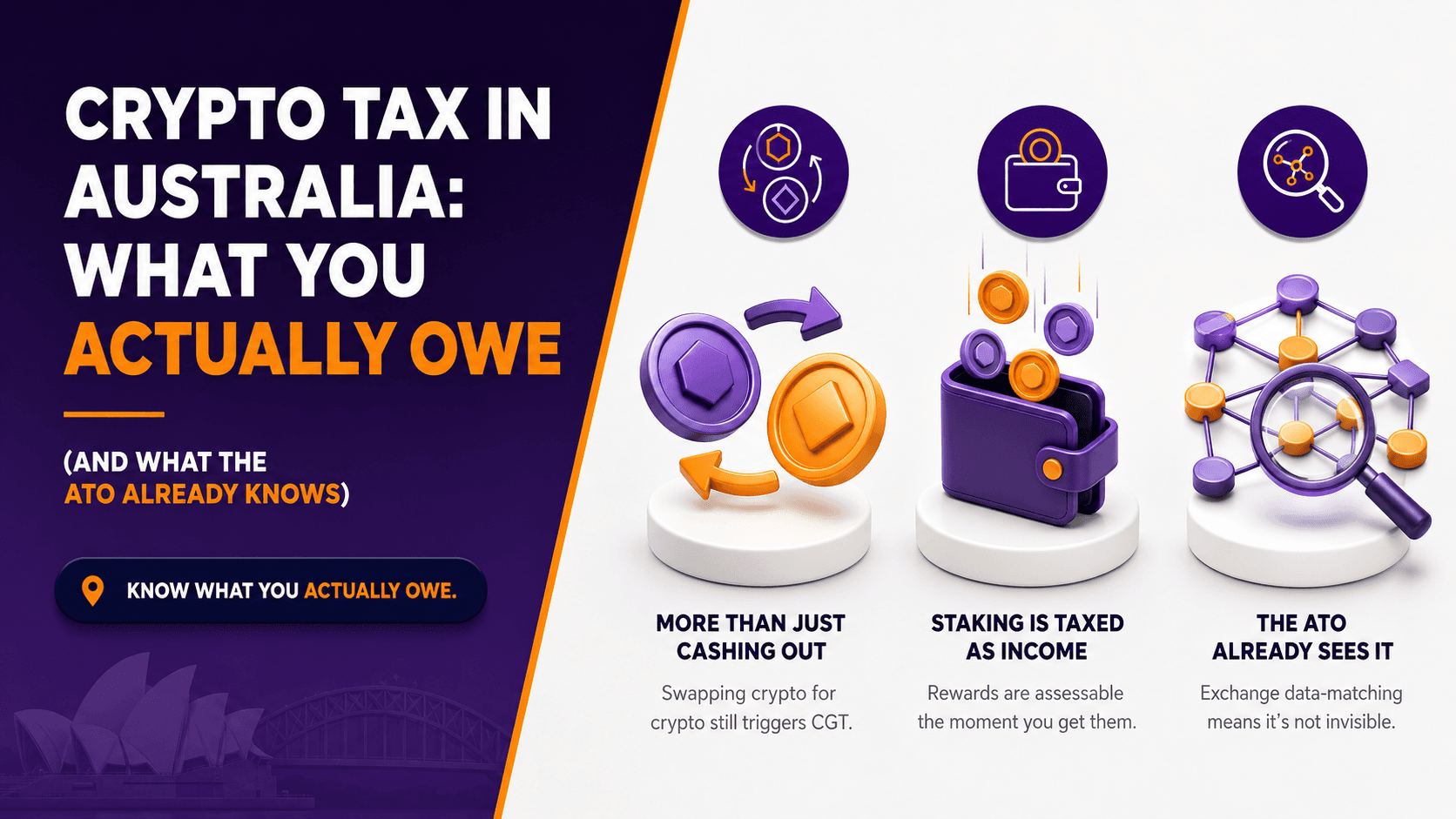
A lot of crypto investors still operate as though it's an untraceable, informal corner of their finances. It isn't, and hasn't been for years. The ATO receives data directly from Australian cryptocurrency exchanges under formal data-matching programs, cross-referencing it against tax returns. Crypto isn't a grey area in Australian tax law, it's treated as property, with clear (if sometimes counterintuitive) rules about when tax is triggered. The confusion isn't usually about whether crypto is taxed, it's about exactly which events trigger tax, and how easy it is to accidentally under-report without realising it.
TL;DR
The ATO treats cryptocurrency as a CGT asset (like shares or property), not currency, meaning Capital Gains Tax applies when you dispose of it, not just when you convert it back to Australian dollars.
"Disposal" is broader than most people think. It includes selling for cash, trading one crypto for another, spending crypto on goods/services, and gifting it.
If you hold a crypto asset for more than 12 months before disposing of it, you may be eligible for the 50% CGT discount (for individuals), same as with other CGT assets. This reflects current, existing tax law, not any proposed or Budget-announced change.
Staking rewards, airdrops, and mining income are generally treated as ordinary income at the time you receive them (taxed at your marginal rate), with a separate CGT event potentially triggered later when you dispose of those tokens.
The ATO runs data-matching programs with Australian and some international exchanges, meaning your trading activity is very likely already visible to them regardless of whether you report it.
Record-keeping is your responsibility. Exchanges don't always provide clean, complete tax reports, especially across multiple platforms or DeFi activity, and the ATO expects you to substantiate your figures.
Losses can offset gains. Capital losses from crypto can offset capital gains (including from other assets like shares), though they can't offset ordinary income.
Bottom line: crypto tax in Australia isn't ambiguous law waiting to be clarified. It's existing CGT and income tax law applied to a new asset type, and the ATO already has more visibility into your activity than most people assume.
Jump to a Section
Crypto Is Property, Not Currency, for Tax Purposes
What Counts as a "Disposal" (More Than You'd Think)
Staking, Airdrops, and Mining: Taxed as Income
The 12-Month CGT Discount
Record-Keeping: The Part Most People Get Wrong
Worked Example: A Year of Crypto Activity, Taxed Properly
Common Mistakes
FAQ
Crypto Is Property, Not Currency, for Tax Purposes
The ATO's foundational position is that cryptocurrency is a CGT asset, treated similarly to shares or an investment property, rather than foreign currency. This distinction matters enormously: if crypto were treated as currency, everyday transactions might not trigger tax the way a currency exchange generally doesn't. Because it's treated as property, disposing of crypto in almost any form is potentially a taxable event, not just converting it back to Australian dollars in your bank account.
This single classification decision is the source of most crypto tax confusion. People intuitively think of digital currency the way they think of foreign cash, but the ATO's rules function much more like the rules for shares or an investment property.
Not sure whether last year's crypto activity actually needs to be reported, or how? A free 15-minute chat can clarify it before tax time gets stressful. Call 1800 942 843.
Bottom line: treat every crypto transaction as though you're dealing with a share portfolio, not spending money from a wallet. That mental shift alone avoids most of the common mistakes.
What Counts as a "Disposal" (More Than You'd Think)
This is where people most commonly under-report, often without realising it. A CGT event can be triggered by:
Selling crypto for Australian dollars (the obvious one).
Trading one cryptocurrency for another. For example, swapping Bitcoin for Ethereum is a disposal of the Bitcoin, even though you never touched Australian dollars.
Spending crypto on goods or services. Using crypto to buy something is treated as disposing of the crypto at its market value at the time of the transaction.
Gifting crypto to someone else. Generally treated as a disposal at market value, even though no money changed hands from your perspective.
Each of these needs to be tracked and valued in Australian dollars at the time of the transaction, not just the "final" cash-out event that most people assume is the only taxable moment.
Bottom line: if you've ever traded one crypto for another or spent crypto directly, you've likely triggered a CGT event that needs reporting. "I never actually cashed out" is not the same as "I have no tax obligation."
Staking, Airdrops, and Mining: Taxed as Income
Beyond CGT on disposals, certain crypto activities generate ordinary income at the point you receive them, taxed at your marginal rate, separate from any later CGT event:
Staking rewards: generally treated as assessable income at their market value when received, based on current ATO guidance.
Airdropped tokens: often treated as income at market value when received, depending on the specific circumstances of the airdrop.
Mining rewards: treatment can depend on whether the activity is a hobby or conducted as a business, affecting whether it's assessed as income and whether related expenses can be deducted.
Once you later dispose of the tokens received this way, a separate CGT event is triggered on any change in value between when you received them (which becomes your cost base) and when you dispose of them.
Involved in staking, DeFi, or mining and not sure how it's meant to be reported? Email tax@whatifadvice.com.au. This is exactly the kind of activity that benefits from a proper look before lodging.
Bottom line: receiving crypto through staking or airdrops isn't a tax-free event just because you didn't "buy" it. It's generally assessable income first, with a further CGT event to track when you eventually dispose of it.
The 12-Month CGT Discount
If you're an individual and you hold a crypto asset for more than 12 months before disposing of it, you may be eligible for the 50% CGT discount, meaning only half of the capital gain is included in your assessable income, the same discount available for other CGT assets like shares or property held long-term. This makes holding period a genuinely relevant tax planning consideration, not just an investment strategy question.
This discount is not automatic in every structure. For example, it generally isn't available to companies, and specific eligibility rules apply, so it's worth confirming your own position rather than assuming the discount applies universally.
Bottom line: the difference between selling at 11 months and 13 months can mean a materially different tax bill on the same gain. Timing genuinely matters here, not just as an investing consideration but as a tax one.
Record-Keeping: The Part Most People Get Wrong
This is where crypto tax gets practically messy, even for people who understand the rules in principle. Common record-keeping problems include:
Trading across multiple exchanges and wallets, making it hard to reconstruct a complete transaction history without dedicated tracking.
DeFi and cross-chain activity that isn't cleanly reported by any single exchange's standard tax report.
Exchanges that have closed or changed since a transaction occurred, making historical data harder to retrieve later.
Not tracking cost base properly, especially across multiple purchases of the same token at different prices and times.
The ATO expects you to be able to substantiate your figures. "The exchange should have that information" isn't a reliable substitute for maintaining your own records as transactions occur, especially given how fragmented crypto activity often becomes across platforms over time. As a general guide, records are typically expected to be kept for at least 5 years from when you lodge the relevant return, though this period can be longer for assets you're still holding, and the exact requirement should be verified with the ATO or your tax agent rather than treated as fixed.
Feeling behind on your crypto record-keeping already? A free 15-minute chat can help you figure out what's salvageable and what needs rebuilding. Book online or call 1800 942 843.
Bottom line: good record-keeping isn't optional admin. It's the difference between confidently lodging an accurate return and scrambling to reconstruct years of scattered transaction history under time pressure.
Worked Example: A Year of Crypto Activity, Taxed Properly
(Figures are illustrative only, for demonstrating the mechanics of multiple tax events within a single year. Actual outcomes depend on your specific transactions, holding periods, and cost base records.)
Priya's crypto year: Priya buys $10,000 of Bitcoin in March. In August, she trades half her Bitcoin holding for Ethereum when that portion is worth $7,000 (a CGT event on the Bitcoin disposed of, resulting in a capital gain relative to its original cost base). In October, she earns the equivalent of $400 in staking rewards from a separate Ethereum holding, which is assessable as ordinary income at the time received. In December, she sells a small amount of Bitcoin she's held for 14 months to cover a personal expense, qualifying that specific portion for the 50% CGT discount given the holding period exceeds 12 months.
Come tax time, Priya's return needs to reflect: the CGT event from the August crypto-to-crypto trade, the assessable staking income from October, and the discounted CGT gain from the December sale, three genuinely separate tax events from what might have felt, day-to-day, like "just moving crypto around."
Bottom line: a single year of active crypto activity can generate multiple distinct tax events of different types. Treating it as one simple "did I make money or not" calculation misses most of what the ATO actually wants reported.
Common Mistakes
Assuming tax only applies when you convert back to Australian dollars. Crypto-to-crypto trades and spending crypto directly are both disposal events.
Not reporting staking or airdrop income as it's received. This is generally assessable at the time received, separate from any later capital gain or loss on disposal.
Poor or missing records across multiple exchanges/wallets. The ATO expects you to substantiate your figures. Not having clean records doesn't remove the obligation to report accurately.
Assuming crypto activity is invisible to the ATO. Data-matching programs with exchanges mean this assumption is genuinely risky, not just technically incorrect.
Forgetting to track cost base properly across multiple purchases. Without accurate cost base records, it's difficult to calculate the correct gain or loss when you eventually dispose of the asset.
Treating losses as simply "gone" rather than usable. Capital losses can offset capital gains (including from other asset types), which is often missed in a bad year for crypto specifically.
FAQ
Do I owe tax on crypto I'm still holding and haven't sold? Generally no CGT applies while you continue holding the asset. CGT is triggered by disposal, though staking or similar rewards received during that holding period can separately be assessable as income.
Is trading one cryptocurrency for another really taxable, even without cashing out? Yes. Swapping one crypto for another is generally treated as a disposal of the first asset at its market value at the time of the trade, triggering a CGT event.
Does the ATO actually know about my crypto trading activity? The ATO runs data-matching programs with cryptocurrency exchanges operating in Australia, meaning a significant amount of trading activity is already visible to them independent of what you self-report.
Can I claim a tax deduction for crypto losses? Capital losses from crypto can generally offset capital gains (from crypto or other assets like shares), though they can't be used to reduce ordinary income like salary or wages.
Are NFTs taxed the same way as other cryptocurrency? Broadly yes. NFTs are generally treated as CGT assets in a similar way to other crypto, with disposal (including trading or selling) potentially triggering a capital gain or loss.
Do I need to report crypto if I only made small amounts? Generally yes. There's no blanket small-transaction exemption for crypto CGT events, meaning even modest trades and disposals should be tracked and reported.
Is crypto received as payment for freelance work taxed differently to crypto I bought as an investment? Yes. Crypto received as payment for goods or services is generally treated as ordinary income at its market value when received, separate from crypto held purely as an investment asset.
How long do I need to keep crypto transaction records? Standard ATO record-keeping requirements apply, generally meaning records should be kept for at least five years from when you lodge the return they relate to, though for CGT assets, records may need to be kept even longer if you're still holding the asset. Confirm the exact requirement for your situation with the ATO or your tax agent rather than treating five years as a fixed rule in every case.
Can crypto tax software replace proper professional advice? Tracking software can help significantly with record-keeping and calculations, especially across multiple exchanges, but it doesn't replace a tax professional's review, particularly for more complex situations like DeFi activity or a mining/staking business.
What happens if I've under-reported crypto income in previous years? It's generally better to proactively correct past returns with the help of a tax professional than to wait for the ATO to identify a discrepancy through data-matching. Voluntary disclosure is typically treated more favourably than a compliance action.
Ready to Get Ahead of Tax Time?
Ready to get your crypto activity properly organised before it becomes a tax-time scramble? Between data-matching, multiple transaction types, and cost base tracking, this is exactly the kind of area where getting it right the first time saves a lot of stress later.
Call us: 1800 942 843
Email: tax@whatifadvice.com.au
Book online: free 15-minute chat, no cost, no pressure
Still asking what if the ATO never notices? They likely already have the data. The only real question is whether your return matches it.
WIAA has filed 2,000+ tax returns across our Toowong, Grange, and Melbourne CBD offices, operating under AFSL 528250 as an Authorised Representative of Beryllium Advisers Pty Ltd.
General Advice Disclaimer: This article contains general information only and does not take into account your personal objectives, financial situation, or needs. It does not constitute personal tax advice, and should not be relied upon as such. Tax treatment of cryptocurrency transactions is complex, fact-dependent, and subject to change. You should seek advice from a registered tax agent regarding your specific transactions and circumstances.