Looking for specific financial advice?
This blog provides general educational content. For personalized advice tailored to your unique situation, book a free consultation with our team of ASIC-licensed financial advisers.
What If Your Executor Can't Get Into Anything You Own?
A Will was built for a world of paper deeds, bank passbooks, and property titles you could physically hand over. It was never built for a crypto wallet secured by a 24-word seed phrase only you know, an online investment account with two-factor authentication tied to a phone your executor can't unlock, or a decade of family photos sitting in cloud storage with no password written down anywhere. If your estate plan hasn't been updated to account for what you actually own today, there's a real chance some of it becomes permanently inaccessible the moment you're gone, not because anyone did anything wrong, but because nobody could get in. For the fundamentals of Wills, intestacy, and EPOA, our dedicated guide covers that ground in full; this piece focuses specifically on the digital layer most of those don't address.
TL;DR
Digital assets include cryptocurrency, online banking and share trading accounts, cloud storage, email, social media, domain names, and paid subscriptions, and most standard Wills don't address them properly.
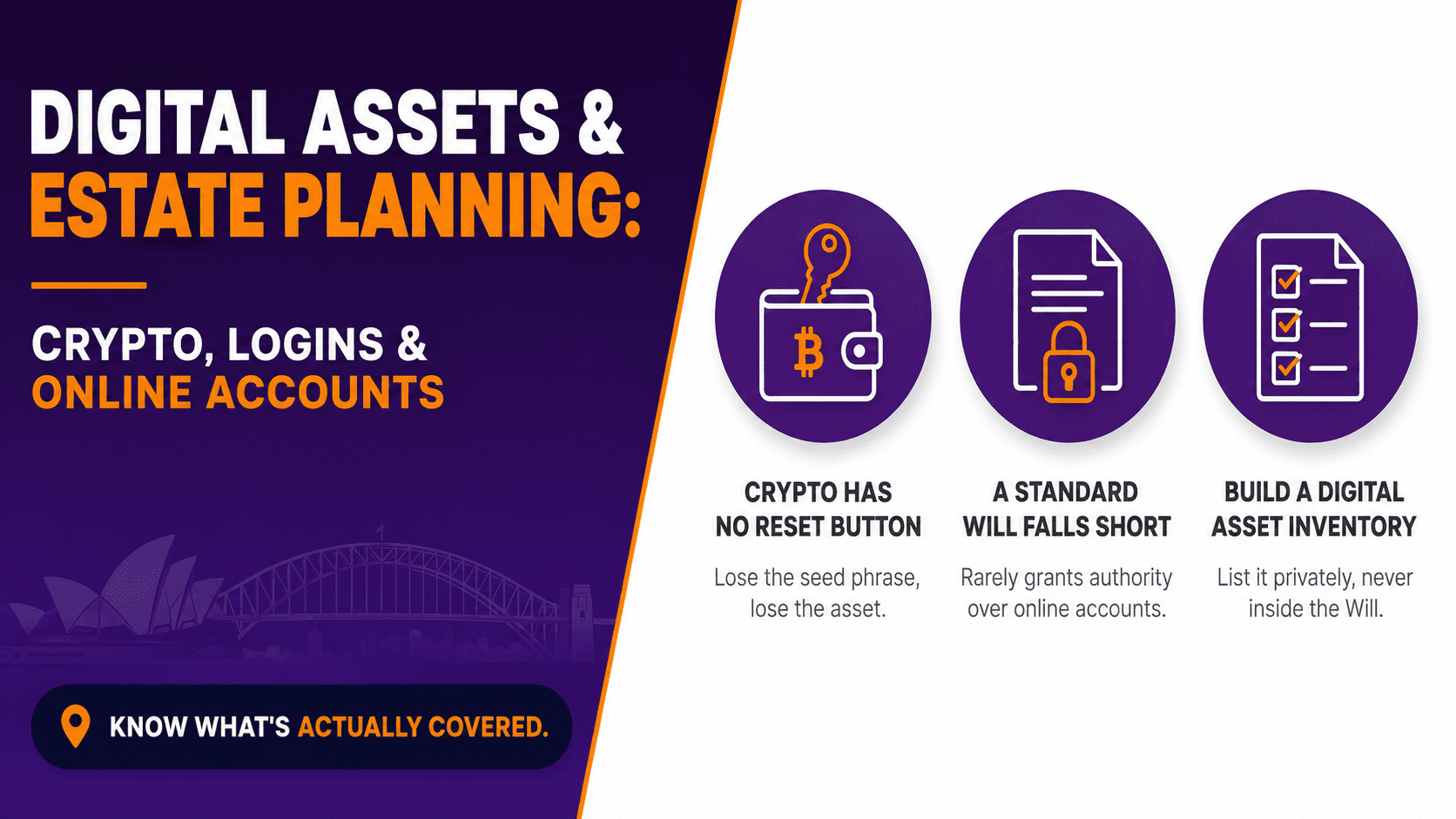
Cryptocurrency is the highest-risk category. Without the private key or seed phrase, crypto holdings can be lost permanently. There is no password reset option and no bank to call. (For how crypto is taxed, rather than how it's inherited, see our separate crypto tax guide.)
A digital asset inventory (kept separate from the Will itself) is the single most useful document you can create, listing what exists and where, without putting passwords directly into a public legal document.
Your Will becomes a public document once probate is granted, so passwords, PINs, and seed phrases should never be written directly into it.
A properly drafted Enduring Power of Attorney and Will should explicitly authorise your attorney or executor to access, manage, and deal with digital assets, since older templates often don't.
Two-factor authentication and biometric locks can block even a legally authorised executor, so the technical access plan matters as much as the legal authority.
Digital assets should be reviewed and updated regularly, since new accounts, wallets, and subscriptions accumulate faster than most people update their estate plan.
Bottom line: if your estate plan was last touched before you owned any crypto, opened your current online accounts, or started storing your life in the cloud, it almost certainly doesn't cover what you actually have.
On This Page
What Counts as a Digital Asset
Why Cryptocurrency Is a Different Problem Entirely
Why a Standard Will Falls Short
Building a Digital Asset Inventory (Without Creating a Security Risk)
Giving Your Executor Legal Authority to Actually Access Everything
The Technical Access Problem: Getting Past 2FA and Biometrics
Worked Example: An Estate With No Digital Plan
Common Mistakes
FAQ
What Counts as a Digital Asset
Digital assets fall into a few broad categories, and most estates hold at least one from each:
Financial assets: cryptocurrency wallets and exchange accounts, online banking, share trading platforms, PayPal or similar payment accounts, buy-now-pay-later balances.
Personal and sentimental assets: photos and videos stored in the cloud, email accounts, personal blogs, gaming accounts with purchased content.
Business and income-generating assets: domain names, websites, monetised social media or content channels, online store accounts.
Recurring liabilities: paid subscriptions and memberships that keep charging a card after death until someone actively cancels them.
Not sure what actually counts as an asset versus just an account you use? A free 15-minute chat with WIAA can help map out what's actually in scope for your situation. Call 1800 942 843 or book online.
Bottom line: if it has a login, a password, or a private key, it needs to be accounted for somewhere in your estate plan.
Why Cryptocurrency Is a Different Problem Entirely
Every other asset class on this list has a fallback. Forgotten a bank password? The bank can verify identity and reset it. Lost the deed to a house? The title still exists on a government register. Cryptocurrency generally has no such safety net. Access is controlled entirely by a private key or seed phrase, and whoever holds that string of words or characters controls the asset, full stop. There's no customer service line to call, no identity verification process, and no way to prove ownership after the fact if the key is gone.
This means crypto holdings can vanish with genuinely no path to recovery if the seed phrase dies with the holder, or if it was written down somewhere nobody else knows to look. It also cuts the other way: anyone who does get hold of the seed phrase, authorised or not, can move the funds instantly with no way to reverse it. Crypto estate planning has to solve for both problems at once, ensuring the right person can access it, and nobody else can.
Bottom line: crypto is the one category where getting the estate plan wrong doesn't just cause delay, it can cause total and permanent loss.
Why a Standard Will Falls Short
A generic Will template typically deals with real property, bank accounts, and personal effects using language that assumes physical assets or accounts a bank can freely unlock for a verified executor. That framing generally leaves gaps for digital assets in a few specific ways:
It rarely grants explicit authority to access, manage, or transfer digital assets and online accounts.
It doesn't address the practical reality that a login and password aren't the same as legal ownership in the eyes of a platform's terms of service.
It says nothing about where digital assets actually are, since unlike a house, they're often invisible until someone goes looking.
It's a public document once probate is granted, meaning anything written directly into it, including passwords, becomes accessible to anyone who requests a copy.
Bottom line: without specific digital asset provisions, an executor can have full legal authority under a Will and still be locked out of everything that matters.
Building a Digital Asset Inventory (Without Creating a Security Risk)
The practical fix isn't cramming passwords into a Will, it's creating a separate, private digital asset inventory that your executor or attorney can locate and use when the time comes. A useful inventory generally lists, for each asset:
What it is and roughly what it's worth.
Where it's held (which exchange, bank, or platform).
How to access it (which device, which password manager, which physical backup).
What should happen to it (transfer, close, memorialise, or sell).
This document should be stored securely, through a reputable password manager with an emergency access feature, a secure physical location such as a safe, or with a solicitor, and it should be updated whenever a new account or wallet is opened. It should never be attached to or referenced inside the Will itself in a way that exposes the actual credentials.
Building or reviewing a digital asset inventory as part of a broader estate plan is exactly the kind of thing a free 15-minute chat with WIAA is designed for. Book online and we'll walk through what's actually worth including.
Bottom line: the inventory does the practical work the Will legally can't, telling your executor what exists and how to reach it, safely and privately.
Giving Your Executor Legal Authority to Actually Access Everything
Legal authority and practical access are two separate problems, and both need solving. On the legal side, your Will and Enduring Power of Attorney should include explicit clauses authorising your executor or attorney to access, manage, transfer, or close digital assets and online accounts, including cryptocurrency. Many older or template documents simply don't contemplate this, since the standard wording predates widespread crypto ownership and cloud-based life admin.
This is a legal drafting matter, and it's worth having a solicitor review or update your Will and EPOA specifically for digital asset clauses rather than assuming existing wording covers it.
Bottom line: legal authority to deal with an asset means nothing if the document authorising it never mentions that the asset exists.
The Technical Access Problem: Getting Past 2FA and Biometrics
Even with full legal authority, an executor can still be blocked by two-factor authentication tied to a phone number that gets disconnected, a fingerprint or face scan that dies with the account holder, or a hardware security key locked in a drawer nobody knows about. This is a genuinely modern problem: platforms designed to keep unauthorised people out don't automatically distinguish between a hacker and a lawfully appointed executor.
The practical answer is planning ahead on the technical side as much as the legal side, using a password manager with a designated emergency contact or legacy access feature, keeping hardware wallets and recovery phrases in a location the executor can actually reach, and periodically checking that 2FA methods are still tied to a device someone else can access if needed.
Bottom line: solve the technical access problem while you're alive, because there is no reliable way to solve it afterwards.
Worked Example: An Estate With No Digital Plan
David, 52, held a modest but meaningful position: roughly $40,000 in cryptocurrency across two exchange accounts, an online share trading account worth $180,000, a decade of family photos in cloud storage, and a handful of paid subscriptions. His Will, drafted years earlier, named his daughter Sarah as executor and covered his house and superannuation in detail, but said nothing about digital assets.
When David passed away, Sarah had clear legal authority under the Will to deal with "all assets of the estate," but no practical way to act on it for the digital side. One crypto exchange account was recoverable through a formal deceased estate process, though it took months and cost time in lost opportunity as the asset sat frozen. The second account, held in a self-custody wallet with the seed phrase stored only on David's phone, which had a passcode nobody knew, was never recovered. The $180,000 share trading account was eventually accessed after Sarah provided a grant of probate directly to the platform, a process that took roughly ten weeks. The cloud photos were recovered through the provider's legacy contact process, but only because David had, coincidentally, set one up years earlier and forgotten about it.
Outcome: roughly $20,000 in crypto was permanently lost, and the remaining process took months longer and involved more legal cost than it would have with a proper digital asset inventory and updated EPOA and Will provisions in place.
Bottom line: the gap between having a Will and having a Will that actually covers digital assets can be the difference between a smooth transfer and a permanent loss.
Common Mistakes
Writing passwords or seed phrases directly into the Will. The Will becomes a public document once probate is granted, exposing anything written into it.
Assuming a password manager account is enough on its own. Without a designated emergency contact or legacy access feature switched on, the manager itself can become another locked door.
Never updating the inventory. New wallets, accounts, and subscriptions accumulate constantly, and an inventory from several years ago is often already out of date.
Relying on family to "figure it out." Without documented access and legal authority, even a close family member has no reliable path into a crypto wallet or a two-factor-locked account.
Treating crypto like a normal financial asset in estate planning conversations. It requires a fundamentally different access solution than a bank account does.
If it's been a while since your Will or EPOA was reviewed, particularly if your digital footprint has grown since, a free 15-minute chat is the easiest way to find the gaps before they matter. Call 1800 942 843.
FAQ
Does cryptocurrency form part of my estate when I die? Generally, yes, cryptocurrency is treated as property and forms part of the estate, but ownership on paper means nothing without practical access to the private key or seed phrase.
Can my executor access my online accounts using my Will alone? Not always. Legal authority under a Will doesn't automatically override a platform's own security measures, such as two-factor authentication or biometric locks, so both legal and practical access need to be planned for.
Should I put my passwords in my Will? No. A Will becomes a public document once probate is granted, so passwords, PINs, and seed phrases should never be written directly into it. Use a separate, securely stored inventory instead.
What happens to my social media accounts when I die? Most major platforms offer either a memorialisation option or an account closure process for a deceased user, generally requiring documentation such as a death certificate, though the specifics vary by platform and should be verified directly.
Do I need a separate crypto Will? Not necessarily a separate legal document, but your existing Will and EPOA generally need specific clauses addressing digital assets and cryptocurrency to be effective, which is a drafting matter for a solicitor.
What is a digital asset inventory and is it legally binding? It's a private, practical document listing what digital assets exist and how to access them. It isn't a legal document in itself, it supports the Will and EPOA rather than replacing them.
Can a financial adviser help with this, or do I need a lawyer? Both generally have a role. A solicitor handles the legal drafting of Will and EPOA clauses, while a financial adviser can help identify and value digital assets and build them into a broader estate and wealth plan.
What happens to subscriptions and recurring payments after death? They generally keep charging the linked card until someone actively identifies and cancels them, which is another reason a documented inventory of accounts matters.
How often should I update my digital asset inventory? Whenever a significant account, wallet, or subscription changes, and at minimum as part of a regular periodic review of your broader estate plan.
Is this covered under normal estate planning services, or is it an extra step? It should be part of a properly built estate plan, not an afterthought, though many older Wills and EPOAs were drafted before it was a standard consideration.
Ready to Make Sure Your Digital Assets Are Actually Covered?
If your Will or Enduring Power of Attorney hasn't been reviewed since you started holding crypto, opened your current online accounts, or moved your life into the cloud, there's a good chance it doesn't cover what you actually own. A free 15-minute chat can help identify the gaps.
Call us: 1800 942 843
Book online: free 15-minute chat, no cost, no pressure
Still asking what if.
WIAA has helped Australians structure estate plans that hold up when they're actually needed, across Toowong, Grange, and Melbourne CBD. WIAA operates under AFSL 528250 as an Authorised Representative of Beryllium Advisers Pty Ltd.
General Advice Disclaimer: This article contains general information only and does not take into account your personal objectives, financial situation, or needs. It is not legal, tax, or personal financial advice, and should not be relied upon as such. Estate planning and Will and EPOA drafting should be undertaken with a qualified solicitor, and digital asset arrangements should be reviewed regularly as your circumstances and holdings change. Before acting on any of the above, consider seeking professional advice tailored to your situation.