Looking for specific financial advice?
This blog provides general educational content. For personalized advice tailored to your unique situation, book a free consultation with our team of ASIC-licensed financial advisers.
What If the Dividend You Never Saw in Cash Still Lands on Your Tax Bill?
You tick the box to reinvest your dividends. No cash arrives, just a few extra shares each half-year. Then tax time comes, and the ATO treats every reinvested dollar as income you received. On a $2,250 fully franked dividend, a top-bracket investor could owe around $546 in extra tax on money that never reached their bank account. Dividend reinvestment plans (DRPs) can be an efficient way to compound a share portfolio, but they come with a tax and record-keeping trail most investors don't see coming. This guide covers how DRPs work, what they cost you, and when they make sense.
If you want the mechanics of franking credits first, read our Franking Credits Explained guide. For selling shares generally, see Tax Implications of Selling Shares. This guide focuses on the DRP itself.
TL;DR
A DRP automatically uses your dividends to buy more shares in the same company or fund, instead of paying you cash.
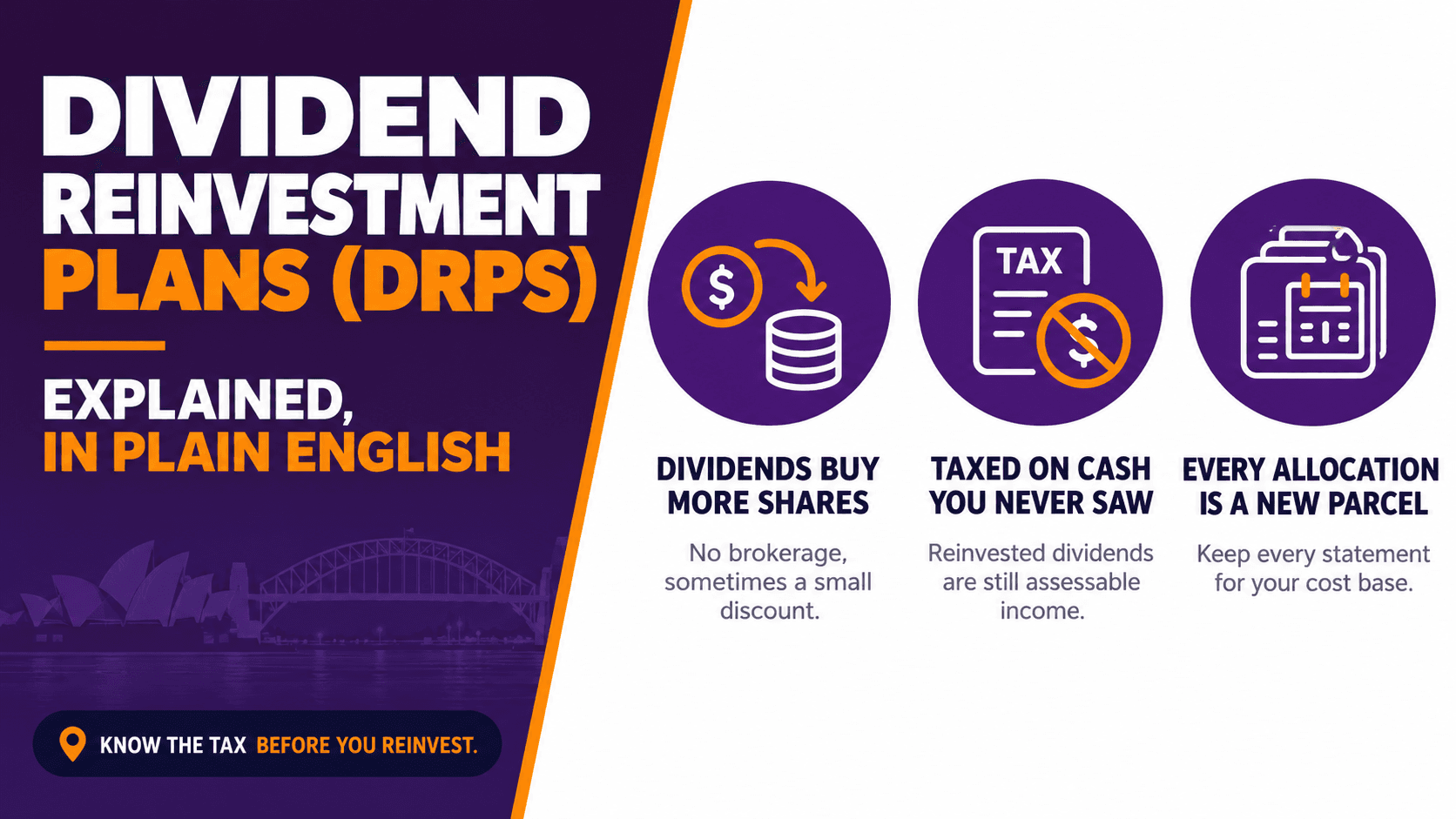
Reinvested dividends are taxed exactly like cash dividends in the year they're paid, franking credits included. A top-rate investor could owe about $546 on a $2,250 fully franked dividend they never received as cash.
Every DRP allocation is a new CGT parcel with its own cost base and acquisition date. Ten years of half-yearly reinvestment means 20 parcels per holding.
DRPs usually charge no brokerage, and some offer a small discount, commonly 0% to around 2.5%, off the market price.
Compounding is the main appeal. In our worked example, reinvesting turned $50,000 into roughly $113,000 over 10 years, versus about $101,000 combined value when dividends were taken as cash and left idle.
The main risk is concentration. A DRP keeps adding to the same stock regardless of price or how overweight it already is.
Bottom line: a DRP is a convenient compounding tool, but it creates tax without cash and paperwork that grows every year, so it suits some portfolios far better than others.
On This Page
How a DRP Actually Works
The Discount, the Brokerage Saving, and the Fine Print
The Tax Catch: Paying Tax on Cash You Never Received
Every Reinvestment Is a New CGT Parcel
DRP vs Taking Cash vs Reinvesting Manually
Worked Example 1: $50,000, Ten Years, Two Choices
Worked Example 2: Selling a Holding Built From 17 DRP Parcels
When a DRP Makes Sense, and When It Doesn't
Common Mistakes
FAQ
How a DRP Actually Works
A DRP is an arrangement offered by a company or fund through its share registry. When it declares a dividend (or a distribution, for ETFs and managed funds), the DRP uses your entitlement to buy additional units instead of paying cash.
The allocation price is usually based on the volume-weighted average price (VWAP), which is the average price the shares traded at, weighted by volume, over a set number of trading days after the record date.
Here is a simple example. You hold 1,000 shares and the dividend is $0.80 per share, so your dividend is $800. At an allocation price of 32.50,theDRPbuys24wholeshares(800 ÷ $32.50 = 24.6). Plans typically allocate whole shares only. The leftover 20(800 − 24 × $32.50) is usually carried forward to the next allocation.
You generally join through the share registry before the DRP election date. Many plans let you choose full or partial participation.
Bottom line: a DRP swaps cash dividends for extra shares at a formula-based price, and once you've opted in it runs automatically.
The Discount, the Brokerage Saving, and the Fine Print
DRPs have three practical advantages over buying the same shares yourself:
No brokerage. Buying $800 of shares manually could cost a meaningful percentage in brokerage on a small trade. A DRP removes that cost.
A possible discount. Some companies apply a discount to the allocation price, commonly between 0% and around 2.5%. A 1.5% discount on $800 is worth $12 per allocation. That's small, but it compounds over time.
Fractional efficiency. Leftover balances carry forward to the next allocation rather than being lost.
The fine print matters too. Companies can change, suspend, or reinstate their DRP and its discount at their own discretion, and discounts tend to appear when a company wants to retain capital. You also can't control the price. The DRP buys at the formula price whether the stock looks cheap or expensive at the time.
Not sure whether your current shareholdings are set to DRP or cash? A free 15-minute chat with WIAA can help you work out whether your current setup still fits your goals. Call 1800 942 843 or book online.
Bottom line: the brokerage saving and any discount are real but modest, and neither is guaranteed to continue.
The Tax Catch: Paying Tax on Cash You Never Received
This is the part most DRP participants underestimate. For tax purposes, a reinvested dividend is treated as if you received the cash and then used it to buy shares. You declare the dividend in your tax return for the year it was paid, along with any franking credits, which is the tax the company has already paid (our Franking Credits Explained guide covers how they work).
Take a $2,250 fully franked dividend at the 30% company tax rate. The franking credit is $964.29 ($2,250 × 30 ÷ 70), so the grossed-up income is $3,214.29. The extra tax payable depends on your marginal rate:
Marginal rate (plus 2% Medicare levy where it applies) | Tax on $3,214.29 | Less franking credit | Net tax payable (or refund) |
Below tax-free threshold (no tax, no levy) | $0 | $964.29 | $964.29 refund |
17% (15% + 2%) | $546.43 | $964.29 | $417.86 refund |
32% (30% + 2%) | $1,028.57 | $964.29 | $64.28 payable |
39% (37% + 2%) | $1,253.57 | $964.29 | $289.28 payable |
47% (45% + 2%) | $1,510.71 | $964.29 | $546.42 payable |
For higher-rate investors, a DRP can create a tax bill that has to be paid from other money. For lower-income investors, including many retirees, the franking credit refund still arrives in cash even though the dividend itself was reinvested.
The 17% row uses the 15% rate scheduled for the lowest taxable bracket from 1 July 2026 (16% applied in 2024-25 and 2025-26). Tax rates, brackets, the Medicare levy (including low-income reductions), and franking rules change. Verify current rates with the ATO or a registered tax agent before relying on these figures.
Bottom line: reinvesting doesn't defer tax, so a high-rate investor on a DRP needs cash set aside for a bill on income they never received in hand.
Every Reinvestment Is a New CGT Parcel
Each DRP allocation is a separate purchase for capital gains tax (CGT) purposes. Each parcel has three things you need to track:
Its own cost base, which is the dividend amount reinvested, adjusted for any residual cash.
Its own acquisition date, which starts a separate 12-month clock for the CGT discount. Under current rules, that's 50% for individuals and trusts (complying super funds receive a smaller, one-third discount).
Its own record-keeping trail, held mainly in the registry's DRP allocation statements.
A holding on half-yearly DRP for 10 years builds 20 parcels. Hold five such stocks and you have 100 parcels to track. ETFs can be more complex again, because annual tax statements can include cost base adjustments that change each parcel's cost base after purchase.
When you sell, the ATO generally lets you identify which parcels you're selling if your records support it. That choice can change your tax outcome significantly, as Worked Example 2 shows. Without records, reconstructing cost bases years later is slow and costly.
Changes to the CGT discount have been announced but not yet legislated. The figures in this guide reflect current rules. Verify current CGT treatment with the ATO or a registered tax agent before selling.
Got years of DRP statements and no idea what your cost base is? Our tax team can help reconstruct it before you sell. Email tax@whatifadvice.com.au for a free 15-minute chat.
Bottom line: a DRP turns one holding into dozens of small purchases, and keeping every allocation statement is the price of selling efficiently later.
DRP vs Taking Cash vs Reinvesting Manually
Factor | DRP | Take cash dividends | Take cash, reinvest manually |
Brokerage | None | None | Yes, on every trade |
Discount possible | Sometimes | No | No |
Control over what you buy | None, same stock only | Full | Full |
Control over price and timing | None | Full | Full |
Portfolio rebalancing | Can worsen concentration | Neutral | Can rebalance toward underweight assets |
Cash to pay tax on dividends | Must come from elsewhere | Comes from the dividend | Comes from the dividend |
Record keeping | Many small parcels | Simple | Fewer, larger parcels |
Effort | Set and forget | Minimal | Ongoing |
Bottom line: none of the three options wins outright. The DRP wins on cost and convenience, while cash wins on flexibility, simplicity, and tax cash flow.
Worked Example 1: $50,000, Ten Years, Two Choices
Emma and Lachlan each invest $50,000 in the same diversified share holding. For simplicity, assume a 4.5% dividend yield, 4% annual price growth, no DRP discount, half-yearly dividends simplified to annual compounding, and tax on dividends paid from other income in both cases.
Emma joins the DRP. Her total return compounds at roughly 8.5% a year:
$50,000 × 1.085¹⁰ ≈ $113,049
Lachlan takes cash and leaves it sitting in a transaction account earning nothing. His holding grows only by price growth:
$50,000 × 1.04¹⁰ ≈ $74,012
His dividends over the 10 years total about $27,014 ($2,250 in year one, growing 4% a year). Combined with his holding, that's $101,026.
Outcome: Emma ends up roughly $12,000 ahead, purely because her dividends earned returns of their own. But that comparison flatters her in two ways:
Lachlan's cash didn't have to sit idle. If he'd parked each dividend in a mortgage offset account at an assumed 5% rate, his dividend pool would grow to about $33,446, bringing his total to roughly $107,459. The gap shrinks to about $5,600, and he'd have reduced debt along the way. (Offset and savings rates change, so treat 5% as illustrative only.)
Emma paid more tax out of salary. Because her balance kept growing, so did her dividends. She was taxed on about $33,379 of dividend income over the decade versus Lachlan's $27,014, roughly $6,365 more, none of which she received as cash.
Emma also has 20 CGT parcels and a portfolio heavier in one holding. Lachlan had flexible cash he could direct anywhere, including a different asset, an offset account, or super.
These figures are illustrative only and assume constant returns. Real markets don't deliver that, and past performance is not a reliable indicator of future returns.
Bottom line: compounding gave Emma the bigger balance, but Lachlan kept flexibility, simpler records, and a smaller tax bill on unseen income. Which is better depends on what each of them actually needed the money to do.
Want to see what reinvesting versus taking cash looks like on your own portfolio? Book a free 15-minute chat online or email clientservices@whatifadvice.com.au.
Worked Example 2: Selling a Holding Built From 17 DRP Parcels
Priya has held shares in one bank for eight years with the DRP switched on the whole time. She now holds about 8,000 shares (roughly $288,000 at $36), made up of her original 2018 purchase plus 16 half-yearly DRP allocations: 17 parcels, each documented only by a registry allocation statement.
At a yield of around 5%, her last two allocations alone added about 400 shares. She sells 400 shares at $36. Because she kept every statement, she can compare two options:
Option A: original 2018 parcel | Option B: two most recent DRP parcels | |
Cost base per share | $24.00 | $35.50 (average) |
Gross capital gain | $4,800 | $200 |
Held 12+ months? | Yes, 50% discount applies | No discount |
Taxable capital gain | $2,400 | $200 |
Outcome: Option B gives Priya a much lower taxable gain this year. But it leaves her lower-cost, older parcels in place, so the larger gain is still there for a future sale. If she expects a lower income in a later year, such as after retiring, Option A may cost less tax overall when she eventually sells.
The DRP-specific point is that this choice only exists because Priya kept 16 small registry statements across eight years. Lose a few, and the cost base of those parcels has to be rebuilt from registry history, dividend records, and old tax returns before she can confidently identify anything.
Bottom line: parcel selection is a real tax planning lever, but on a DRP holding it depends entirely on a stack of small statements most investors never think to keep.
When a DRP Makes Sense, and When It Doesn't
A DRP may suit you when:
You're in the accumulation phase with a long time horizon and don't need the income.
The holding is a broad, diversified fund, where concentration risk is lower.
You have spare cash flow to cover tax on reinvested dividends.
You value automation and would otherwise let the cash sit idle.
A DRP may not suit you when:
You need the income, for example in retirement or while funding living costs.
One stock already makes up a large share of your portfolio.
You're a high-rate taxpayer without spare cash for the tax.
You want to rebalance into other assets or pay down non-deductible debt.
You're unlikely to keep years of allocation statements.
The answer doesn't have to be the same across your whole portfolio. Running a DRP on a diversified ETF while taking cash from a concentrated single stock is a perfectly reasonable split, much like matching different pots of money to different purposes in our Understanding Your Investment Risk Profile guide. For automating regular contributions more broadly, see Dollar-Cost Averaging Explained.
Bottom line: a DRP is a strategy decision, not a default setting, and the right answer can differ from one holding to the next in the same portfolio.
Common Mistakes
Assuming reinvested dividends aren't taxable. They're assessable income in the year paid, exactly like cash.
Not keeping DRP allocation statements. Each one records a parcel's cost base and acquisition date. Lose them and selling becomes a reconstruction job.
Leaving DRPs running on autopilot for years. A holding that compounds unchecked can grow into an outsized, concentrated position.
Treating the DRP discount as free money. It's modest, can be withdrawn at any time, and doesn't make an overvalued stock a good buy.
Forgetting the 12-month CGT clock restarts for every parcel. Recently reinvested shares sold within 12 months don't get the CGT discount.
Running DRPs when the income is needed. Retirees sometimes keep plans running from their working years without revisiting whether that still fits.
Not sure whether your DRP settings still suit your stage of life? A free 15-minute chat with WIAA can help you review them. Call 1800 942 843.
FAQ
Do I pay tax on dividends I reinvest through a DRP?
Yes. Reinvested dividends are treated as income in the year they're paid, along with any franking credits, the same as if you'd received cash.
Do I still get franking credits on reinvested dividends?
Yes. Franking credits attach to the dividend regardless of whether you take cash or reinvest. If your tax rate is below the company rate, excess credits may be refundable.
Does the 45-day holding rule affect DRP shares?
It can. To claim franking credits, you generally need to hold shares "at risk" for at least 45 days (not counting the days you buy and sell). Selling recently allocated DRP shares quickly could affect credits on those shares. A small shareholder exemption applies if your total franking credits for the year are under $5,000. Verify how the rule applies to you with the ATO or a registered tax agent.
What is the cost base of DRP shares?
Generally it's the amount of the dividend reinvested to acquire them, as shown on your DRP allocation statement. ETFs can have later cost base adjustments, so check your annual tax statements.
Does each DRP allocation have its own 12-month CGT discount period?
Yes. Each parcel's acquisition date is the date of that allocation, so the 12-month period runs separately for each one. Changes to the CGT discount have been announced but not yet legislated, so check current rules before selling.
Can I choose which DRP parcels to sell?
Generally yes, if your records clearly identify the parcels. Without adequate records, working out the right cost base becomes much harder. Confirm your approach with a registered tax agent.
Do DRPs charge brokerage?
Typically no, which is one of their main cost advantages, particularly for smaller dividend amounts.
Can I join a DRP for only part of my holding?
Many plans allow partial participation, but the rules vary by company or fund. Check the specific plan's terms with the share registry.
Can a company cancel its DRP or remove the discount?
Yes. Companies can suspend, change, or reinstate their DRP and any discount at their discretion.
Are DRPs a good idea for retirees?
It depends on whether the income is needed. Many retirees rely on dividends for living costs. Reinvesting them can mean selling other assets to fund spending, which adds complexity.
Ready to Make Your Dividends Work the Way You Actually Need Them To?
Whether to reinvest or take cash is part of a bigger picture: your income needs, tax position, and how concentrated your portfolio has become. A free 15-minute chat can help you see where DRPs fit for you.
Call us: 1800 942 843
Email: clientservices@whatifadvice.com.au (investment strategy) or tax@whatifadvice.com.au (DRP tax and cost base questions)
Book online: free 15-minute chat, no cost, no pressure
Still asking what if?
WIAA has helped Australians make smarter investment and tax decisions across Toowong, Grange, and Melbourne CBD. WIAA operates under AFSL 528250 as an Authorised Representative of Beryllium Advisers Pty Ltd and is a registered tax agent practice with the Tax Practitioners Board.
General Advice Disclaimer: This article contains general information only and does not take into account your personal objectives, financial situation, or needs. It is not personal financial or tax advice and should not be relied upon as such. Worked examples are illustrative, use simplified assumptions, and do not predict future returns. Tax rates, franking rules, CGT treatment, and DRP terms change over time and vary between companies and funds. Any references to announced changes to the CGT discount reflect measures that are announced but not yet legislated. Verify current details with the ATO, the relevant share registry, or a qualified adviser. Seek professional advice before making any investment or tax decision.