Looking for specific financial advice?
This blog provides general educational content. For personalized advice tailored to your unique situation, book a free consultation with our team of ASIC-licensed financial advisers.
What If Your Employer’s Free Shares Come With a Tax Bill and No Cash to Pay It?
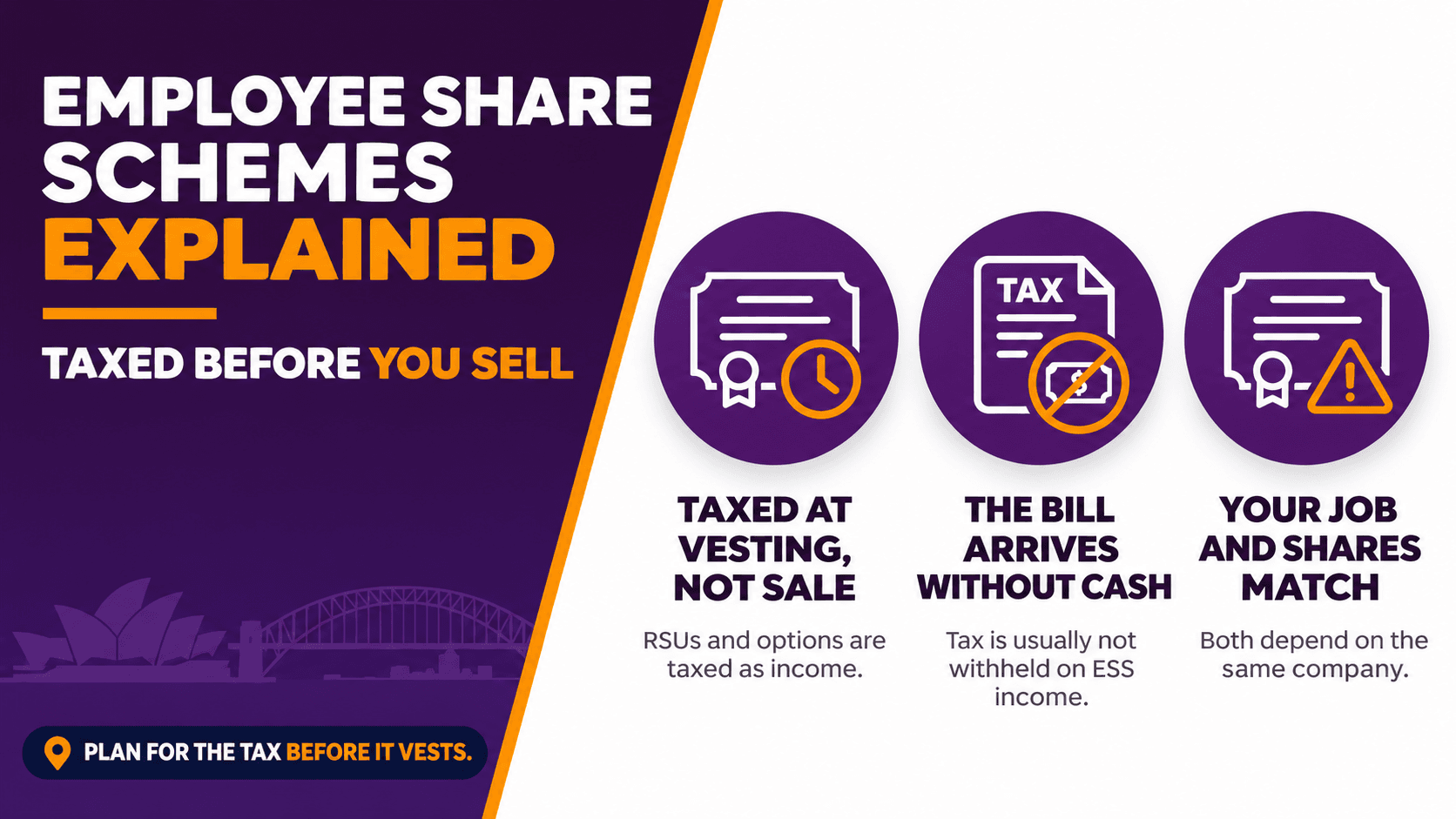
Your employer offers shares or RSUs as part of your pay. It feels like a bonus that grows quietly in the background. Then the shares vest, and the ATO treats their full market value as income, often with no tax withheld. An employee on the top tax rate who vests $90,000 of RSUs can owe around $42,300 in tax, even if they haven’t sold a single share. If the share price falls afterwards, the tax bill doesn’t fall with it. Employee share schemes can build real wealth, but only if you understand when and how they’re taxed.
If your shares are in an overseas parent company, see International Shares and Tax for the foreign share side. For the tax on eventually selling, see Tax Implications of Selling Shares.
TL;DR
An employee share scheme (ESS) gives you shares, options, or rights to shares (such as RSUs) at a discount because of your employment.
The discount is taxed as income at your marginal rate, either upfront when you receive the interest or later at a deferred taxing point.
Deferred taxing points often arrive when RSUs vest or restrictions lift. Tax is usually not withheld, so you may need cash to pay a bill on shares you still hold.
A $1,000 upfront concession may apply under eligible broad-based schemes for employees with adjusted taxable income of $180,000 or less.
Eligible startups can offer a concession that shifts tax from income to capital gains, which is often much cheaper.
The 30-day rule means if you sell within 30 days of a deferred taxing point, the sale date becomes the taxing point.
Holding a lot of your employer’s shares concentrates risk, because your job and your investments depend on the same company.
Bottom line: ESS can be a valuable part of your pay, but the tax usually arrives before the cash does, so plan for it.
On This Page
What an Employee Share Scheme Actually Is
Shares, Options, and RSUs: What You Might Be Offered
The Two Tax Paths: Upfront vs Deferred
The Taxing Point: When the ATO Says You’ve Been Paid
The 30-Day Rule
The Startup Concession
After the Taxing Point: Capital Gains on Sale
The Concentration Problem Nobody Mentions
Worked Example 1: Sarah’s RSUs and a Falling Share Price
Worked Example 2: Ben’s Startup Options, With and Without the Concession
Common Mistakes
FAQ
What an Employee Share Scheme Actually Is
An employee share scheme is any arrangement where you acquire shares, or rights to acquire shares, in your employer or a related company, at a discount because of your employment. “Discount” can mean you pay nothing at all. The rules sit in Division 83A of the tax law.
The tax rules treat that discount as part of your employment income. That’s why ESS is taxed as income first, and only later, after the taxing point, under capital gains tax.
Your employer must give you an ESS statement after the end of the financial year, generally by 14 July, showing the taxable amounts you need to include in your return. It also reports this to the ATO.
Bottom line: from a tax perspective, ESS isn’t a gift, it’s employment income paid in shares instead of cash.
Shares, Options, and RSUs: What You Might Be Offered
Type | What it is | Typical tax timing |
Shares | You receive shares directly, often free or discounted | Upfront, unless conditions allow deferral |
Options | The right to buy shares later at a set exercise price | Often deferred, depending on scheme conditions |
Rights or RSUs (restricted stock units) | The right to receive shares in future, usually once vesting conditions are met | Usually deferred until vesting and restrictions lift |
Salary sacrifice shares | Shares received in place of up to $5,000 of salary a year | Deferred, if conditions are met |
RSUs are common with large listed and multinational employers, particularly US tech companies. Options are common in startups.
Bottom line: the type of interest you receive largely determines when the tax hits, so check your plan rules before assuming anything.
The Two Tax Paths: Upfront vs Deferred
Upfront taxation. The discount is taxed in the year you acquire the ESS interest. The discount is the market value minus anything you paid. If your scheme is eligible, generally a broad-based scheme where you must hold the shares for at least three years, and your adjusted taxable income is $180,000 or less, the first $1,000 of discount can be tax-free.
Deferred taxation. If your interest meets the deferral conditions, tax is postponed to a later deferred taxing point. Common examples are a real risk of forfeiture, such as needing to stay employed until vesting, or a salary sacrifice arrangement within the limit. You’re then taxed on the market value at that point, minus anything you paid.
Deferral cuts both ways. If the share price rises during the deferral period, you pay income tax on a larger amount than you would have upfront. If it falls before the taxing point, you pay income tax on a smaller amount.
The $1,000 concession, the $180,000 income test, and the $5,000 salary sacrifice limit can change, so verify the current figures with the ATO or a registered tax agent.
Not sure whether your ESS is taxed upfront or deferred? Our tax team can read your plan terms and ESS statement with you. Email tax@whatifadvice.com.au for a free 15-minute chat.
Bottom line: upfront taxes a smaller, earlier value, deferral taxes a later value that could be bigger or smaller, and your scheme’s terms decide which applies.
The Taxing Point: When the ATO Says You’ve Been Paid
For deferred schemes, the deferred taxing point is generally the earliest of:
For shares: when there’s no longer a real risk of forfeiture and no genuine restriction stopping you from selling.
For rights and options: either when there’s no real risk of losing the right and no genuine restriction on disposing of it, which can happen before you exercise, or, once you exercise, when there’s no real risk of forfeiting the resulting shares and no restriction on selling them.
15 years after you acquired the interest.
For ESS interests acquired from 1 July 2022, ceasing employment is no longer a taxing point on its own. Before that, leaving your job could trigger tax on unvested interests you still held.
At the taxing point, the market value of the shares (less anything you paid) is added to your assessable income for that year. Australian employers generally don’t withhold tax on ESS income, unless you haven’t provided your TFN. So the bill usually arrives in full when you lodge.
What if you lose the interest? If an ESS interest you were taxed on upfront is later forfeited, for example because you leave before a vesting condition is met, you may be treated as never having acquired it. You can then amend the return to recover the tax (see How to Amend a Tax Return After You’ve Lodged It). This generally doesn’t apply if you chose to let the interest lapse, such as by not exercising an option, or if it was lost under a condition designed to protect you from a fall in market value. Check your situation with a registered tax agent.
Bottom line: the taxing point is often a vesting date, not a sale date, and the tax arrives whether you’ve sold or not.
The 30-Day Rule
If you sell or otherwise dispose of the shares within 30 days after a deferred taxing point, the taxing point moves to the date of sale. The whole amount, sale proceeds minus what you paid, is then taxed as employment income. There’s no separate capital gain or loss.
This is why many employees with RSUs sell some or all of their shares at vest, sometimes called “sell to cover”. The cash from the sale funds the tax bill, and the taxable amount reflects the price they actually received. Selling isn’t always the right call, but knowing the rule lets you choose deliberately.
Bottom line: selling within 30 days of the taxing point keeps everything under income tax at the actual sale price, and creates cash to pay the bill.
The Startup Concession
Eligible startups can offer ESS interests under a concession that’s often much cheaper for employees. Broadly, the company must be unlisted, incorporated for less than 10 years, and have aggregated turnover under $50 million. Other conditions apply.
Where it applies:
Shares issued at a discount of no more than 15% of market value aren’t taxed as income on the discount.
Options with an exercise price at least equal to market value at grant aren’t taxed as income on the discount.
Instead, the gain is taxed under CGT when you sell. The 50% CGT discount may be available if you’ve held the interest for 12 months or more, counting from when you acquired the original option or share.
Much of the concession’s value comes from that 50% CGT discount. Changes to the CGT discount have been announced but not yet legislated, and any change could reduce the benefit. Check whether any transitional rules would apply to interests you already hold. These eligibility criteria and limits also change from time to time, so verify the current rules before relying on the concession.
Joining a startup with an option package? Find out whether the startup concession applies before you sign. Call 1800 942 843 for a free 15-minute chat.
Bottom line: the startup concession can turn an income tax bill at your marginal rate into a discounted capital gain years later, but only if every condition is met.
After the Taxing Point: Capital Gains on Sale
After the taxing point, and outside the 30-day rule, your shares become a normal CGT asset:
The cost base is generally reset to the market value at the taxing point.
The CGT acquisition date is generally the taxing point, so the 12-month clock for the CGT discount starts then. Under current rules that discount is 50% for individuals, and changes to it have been announced but not yet legislated.
Any rise after that is a capital gain when you sell.
Any fall is a capital loss once you sell. That loss can only offset capital gains, not your salary or the ESS income you’ve already paid tax on.
Dividends on ESS shares are taxed like any other dividends.
For more on selling shares, including record keeping, see Tax Implications of Selling Shares.
Bottom line: income tax is applied to the value at the taxing point, and anything after that is a capital gain or loss.
The Concentration Problem Nobody Mentions
Beyond tax, ESS creates a quieter risk. Your salary already depends on your employer. Holding a large share of your wealth in that same company doubles your exposure. If the company struggles, you could lose both your job and a big chunk of your savings at the same time.
Many employees keep vesting and holding for years without ever rebalancing. Whether to hold, sell, or sell gradually depends on your risk profile, goals, and tax position, which our Understanding Your Investment Risk Profile guide covers.
Have your employer’s shares grown into a big slice of your wealth? A free 15-minute chat can help you think through diversifying. Email clientservices@whatifadvice.com.au or book online.
Bottom line: ESS shares are worth managing like the rest of your portfolio, because concentration risk doesn’t show up on your payslip.
Worked Example 1: Sarah’s RSUs and a Falling Share Price
Sarah earns $200,000 with a US-listed tech company and holds private hospital cover, which puts her on a 45% marginal rate plus the 2% Medicare levy (47%). This year, 400 RSUs vest at US$150 a share. Assume an exchange rate of 1 USD = 1.50 AUD, held constant for simplicity.
At vesting (taxing point):
Value: 400 × US$150 × 1.50 = $90,000 assessable income
Tax: $90,000 × 47% = $42,300, with nothing withheld
Sarah holds the shares. Over the following year, the price falls 40% to US$90.
A year later:
Value: 400 × US$90 × 1.50 = $54,000
Capital loss if she sells: $90,000 − $54,000 = $36,000
Sold within 30 days of vest | Held, then the price fell 40% | |
Income taxed | $90,000 (at actual sale price) | $90,000 |
Tax payable | $42,300 | $42,300 |
Cash or shares left after tax | $47,700 cash | $54,000 in shares, but $42,300 tax paid from other money |
Capital loss | None | $36,000 if she sells, usable only against capital gains |
Outcome: Sarah paid $42,300 in tax on shares now worth $54,000. If she sells, her $36,000 loss can’t reduce the income tax already assessed, and can only offset capital gains. If she keeps holding, the loss stays on paper. Had the share price risen instead, holding would have looked smart. Neither choice is automatically right, but she needed a plan for the tax bill either way. These figures are simplified and illustrative only.
Bottom line: with RSUs, the tax is locked in at vest, and the market only decides what you have left afterwards.
Worked Example 2: Ben’s Startup Options, With and Without the Concession
Ben earns a $140,000 salary and holds private hospital cover. With $30,000 of ESS income added, his $170,000 total stays in the 37% bracket, so his marginal rate plus Medicare is 39%. He receives 10,000 options with a $1.00 exercise price, equal to market value at grant. After three years he exercises, paying $10,000, when shares are worth $4.00. Two years later he sells at $6.00 for $60,000.
Startup concession applies | Deferred, no startup concession (taxing point at exercise) | |
Income taxed at exercise | $0 | ($4.00 − $1.00) × 10,000 = $30,000 → $11,700 tax |
Capital gain on sale | $60,000 − $10,000 = $50,000 | $60,000 − $40,000 = $20,000 |
50% CGT discount | Yes (held 12+ months from grant) | Yes (held 12+ months from exercise) |
Taxable gain | $25,000 → $9,750 tax | $10,000 → $3,900 tax |
Total tax | $9,750 | $15,600 |
Outcome: under current rules, the startup concession saves Ben $5,850 on the same shares and the same sale price, and he pays nothing until he actually sells. Because the concession’s advantage relies on the 50% CGT discount, the announced (not yet legislated) changes to that discount could materially narrow the gap, depending on their final form and any transitional rules. If the startup had failed, he’d have lost his $10,000 exercise cost under either scenario, but without the concession he’d also have paid tax on a paper gain at exercise. The no-concession column assumes the taxing point is at exercise. For rights and options, it can arrive earlier if there’s no real risk of forfeiture and no restriction on disposal, so the actual taxing point depends on the plan terms. These figures are simplified and illustrative.
Bottom line: before accepting a startup option package, confirm whether the startup concession applies, because it can change both how much tax you pay and when.
Common Mistakes
Assuming you’re only taxed when you sell. Most ESS income is taxed at a taxing point such as vesting, not at sale.
Not setting aside cash for the tax bill. Tax usually isn’t withheld on ESS income.
Forgetting ESS income on your tax return. Your employer reports it to the ATO, so a mismatch is easy to pick up.
Expecting a later share price fall to reduce the income tax already assessed. It creates a capital loss instead, which only offsets capital gains.
Missing the 30-day rule. Selling within 30 days changes how the whole amount is taxed.
Assuming the startup concession applies to every startup. The company and the offer both need to meet specific conditions.
Not reclaiming tax on forfeited interests. If an interest you were taxed on upfront is forfeited, you may be able to amend and recover the tax.
Letting employer shares build into an outsized share of your wealth. It ties your job and your investments to the same company.
Ignoring currency for overseas employers. RSUs in foreign companies need to be valued in Australian dollars at the taxing point.
Already vested and holding a tax bill you weren’t expecting? A free 15-minute chat with WIAA’s tax team can help you plan for it. Call 1800 942 843.
FAQ
How are employee shares taxed in Australia?
The discount, which is the market value minus anything you paid, is taxed as income, either when you acquire the interest or at a later deferred taxing point. Later growth is generally taxed as a capital gain when you sell.
When are RSUs taxed in Australia?
Usually at the deferred taxing point, which is often when they vest and any restrictions on selling are lifted. The market value at that point is taxed as income.
Is tax withheld from my employee shares?
Generally not, unless you haven’t provided your TFN to your employer. Most people need to plan to pay the tax when they lodge.
What is the $1,000 ESS concession?
Under eligible upfront schemes, the first $1,000 of discount may be tax-free if your adjusted taxable income is $180,000 or less and other conditions, including a minimum holding period, are met.
What is the 30-day rule for employee shares?
If you sell within 30 days after a deferred taxing point, the sale date becomes the taxing point, and the whole amount is taxed as income at the actual sale price.
What happens if my employee shares fall in value after I’ve been taxed?
The income tax already assessed doesn’t change. If you sell for less, you make a capital loss that can generally only offset capital gains.
Does leaving my job trigger tax on unvested ESS interests?
For interests acquired from 1 July 2022, ceasing employment is no longer a taxing point on its own. Check your plan rules, as unvested interests may be forfeited when you leave. If you were taxed upfront on an interest that’s then forfeited, you may be able to recover that tax.
What is the startup concession?
A concession for eligible startups that can mean no income tax on the discount, with the gain taxed under CGT when you sell instead. Under current rules that’s often with the 50% CGT discount, which is subject to announced but not yet legislated changes.
Where do I find my ESS income for my tax return?
On the ESS statement your employer provides after the end of the financial year, generally by 14 July.
Should I sell my employee shares as soon as they vest?
It depends on your tax position, cash needs, how concentrated you are in your employer, and your risk profile. Get advice on your own circumstances.
Ready to Make Your Employee Shares Work For You, Not Against You?
ESS can be one of the most valuable parts of your pay, or the source of a tax bill you didn’t see coming. A free 15-minute chat can help you understand your taxing points, plan for the tax, and decide what to hold.
Call us: 1800 942 843
Email: tax@whatifadvice.com.au (ESS tax questions) or clientservices@whatifadvice.com.au (investment strategy)
Book online: free 15-minute chat, no cost, no pressure
Still asking what if?
WIAA helps employees understand and plan for employee share schemes across Toowong, Grange, and Melbourne CBD. WIAA is a registered tax agent practice with the Tax Practitioners Board and operates under AFSL 528250 as an Authorised Representative of Beryllium Advisers Pty Ltd.
General Advice Disclaimer: This article contains general information only and does not take into account your personal objectives, financial situation, or needs. It is not personal tax or financial advice and should not be relied upon as such. ESS rules, concession thresholds, eligibility criteria, tax rates, and exchange rates can change, and the tax treatment of any scheme depends on its specific terms. Any reference to changes to the CGT discount reflects measures that are announced but not yet legislated. Verify current rules with the ATO or a registered tax agent. Worked examples are illustrative and simplified. Seek professional advice for your own circumstances.