Looking for specific financial advice?
This blog provides general educational content. For personalized advice tailored to your unique situation, book a free consultation with our team of ASIC-licensed financial advisers.
What If Two People Invested the Same $50,000, One in an ETF, One in a Managed Fund, and Ended Up With Very Different Outcomes, Purely From Fees?
Most investors focus on picking the "right" shares. Fewer focus on the structure they're investing through, and that structure quietly eats into returns every single year, compounding for decades. ETFs, Listed Investment Companies (LICs), and managed funds all let you access diversified portfolios without picking individual stocks yourself, but they're built completely differently, different cost structures, different tax treatment, different liquidity, and different levels of manager discretion. Picking the wrong one for your situation isn't catastrophic, but it's an ongoing, compounding cost most people never actually calculate.
This comparison covers structural differences only. It doesn't account for your personal tax position, risk profile, or overall portfolio, which is exactly the kind of thing worth reviewing with an adviser before choosing between them.
TL;DR
ETFs (Exchange Traded Funds) trade on the ASX like shares, typically track an index, and generally have the lowest ongoing fees of the three, often between 0.03% and 0.50% per year.
LICs (Listed Investment Companies) also trade on the ASX like shares but are actively managed companies, can trade at a premium or discount to their actual asset value (NAV), and often pay strong fully franked dividends.
Managed funds aren't traded on an exchange, you buy/redeem units directly with the fund manager at end-of-day pricing, generally have higher fees than ETFs, and can be actively or passively managed.
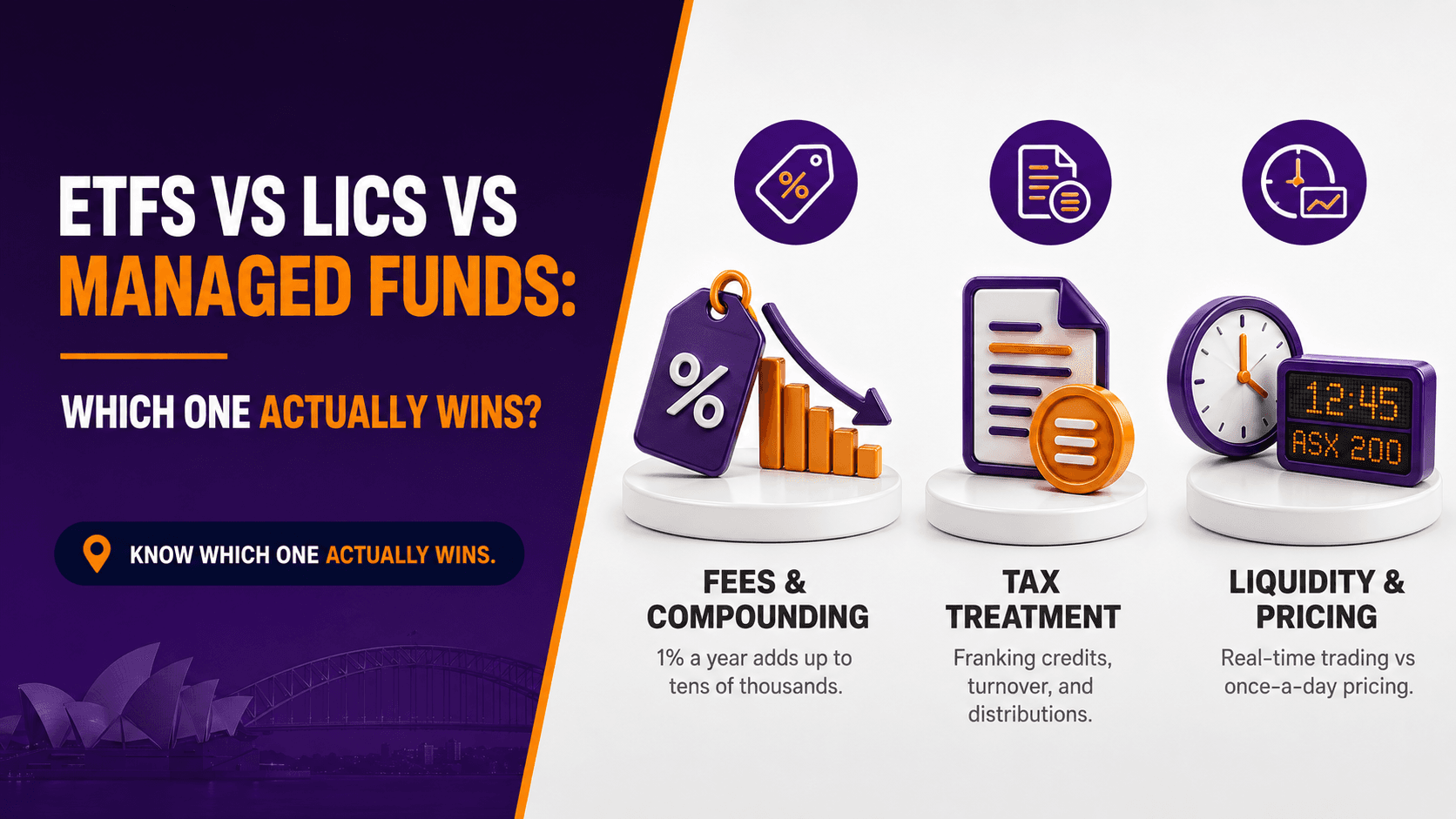
Fees compound significantly over time: a 1% difference in annual fees on $100,000 over 20 years can mean a difference of tens of thousands of dollars, even before considering performance differences.
Tax treatment differs at the margins: ETFs and managed index funds are generally tax-efficient due to lower turnover, while LICs can offer franking credit advantages, and actively managed funds can generate more taxable events through trading.
Liquidity differs: ETFs and LICs can be bought/sold any time the ASX is open at the current market price; managed funds are typically priced and processed once daily.
There's no single "winner." The right choice depends on your goals, whether you want active management, your tax position, and how much you value flexibility vs simplicity.
Bottom line: none of these three structures is inherently "better." They're different tools, and the fee and tax differences between them are real enough to be worth understanding before choosing where your money sits.
Jump to a Section
How Each Structure Actually Works
The Fee Difference (and Why It Compounds)
Tax Treatment: Franking Credits, Turnover, and Distributions
Liquidity and Pricing Differences
Active vs Passive: Where LICs and Managed Funds Diverge From ETFs
Worked Example: Same $50,000, Three Structures
Common Mistakes
FAQ
How Each Structure Actually Works
ETFs are open-ended funds that trade on the ASX exactly like an individual share, you buy and sell them through a broker at the current market price throughout the trading day. Most ETFs track an index (like the ASX 200 or S&P 500), meaning the fund simply holds the underlying shares in proportion to that index, with minimal ongoing manager decision-making.
LICs are companies (with their own ASX ticker, board of directors, and share price) whose sole business is holding a portfolio of investments, typically shares, on behalf of shareholders. Because they're actively managed companies with a fixed number of shares on issue, their share price can trade above or below the actual value of the underlying assets they hold (known as trading at a premium or discount to Net Asset Value).
Managed funds are pooled investment vehicles you invest in directly through the fund manager (or a platform), not via the ASX. Units are priced once per day based on the fund's net asset value, and you buy or redeem units directly with the manager rather than trading with other investors on an exchange.
Not sure which of these actually fits how you want to invest? A free 15-minute chat will clarify it fast. Call 1800 942 843.
Bottom line: the core difference is where and how you transact, on an exchange in real time (ETFs, LICs) versus directly with a fund manager once a day (managed funds), and that difference cascades into almost everything else about each structure.
The Fee Difference (and Why It Compounds)
Fees are where the starkest differences usually show up:
Structure | Typical Ongoing Fee Range | Notes |
ETF (passive/index) | ~0.03% to 0.50% p.a. | Lowest cost tier generally, minimal active decision-making |
LIC | ~0.5% to 1.2% p.a. | Reflects active management and company running costs |
Managed fund (active) | ~0.7% to 2%+ p.a. | Higher due to active research, trading, and distribution costs |
Managed fund (index/passive) | ~0.1% to 0.4% p.a. | Competitive with ETFs when passively managed |
(Ranges are general and vary significantly by specific product and provider. Always check the current Product Disclosure Statement fee schedule.)
A 1% annual fee difference sounds small in isolation, but compounds meaningfully over long investment horizons. On $100,000 invested over 20 years at a steady return, that 1% difference alone can amount to tens of thousands of dollars in lost compounding, independent of which product actually performed better.
Want to see what a fee difference like this would actually mean for your own numbers? Book a free 15-minute chat online and we'll walk through it.
Bottom line: fees are one of the few investing variables you can know with certainty in advance, and over a multi-decade horizon, they're often a bigger driver of your outcome than trying to pick the better-performing product.
Tax Treatment: Franking Credits, Turnover, and Distributions
All three structures can distribute franked dividends if they hold Australian shares, but the tax efficiency differs in practice:
ETFs tracking an index generally have low portfolio turnover (the underlying holdings don't change often), which tends to mean fewer taxable capital gains events passed on to investors each year.
LICs are companies, and their profits are taxed at the company tax rate before dividends are paid. This means LIC dividends often carry franking credits, which can be valuable for investors on lower marginal tax rates or those who can use the offset effectively.
Actively managed funds with higher turnover can generate more frequent taxable capital gains distributions, even in years where the fund's overall performance was flat or negative, a detail that surprises investors who don't expect a tax bill from a fund that didn't obviously "make money" that year.
Bottom line: the tax outcome isn't just about the headline return. Turnover and structure both affect how much of that return actually reaches you after tax, and this varies meaningfully between the three.
Liquidity and Pricing Differences
ETFs and LICs can be bought or sold at any point the ASX is open, at the live market price, genuinely liquid, same as trading a share. Managed funds are typically priced once per day (often based on the prior day's closing valuations), and redemption requests are processed at that day's unit price, not a real-time figure, meaning there's inherently less pricing precision and same-day flexibility.
There's a further wrinkle specific to LICs: because they trade as companies with a fixed number of shares, their market price can drift away from the actual value of the underlying portfolio, sometimes trading at a discount (buying $1 of assets for less than $1) or a premium (paying more than $1 for $1 of underlying assets), depending on market sentiment toward that particular LIC and manager.
Bottom line: ETFs offer the most straightforward liquidity and pricing transparency of the three; LICs add a genuine premium/discount dynamic worth understanding before buying; managed funds trade same-day flexibility for simplicity.
Active vs Passive: Where LICs and Managed Funds Diverge From ETFs
Most ETFs are passively managed, simply tracking an index, though actively managed ETFs do exist and are growing in number. LICs and managed funds are far more likely to be actively managed, meaning a manager is making ongoing decisions about which securities to hold, in what proportion, and when to trade, aiming to outperform a benchmark rather than just replicate it.
Active management carries a genuine trade-off: the potential for outperformance, at a higher fee, with no guarantee the manager actually beats the index after costs, and a substantial body of long-term research suggests most active managers underperform their benchmark over extended periods, though individual managers and specific market segments can and do outperform.
Weighing up whether active management is worth the extra cost for your situation? Email clientservices@whatifadvice.com.au and we can talk it through.
Bottom line: choosing active management (via a LIC or actively managed fund) is a bet that a manager's skill and process will outweigh the extra cost over time, a reasonable bet in some cases, but one that should be made deliberately, not by default.
Worked Example: Same $50,000, Three Structures
(Figures below are illustrative worked examples only, assuming identical gross returns before fees as a simplification. They are not performance projections or guarantees of any actual outcome.)
Investor A, Tom (passive ETF): Invests $50,000 in a broad-market index ETF with an annual fee of 0.10% ($50/year on the initial balance). Low turnover keeps the tax position relatively simple, and he can buy or sell at any point the market's open.
Investor B, Priya (LIC): Invests $50,000 in an actively managed LIC with a 0.95% annual fee ($475/year on the initial balance), receives strong fully franked dividends reflecting the underlying portfolio's income, but notes the LIC's share price is currently trading at an 8% discount to its actual net asset value, meaning her $50,000 effectively bought about $54,300 worth of underlying assets at the time of purchase (illustrative only; premiums/discounts fluctuate and aren't guaranteed to persist or reverse).
Investor C, Marcus (actively managed fund): Invests $50,000 in an actively managed fund with a 1.6% annual fee ($800/year on the initial balance), redeemable only at end-of-day pricing, with higher portfolio turnover generating a taxable capital gains distribution in a year the fund's overall return was modest.
Over 20 years, assuming identical gross returns before fees, the fee difference alone between Tom's ETF and Marcus's managed fund would compound into a substantial gap in final balance, before even considering whether the actively managed options outperformed or underperformed their benchmarks.
Bottom line: three investors, three structures, three genuinely different cost and tax outcomes, none of which had anything to do with picking the "right" shares.
Common Mistakes
Comparing only headline returns, not fees. A fund that returned 8% with a 1.5% fee didn't necessarily do better than an ETF that returned 7.5% with a 0.1% fee, once compounding is considered over time.
Buying a LIC without checking its premium/discount to NAV. Paying a premium means overpaying for the underlying assets relative to their actual value.
Assuming all ETFs are passive. Actively managed ETFs exist and carry different fee and risk profiles than standard index-tracking ETFs.
Ignoring tax drag from high-turnover active funds. A fund can generate a taxable distribution even in a year it didn't perform well, which catches people off guard at tax time.
Treating "diversified" as automatically "safe." All three structures can be more or less diversified depending on what they actually hold. The structure itself doesn't guarantee diversification.
Choosing based on which is trendiest rather than what fits your goals. ETFs have become popular, but that doesn't automatically make them the right fit for every investor's tax position or preference for active management.
FAQ
Which is cheapest, ETFs, LICs, or managed funds? Passive ETFs are generally the cheapest on average, but actively managed LICs and managed funds can be competitively priced depending on the specific product. Always compare the actual fee schedule rather than assuming based on structure alone.
Can I lose money buying a LIC at a premium to its NAV? Yes. If you buy at a premium and the share price later reverts toward or below NAV, that's a loss independent of how the underlying portfolio itself performed.
Do ETFs pay dividends like LICs and managed funds? Yes. ETFs holding dividend-paying shares generally pass on distributions to unit holders, including franking credits where applicable, similar in principle to LICs and managed funds.
Are managed funds only for large investors? No, though some managed funds have minimum initial investment amounts (commonly a few thousand dollars) that can be higher than the cost of buying a single ETF unit. This varies by fund.
Is an actively managed fund ever worth paying more for? Potentially, if the manager has a genuine track record and process suited to a specific market segment where active management has historically added value, but this needs individual assessment, not a blanket assumption either way.
Can I hold ETFs, LICs, and managed funds inside superannuation? Generally yes, depending on your fund type (particularly with an SMSF or a platform offering a broad investment menu), though availability varies by super fund.
Do ETFs have the same franking credit benefits as LICs? ETFs holding Australian shares that pay franked dividends do pass through franking credits, though the LIC company-tax structure can create a particular franking credit dynamic worth understanding for investors specifically seeking that income style.
How do I check if a LIC is trading at a premium or discount? This information is generally published by the LIC itself or available through market data providers, comparing the current share price to the most recently reported net asset value per share.
Is it common to hold a mix of ETFs, LICs, and managed funds rather than just one? Yes. Many investors use a blend, for example a low-cost ETF core with a targeted active LIC or managed fund allocation for a specific strategy or sector, rather than treating it as an either/or choice.
Which one should I choose for my situation? It depends on your investment goals, tax position, appetite for active management, and how much you value real-time liquidity versus simplicity. This is exactly the kind of decision worth reviewing with an adviser rather than defaulting to whichever option is currently most talked about.
Ready to Figure Out What Actually Fits?
Ready to figure out which structure, or mix of structures, actually fits your goals, tax position, and investing style? Fees and tax treatment compound quietly for decades. It's worth getting the structure right before the amount invested gets a lot bigger.
Call us: 1800 942 843
Book online: free 15-minute chat, no cost, no pressure
Still asking what if you just picked whichever one your mate mentioned at a barbecue? Structure matters as much as the shares underneath it. Get both right.
WIAA has advised 1,000+ clients across our Toowong, Grange, and Melbourne CBD offices, operating under AFSL 528250 as an Authorised Representative of Beryllium Advisers Pty Ltd.
General Advice Disclaimer: This article contains general information only and does not take into account your personal objectives, financial situation, or needs. It does not constitute personal financial advice, and should not be relied upon as such. Fees, tax treatment, and figures referenced are general guides and illustrative examples only, are subject to change, and should be verified against current Product Disclosure Statements or with a financial adviser before making investment decisions. Past performance is not a reliable indicator of future performance.