Looking for specific financial advice?
This blog provides general educational content. For personalized advice tailored to your unique situation, book a free consultation with our team of ASIC-licensed financial advisers.
What If Your "Ethical" Fund Still Owns Something You'd Rather It Didn't?
Ethical and ESG investing has grown from a niche corner of the market into a genuine mainstream category, with most major super funds now offering some version of a "sustainable" or "socially responsible" option. What's grown alongside it is confusion about what these labels actually guarantee, and in some cases, genuine greenwashing, funds marketed as ethical that still hold companies or sectors an investor would reasonably expect to be excluded. This guide covers what ESG investing actually means in practice, and how to check whether a fund does what its marketing suggests.
TL;DR
ESG stands for Environmental, Social, and Governance, a framework for assessing companies on factors beyond pure financial performance, while "ethical investing" is a broader, less standardised term.
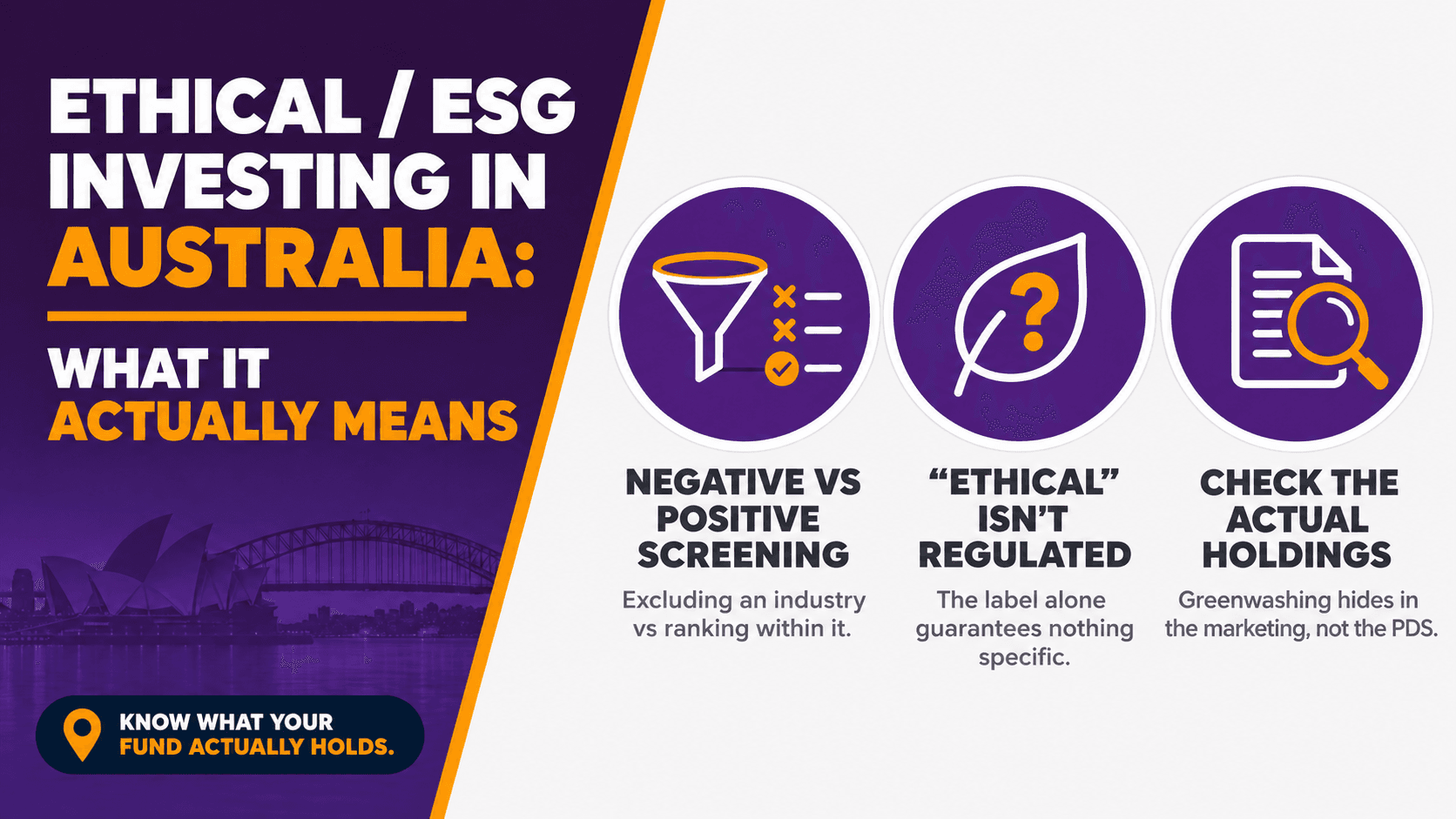
Negative screening excludes specific industries or companies (tobacco, weapons, fossil fuels), while positive screening actively selects companies rated well on ESG criteria, and many funds use a mix of both.
There's no single legal standard for what counts as "ethical" or "ESG" in Australia, meaning the label alone doesn't guarantee any specific exclusions or standards.
Greenwashing is a genuine, regulator-recognised risk, where funds market themselves as sustainable while holding investments that arguably contradict that positioning.
Performance is not inherently worse for ESG funds, though it can differ from a standard index due to different sector weightings, sometimes better, sometimes worse, depending on the period.
Fees can be higher for ESG-labelled funds, particularly actively managed ones, which is worth weighing against a comparable standard index option.
Checking a fund's actual holdings and exclusion criteria, not just its marketing name, is the only reliable way to confirm whether it matches an investor's specific values.
Bottom line: "ethical" and "ESG" are marketing-adjacent terms with no fixed legal meaning in Australia, and the only way to know what a fund actually does is to check its stated screening criteria and real holdings.
On This Page
What ESG and Ethical Investing Actually Mean
Negative Screening vs Positive Screening
Why "Ethical" Isn't a Regulated Term
The Greenwashing Problem
Does ESG Investing Cost You Performance?
How to Actually Evaluate a Fund
Worked Example: Two "Ethical" Funds, Very Different Holdings
Common Mistakes
FAQ
What ESG and Ethical Investing Actually Mean
ESG is shorthand for Environmental, Social, and Governance, three categories of non-financial factors used to assess a company alongside its traditional financial metrics. Environmental covers things like carbon emissions and resource use. Social covers labour practices, community impact, and human rights considerations. Governance covers board structure, executive pay, and corporate transparency. Ethical investing is a broader, older term that generally refers to excluding investments an investor considers morally objectionable, historically tobacco, gambling, and weapons, though the term has expanded to overlap heavily with ESG language.
In practice, the two terms are used loosely and often interchangeably in fund marketing, which is part of the confusion, a fund calling itself "ethical" and a fund calling itself "ESG" might apply genuinely different screening criteria despite similar-sounding names.
Not sure what your current super fund's "sustainable" option actually excludes? A free 15-minute chat with WIAA can pull the fund's actual screening criteria. Call 1800 942 843 or book online.
Bottom line: ESG and ethical investing are related but distinct concepts, and neither term comes with a fixed, universally applied definition.
Negative Screening vs Positive Screening
Funds generally apply one or both of two screening approaches:
Negative screening excludes specific industries or companies outright, commonly fossil fuels, tobacco, weapons manufacturing, gambling, or thermal coal, meaning the fund simply won't hold anything in that category regardless of financial performance.
Positive screening actively selects companies that score well on ESG criteria relative to their industry peers, which can mean a fund still holds companies in industries like mining or energy, provided that specific company scores comparatively well on environmental and governance measures within its sector.
This distinction matters enormously in practice. A fund using only positive screening might still hold a fossil fuel company an investor assumed was excluded, simply because that company scored relatively well against other companies in the same sector, a genuinely different standard from "we don't hold fossil fuels at all."
Bottom line: whether a fund excludes an entire industry or simply ranks companies within it changes what "ethical" actually means in practice, and the difference is easy to miss without checking.
Why "Ethical" Isn't a Regulated Term
There's no single Australian legal or regulatory standard defining what a fund must do to call itself "ethical," "sustainable," or "ESG." Funds set and disclose their own screening criteria, which vary significantly between providers. Regulators, including ASIC, have acknowledged this gap and increased scrutiny of sustainability-related claims in recent years, but the underlying reality remains that the label itself guarantees nothing specific.
This means the fund's actual disclosed methodology, not its name or marketing language, is the only reliable source of truth about what it actually does.
Fund names and marketing language can say very little about actual holdings. A free 15-minute chat can help you look past the label to what a fund genuinely screens for. Email clientservices@whatifadvice.com.au or book online.
Bottom line: "ethical" is a marketing term without a fixed legal definition in Australia, which places the burden on the investor to check the actual methodology.
The Greenwashing Problem
Greenwashing refers to marketing an investment as more environmentally or socially responsible than its actual holdings and practices support. This has become a genuine regulatory concern in Australia, with enforcement action taken against funds and companies over misleading sustainability claims in recent years. Common patterns include vague or aspirational language without specific exclusion criteria, selective disclosure that highlights a small number of "clean" holdings while omitting others, and claims based on future targets rather than current holdings.
Investors genuinely seeking to align their portfolio with specific values need to look past marketing language toward the fund's actual product disclosure statement and stated exclusion or inclusion criteria.
Bottom line: greenwashing is a real and regulator-acknowledged risk, and the only defence against it is checking a fund's actual disclosed methodology rather than trusting its name or marketing copy.
Does ESG Investing Cost You Performance?
Performance comparisons between ESG and standard index funds vary significantly depending on the specific period examined and the sectors each fund is weighted toward or away from. ESG funds that exclude fossil fuels, for example, have performed differently to broader indices during periods when energy prices moved sharply, sometimes better, sometimes worse, depending on the direction of that movement. There's no consistent, universal answer that ESG investing definitively outperforms or underperforms standard investing over the long term, the outcome depends heavily on sector weightings and the specific time period measured.
What's more consistently true is that some actively managed ESG funds carry higher fees than a comparable standard index fund, which is a cost that applies regardless of how the underlying screening performs.
Bottom line: ESG performance isn't inherently better or worse than standard investing, it's different, shaped by whichever sectors the screening includes or excludes, and fees are often the more predictable cost to weigh up.
How to Actually Evaluate a Fund
Rather than relying on a fund's name or general marketing, a more reliable evaluation generally involves:
Reading the fund's Product Disclosure Statement for its specific stated screening methodology.
Checking the actual top holdings list, generally published periodically, against what the fund's marketing implies it excludes.
Comparing fees against a standard index fund covering a similar market, since ESG framing doesn't automatically justify a higher cost.
Looking for specific, measurable exclusion criteria (e.g. "excludes companies deriving more than 10% of revenue from thermal coal") rather than vague aspirational language.
Checking for independent verification or certification, where available, rather than relying solely on the fund provider's own claims.
Bottom line: the fund's actual disclosed holdings and methodology, checked directly, are the only reliable way to confirm it does what its marketing suggests.
Worked Example: Two "Ethical" Funds, Very Different Holdings
Two super funds both market a "Sustainable Balanced" option.
Fund A applies strict negative screening, fully excluding fossil fuels, weapons, tobacco, and gambling companies outright, regardless of how those companies perform on other ESG measures. Its top holdings list, checked directly, confirms no exposure to any excluded sector.
Fund B applies positive screening only, selecting companies that score comparatively well on ESG measures within their own industry. Its top holdings list includes a major oil and gas company, included because it scored well on environmental and governance measures relative to other fossil fuel companies, despite still being a fossil fuel producer.
Both funds use the word "sustainable" in their marketing. An investor who assumed both meant the same thing, full fossil fuel exclusion, would be surprised to find Fund B doesn't deliver that at all, despite the label suggesting otherwise.
Outcome: identical marketing language produced genuinely different actual portfolios, and only checking each fund's specific holdings and methodology revealed the difference.
Bottom line: two funds can use the same "ethical" or "sustainable" label and hold fundamentally different things, which is exactly why checking beyond the name matters.
Common Mistakes
Assuming "ethical" or "ESG" in a fund's name guarantees specific exclusions. The terms aren't regulated, and methodology varies significantly between providers.
Not distinguishing between negative screening and positive screening. These produce genuinely different portfolios despite both being marketed as "sustainable."
Relying on marketing language instead of the Product Disclosure Statement. The PDS contains the actual, specific methodology.
Assuming ESG funds always underperform, or always outperform. Performance varies by period and sector weighting, with no consistent universal pattern.
Not comparing fees against a standard equivalent fund. ESG framing doesn't automatically justify a higher cost, and some ESG-labelled index funds are competitively priced.
Working out whether your current fund's "sustainable" option actually matches what you'd expect is worth a direct check rather than an assumption. A free 15-minute chat can help. Call 1800 942 843.
FAQ
Is ESG investing the same as ethical investing? They're related but not identical. ESG refers specifically to Environmental, Social, and Governance assessment criteria, while ethical investing is a broader, older term often overlapping with ESG language but not always applying the same methodology.
Does an "ethical" super fund guarantee it excludes fossil fuels? Not necessarily. This depends entirely on whether the fund uses negative screening (full exclusion) or positive screening (relative ranking within an industry, which can still include fossil fuel companies).
Is there a regulator or legal standard for what counts as ESG in Australia? No single fixed legal standard defines the term, though regulators including ASIC have increased scrutiny of sustainability-related marketing claims in recent years.
Do ESG funds perform worse than standard funds? Not consistently. Performance varies depending on the period examined and which sectors the ESG screening includes or excludes, with no universal pattern of consistent under or outperformance.
Are ESG fund fees higher than standard funds? Sometimes, particularly for actively managed ESG funds, though some ESG-labelled index-style options are competitively priced. This is worth comparing directly rather than assuming.
What is greenwashing? Marketing an investment as more environmentally or socially responsible than its actual holdings and practices support, a recognised regulatory concern in Australia.
How can I check what a fund actually excludes? By reading its Product Disclosure Statement and checking its published holdings list directly, rather than relying on its name or general marketing language.
Can I build my own ethical portfolio instead of using a labelled fund? Yes, this is an option for investors with specific values who want direct control, though it generally requires more active research and management than a pre-screened fund.
Does my super fund's default option have any ESG screening at all? This varies by fund. Some default options include limited ESG considerations, while others don't, which is worth checking directly rather than assuming.
Is ethical investing only relevant to environmental concerns? No. Ethical and ESG frameworks generally also cover social factors like labour practices and human rights, and governance factors like board structure and transparency, not just environmental criteria.
Ready to Check What Your Fund Actually Invests In?
If your super fund's "ethical" or "sustainable" option has never been checked against its actual holdings, it might not do what its name suggests. A free 15-minute chat can help you look past the label.
Call us: 1800 942 843
Book online: free 15-minute chat, no cost, no pressure
Still asking what if.
WIAA has helped Australians look past fund marketing to what's actually held in their portfolio, across Toowong, Grange, and Melbourne CBD. WIAA operates under AFSL 528250 as an Authorised Representative of Beryllium Advisers Pty Ltd.
General Advice Disclaimer: This article contains general information only and does not take into account your personal objectives, financial situation, or needs. It is not personal financial advice and should not be relied upon as such. Fund screening methodologies, holdings, and fees are subject to change and should be verified directly with the fund's current Product Disclosure Statement before making any investment decision.