Looking for specific financial advice?
This blog provides general educational content. For personalized advice tailored to your unique situation, book a free consultation with our team of ASIC-licensed financial advisers.
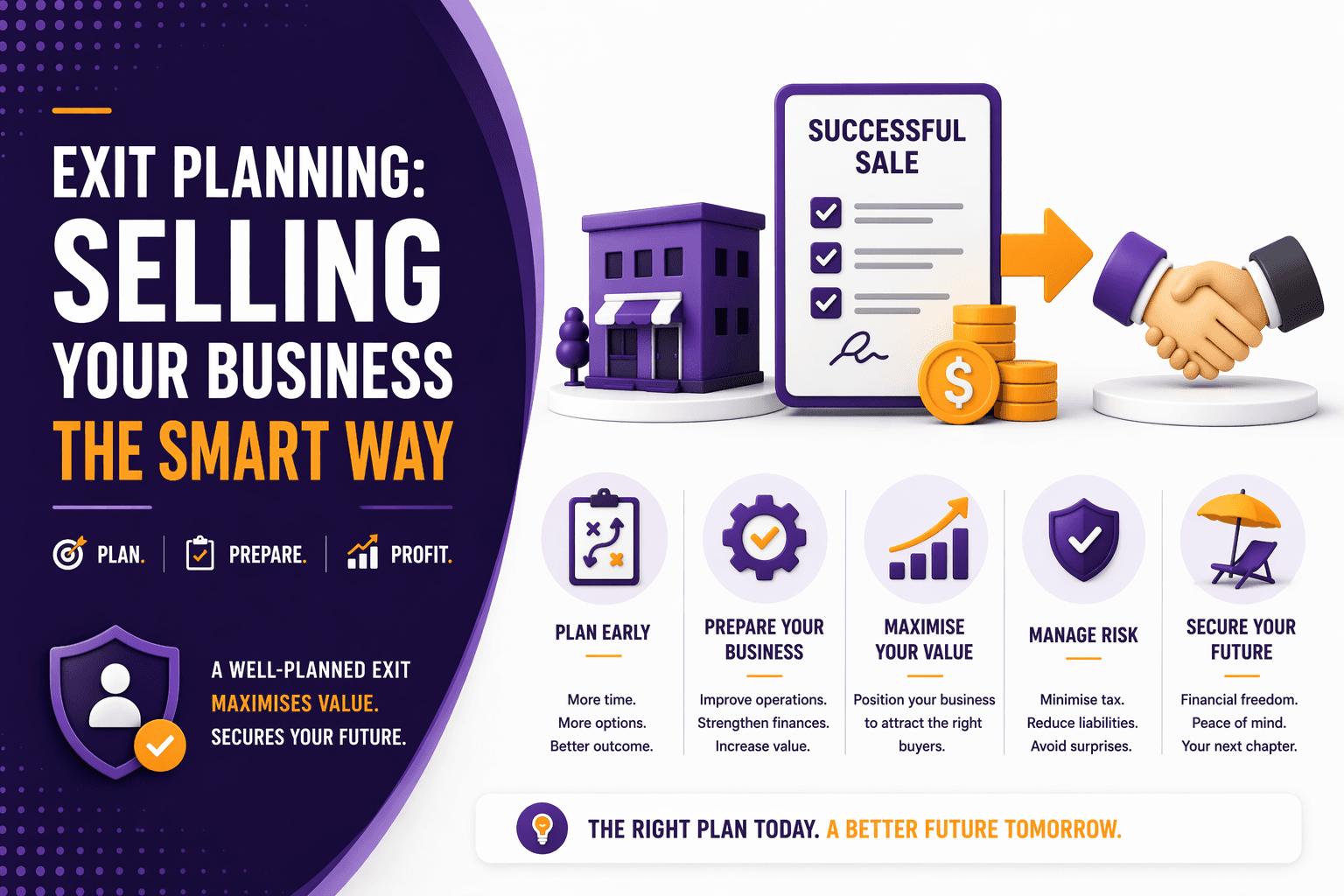
Exit Planning: Selling Your Business the Smart Way in Australia
Selling your business is one of the biggest financial events you’ll experience.
Do it right, and you can:
Maximise your sale price
Minimise tax
Transition smoothly
Do it poorly, and you risk:
Leaving money on the table
Paying unnecessary tax
Creating a stressful exit
Here’s how to approach it strategically.
What Does “Selling Smart” Actually Mean?
A smart exit isn’t just about:
Finding a buyer
Agreeing on a price
It’s about:
Structuring the sale to maximise what you keep after tax and costs
Because:
Sale price ≠ money in your pocket
Step 1: Know What Your Business Is Worth
Before selling, you need a realistic valuation.
Common valuation methods:
Earnings multiple (EBITDA-based)
Revenue multiple
Asset-based valuation
Factors that influence value:
Profitability
Growth potential
Systems and processes
Owner dependence
Quick Example
Business Type | Likely Multiple |
Service-based | 2x–4x profit |
Established scalable business | 4x–7x+ profit |
(Varies by industry and market conditions)
Step 2: Prepare Your Business for Sale
Most businesses are not sale-ready.
To improve value:
Clean up financial records
Reduce owner dependence
Document processes
Strengthen recurring revenue
Buyers pay more for certainty and stability.
Step 3: Choose the Right Sale Structure
This is where things get interesting.
1. Asset Sale
Buyer purchases business assets
You retain the entity
✔ Simpler for buyer
✖ May have higher tax impact
2. Share Sale
Buyer purchases company shares
✔ Potential tax advantages
✔ Cleaner exit
✖ More due diligence required
The structure affects:
Tax
Risk
Complexity
Step 4: Understand the Tax Impact
Selling a business typically triggers:
Capital Gains Tax (CGT)
But small business owners may qualify for concessions:
Key CGT Concessions
15-year exemption
50% active asset reduction
Retirement exemption
Rollover relief
These can significantly reduce, or even eliminate tax.
(Subject to current ATO rules and eligibility criteria.)
Step 5: Plan the Timing of Your Sale
Timing affects:
Market conditions
Business performance
Tax outcomes
Example:
Selling in a high-profit year → higher valuation
Selling after a downturn → reduced value
Also consider:
Personal tax position
Super contribution opportunities
Step 6: Negotiate Beyond Price
Price matters, but terms matter just as much.
Key terms:
Payment structure (upfront vs earn-out)
Transition period
Warranties and liabilities
A higher price with poor terms can:
Result in lower actual outcomes
Step 7: Plan Your Life After the Sale
Surprisingly overlooked.
After selling:
Where does the money go?
How is it invested?
What income do you need?
Without a plan:
Wealth can erode quickly
Example Scenario
Unplanned Exit
Sale price: $1.2M
High tax payable
Poor negotiation
Net outcome significantly reduced
Planned Exit
Same business
Structured sale
CGT concessions applied
Higher net proceeds + smoother transition
Same business. Different result.
Common Mistakes When Selling a Business
1. Waiting Until You Want to Exit
Preparation should start years earlier.
2. Overestimating Value
The market decides, not the owner.
3. Ignoring Tax Planning
This can cost hundreds of thousands.
4. Being Too Involved in Operations
Owner-dependent businesses sell for less.
5. Accepting the First Offer
Rarely the best outcome.
Strategic Insight: Buyers Buy Certainty, Not Potential
What you think:
“This business could grow massively”
What buyers think:
“Show me consistent, predictable results”
Value comes from:
Systems
Stability
Transferability
When Should You Get Advice?
You should seek advice if:
You plan to sell within 2–5 years
Your business is a major asset
You want to reduce tax and maximise value
You’re unsure about structure
Because:
Most of the value in a sale is created before the business is listed.
FAQs
1. How long does it take to sell a business?
Typically 3–12 months, depending on the business and market conditions.
2. What is my business worth?
It depends on profitability, industry, and risk factors. A professional valuation is recommended.
3. Do I pay tax when selling my business?
Yes, usually capital gains tax applies, but concessions may reduce it.
4. What is better: asset sale or share sale?
It depends on tax, risk, and buyer preference.
5. Can I reduce tax when selling my business?
Yes, through planning and CGT concessions (subject to eligibility).
6. Should I sell when business is performing well?
Generally yes. Strong performance supports higher valuation.
7. What is the biggest mistake when selling?
Not preparing early enough.
Thinking About Selling Your Business? Plan It Properly
The difference between a good exit and a great one comes down to preparation.
At What If Advice, we help business owners:
Maximise business value
Structure sales tax-effectively
Plan life after exit
Book a strategy session to ensure your exit works in your favour, not just the buyer’s.
Disclaimer
This information is general in nature and does not take into account your personal objectives, financial situation, or needs. You should consider whether it is appropriate for your circumstances and seek professional advice. Taxation laws, including CGT rules and concessions, are subject to change and ATO interpretation.