Looking for specific financial advice?
This blog provides general educational content. For personalized advice tailored to your unique situation, book a free consultation with our team of ASIC-licensed financial advisers.
What If the Business You Built for Your Kids Is the One Thing They Don’t Want?
You’ve spent 30 years building the business, partly so the kids would have something to step into. Then one becomes a nurse, one moves to London, and one tells you, kindly, that they’d rather not run a plumbing company. That’s not a failure. It’s a common turning point. But if your retirement depends on the business being worth something when you step back, the plan has to change, and the earlier the better. A business generating $400,000 a year in profit might be worth around $1.2 million to a buyer, or about $150,000 in equipment if you simply close the doors.
For the broader succession framework, see Succession Planning for Business Owners. For the mechanics of selling, including the CGT concessions, see Exit Planning: Selling Your Business the Smart Way.
TL;DR
Children declining the business is common, and it’s better to find out early than to plan around an assumption.
For many owners, the business is the retirement plan. The exit option you choose can change your retirement capital by hundreds of thousands of dollars.
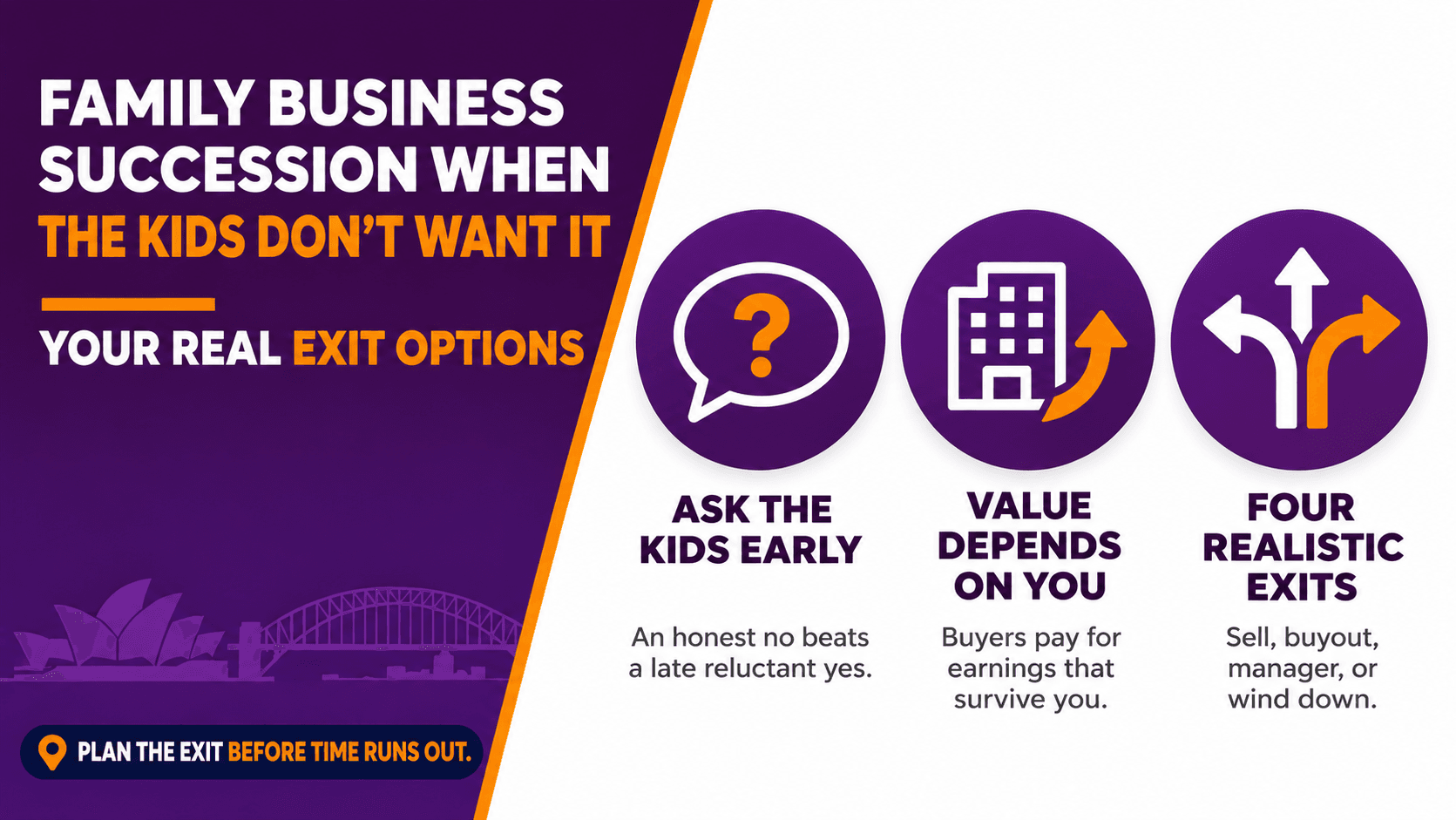
The business may be worth less without you. Buyers pay for earnings that survive the owner leaving.
Your realistic options are a third-party sale, a management or employee buyout, keeping ownership with a manager running it, or an orderly wind-down.
Small business CGT concessions may significantly reduce tax on a sale if you qualify, and some can help move sale proceeds into super. Eligibility is worth checking well before you sell.
If one child wants the business and the others don’t, fairness becomes an estate planning question, not just a business one.
Bottom line: when the kids say no, the goal shifts from handing the business on to turning it into the retirement and legacy you actually need.
On This Page
Start With the Honest Conversation
Your Retirement Probably Depends on This Decision
What the Business Is Actually Worth Without You
The Four Realistic Options
Option 1: Sell to a Third Party
Option 2: Management or Employee Buyout
Option 3: Keep Ownership, Hand Over Management
Option 4: Wind Down and Close
When One Child Wants It and the Others Don’t
Worked Example 1: Dave and Linda’s Plumbing Business
Worked Example 2: Elise, Her Siblings, and an Uneven Estate
Common Mistakes
FAQ
Start With the Honest Conversation
Many succession plans fail because the owner assumed rather than asked. Children may feel they can’t say no, or may say yes out of loyalty and leave years later. A direct, low-pressure conversation, ideally years before you plan to step back, gives everyone room to answer honestly.
Questions worth asking:
Do any of the children genuinely want to run the business, not just inherit it?
Would anyone want a smaller role, such as an owner who isn’t the manager?
What do they expect from your estate, and what do you want for them?
How much do you need from the business to retire?
If the answer is no, that’s useful information. It gives you time to build a business that’s sellable or that runs without you.
Bottom line: an honest no five years out is far more valuable than a reluctant yes six months before you retire.
Your Retirement Probably Depends on This Decision
Many business owners have put their money into the business instead of super. That can work well, but only if the business converts to cash or income when you leave.
Example owner | |
Target retirement income | $80,000 a year |
Combined super | $450,000 |
Business value if sold well | $1.2 million |
Business value if closed | $150,000 |
The difference between those last two lines can decide whether retirement is comfortable or tight. Our How Much Super Do I Need to Retire Comfortably in Australia? guide covers the retirement income side in more detail.
Is your business your retirement plan? A free 15-minute chat can help you see how different exit options affect your retirement income. Call 1800 942 843 or book online.
Bottom line: the succession decision is also a retirement decision, so plan them together.
What the Business Is Actually Worth Without You
Buyers generally value small businesses on maintainable earnings, meaning profit they can expect to continue after a market wage for the person doing the owner’s job. That’s multiplied by a figure that reflects risk.
A simplified example:
Profit before owner’s wages: $520,000
Less a market wage for a manager to replace the owner: $120,000
Maintainable earnings: $400,000
Multiple applied (illustrative, varies widely by industry and risk): 3×
Indicative value: $1.2 million
If customers, suppliers, or key knowledge depend on you personally, a buyer will either pay a lower multiple or insist you stay on for a handover period. Building a business that runs without you is the most reliable way to protect its value. That means documented systems, a second-in-command, and customer relationships spread across the team.
Bottom line: the more the business depends on you, the less it’s worth to anyone else.
The Four Realistic Options
Option | Typical value outcome | Speed | Your ongoing involvement | Main risk |
Sell to a third party | Usually highest | 6 to 24 months | Handover period | Finding the right buyer at the right price |
Management or employee buyout | Often lower than market | Can be gradual | Often vendor finance and mentoring | Buyer’s ability to pay, business performance after you leave |
Keep ownership, hand over management | Ongoing income instead of a lump sum | Gradual | Board-level oversight | Manager quality and business risk while you remain the owner |
Wind down and close | Usually lowest (assets only) | Months | Until closure | Losing goodwill value entirely |
Bottom line: each option trades value, speed, risk, and involvement differently, so choose based on your retirement needs as well as your preferences.
Option 1: Sell to a Third Party
Selling to an outside buyer, such as a competitor, investor, or individual, often achieves the highest price. It generally requires a business that can operate without you, clean financial records, and a realistic valuation.
Tax: small business CGT concessions may significantly reduce the tax on a sale, especially if you’re 55 or over and retiring, and have owned the business for 15 years or more. Eligibility involves specific tests, including a net asset value or turnover test, and the structure you sell through matters. Our Exit Planning guide covers these in more detail. Changes to CGT settings have also been announced but not yet legislated, so owners planning a sale should check whether those changes would affect their position. Thresholds and caps change, so verify eligibility with a registered tax agent well before you sell.
Bottom line: a third-party sale often maximises value, but only if the business is genuinely sellable without you.
Option 2: Management or Employee Buyout
If you have a capable senior employee or management team, they may want to buy the business. Benefits include continuity for staff and customers, and a buyer who already knows the business.
The challenge is usually funding. Employees rarely have the full purchase price, so these deals often involve:
Vendor finance, where you’re paid in instalments over several years.
Earn-outs, where part of the price depends on future performance.
Staged ownership transfers, where shares are sold gradually.
The risk is that you’re relying on the business continuing to perform after you leave. If it struggles, your instalments can be at risk. Money paid over several years is also worth less than the same amount today, so a buyout price isn’t directly comparable to a cash sale.
Got a key employee who might want to buy you out? A free 15-minute chat can help you think through the tax and structure. Email tax@whatifadvice.com.au.
Bottom line: a management buyout protects your legacy and your team, but you may be financing your own exit, and carrying the risk that comes with it.
Option 3: Keep Ownership, Hand Over Management
Some owners keep the business and appoint a general manager. The business becomes an investment that produces income in retirement. Later, it could pass to children as owners rather than operators, or be sold.
This can work well for a stable, profitable business with a strong manager. But you’re still exposed to business risk in retirement, your wealth stays concentrated in one asset, and a manager’s interests aren’t always the same as an owner’s. Retaining the right person often means offering incentives, which can include equity.
Bottom line: keeping ownership can provide income without a sale, but it keeps your retirement tied to a business you no longer control day to day.
Option 4: Wind Down and Close
If the business can’t be sold, or isn’t worth selling, an orderly wind-down may be the right choice. That can involve:
Completing current work and ceasing to take on new jobs.
Selling equipment, stock, and other assets.
Meeting obligations to staff, including notice and any redundancy entitlements. Small business employers with fewer than 15 employees are generally exempt from National Employment Standards redundancy pay, but notice and award or agreement entitlements can still apply.
Collecting debts and settling liabilities.
If the business is a company, dealing with retained profits and deregistering or winding up the company.
Retained profits in a company need careful planning on the way out, which our Retained Profits Strategy for Small Businesses guide covers. Closing isn’t a failure. For a business built around one person’s skills, it can be the most realistic outcome. But it usually means giving up goodwill value entirely, so it shouldn’t be the default because nothing else was planned.
Bottom line: closing can be the right answer, but it should be a decision, not what happens because time ran out.
When One Child Wants It and the Others Don’t
This is where succession and estate planning collide. If one child takes over the business, how do you treat the others fairly?
Common approaches:
Equalisation through other assets. The child taking the business receives it, and the others receive other assets of similar value.
Sale at fair value. The interested child buys the business, often with vendor finance, and the proceeds form part of the estate shared equally.
Recognising contribution. If a child has worked in the business for years at below-market pay, the family may decide “equal” isn’t the same as “fair”. That decision needs to be clear and documented.
Life insurance. Sometimes used to create cash for siblings who aren’t receiving the business.
How the business is held changes what your will can do. Shares in a company you own personally generally pass under your will. But assets held in a discretionary trust don’t. They’re controlled through the trust deed and whoever holds the appointor role, so the deed and succession of control need to line up with your plan. Super doesn’t automatically pass under your will either, so death benefit nominations also need to match.
Unclear arrangements are a common source of family disputes and can lead to claims against an estate. Our Family Provision Claims guide explains how that works. Estate documents, trust deed changes, and nominations should all be prepared with a lawyer.
Bottom line: if one child gets the business, the rest of the estate plan has to do the balancing, and it needs to be written down.
Worked Example 1: Dave and Linda’s Plumbing Business
Dave and Linda, both 63, own a plumbing business through a company that they’ve held for 30 years. Its maintainable earnings are $400,000 after a manager’s wage. They have $450,000 combined in super and want about $80,000 a year in retirement. None of their three children wants the business.
Third-party sale | Management buyout (key employee) | Wind down and close | |
Value | $1.2m (3× earnings) | $1.0m (discounted to make it affordable) | $150,000 (equipment and vehicles) |
Less costs (illustrative) | −$60,000 (5%) | −$25,000 (lower costs, no broker) | −$10,000, plus any staff notice and redundancy costs |
Net proceeds before tax and extraction | $1,140,000 | $975,000, paid over 5 years | $140,000 |
Plus super | $450,000 | $450,000 | $450,000 |
Total retirement capital | ≈ $1.59m | ≈ $1.43m (if every instalment is paid, and worth less in today’s dollars) | ≈ $590,000 |
The company changes where the money lands. In an asset sale, the company receives the proceeds, not Dave and Linda. Getting that money into their hands is a second step, through dividends, a liquidation, or concession-based payments, each with its own tax treatment. In a share sale, they sell their shares directly and receive the proceeds personally, though buyers often prefer to buy assets. The small business CGT concessions can apply to company sales, but the tests work differently when the company is the seller. Our Retained Profits Strategy for Small Businesses guide covers the extraction side. The table above shows proceeds before tax and before extraction.
The retirement lever. At 63, retiring, with a business held for 30 years, Dave and Linda may qualify for the 15-year exemption, which can disregard the capital gain entirely. Where a company qualifies, it can generally pass the exempt amount to them without further tax, within set time limits. They may then be able to contribute qualifying sale proceeds to super under a separate CGT cap, which doesn’t count against their usual non-concessional caps. That’s how the sale can directly lift their $450,000 super balance and their retirement income. Eligibility depends on detailed tests and the current cap, so verify both with a registered tax agent and see our Exit Planning guide.
Outcome: the third-party sale gives the most capital, but requires a business that runs without Dave and a buyer willing to pay. The buyout keeps their staff and customers looked after, but $975,000 arrives over five years, is worth less than that in today’s dollars, and depends on the business continuing to perform. Winding down leaves them with about a third of the capital. At around $590,000 in assessable assets, they would likely qualify for a part Age Pension from 67, subject to the assets and income tests, which softens the gap but doesn’t close it. These figures are simplified and illustrative. Actual values, tax outcomes, and pension entitlements depend on the business, your eligibility, and current thresholds.
Bottom line: for Dave and Linda, the choice of exit was worth about $1 million in retirement capital, which is why it deserved years of planning, not months.
Worked Example 2: Elise, Her Siblings, and an Uneven Estate
Rob and Sue have three adult children. Elise has worked in the family landscaping business for 12 years and wants to take it over. Her brother and sister don’t. The parents’ assets:
Asset | Value |
Landscaping business | $900,000 |
Family home | $1,100,000 |
Investment portfolio | $600,000 |
Total | $2,600,000 |
An equal split would be about $866,667 each.
Option A: equalise through the estate. Elise receives the business (900,000),andhersiblingssharethehomeandinvestments(1.7 million, or $850,000 each). That looks close to equal, but it may not be equal after tax. The family home can often pass to beneficiaries largely free of CGT, while the business and the investment portfolio may carry embedded capital gains that whoever inherits them will eventually pay. Option A also depends on the business still being worth $900,000 when the parents die, and it leaves the home and investments to be divided between two siblings.
Option B: Elise buys the business now. Elise buys the business at $900,000, paid over 8 years by vendor finance (about $112,500 a year before interest). Rob and Sue receive income in retirement, and the $900,000 forms part of an estate shared equally.
Outcome: both approaches can work. Option B is cleaner and funds Rob and Sue’s retirement, but it puts pressure on Elise’s cash flow. Option A is simpler today but relies on future values and hides uneven tax outcomes. The family also discussed whether Elise’s 12 years of below-market wages should be recognised, and documented their decision to reduce the risk of a later dispute. These figures are simplified and illustrative. Legal and tax advice is needed to implement either option.
Bottom line: the fairest outcome isn’t always an equal one, but it always needs to be an agreed and documented one.
Planning how the business fits into your estate? A free 15-minute chat can help you think through the financial side before you see your lawyer. Email clientservices@whatifadvice.com.au or book online.
Common Mistakes
Assuming the kids will take over without asking them. The plan collapses late, when there’s no time to build alternatives.
Letting the business depend entirely on you. It reduces the sale price, or makes the business unsellable.
Treating the business as your retirement plan without testing its value. Many owners overestimate what a buyer will pay.
Leaving tax planning until a buyer appears. CGT concession eligibility often depends on decisions made years earlier.
Forgetting the company layer. If a company sells the business, the money still has to get from the company to you.
Relying on vendor finance without protection. If the buyer’s business struggles, so do your instalments.
Promising the business to one child without balancing the estate. It’s a common trigger for family disputes.
Assuming your will controls everything. Trust assets and super generally follow their own rules.
Winding down by default rather than by decision. Closing may be the right answer, but it should be chosen, not forced by time.
Not sure which exit route fits your business and your retirement? Call 1800 942 843 for a free 15-minute chat.
FAQ
What happens to a family business if the children don’t want it?
The main options are selling to a third party, a management or employee buyout, keeping ownership with a manager running it, or an orderly wind-down.
How do I find out if my children want the business?
Ask directly and early, ideally years before you plan to step back, and make it clear that no is an acceptable answer.
How much is my business worth if I leave?
Buyers generally value small businesses on maintainable earnings after a market wage for the owner’s role, multiplied by a risk-based figure. The more the business depends on you, the lower the value tends to be.
Can my employees buy my business?
Yes, often through vendor finance, earn-outs, or staged share transfers. The main risk is that your payments depend on the business performing after you leave.
Do I pay tax when I sell my business?
Capital gains tax may apply, but small business CGT concessions can significantly reduce or eliminate it if you qualify. If your business is in a company, getting the proceeds out of the company is a separate step with its own tax treatment. Get advice well before you sell.
Can I put the proceeds of my business sale into super?
Possibly. Proceeds that qualify under certain small business CGT concessions can often be contributed under a separate CGT cap, without counting against your usual non-concessional caps. Eligibility and cap amounts need checking with a registered tax agent.
Is it better to sell or close my business?
Selling usually returns more because goodwill has value. Closing may be right if the business can’t operate without you or a buyer can’t be found.
How do I treat my children fairly if only one takes over the business?
Common approaches include equalising through other assets, having the child buy the business at fair value, or recognising their contribution. Whatever you decide, document it clearly with a lawyer.
Does my will cover my business and super?
Not always. Shares you own personally generally pass under your will, but assets in a discretionary trust are controlled by the trust deed and appointor, and super is paid according to your fund’s rules and any death benefit nomination. All of these need to match your estate plan.
When should I start succession planning?
Ideally five to ten years before you plan to retire. That gives you time to build value, explore options, and qualify for tax concessions.
Ready to Plan an Exit That Works Even Without a Family Successor?
When the kids don’t want the business, your options don’t disappear, but they take time to set up properly. A free 15-minute chat can help you understand what your business could fund, and what to start working on now.
Call us: 1800 942 843
Email: clientservices@whatifadvice.com.au (retirement and estate planning) or tax@whatifadvice.com.au (business sale and tax)
Book online: free 15-minute chat, no cost, no pressure
Still asking what if?
WIAA helps family business owners plan succession, retirement, and the tax on exit across Toowong, Grange, and Melbourne CBD. WIAA operates under AFSL 528250 as an Authorised Representative of Beryllium Advisers Pty Ltd and is a registered tax agent practice with the Tax Practitioners Board.
General Advice Disclaimer: This article contains general information only and does not take into account your personal objectives, financial situation, or needs. It is not personal financial, tax, or legal advice and should not be relied upon as such. Business valuations, small business CGT concession eligibility and thresholds, super contribution caps, Age Pension thresholds, employment entitlements, and tax rates can change and depend on individual circumstances. Any reference to changes to CGT settings reflects measures that are announced but not yet legislated. Verify current rules with the ATO, Services Australia, or a registered tax agent. Estate planning documents should be prepared by a qualified lawyer. Worked examples are illustrative and simplified. Seek professional advice for your own circumstances.