Looking for specific financial advice?
This blog provides general educational content. For personalized advice tailored to your unique situation, book a free consultation with our team of ASIC-licensed financial advisers.
What If the Will You Carefully Drafted Gets Challenged the Moment You're Gone?
A Will represents someone's final say over their own assets, but in Australia, that final say isn't always absolute. Family provision laws allow certain eligible people who feel they haven't been adequately provided for to challenge a Will through the courts, regardless of what the Will itself says. This surprises a lot of people, who assume a validly signed Will is the end of the conversation. For anyone drafting a Will, understanding family provision claims matters just as much as getting the document itself right, because a technically valid Will can still end up contested, delayed, and expensively litigated if it doesn't account for this possibility. For the basics of Wills, intestacy, and Enduring Power of Attorney more broadly, our dedicated guide on that topic covers the ground this piece builds on.
TL;DR
A family provision claim allows certain eligible people to ask a court to award them a share (or a larger share) of a deceased person's estate, even if the Will specifically excluded them or gave them less than they expected.
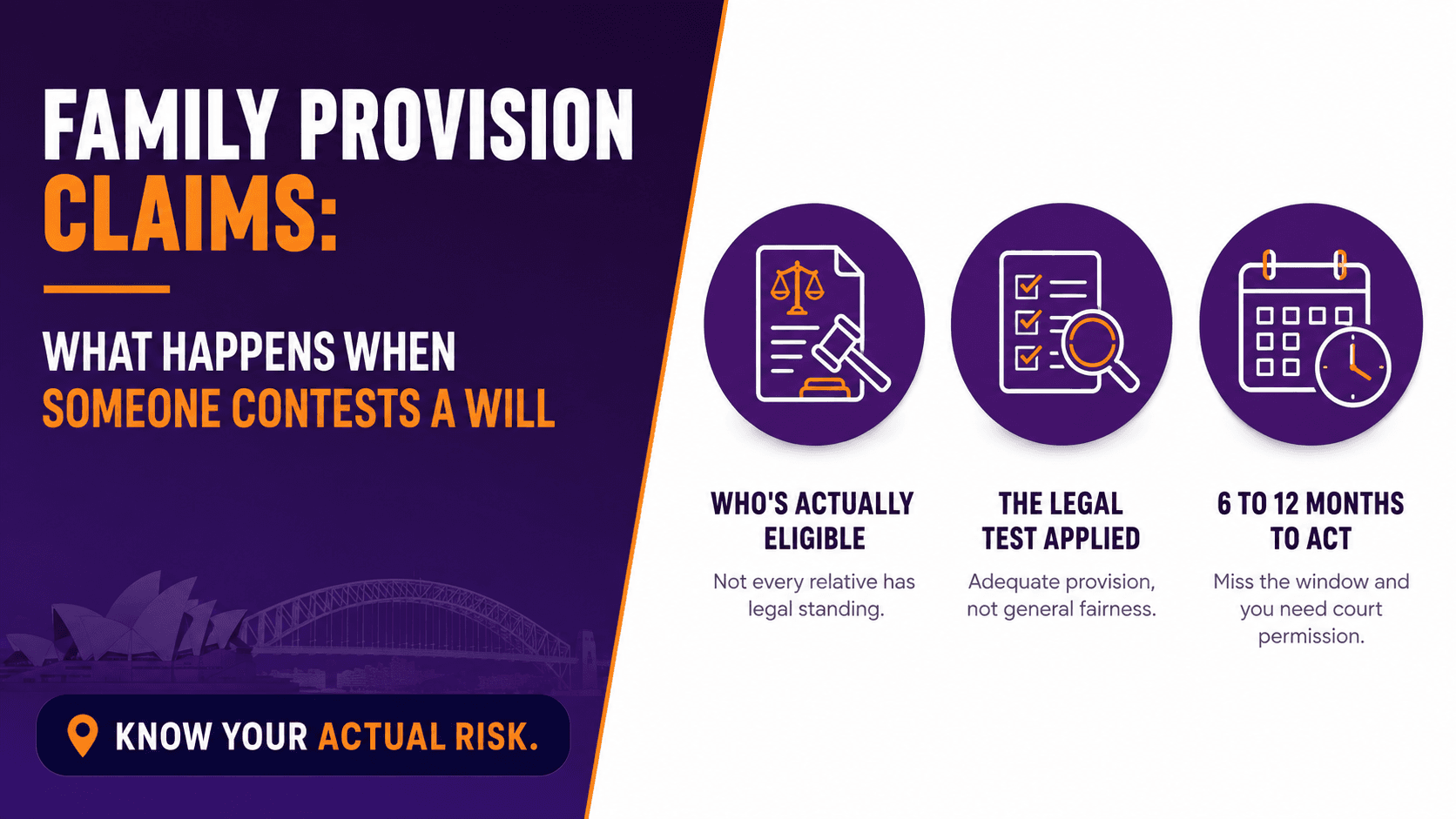
Eligibility is limited to specific categories of people, generally spouses, de facto partners, children, and in some cases other dependents, and varies somewhat between states.
Claims must generally be lodged within a strict time limit after death (commonly around 6 to 12 months depending on the state), and missing this window can mean losing the right to claim without court permission to proceed late.
The court doesn't simply ask "was this fair." It applies a legal test around whether adequate provision was made for the claimant's proper maintenance and support, considering their needs, relationship with the deceased, and competing claims.
Blended families and estranged relationships are common sources of family provision disputes, since intentionally excluding a child or partner from a Will doesn't automatically prevent them from making a claim.
Contesting (or defending) a Will can be genuinely expensive and slow, often eating into the estate's value regardless of the outcome, which is a real cost worth understanding on both sides.
Good estate planning can reduce the risk of a successful claim, though it can't eliminate the ability of an eligible person to bring one in the first place.
Bottom line: a valid Will isn't automatically the final word. Family provision laws exist specifically to allow eligible people to challenge it, and understanding this is important both for anyone drafting a Will and anyone who might have grounds to contest one.
On This Page
What a Family Provision Claim Actually Is
Who's Actually Eligible to Make a Claim
The Legal Test: What Courts Actually Consider
Time Limits You Can't Afford to Miss
Why Blended Families Face Higher Dispute Risk
The Real Cost of Contesting (or Defending) a Will
Worked Example: A Contested Estate
Common Mistakes
FAQ
What a Family Provision Claim Actually Is
A family provision claim is a legal application to the court, made by an eligible person, arguing that a deceased person's Will (or the outcome of intestacy, if there's no Will) hasn't made adequate provision for their proper maintenance, education, or advancement in life. Importantly, this isn't a challenge to whether the Will was validly executed (that's a separate legal question, and a solicitor is the right person to assess it). It's a challenge to whether the outcome of the Will is adequate for a specific eligible person, regardless of whether the document itself was properly signed and witnessed.
This means a Will can be entirely valid, properly drafted, signed, witnessed, and still be successfully challenged if a court decides an eligible person hasn't been adequately provided for.
Concerned about how your Will might hold up if someone eligible feels excluded or shortchanged? A free 15-minute chat can help you understand the risk before we point you toward a solicitor for the legal specifics. Call 1800 942 843.
Bottom line: "the Will was valid" and "the Will can't be successfully challenged" are two genuinely different things. Family provision claims specifically target the second question, independent of the first.
Who's Actually Eligible to Make a Claim
Eligibility for a family provision claim is limited to specific categories of people, and this varies somewhat by state, but generally includes a spouse or de facto partner of the deceased, children (including, in some circumstances, adult children), and in certain states, other dependents such as a former spouse, a grandchild who was dependent on the deceased, or someone who was a member of the deceased's household and dependent on them. Simply being a relative, or having had a relationship with the deceased, doesn't automatically confer eligibility. The specific category and circumstances matter, and a solicitor is best placed to confirm whether someone genuinely qualifies.
Bottom line: not everyone who feels aggrieved by a Will has legal standing to challenge it. Eligibility is defined by specific categories of relationship and dependency, and confirming whether someone actually qualifies is the first real question in any potential claim, one for a solicitor to answer definitively.
The Legal Test: What Courts Actually Consider
Courts don't ask whether a Will's distribution seems generally "fair" in an abstract sense. They apply a specific legal test around whether adequate provision has been made for the claimant's proper maintenance, education, or advancement in life. Factors considered typically include the claimant's financial position and needs, their relationship with the deceased (including its nature and length), any contributions they made to the deceased's estate or wellbeing, competing claims from other beneficiaries, and the size of the estate itself.
Weighing up whether a specific family situation might create genuine family provision risk for a Will you're planning? Email clientservices@whatifadvice.com.au and we'll help you think it through alongside your solicitor.
Bottom line: the legal test isn't about matching everyone's expectations or subjective sense of fairness. It's a specific, multi-factor assessment of genuine need and relationship, which is exactly why outcomes can be difficult to predict with certainty in advance, and why this is genuinely solicitor territory rather than something to guess at.
Time Limits You Can't Afford to Miss
Family provision claims must generally be lodged within a strict time limit after the date of death, commonly somewhere in the range of 6 to 12 months depending on the state, though the exact period and how it's calculated varies. Missing this window doesn't necessarily end all hope of a claim, but it generally means needing to seek the court's permission to proceed out of time, which isn't guaranteed and adds genuine complexity and cost to an already difficult process.
Think you or someone you know might be approaching this deadline without having addressed it? Book a free 15-minute chat online, and we'll help you understand the urgency before pointing you to a solicitor who can act on it.
Bottom line: unlike some legal rights that can be pursued whenever someone gets around to it, family provision claims operate on a genuinely tight clock. Waiting too long to act, even out of grief or reluctance to cause family conflict, can close off the option entirely.
Why Blended Families Face Higher Dispute Risk
Blended families are a particularly common source of family provision disputes, because a Will that favours a current spouse over children from a previous relationship (or vice versa) can create exactly the kind of situation where an excluded or under-provided-for eligible person has genuine grounds to claim. Simply deciding to leave a child or former partner out of a Will doesn't prevent them from being eligible to challenge that decision. Intention alone doesn't override the legal test the court applies.
This section covers the litigation risk specifically, what can happen after death if a blended family arrangement is challenged. The separate question of how to actually structure a Will for a blended family upfront, life interests, trust structures, and balancing a second spouse's and first-marriage children's interests, is a distinct estate-planning topic in its own right, which we cover elsewhere.
Bottom line: if your family situation involves a blended family, estrangement, or a deliberate decision to exclude someone who might otherwise be eligible, this is exactly the kind of scenario where proper estate planning advice matters most. Good intentions in the Will's drafting don't automatically prevent a successful challenge.
The Real Cost of Contesting (or Defending) a Will
Family provision litigation can be genuinely expensive and slow, and importantly, legal costs are often paid out of the estate itself, meaning a contested Will can meaningfully reduce what's actually left to distribute, regardless of who ultimately succeeds. This is a real cost worth understanding on both sides: for a potential claimant weighing up whether to pursue a claim, and for an estate's executor and beneficiaries who may need to defend one.
Bottom line: a contested estate isn't just emotionally difficult. It's often financially costly for everyone involved, since legal fees frequently come straight out of the estate's value before anyone actually receives their share.
Worked Example: A Contested Estate
The Delacroix estate: A father passes away, leaving his estate primarily to his second wife, with a comparatively modest provision for his adult daughter from his first marriage, reflecting years of limited contact between them. The daughter, who has genuine ongoing financial need and can demonstrate her father provided meaningful support during her younger years despite the later estrangement, brings a family provision claim within the required time limit. After mediation (a common step before matters proceed to a full court hearing), the estate reaches a settlement providing the daughter with a larger share than the original Will allocated, with legal costs from the dispute paid out of the estate, reducing what both the wife and daughter ultimately received compared to a scenario where no dispute had arisen.
Bottom line: nobody in this scenario "won" in a straightforward sense. The daughter received more than the Will originally provided, but both she and the wife received less than they otherwise might have, once legal costs are accounted for, which is a genuinely common outcome in contested estates.
Common Mistakes
Assuming a validly signed Will can't be successfully challenged. Validity and adequacy are different legal questions. A valid Will can still be contested on family provision grounds.
Excluding an eligible person from a Will without addressing the family provision risk. Intention alone doesn't prevent a claim. Proper solicitor advice on how to structure the Will can help manage (though not eliminate) this risk.
Waiting too long to consider a potential claim. The strict time limit means delaying out of grief, uncertainty, or reluctance to cause conflict can close off the option entirely.
Assuming any disgruntled relative can challenge a Will. Eligibility is limited to specific categories of people, and confirming genuine eligibility with a solicitor is an important first step.
Not accounting for potential family provision risk during estate planning. A Will drafted without considering likely claimants can end up costing the estate considerably more in eventual litigation than proper upfront planning would have.
Treating mediation or settlement as a loss. Many family provision matters resolve without a full court hearing, and a negotiated outcome can be a reasonable, cost-effective resolution rather than a failure.
FAQ
Can any family member contest a Will? No. Eligibility is limited to specific categories, generally including spouses, de facto partners, children, and in some cases other dependents, varying by state. Not every relative or acquaintance has standing to bring a claim.
Can I completely disinherit my child to avoid a family provision claim? You can choose to exclude a child from your Will, but this doesn't prevent them from being eligible to bring a family provision claim if they meet the relevant criteria. Proper solicitor advice on structuring the Will and documenting your reasoning can help manage this risk, though it can't eliminate the possibility entirely.
How long do I have to contest a Will? This varies by state, generally somewhere in the range of 6 to 12 months from the date of death, and missing this window generally requires seeking the court's permission to proceed out of time, which isn't guaranteed.
Does contesting a Will mean going to court? Not necessarily. Many family provision matters are resolved through negotiation or mediation before reaching a full court hearing, which can be faster and less costly than full litigation.
Who pays the legal costs of a family provision dispute? Legal costs are often paid out of the estate itself, meaning a contested Will can reduce the value ultimately available to distribute, regardless of the specific outcome.
Can a former spouse make a family provision claim? In some states, yes, depending on the specific circumstances and whether they meet the relevant eligibility criteria for that jurisdiction.
Does having a valid, properly witnessed Will prevent it from being contested? No. A Will's validity and whether it makes adequate provision for an eligible person are separate legal questions, and a technically valid Will can still be successfully challenged on family provision grounds.
What happens if there's no Will at all, can intestacy outcomes be contested too? Yes. Family provision claims can also apply to the outcome of intestacy, not just a written Will, if an eligible person believes the intestacy distribution doesn't adequately provide for them.
Does the size of the estate affect whether a family provision claim succeeds? Yes, it's one of several factors a court considers. The size of the estate relative to the claimant's needs and other beneficiaries' claims all factor into the overall assessment.
Can proper estate planning reduce the risk of a successful family provision claim? Yes, to a meaningful degree. Clear documentation of reasoning, appropriate structuring, and professional solicitor advice can help reduce risk, though it can't completely eliminate an eligible person's ability to bring a claim in the first place.
Ready to Understand Your Own Position?
Ready to understand whether your own estate plan carries genuine family provision risk, or whether you might have grounds to contest a Will yourself? This is exactly the kind of situation where proper legal and financial advice, sought early, makes a real difference to the outcome.
Call us: 1800 942 843
Book online: free 15-minute chat, no cost, no pressure
Still asking what if your Will says exactly what you want it to? Saying it clearly is only half the job. Making sure it can actually hold up matters just as much.
WIAA has advised 1,000+ clients across our Toowong, Grange, and Melbourne CBD offices, operating under AFSL 528250 as an Authorised Representative of Beryllium Advisers Pty Ltd.
General Advice Disclaimer: This article contains general information only and does not take into account your personal objectives, financial situation, or needs. It does not constitute legal advice, and should not be relied upon as such. Family provision laws, eligibility criteria, and time limits vary by state and are subject to change. You should seek advice from a qualified solicitor regarding your specific circumstances.