Looking for specific financial advice?
This blog provides general educational content. For personalized advice tailored to your unique situation, book a free consultation with our team of ASIC-licensed financial advisers.
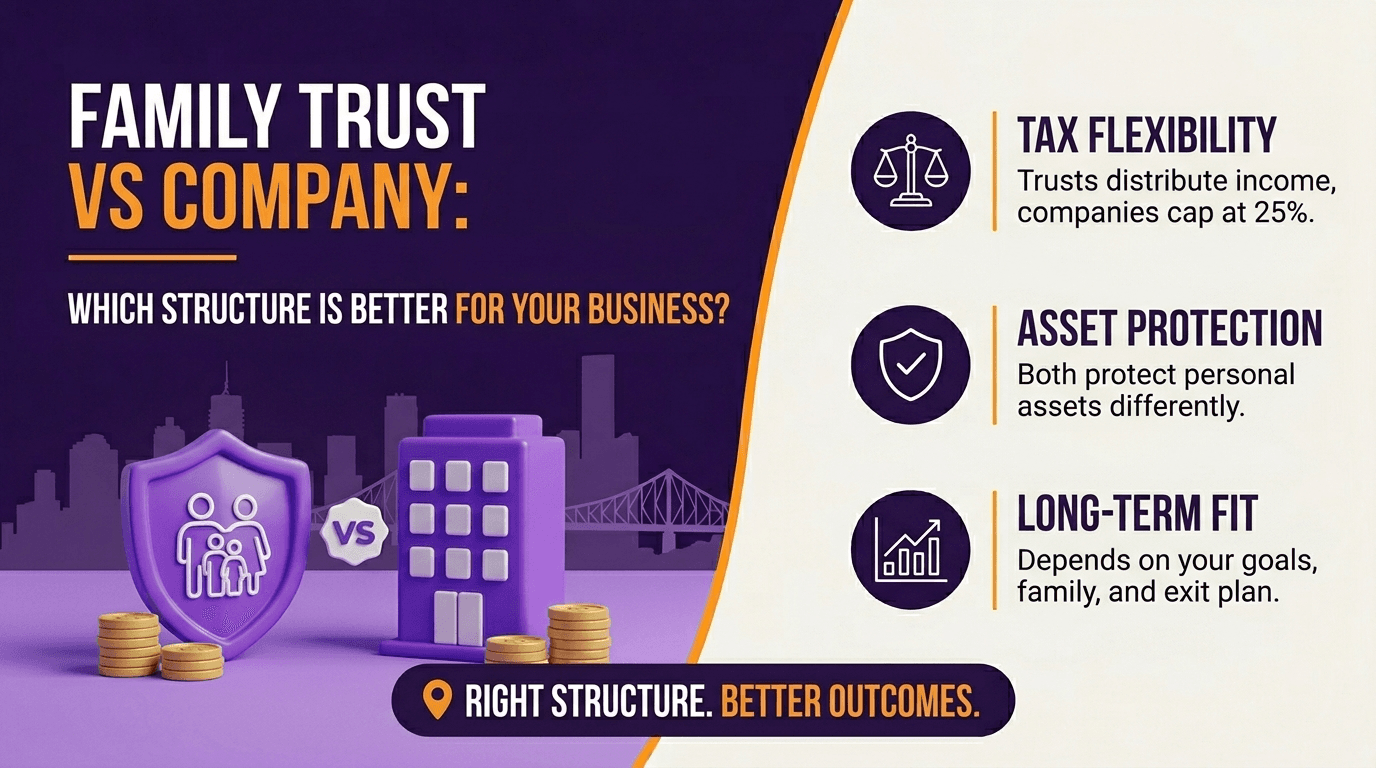
Family Trust vs Company: Which Structure Is Better for Your Business?
What if the structure you set up five years ago is now quietly costing you more than it saves, and the 2026 Budget has just changed the calculation again? For most of the past two decades, the family trust vs company comparison had a relatively settled answer for many Australian business owners. Trusts offered flexible income splitting and the 50% CGT discount. Companies offered lower flat tax rates and clean profit retention. That stability has ended. WIAA's registered tax agents have been reviewing client structures in light of the Budget announcements since Budget night. This guide covers the current law comparison, the announced changes, and what business owners should and should not be doing right now.
TL;DR: The Core Comparison in 2026
Family trusts offer flexible income splitting, the 50% CGT discount (currently), and asset protection through trustee ownership
Companies offer a flat 25% tax rate for base rate entities, clean profit retention, and simpler access to debt and equity
The 2026-27 Budget has announced a 30% minimum tax on discretionary trust distributions from 1 July 2028 and replacement of the 50% CGT discount with indexation from 1 July 2027
Both measures are announced but not yet legislated and should not drive irreversible structural decisions alone
A three-year CGT rollover relief window from 1 July 2027 will allow restructuring from trusts to companies without immediate CGT or stamp duty implications for eligible businesses
Seeking professional advice now, before the legislation passes, is the right move. Making irreversible structural changes based on announced measures alone is not.
Bottom line: The family trust vs company decision has become more complex in 2026 than at any point in recent history. Both structures remain viable and each retains meaningful advantages. The right choice depends on your specific income profile, growth plans, and willingness to restructure before 2028 if required.
Jump to a Section
How Each Structure Works
The Current Tax Comparison
Asset Protection Comparison
The 2026 Budget Changes That Are Reshaping the Decision
How Each Structure Looks After the Reforms
What Should You Actually Do Right Now?
Two Australian Business Examples
Common Mistakes Business Owners Make
FAQ
Ready to Review Your Business Structure?
How Each Structure Works
Before comparing the two, it is worth being clear about what each structure actually is.
Family Trust (Discretionary Trust)
A family trust is a legal arrangement where a trustee holds assets for the benefit of nominated beneficiaries. The trustee has discretion over how income is distributed each year, allowing income to flow to whichever beneficiaries are in the lowest tax positions.
The structure sounds complicated but the operating logic is straightforward. In practice, most family trusts work like this:
The trust itself does not pay income tax (unless income is undistributed, in which case the trustee pays the top marginal rate of 47%)
Beneficiaries pay tax on their distributed share at their own marginal rates
Assets are held in the name of the trustee, not the individual, providing a degree of asset protection
The trust deed governs the rules and beneficiaries of the structure
Company (Proprietary Limited)
A company is a separate legal entity that pays its own tax on taxable income. Profits can be retained inside the company at the corporate rate, or distributed to shareholders as dividends.
A company operates as its own legal entity with its own tax file number and ATO obligations. In practice:
Flat 25% tax rate for base rate entities (companies with aggregated annual turnover under $50 million that derive no more than 80% of income from passive sources)
Flat 30% tax rate for larger or passive-income companies
Dividends are paid to shareholders with franking credits attached, reducing double taxation
The company is a separate legal entity, providing strong asset protection for shareholders
Division 7A applies to loans or benefits from the company to shareholders or associates, creating compliance obligations
Bottom line: Both structures are legally sound and widely used across Australia. The choice is primarily a tax and operational decision, not a legal one.
The Current Tax Comparison
Before accounting for the announced Budget changes, the tax comparison in 2025-26 looks like this.
Income Tax
Scenario | Trust Outcome | Company Outcome |
Profits distributed to 30% bracket beneficiary | Beneficiary pays 30% | Dividend paid with franking; 25% tax in company, shareholder pays net difference |
Profits distributed to low-income spouse (16% rate) | Spouse pays 16% tax | Dividend to shareholder; 25% already paid, credit flows through |
Profits retained (not distributed) | Trustee pays 47% | Company retains at 25% |
High-income owner needs the income personally | Owner pays marginal rate (up to 47%) | Dividend received, with franking credit offsetting some personal tax |
The trust wins decisively where there are lower-income family beneficiaries to receive distributions. The company wins decisively where profits need to be retained inside the structure for reinvestment, since 25% is far preferable to the 47% the trust pays on undistributed income.
Capital Gains Tax
This has historically been one of the clearest wins for trusts over companies. The access to the 50% CGT discount for assets held over 12 months is a material advantage that companies do not share.
Family trust (distributing to individual beneficiaries): Access to the 50% CGT discount on assets held over 12 months, meaning only half the gain is taxed at the beneficiary's marginal rate
Company: No access to the 50% CGT discount. Capital gains are taxed at the full company rate of 25% to 30%
For an asset with a $500,000 capital gain held for over 12 months:
Trust distributing to a 30% marginal rate beneficiary: Taxable gain of $250,000 (after 50% discount), tax of approximately $75,000
Company: Taxable gain of $500,000 at 25%, tax of $125,000
The trust saves approximately $50,000 on this single transaction. Across a business lifetime with multiple asset sales, this advantage compounds significantly.
Bottom line: Under current law, trusts win on CGT and income distribution flexibility. Companies win on profit retention and operational simplicity.
What if the structure you're in now was right five years ago but isn't anymore? Tax positions, income profiles, and family circumstances all change. The structure review is the thing most business owners keep meaning to schedule.
Not sure whether your current structure is costing you money? WIAA's registered tax agents can model your specific income profile against both options. Single-issue business structure review typically starts at $1,500. Book a free 15-min scoping chat or email tax@whatifadvice.com.au.
Asset Protection Comparison
Both structures provide meaningful asset protection, but in different ways.
Feature | Family Trust | Company |
Ownership of assets | Trustee holds assets, not the individual | Company holds assets; shareholders own shares |
Personal liability | Beneficiaries have no direct liability for trust debts | Shareholders have limited liability for company debts |
Trustee liability | Corporate trustee (common structure) limits trustee liability | Directors have duties and potential liability |
Creditor access | Trust assets generally protected from beneficiary's creditors | Company assets protected from shareholder's personal creditors |
Best practice | Use a corporate trustee company | Keep personal and business assets separated |
Most well-structured family trusts use a corporate trustee rather than an individual trustee. This further separates the assets from the individuals and reduces personal liability exposure.
Bottom line: Both structures provide meaningful asset protection when set up correctly. A corporate trustee structure for the family trust comes closest to the company's asset protection profile.
The 2026 Budget Changes That Are Reshaping the Decision
The 2026-27 Federal Budget announced three significant changes to the trust and CGT landscape. All three are announced but not yet legislated. Structural decisions should not be made based solely on announced measures.
1. Replacement of the 50% CGT Discount (from 1 July 2027)
The government has announced that from 1 July 2027, the 50% CGT discount for individuals, trusts, and partnerships will be replaced by cost base indexation for assets held over 12 months (adjusting the cost base for inflation) and a 30% minimum tax on net capital gains after indexation.
The government has provided the following specifics. All are subject to change before legislation passes:
Applies only to gains arising after 1 July 2027 (transitional provisions protect pre-2027 gains)
Applies to all CGT assets including shares, ETFs, and investment property
Superannuation funds are not affected (they retain the one-third discount)
Small business CGT concessions are explicitly retained unchanged
New residential builds are exempt, with investors able to choose the current discount or new rules
The practical impact on the trust vs company comparison: the CGT advantage of trusts narrows significantly once the discount is gone. With a 30% minimum tax applying regardless of the beneficiary's marginal rate, and cost base indexation replacing the flat discount, the trust's historical CGT advantage diminishes substantially.
2. Minimum 30% Tax on Discretionary Trust Distributions (from 1 July 2028)
The government has announced a 30% minimum tax on distributions from discretionary trusts commencing 1 July 2028.
The announced mechanics are as follows. These are subject to consultation and legislative change:
Applies to distributions to beneficiaries where the effective tax rate is below 30%
Specifically targets income-splitting strategies that distribute to low-tax beneficiaries
Bucket companies receiving trust distributions will be denied any credit for the 30% trust tax paid (a significant change)
Not yet legislated and subject to consultation
WIAA's registered tax agents will update clients as the legislation progresses through Parliament. Do not restructure on the basis of this announcement alone.
The practical impact: the income-splitting advantage of trusts is materially reduced. Distributing to a low-income spouse at 16% to 19% will no longer save tax if a 30% minimum applies. The trust retains some advantages (particularly for beneficiaries already in the 30%+ bracket) but the flexibility that made trusts so attractive is constrained.
3. Three-Year CGT Rollover Relief Window (from 1 July 2027)
To assist business owners who need to restructure, the government has announced a CGT and stamp duty rollover relief window from 1 July 2027 to 30 June 2030. This allows eligible businesses to transfer assets from a discretionary trust into a company or fixed trust without triggering immediate CGT or stamp duty.
The rollover relief window, if legislated as announced, represents the right moment for most trust-to-company restructuring. Acting before that window opens may be premature.
Bottom line: The announced changes fundamentally alter the trust vs company comparison, particularly for income-splitting and CGT planning. None of these measures is yet law. Seek specific professional advice before making any structural decisions.
Budget measures like these are exactly when existing structures need a review. WIAA's team has been reviewing client structures since Budget night. If you haven't had a structure conversation with your accountant or adviser since the Budget, it's overdue. Book a 15-min chat or email tax@whatifadvice.com.au.
How Each Structure Looks After the Reforms
Consideration | Trust (Current Law) | Trust (Post-2028 Announced) | Company (2026) |
Income splitting | Flexible, full benefit | Constrained by 30% minimum tax | Fixed dividend with franking |
CGT on asset sale | 50% discount (individuals) | Indexation + 30% minimum tax | 25% to 30% flat (no change) |
Profit retention | 47% if undistributed | 47% if undistributed | 25% flat (no change) |
Asset protection | Strong with corporate trustee | No change | Strong |
Debt financing access | Moderate | No change | Strong |
Employee equity | Difficult | No change | Straightforward |
Business sale | Complex | Rollover relief from 2027 | Share sale preferred |
The company's advantages become more competitive under the announced reforms, particularly for businesses that retain profits, have high-income owners, or plan eventual sale. The trust retains advantages for those already in the 30%+ bracket, those with significant existing asset bases benefiting from transitional rules, and those in the three-year rollover window.
Bottom line: The announced reforms narrow the trust's advantages but do not eliminate them. Under the new regime, the right answer depends more than ever on the specific circumstances of each business.
What Should You Actually Do Right Now?
The Budget changes section explains what has been announced. This section tells you what to do with that information based on your situation.
Scenario A: You're in a family trust and considering whether to restructure now.
Don't restructure yet. The three-year CGT rollover relief window opens 1 July 2027, allowing restructuring without immediate CGT or stamp duty consequences for eligible businesses. Restructuring before that window opens may trigger avoidable costs. Monitor the legislation and seek advice again in early 2027 when the picture is clearer.
Scenario B: You're setting up a new structure from scratch in 2026.
Consider a company as the primary operating structure unless you have clear reasons to prefer a trust (significant lower-income family beneficiaries, existing asset base in a trust context). Get specific modelling of your income profile against both options before deciding. The announced changes make the company a stronger default position for most new structures than it was three years ago.
Scenario C: You have significant unrealised capital gains in a trust.
Model whether crystallising gains before 1 July 2027 under current law (50% CGT discount) produces a better outcome than waiting. Do not act on Budget announcements alone. The measures are not yet law and transitional provisions protect pre-2027 gains regardless. Get specific advice before any asset sale or restructuring decision.
All three scenarios warrant specific professional advice. The right move depends on your individual income profile, family structure, and balance sheet.
Two Australian Business Examples
Example 1: A Brisbane Professional Services Firm Considering Structure
Marcus and Emma run a professional services consultancy from offices in Brisbane's inner south, serving clients across Queensland and interstate. They earn net profits of $400,000 per year and have two adult children with modest incomes. They are considering whether to operate through a family trust or a company.
Under current law:
Family trust: Distribute $100,000 to each adult child (paying 30%), $100,000 each to Marcus and Emma (at their marginal rates). Effective blended rate: approximately 26% to 30% depending on distributions
Company: Profits taxed at 25% flat. Franked dividends distributed to Marcus and Emma when needed
Under the announced 2028 rules:
Family trust: 30% minimum tax applies. Distributions to adult children no longer produce the same tax saving if their rate is below 30%
Company: No change. Continues to tax at 25%, with franked dividends providing credit
Conclusion: Under current law, the trust is marginally better for their specific profile. Under the announced 2028 rules, the company becomes more attractive. Given the three-year rollover window from 2027, Marcus and Emma decide not to restructure yet, monitor the legislation, and seek advice again before 30 June 2028.
Example 2: An Investment-Focused Couple Holding Property and Shares
Susan and David are established investors with a family trust holding a commercial property and a share portfolio. Their trust was set up 15 years ago. The property has a large unrealised gain of $900,000. Their adult children are all financially independent.
Their position:
Under current law, selling the property through the trust and distributing the gain to family members accesses the 50% CGT discount, resulting in tax of approximately $90,000 to $135,000 depending on distribution
Under the announced 2027 rules, the same sale would attract the 30% minimum tax on the indexed gain, potentially resulting in higher tax
Conclusion: Susan and David consider crystallising the gain before 1 July 2027 under current rules. They consult their accountant and financial planner before acting, noting the changes are not yet legislated and transitional provisions protect gains accruing before 1 July 2027 in any case. They take no irreversible action based on the Budget announcement alone.
Common Mistakes Business Owners Make
Setting up a structure and never reviewing it. Business circumstances change. A structure set up 15 years ago may no longer suit the current income profile, family situation, or legislative environment.
Making irreversible decisions based on announced but unlegislated changes. The 30% minimum trust tax and CGT discount changes are announced, not law. Restructuring prematurely could trigger CGT and stamp duty unnecessarily.
Ignoring Division 7A obligations. Business owners who take loans or benefits from their company without proper Division 7A loan agreements face deemed dividend treatment. This is one of the most common and costly compliance failures in small business.
Assuming the trust CGT discount survives unchanged. The 50% discount is being replaced from 1 July 2027 under the announced changes. Business owners with significant unrealised gains should model the impact and understand their options.
Choosing a structure based on setup cost alone. Family trusts cost $1,500 to $3,000 to establish. Companies cost $611 in ASIC fees plus professional setup. The ongoing tax consequences dwarf these setup costs many times over.
Not using a corporate trustee for a family trust. Operating a family trust with an individual trustee rather than a corporate trustee creates unnecessary personal liability exposure and limits structural flexibility.
Treating the two structures as mutually exclusive. Many well-structured businesses use both: a family trust for investment assets and income splitting, and a company for the operating business. The combination often produces better outcomes than either alone.
What if the most expensive mistake on this list is the one you're currently making without realising? The ones that compound the longest are usually the ones that seem harmless: a structure that's never been reviewed, a Division 7A loan that's never been formalised.
FAQ
What is the company tax rate in Australia? Base rate entities (companies with aggregated annual turnover under $50 million deriving no more than 80% of income from passive sources) pay 25% in 2025-26. All other companies pay 30%.
Is the 30% minimum trust tax definitely happening? It is announced in the 2026-27 Federal Budget but not yet legislated. The government has committed to the measure commencing 1 July 2028, with consultation underway. Irreversible structural decisions should not be based on announced measures alone. Seek specific professional advice before acting.
Should I move from a family trust to a company now? Not necessarily. The three-year CGT rollover relief window opens 1 July 2027, allowing restructuring without immediate CGT or stamp duty consequences for eligible businesses. Acting before that window could trigger avoidable costs. Monitor the legislation and seek specific advice before making any move.
What is Division 7A? Division 7A treats certain loans, payments, and debt forgiveness from a private company to shareholders or associates as unfranked dividends unless a complying Division 7A loan agreement is in place. It is one of the most common compliance obligations for business owners operating through companies.
Can I use both a family trust and a company? Yes, and this is common. Many Australian businesses use a discretionary trust to hold assets and distribute income, with a company as either the operating entity or a beneficiary. The combination provides flexibility, tax efficiency, and asset protection across different functions.
Are the small business CGT concessions changing in 2026? No. The 2026-27 Budget explicitly confirms that the four small business CGT concessions in Division 152 are retained unchanged. These concessions remain available for eligible small business entities on qualifying asset disposals.
How much does it cost to set up a family trust or company? A family trust typically costs $1,500 to $3,000 for a professionally drafted trust deed, plus ASIC fees if a corporate trustee is used. A company registration costs $611 in ASIC fees plus professional setup costs. Ongoing compliance typically costs $2,000 to $5,000 per year for each structure.
What happens to my family trust if the 30% minimum tax passes? Distributions to beneficiaries with effective tax rates below 30% would attract a top-up tax to reach the 30% minimum. Distributions to beneficiaries already in the 30% or higher bracket would be unaffected. Bucket company arrangements would also change materially, as the credit mechanism for the 30% trust tax paid is proposed to be denied. All subject to final legislation.
Is a family trust still worth setting up in 2026? Possibly, depending on your specific situation. For businesses with significant lower-income beneficiaries and near-term income splitting opportunities, a trust may still be the right structure under current law. For those planning to retain profits or expecting significant capital gains post-2027, a company is increasingly the stronger default. Get specific modelling before deciding, and factor in that the legislative landscape is shifting.
Ready to Review Your Business Structure?
Business structure decisions compound over decades. The right structure, set up correctly and reviewed regularly, is one of the most valuable financial moves an Australian business owner makes. Getting it wrong costs quietly for years before anyone notices.
Three ways to start a conversation:
Free 15-minute phone or video chat for a scoping conversation on your current or planned structure. Call 1800 942 843 or book online.
Email the tax team directly at tax@whatifadvice.com.au for a specific question on trusts, companies, Division 7A, or the Budget changes. Useful if you want to scope one issue before deciding what level of advice you need.
Single-issue structure advice from $1,500 for a modelled comparison of your specific situation against both structures.
Still asking what if about your business structure? Let's run the numbers.
WIAA combines registered tax agents and AFSL-licensed financial advisers under one roof. Offices in Brisbane and Melbourne, plus virtual advice Australia-wide. AFSL 528250.
General Advice Disclaimer: This information is general in nature and does not take into account your personal financial situation, needs, or objectives. The 2026-27 Budget measures discussed in this article are announced but not yet legislated. Rules change and you should verify current measures and seek specific professional advice before making any structural decisions. What If Advice is an Authorised Representative under Beryllium Advisers Pty Ltd, AFSL 528250.