Looking for specific financial advice?
This blog provides general educational content. For personalized advice tailored to your unique situation, book a free consultation with our team of ASIC-licensed financial advisers.
First Home Super Saver Scheme: Is It Actually Worth Using?
What if the tax advantage on your first home deposit is sitting inside the super system waiting for you to claim it, but only if you start early enough and understand how it actually works? The FHSS is genuinely valuable for some first home buyers and marginal for others. This guide is the honest assessment of which category you're in, what the real numbers look like, and whether the effort is worth it for your specific income and timeline.
The honest answer is that the First Home Super Saver Scheme is genuinely valuable for some first home buyers and marginal for others. The tax saving is real. The complexity is also real. Which category you fall into depends on your income, timeline, and how disciplined you are willing to be with contributions over several years.
TL;DR: The Honest Answer
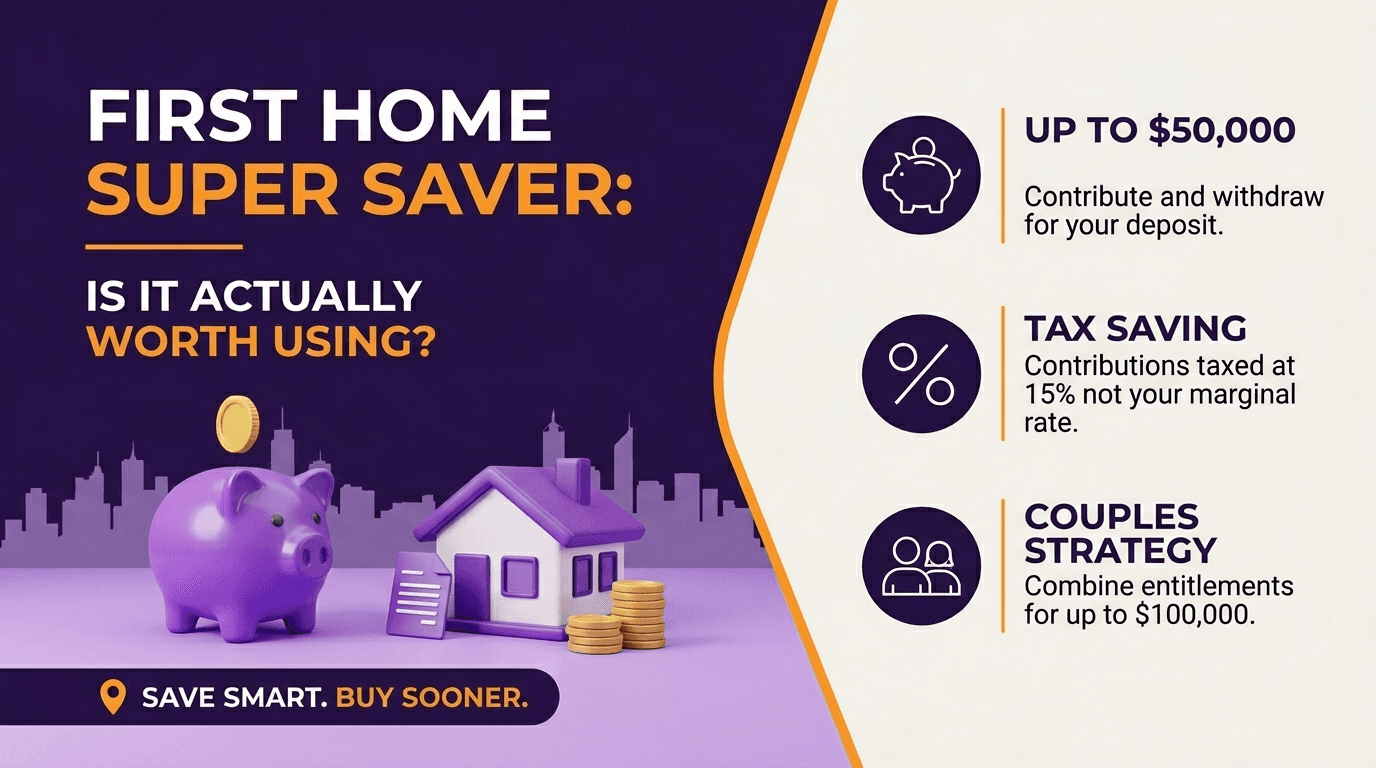
You can make voluntary super contributions of up to $15,000 per year and withdraw up to $50,000 total for a first home deposit
Couples can combine their entitlements for up to $100,000 total
Contributions taxed at 15% instead of your marginal rate, producing a genuine tax saving
The ATO adds deemed earnings to your withdrawal amount, calculated at a rate set by the ATO (currently around 8% to 9%)
The scheme only works for properties you will live in, not investment purchases
ATO processing takes 15 to 25 business days — apply well before exchange of contracts
Bottom line: The FHSS is worth using if you are in a middle or higher tax bracket, have 2 to 4 years before purchasing, and are disciplined enough to make regular voluntary contributions. For lower-income earners or buyers with a short timeline, the benefit is smaller and the complexity may outweigh it.
Jump to a Section
How the FHSS Works
The Contribution Limits
The Real Tax Saving
The Withdrawal Process (Important Timing Details)
The Couples Strategy
When the FHSS Is and Is Not Worth Using — start here if you want the direct answer
What Happens If Things Go Wrong — read this before committing
Two FHSS Examples: Single Buyer and Couple
Common Mistakes First Home Buyers Make
FAQ
Ready to Work Out Whether the FHSS Is Right for You?
How the First Home Super Saver Scheme Works
The FHSS allows first home buyers to make voluntary contributions to their superannuation fund and later withdraw those contributions, plus associated earnings, to use as a home deposit.
The mechanism is simple in principle. The tax advantage comes from the difference between your marginal tax rate and the 15% contributions tax inside super.
The four-stage process is straightforward once you've done it once. The timing of stage four is where most buyers get caught:
Contribute. Make voluntary contributions to your super fund above the mandatory employer SG amount. These can be concessional (salary sacrifice or personal deductible) or non-concessional (after-tax personal contributions).
Accumulate. Contributions grow inside super at the ATO's deemed earnings rate, which is calculated using the Shortfall Interest Charge rate. This rate is set quarterly and is currently around 8% to 9%, though it varies.
Request a determination. When you are ready to buy, apply to the ATO through myGov for an FHSS determination, which confirms how much you can withdraw.
Request a release. Once you have a signed contract or are actively searching, request the ATO to release the funds. They are paid directly to you, net of tax, and must be used toward a first home within 12 months.
Bottom line: The FHSS is a structured savings mechanism, not a grant. It does not give you free money. It gives you a tax advantage on money you were going to save anyway.
The Contribution Limits
The limits are straightforward but easily misread.
Annual limit: You can count up to $15,000 of eligible voluntary contributions from any single financial year toward the FHSS
Lifetime limit: The total you can withdraw is capped at $50,000 of contributions across all years, plus associated earnings
Couples: Each person has their own $50,000 entitlement. Combined, a couple can withdraw up to $100,000 of contributions plus associated earnings, potentially bringing the combined withdrawal to $110,000 to $120,000+ depending on the deemed earnings accumulated
Important to understand: the $15,000 annual limit is not a separate contribution cap sitting on top of your normal contribution limits. It counts inside the concessional contributions cap for salary sacrifice and personal deductible contributions. Always check the current concessional contributions cap with the ATO before contributing, as exceeding the cap results in excess contributions tax.
Non-concessional (after-tax) contributions can also be used for FHSS but provide a smaller tax advantage since they are not taxed going in and are not pre-tax. Most FHSS strategies focus on concessional contributions for this reason.
Bottom line: Three years of maximum contributions of $15,000 per year takes you to the $45,000 contribution limit, and four years gets you close to the $50,000 ceiling. Planning contributions over 2 to 4 years is the typical approach.
The Real Tax Saving: What the Numbers Actually Show
The tax saving is the central case for the FHSS. Here is how it works in practice.
For a salary earner contributing $10,000 via salary sacrifice:
Income Level | Marginal Rate | Tax Without FHSS | Tax Inside Super (15%) | Annual Saving |
$60,000 | 30% (effective) | $3,000 | $1,500 | $1,500 |
$100,000 | 34.5% (incl. Medicare) | $3,450 | $1,500 | $1,950 |
$150,000 | 39% (incl. Medicare) | $3,900 | $1,500 | $2,400 |
$200,000 | 47% (incl. Medicare) | $4,700 | $1,500 | $3,200 |
For a higher-income earner contributing the maximum $15,000 per year over three years:
Total contributions: $45,000
Tax saving compared to saving from after-tax income: approximately $9,000 to $14,400 depending on marginal rate
Plus deemed earnings accumulated over the contribution period (at around 8% to 9% per year)
Less 30% withholding tax on the released amount (with a 15% tax offset applied)
The net benefit after tax on release is approximately $8,000 to $12,000 for a higher-income earner maximising contributions over three years. For a couple both doing this, the combined net benefit is approximately $16,000 to $24,000.
What if the deposit you've been saving in a bank account at 4.5% interest could have been accumulating inside super at a lower tax rate for the past three years? For a higher-income earner, the difference is typically $8,000 to $12,000 by purchase time.
Bottom line: The tax saving is genuine and material for middle and higher-income earners. For lower-income earners in the 16% to 19% bracket, the saving is real but smaller, and the complexity warrants more careful evaluation.
Want to know your specific tax saving based on your income and planned timeline? WIAA's registered tax agents can calculate your exact FHSS benefit in a 15-min chat. No cost, no pressure. Call 1800 942 843 or book online.
The Withdrawal Process: How It Actually Works
This is where many first home buyers get caught. The withdrawal process has specific steps and timing requirements that cannot be skipped or shortened.
The steps are:
Request an FHSS determination from the ATO. This is done through myGov and confirms your eligible amount. You can do this before you have found a property.
ATO processing time. The ATO typically takes 15 to 25 business days to process the determination and release the funds.
Funds are paid to you. The ATO withholds 30% tax from the released amount, then applies a 15% tax offset at tax return time, resulting in an effective 15% additional tax on the gross amount. Your accountant or tax agent will manage this in your annual return.
You must use the funds within 12 months. Once released, the funds must be used toward a first home deposit within 12 months. Extensions are available in limited circumstances.
You must occupy the property. You must genuinely intend to live in the property as soon as practical and occupy it for at least 6 of the first 12 months after it is practical to do so.
The most common mistake is applying too late. The ATO processing time means you should apply for the release well before you expect to exchange contracts, not after finding a property. If you apply after exchange, the funds may not arrive before settlement.
Bottom line: Apply for your FHSS release as early as possible in your property search. The 15 to 25 business day processing window means last-minute applications frequently create settlement stress.
The Couples Strategy: Doubling the Benefit
For couples buying together, the FHSS can be particularly powerful. Each person has their own $50,000 entitlement, meaning a couple can combine up to $100,000 in contributions plus associated earnings.
The couples strategy requires both partners to act independently, not just the higher earner. Here's what that means in practice:
Both partners must meet the eligibility requirements individually, meaning neither has previously owned residential property in Australia
If one partner has previously owned property, the other can still use their own FHSS entitlement for the purchase
Both partners must apply for their own determination and release separately
The combined funds are then used toward the same property purchase
For a couple both contributing $15,000 per year for three years at combined marginal rates of 37% to 47%:
Combined tax saving over the contribution period: approximately $16,000 to $28,000
Combined withdrawal including deemed earnings: potentially $110,000 to $120,000+
What if both partners are consistently contributing to FHSS for four years and neither realises the other has already met the annual limit? It happens. Both partners need independent tracking, not a shared assumption.
Bottom line: The couples strategy is where the FHSS delivers its strongest result. Both partners contributing consistently over 2 to 4 years can produce a combined benefit of $16,000 to $28,000 in tax savings alone.
When the FHSS Is and Is Not Worth Using
This is the section that answers the title question. Everything above explains the mechanism. This section tells you whether the mechanism is worth using for your specific situation.
The FHSS is worth using when:
You are in a marginal tax rate of 30% or higher, where the saving is material
You have 2 to 4 years before you intend to purchase, giving time to maximise contributions
You are disciplined enough to make regular voluntary contributions rather than spending the money
You are buying a property you will live in, not an investment property
Your super fund allows salary sacrifice or personal deductible contributions easily (most do)
The FHSS is less compelling when:
You are in the lowest tax bracket (16% to 19%), where the saving is modest and the complexity may not be worth it
You are buying within 12 months, leaving little time to accumulate meaningful contributions
Your employer does not offer salary sacrifice, limiting you to personal deductible contributions (still works but requires more active management)
You are buying an investment property as your first purchase (rentvesting), in which case the FHSS cannot be used at all
You are uncomfortable locking savings inside super where access requires ATO approval and a specific property purchase
Bottom line: The FHSS suits disciplined medium to higher-income earners with a 2 to 4 year deposit-saving horizon buying an owner-occupied property. It is not a universal first home buyer solution.
Not sure which category you're in? The two variables that matter most are your marginal tax rate and your timeline to purchase. Book a free 15-min chat with WIAA and we'll give you a straight answer for your specific situation. Phone 1800 942 843 or book online.
What Happens If Things Go Wrong
Most FHSS guides skip this section. Don't. Understanding what happens when things go wrong is part of deciding whether the strategy is right for you.
Several scenarios can disrupt an FHSS plan. Knowing them in advance avoids expensive surprises.
Property purchase falls through. If your purchase does not proceed, your determination is cancelled and your contributions remain in super. You can request a new determination for a future purchase. The funds are not lost.
You do not buy within 12 months. If you do not sign a contract within 12 months of your release request, you must either recontribute the released amount back to super or pay an additional FHSS tax. You cannot simply keep the money.
You buy an investment property. FHSS funds cannot be used for investment purchases. If you buy a property and do not occupy it as required, the ATO can assess additional tax.
One partner has owned property before. The previously-owned property owner is ineligible, but their partner can still use their own entitlement toward the joint purchase.
You exceed the concessional cap. FHSS contributions count toward your concessional cap. Exceeding the cap triggers excess contributions tax at your marginal rate. Always check the current cap before contributing.
Bottom line: The FHSS has specific rules around use-it-or-lose-it timing and occupancy requirements. Understand these before committing to the strategy.
Two FHSS Examples: Single Buyer and Couple
Example 1: Claire, 28, Single Buyer Planning Ahead
Claire earns $95,000 as a project coordinator and is planning to buy in 3 years. She currently saves $800 per fortnight and wants to maximise her FHSS benefit.
Her FHSS strategy:
Salary sacrifice $10,000 per year over 3 years through her employer (within the FHSS $15,000 annual limit and the concessional cap after employer SG)
Total contributions: $30,000
Tax saving compared to saving from after-tax income at her marginal rate: approximately $6,000
Deemed earnings accumulated over 3 years at approximately 8%: approximately $4,500
Total FHSS release (before final withholding tax): approximately $34,500
Net benefit after all taxes: approximately $28,500 in hand, versus approximately $23,000 she would have saved from after-tax income with the same gross commitment
The FHSS puts Claire approximately $5,500 ahead compared to saving through a bank account. Combined with her other savings, her total deposit is materially larger 3 years earlier than it would have been. For Claire, the FHSS is clearly worth using: a $5,500 net benefit with a 3-year timeline and a 34.5% marginal rate puts her solidly in the "yes" category.
Example 2: James and Priya, Couple Buying Together in 4 Years
James earns $145,000 and Priya earns $110,000. Both plan to contribute the full $15,000 per year for 4 years.
Their combined FHSS strategy:
James contributes $15,000 per year for 4 years: total $60,000 (capped at $50,000 for FHSS purposes)
Priya contributes $15,000 per year for 4 years: total $60,000 (capped at $50,000 for FHSS purposes)
Combined eligible contributions: $100,000
Combined tax saving at their marginal rates: approximately $21,000 to $24,000
Combined deemed earnings over 4 years: approximately $16,000 to $18,000
Combined gross release: approximately $116,000 to $118,000
Combined net release after final withholding tax: approximately $97,000 to $99,000
Without the FHSS, the same contributions from after-tax income would have yielded approximately $75,000 to $77,000 in a high-interest savings account. The FHSS puts James and Priya approximately $20,000 to $22,000 ahead, accelerating their deposit timeline by roughly 12 to 18 months. For James and Priya, the FHSS couples strategy is the single highest-leverage deposit accelerator available: a $20,000 to $22,000 combined benefit puts it well into "yes" territory for a couple in their income brackets.
Common Mistakes First Home Buyers Make
Applying for the FHSS release too late. The ATO processing window is 15 to 25 business days. Applying after finding a property and expecting funds before settlement is the most common and costly mistake.
Contributing more than the annual limit. The $15,000 annual limit applies to what can be counted for FHSS purposes, not what you contribute to super. Contributing more does not increase your FHSS entitlement and uses up your concessional cap.
Assuming the scheme applies to investment property purchases. The FHSS cannot be used for investment properties or rentvesting purchases. It applies only to properties the buyer will genuinely occupy.
Not both partners applying independently. Couples sometimes assume the higher-income partner applies on behalf of both. Each partner must make their own contributions, apply for their own determination, and request their own release.
Forgetting the occupancy requirement. You must occupy the property for at least 6 of the first 12 months after it is practical to do so. Buying and then renting the property out immediately invalidates the scheme and creates additional tax obligations.
Not checking the concessional cap before contributing. FHSS contributions count toward your concessional cap. Exceeding the cap triggers harsh excess contributions tax. Always verify the current cap and your employer SG before salary sacrificing.
Not planning the timeline. The FHSS works best with 2 to 4 years of consistent contributions. Buyers who start contributing 6 months before purchase get a fraction of the benefit. Start early.
FAQ
Who is eligible for the First Home Super Saver Scheme? You must be at least 18 years old, must never have owned residential property in Australia (including investment property, commercial property, or vacant land), must not have previously made a valid FHSS release request, and must genuinely intend to live in the property you purchase. Eligibility is assessed individually, so one partner's previous property ownership does not automatically disqualify the other.
Can I use my existing super balance for a home deposit? No. Only voluntary contributions made above the mandatory employer SG amount are eligible for FHSS withdrawal. Your existing super balance, including all employer contributions, cannot be accessed under the scheme.
How much can I withdraw under the FHSS? You can withdraw up to $50,000 of eligible contributions per person, plus associated earnings calculated at the ATO's deemed earnings rate. A couple can combine their entitlements for up to $100,000 in contributions plus earnings.
Does the FHSS affect my borrowing capacity? The FHSS funds count as part of your deposit, improving your loan-to-value ratio and potentially reducing the loan amount you need. Some lenders may also factor in the expected FHSS release when assessing your deposit capacity. Confirm this with your lender or mortgage broker.
What if my property purchase falls through after I request a release? Your determination is cancelled and the request can be revoked in limited circumstances before the funds are released. If the funds have already been paid, you must either recontribute the amount back to super or pay an FHSS tax. You can request a new determination for a future purchase.
Can I use the FHSS scheme if I am buying with someone who has previously owned property? Yes, your individual eligibility is not affected by your co-purchaser's history. You can still use your own FHSS entitlement toward the joint purchase, even if your co-buyer is ineligible.
Is the First Home Super Saver Scheme available alongside other first home buyer schemes? Yes. The FHSS can be used alongside the First Home Guarantee, state stamp duty concessions, and the First Home Owner Grant where applicable. These schemes address different parts of the deposit equation and are designed to be complementary.
Can I use the FHSS if I've already bought an investment property (rentvesting)? No. FHSS eligibility requires that you have never previously owned residential property in Australia, and this includes investment properties. If you have already purchased an investment property, you are not eligible for the FHSS. If you are considering rentvesting and have not yet purchased anything, make your FHSS contributions before buying the investment property, as the order of purchase matters for eligibility.
What is the current ATO deemed earnings rate for FHSS calculations? The deemed earnings rate is based on the Shortfall Interest Charge rate, which the ATO sets quarterly. It is currently approximately 8% to 9%, but it changes. Check the ATO website for the current rate before modelling your expected withdrawal amount, as the rate affects both your projected balance and the tax calculation on release.
Ready to Work Out Whether the FHSS Is Right for You?
The FHSS can accelerate your deposit timeline by 12 to 18 months for the right buyer, but only if you start early enough and set it up correctly.
Two ways to find out if that buyer is you:
Free 15-min chat to find out if FHSS suits your timeline and income. Call 1800 942 843 or book online.
Email the team at clientservices@whatifadvice.com.au with your income, current super balance, and target purchase timeline and we'll give you an initial read.
Still asking what if about the FHSS? The answer depends on your income, your timeline, and how disciplined you are. Let's find out.
WIAA's registered tax agents handle FHSS applications and ATO communications for clients across Australia, with offices in Brisbane and Melbourne. AFSL 528250.
General Advice Disclaimer: This information is general in nature and does not take into account your personal financial situation, needs, or objectives. You should consider whether it is appropriate for you and seek personal financial advice before making any decisions. FHSS eligibility rules, contribution limits, and ATO processing requirements are subject to change. Always verify current rules with the ATO or a registered tax agent before contributing. What If Advice is an Authorised Representative under Beryllium Advisers Pty Ltd, AFSL 528250.