Looking for specific financial advice?
This blog provides general educational content. For personalized advice tailored to your unique situation, book a free consultation with our team of ASIC-licensed financial advisers.
One of the most important, and often misunderstood decisions for Australian business owners is how to pay yourself.
If you’re running a business through a:
company
trust
or a company + trust structure,
you usually have options for taking money out, including:
wages/salary
dividends
trust distributions
Each option has different tax consequences, legal requirements, and cash flow impacts. Get it right, and you can save tax (legally), improve certainty, and grow wealth. Get it wrong, and you risk problems like:
unexpected tax bills
cash flow stress
ATO attention
Division 7A issues (for company owners)
poor record keeping and compliance failures
This guide breaks down salary vs dividends vs trust distributions in a clear, practical way, so you can understand what they are, how they work, and when each might make sense.
First: Your Business Structure Changes Everything
Before comparing options, it’s important to understand that how you can pay yourself depends on your business structure.
Sole trader
You don’t pay yourself a wage
You take drawings from business profits
You’re taxed personally on business profit (not on what you “withdraw”)
Company (Pty Ltd)
You can pay yourself a salary (as an employee/director)
You can receive dividends as a shareholder
Loans and drawings can trigger Division 7A if not managed
Trust (family trust)
You can distribute income to beneficiaries (including yourself)
Trust distributions must follow trust deed rules
No “dividends” (because trusts don’t issue shares)
Company + trust (common structure)
Often used for flexibility and tax planning
The trust may own shares in the company
Income might flow through multiple layers depending on design
The right “pay yourself” strategy almost always starts with confirming your structure and goals, not just choosing what seems tax-effective in the short term.
Option 1: Paying Yourself a Salary (Wages)
What it is
A salary is regular pay you receive from your business (usually from a company). It’s treated like standard employment income.
Your business pays you through payroll, and you pay personal tax through PAYG withholding.
How it works
If you pay yourself a salary, you usually need to:
run payroll
withhold PAYG tax
pay super guarantee (if applicable)
report via Single Touch Payroll (STP)
include the wage expense in business accounts
Pros of paying a salary
Predictable income: easier for budgeting and personal lending
Tax-deductible for the business (for companies)
Super is usually paid: helps build retirement wealth
Cleaner compliance: especially when structured properly
Can be useful for consistent cash flow businesses
Cons of paying a salary
May result in higher personal tax if your salary pushes you into higher brackets
Requires payroll admin and reporting
Super obligations can increase costs
Less flexible if business income is irregular
When salary often makes sense
Salary can be a good option if:
you want stable income each month
you’re applying for a mortgage and want payslips
your company generates consistent profit
you want a simple, compliant baseline strategy
Option 2: Paying Yourself Dividends (Company Profits)
What it is
A dividend is a payment to shareholders from the company’s profits.
Dividends are not a wage, they’re profit distribution.
If your company pays dividends, they:
must come from profits
must be declared properly
must be paid to shareholders according to share ownership
Franked vs unfranked dividends (simple explanation)
Dividends can be:
Franked: company has already paid tax, and you receive a franking credit
Unfranked: no franking credits attached
Franking credits can reduce your personal tax. Depending on your personal taxable income and circumstances.
Always check current ATO rules and accounting advice, because franking outcomes depend on tax rates and company tax already paid.
Pros of dividends
Can be tax-effective depending on your personal tax position
No super guarantee costs on dividends
More flexibility than wages (can pay annually or quarterly)
Can utilise franking credits for some taxpayers
Useful when you don’t need consistent weekly income
Cons of dividends
You need profits. Dividends can’t be paid if there’s no profit
Must be declared correctly and documented
Can create personal tax bills (depending on the dividend size)
Less stable income for lending compared to wages
Not available if you’re not a shareholder
When dividends often make sense
Dividends can work well if:
your company is profitable
you don’t need regular wages
you want flexibility in timing
you want to use franking credits strategically
you want to distribute profits to multiple shareholders (e.g., spouse shareholders)
Option 3: Paying Yourself Trust Distributions (Family Trust)
What it is
A trust distribution is when a trust allocates its income to beneficiaries (like you, your spouse, or adult children).
This is common for business owners operating through a family trust, or where a trust owns shares in a company.
How it works
The trust earns income and then, at the end of the financial year, it distributes (allocates) that income to beneficiaries.
Beneficiaries pay tax at their own marginal tax rates.
Trusts are often used for:
income splitting across family members
asset protection (depending on structure)
flexibility in distributing profits
Pros of trust distributions
High flexibility in who receives income
Potential to distribute income to lower-tax beneficiaries (where legally permitted)
Can be powerful for families with multiple adult beneficiaries
Useful in combination with companies and bucket company strategies
Often supports asset protection goals (depending on design)
Cons of trust distributions
Must follow trust deed rules
Must be properly resolved and documented before deadlines
Beneficiaries must be eligible and tax outcomes can be complex
ATO scrutiny has increased in recent years on trust distribution strategies
Can create compliance risk if done incorrectly
When trust distributions often make sense
Trust distributions can be useful if:
your business income is earned in a trust
you want income flexibility across family
you have adult beneficiaries with lower taxable income
you’re building long-term family wealth
you have a trust structure for asset protection or investment purposes
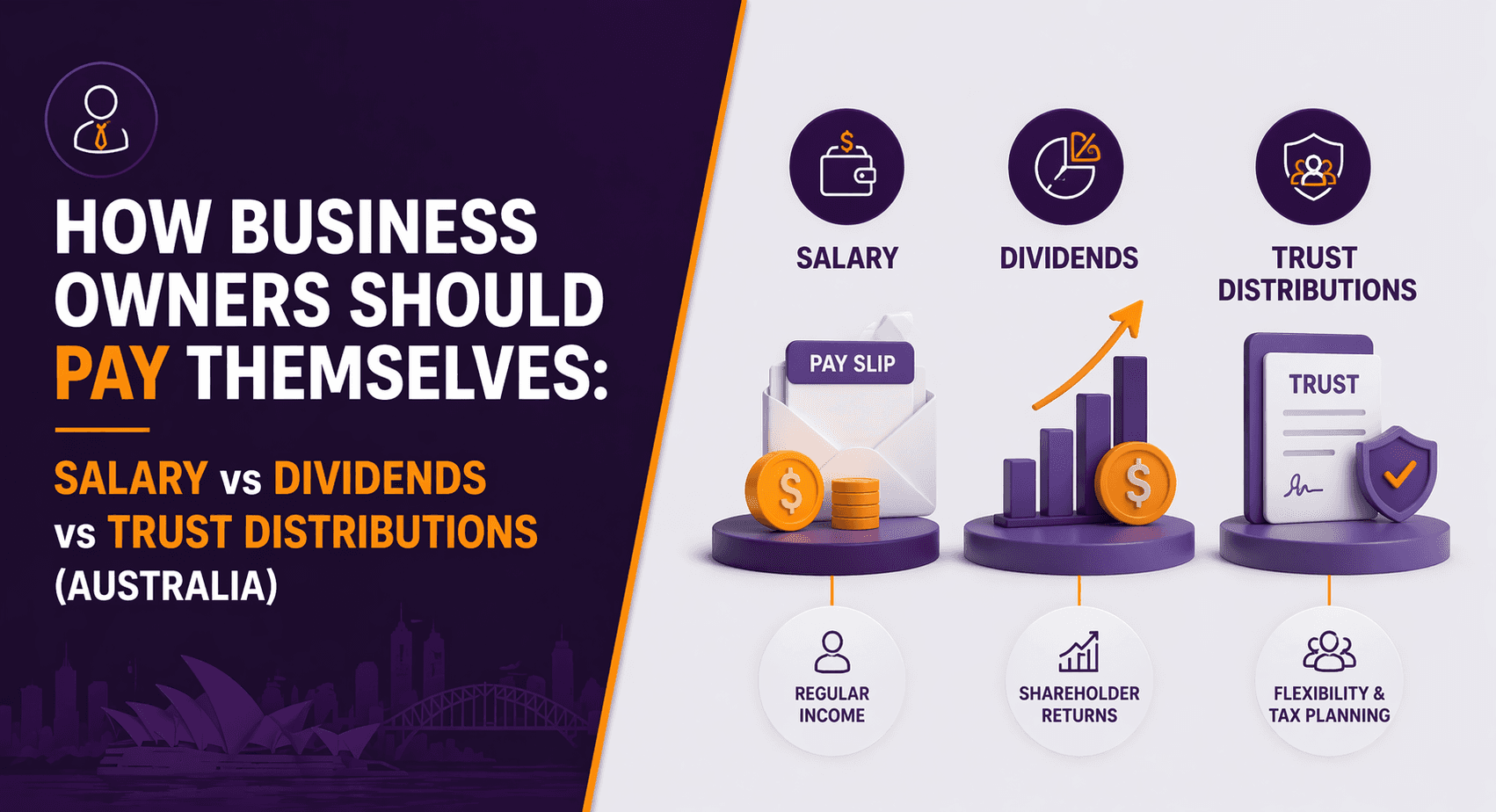
Key Differences: Salary vs Dividends vs Trust Distributions
Here’s the simple comparison:
Salary (wages)
Paid regularly via payroll
Tax withheld through PAYG
Usually includes super
Business gets a tax deduction (in companies)
Good for stability and lending
Dividends (company profits)
Paid from company profits to shareholders
May come with franking credits
No super guarantee
More flexible timing
Requires profits and proper declarations
Trust distributions
Allocated at year-end to beneficiaries
Beneficiaries pay tax at their rates
Highly flexible within legal rules
Requires strong compliance and documentation
Common for income splitting and wealth planning
What’s the “Best” Way to Pay Yourself?
Most Australian business owners don’t choose just one. Often, the best approach is a mix based on:
how stable your business cash flow is
your personal tax bracket
your spouse’s income
your structure (company/trust)
whether you want to build super
whether you need income proof for lending
long-term business and wealth goals
A common strategy (in plain terms)
Many business owners take:
a reasonable salary for stability + super
dividends or trust distributions for profit extraction and tax planning
retain some profits inside the business for growth and buffers
But the right mix depends on your numbers.
Examples: How Different Business Owners Might Pay Themselves
Example 1: Company owner needing stable income
A director runs a marketing agency through a Pty Ltd company. Income is stable.
A practical approach may be:
a consistent salary for monthly living costs and borrowing capacity
a dividend at year-end if profits allow
Example 2: Trust-based business with family beneficiaries
A trades business operates through a family trust. One spouse works part-time.
A possible approach:
distribute trust income between spouse beneficiaries (within legal rules)
retain some profit for cash flow
contribute to super for retirement planning (as a separate strategy)
Example 3: High-growth business owner
A business owner wants to reinvest heavily in the business and minimise personal drawings.
A possible approach:
pay a modest salary to cover basics
leave profits in the company/trust to fund growth
manage tax planning carefully across years
The ATO and Compliance: What Business Owners Must Get Right
Paying yourself isn’t only about “tax effectiveness”. It must also be compliant.
Things to get right:
correct structure set-up
proper bookkeeping and records
clear separation of business vs personal expenses
correct payroll reporting (STP) if paying salary
accurate dividend documentation if paying dividends
proper trust distribution resolutions and beneficiary records
avoid “random transfers” that become problematic later
Common ATO red flags:
inconsistent trust distributions without commercial reasoning
unpaid entitlements without proper documentation
directors taking money as “loans” without Division 7A compliance
personal spending through business accounts
poor record keeping and late resolutions
In many cases, the tax risk isn’t the strategy. It’s the lack of documentation and structure behind it.
Common Mistakes to Avoid
Mistake 1: Paying yourself randomly
Many business owners take money out “as needed” without tracking what it is.
This creates issues like:
unclear tax reporting
director loan problems
inaccurate accounts
cash flow and planning issues
Mistake 2: Ignoring super obligations
If you’re paying salary/wages, super may apply.
Not paying super properly can lead to:
penalties
super guarantee charge
ATO enforcement action
Mistake 3: Assuming trust distributions are always tax-saving
Trust distributions can be useful. But the ATO has rules about:
who can receive distributions
whether beneficiaries are actually entitled
the documentation required
how income is allocated
Mistake 4: Forgetting the personal tax bill
Dividends and trust distributions can cause personal tax bills, especially if:
you receive a large year-end distribution
you haven’t set aside money for tax
you don’t plan your withholding and instalments
Key Takeaways
Salary = stable income, payroll compliance, often super included
Dividends = profit distribution from a company, may include franking credits
Trust distributions = flexible allocation to beneficiaries, requires strong documentation
The “best” method is often a mix
Your structure and goals matter more than one-size strategies
Compliance and record keeping are as important as tax outcomes
Get professional advice before making changes; especially if large amounts are involved
FAQ
1) Should I pay myself a salary from my company?
Many business owners do, especially for stable income and lending purposes. Whether it’s the best option depends on profits, cash flow, and tax position.
2) Are dividends better than salary in Australia?
Not always. Dividends can be flexible and tax-effective in some cases, but they require company profits and correct documentation. A mix is often used.
3) What is a trust distribution and how is it taxed?
A trust distribution is income allocated from a trust to beneficiaries. The beneficiary pays tax on that income at their marginal tax rate.
4) Can I pay myself dividends without paying a salary?
Yes, if you are a shareholder and the company is profitable. Some owners do this, but it can create income volatility and personal tax planning needs.
5) What happens if I take money from my company without declaring it properly?
It can create compliance issues like Division 7A loans, incorrect accounts, and ATO penalties. It’s best to document all payments clearly.
How you pay yourself as a business owner isn’t just a “tax question”, it’s a strategy decision that affects:
your lifestyle and cash flow
your tax bill
your super and long-term wealth
your compliance risk
your ability to grow and reinvest
The best approach is usually a well-planned mix of salary, dividends and/or trust distributions, tailored to your business structure and personal circumstances.
Still asking “what if” about your finances?
That’s exactly where clarity begins.
Whether you’re planning ahead, growing wealth, or simply want confidence in your financial decisions, the advisers at What If Advice can help you turn questions into a clear, personalised plan.
👉 Book a free 15-minute strategy session or get in touch today at
whatifadvice.com.au
General Advice Disclaimer
This information is general in nature and does not take into account your personal financial situation, needs, or objectives. You should consider whether it is appropriate for you and seek personal financial advice before making any decisions.