Looking for specific financial advice?
This blog provides general educational content. For personalized advice tailored to your unique situation, book a free consultation with our team of ASIC-licensed financial advisers.
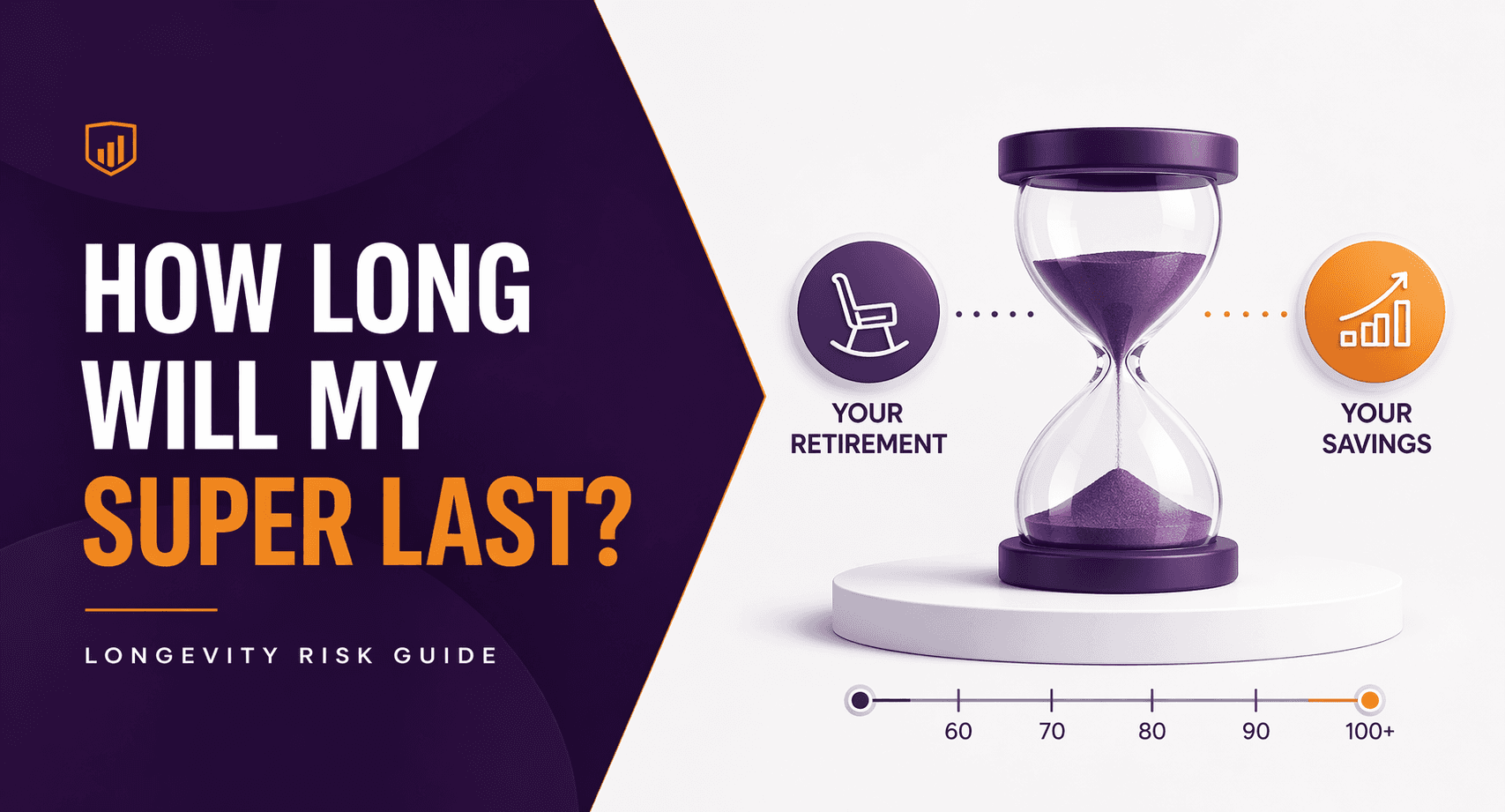
How Long Will My Super Last? (Longevity Risk Guide)
A common concern for Australians approaching retirement is simple but confronting:
How long will my super actually last?
The answer depends on several factors including your retirement balance, investment returns, withdrawal rate, lifestyle spending and life expectancy.
The risk of running out of money in retirement is known as longevity risk, and managing it is a central part of retirement planning.
What Is Longevity Risk?
Longevity risk is the possibility that you live longer than expected and exhaust your retirement savings.
Australians are living longer than previous generations. According to life expectancy data (subject to change over time):
A 65-year-old male may live into his mid-80s
A 65-year-old female may live into her late-80s
Many retirees will live well into their 90s
That means retirement savings may need to last 25–30 years or more.
The Key Factors That Determine How Long Your Super Lasts
Several variables influence retirement sustainability.
1. Your Starting Super Balance
The obvious starting point is the size of your retirement savings.
Example:
Super Balance | Annual Income (5% withdrawal) |
$400,000 | $20,000 |
$600,000 | $30,000 |
$800,000 | $40,000 |
$1,000,000 | $50,000 |
These figures assume funds remain invested and markets perform reasonably over time.
2. Your Withdrawal Rate
Your withdrawal rate is one of the biggest determinants of longevity.
A commonly referenced guideline is the 4–5% rule, meaning you withdraw about 4–5% of your balance annually.
Example:
Withdrawal Rate | Sustainability Risk |
3–4% | Low risk |
5–6% | Moderate risk |
7%+ | Higher risk |
However, real retirement income strategies require more detailed modelling.
3. Investment Returns
Super does not sit idle in retirement. It remains invested.
Investment allocation significantly affects longevity.
Investment Style | Expected Behaviour |
Conservative | Lower returns, lower volatility |
Balanced | Moderate returns |
Growth | Higher long-term return potential |
Too conservative an allocation may increase the risk that savings do not keep pace with inflation.
4. Inflation
Inflation gradually erodes purchasing power.
Example:
If inflation averages 3% annually, $50,000 of spending today may require roughly $67,000 in 10 years.
Your super strategy must account for rising costs over time.
5. Age Pension Support
For many Australians, the Age Pension forms part of retirement income.
Depending on your assets and income (subject to Services Australia rules), the Age Pension may:
Provide partial income support
Act as a “safety net” if investments decline
This can materially extend the life of retirement savings.
Example: How Long Super Might Last
Consider this simplified scenario.
Scenario
Age: 67
Super balance: $800,000
Withdrawal: $40,000 per year (5%)
Investment return: 5–6% long term
Under reasonable market conditions, the balance may potentially support 25+ years of retirement income.
However, market volatility and higher withdrawals can shorten this period.
Retirement planning should always consider multiple scenarios.
Strategies to Reduce Longevity Risk
If the goal is ensuring super lasts as long as possible, several strategies can help.
1. Adjust Withdrawal Rates
Reducing withdrawals in early retirement can significantly extend savings.
Even a small adjustment may add years of sustainability.
2. Maintain Growth Exposure
Many retirees move entirely to cash or conservative assets.
But retirement can last decades. Maintaining some exposure to growth investments may help protect purchasing power.
3. Delay Retirement
Working even two to three additional years can have a large impact:
More contributions
Shorter retirement period
Additional investment growth
4. Use the Age Pension Strategically
Understanding how assets interact with Age Pension thresholds can help optimise retirement income.
5. Review Your Plan Regularly
Retirement plans should be reviewed annually to adjust for:
Market performance
Spending changes
Legislative updates
Common Longevity Planning Mistakes
Many Australians unintentionally increase longevity risk by:
Withdrawing too aggressively early in retirement
Holding excessive cash allocations
Ignoring inflation
Failing to adjust spending during downturns
Not modelling multiple retirement scenarios
Longevity planning requires ongoing strategy.
FAQs
1. How long should super last in retirement?
For many Australians retiring around age 65–67, super may need to last 25–30 years.
2. What is longevity risk?
Longevity risk is the risk of outliving your retirement savings.
3. What withdrawal rate is safe?
Many planners use 4–5% as a starting guideline, but individual circumstances vary.
4. Does the Age Pension extend how long super lasts?
Yes. Age Pension income can reduce withdrawals from super, helping balances last longer.
5. Should retirees stay invested in growth assets?
Often yes, because retirement may last decades and inflation must be managed.
6. Can financial modelling predict how long my super will last?
Professional modelling can estimate sustainability under various scenarios, but future market returns cannot be guaranteed.
Understand How Long Your Super Could Last
Retirement sustainability depends on multiple variables — withdrawal rates, investment returns, Age Pension eligibility and spending patterns.
At What If Advice, we model retirement income scenarios to estimate how long your super may last under different market conditions and lifestyle choices.
This allows you to adjust strategy early and reduce longevity risk.
Book a retirement modelling consultation with What If Advice.
General Advice Disclaimer
This article provides general information only and does not take into account your personal objectives, financial situation or needs. Before making financial decisions, consider whether the information is appropriate to your circumstances and seek personal advice from a licensed financial adviser. Superannuation, taxation and Age Pension rules are subject to change under current ATO and Services Australia regulations.