Looking for specific financial advice?
This blog provides general educational content. For personalized advice tailored to your unique situation, book a free consultation with our team of ASIC-licensed financial advisers.
How Much Does Financial Advice Cost in Australia?
Financial advice in Australia isn’t cheap. But it’s also not random.
The short answer:
Most Australians pay between $3,000 and $5,000 per year for ongoing advice, or $3,000–$4,000 for a one-off plan.
More complex situations? You can easily see fees well above that.
Typical Financial Advice Costs in Australia (2026)
Here’s what you’ll realistically encounter:
Type of Advice | Typical Cost |
Initial consultation | Free – $500 |
One-off financial plan | $2,000 – $5,000+ |
Comprehensive plan (complex) | $5,000 – $12,000 |
Ongoing advice (annual) | $3,000 – $6,000+ |
High-complexity clients | $10,000+ per year |
These ranges vary based on:
Complexity of your situation
Type of advice
Adviser experience and structure
Industry data suggests the median annual fee is around $3,960, but many clients pay more for comprehensive advice.
Why Financial Advice Costs What It Does
People assume it’s just “a few meetings.” It’s not.
You’re paying for:
Strategy development
Compliance and documentation
Ongoing reviews and adjustments
Regulatory requirements (ASIC standards)
Post-Royal Commission, advice has become more:
Regulated
Time-intensive
Expensive to deliver
Which is why costs have increased significantly over time.
How Financial Advisers Charge Fees
There are a few common pricing models in Australia.
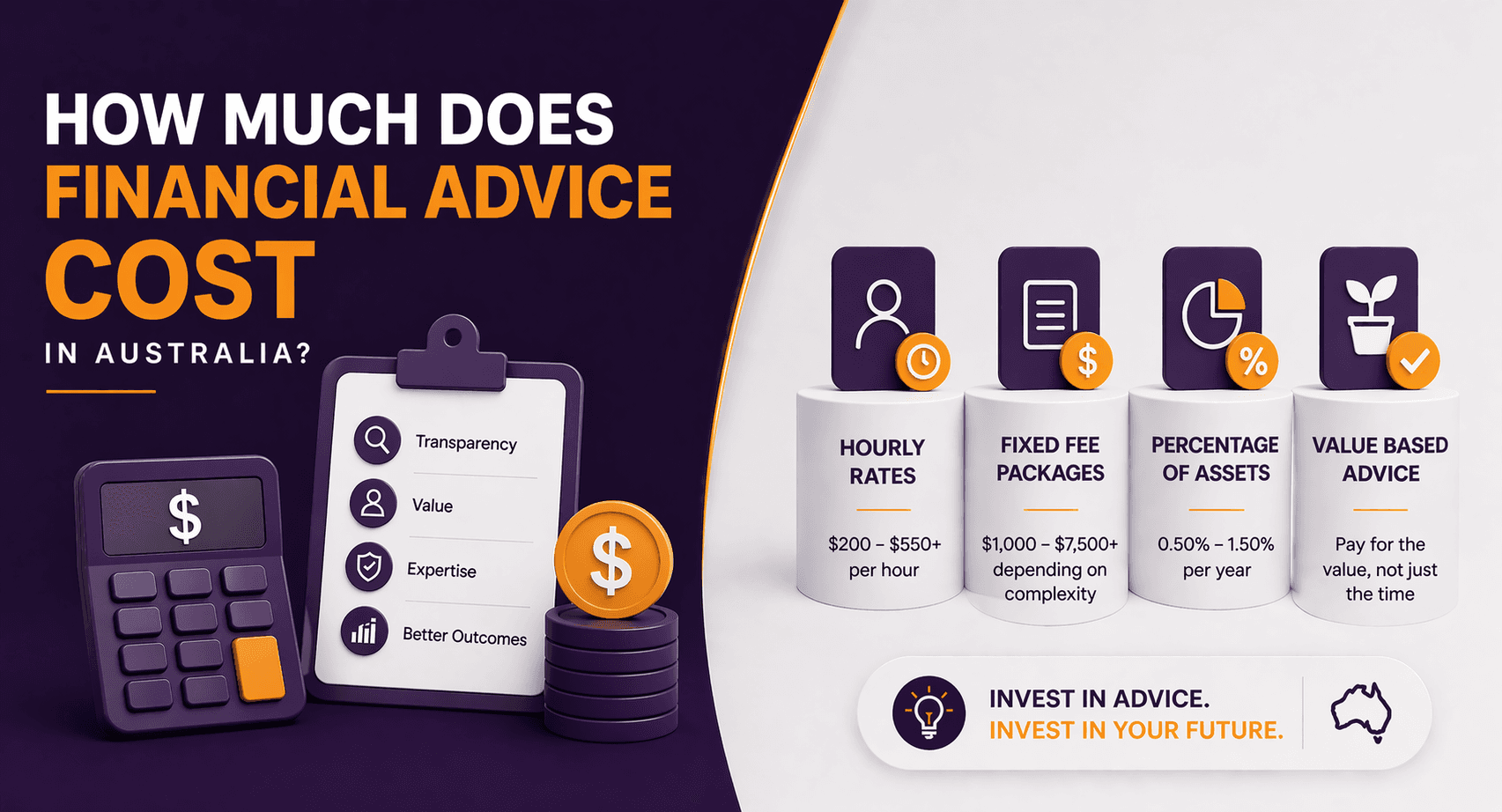
1. Fixed Fees (Most Common)
You pay a set amount for a defined service.
Examples:
$3,500 for a financial plan
$4,000/year for ongoing advice
This is now the preferred model for transparency.
2. Percentage-Based Fees
Typically:
0.5% to 1.5% of assets under management
Example:
$500,000 portfolio
1% fee = $5,000/year
This can become expensive as your wealth grows.
3. Hourly Fees
Usually:
$150 to $400 per hour
Used for:
One-off advice
Specific questions
4. One-Off vs Ongoing Advice
Type | Description |
One-off advice | Strategy, no ongoing support |
Ongoing advice | Reviews, adjustments, ongoing planning |
Not everyone needs ongoing advice every year. That’s where people overpay.
What Drives the Cost?
This is where the price can swing wildly.
1. Complexity
Multiple properties
Business ownership
Trust structures
More moving parts = higher cost.
2. Scope of Advice
Simple budgeting → cheaper
Retirement + tax + investments → more expensive
3. Level of Service
One-off plan
Full ongoing relationship
4. Adviser Model
Boutique firms → often higher touch, higher cost
Scaled firms → more standardised pricing
Is Financial Advice Worth the Cost?
This is the real question.
When It Can Be Worth It:
You’re making high-stakes decisions
You have complex finances
You want a long-term strategy
You want to avoid costly mistakes
Good advice can:
Improve tax outcomes
Optimise investments
Prevent poor decisions
When It May NOT Be Worth It:
Your finances are simple
You just need basic guidance
You’re early in your financial journey
In these cases, a one-off session or education may be enough.
Real-Life Scenario
Couple (Sydney, combined income $220k):
Pays $4,500/year for advice
Adviser helps with:
Investment strategy
Super optimisation
Debt structuring
Outcome:
Saves tax
Improves long-term returns
Gains clarity
Value depends on execution, not just cost.
The Hidden Cost Most People Ignore
Not getting advice can also cost you.
Examples:
Poor loan structure → costs thousands
Missed tax strategies → ongoing losses
Bad investment decisions → long-term impact
The real comparison isn’t:
“Advice vs no cost”
It’s:
“Advice cost vs cost of mistakes”
How to Tell If You’re Paying Too Much
Ask yourself:
Do I understand what I’m paying for?
Am I getting proactive advice or just reviews?
Is the strategy improving my position?
If the answer is “not really,” you’re probably overpaying.
Key Question: How Much Should You Pay?
There’s no single “correct” number.
But as a rough guide:
Simple situation → $2,000–$4,000
Moderate complexity → $3,000–$6,000/year
Complex → $6,000+
What matters is:
value relative to your financial outcomes
FAQs
1. What is the average cost of a financial adviser in Australia?
Around $3,000–$5,000 per year for ongoing advice, depending on complexity.
2. Is financial advice tax deductible?
Some advice related to income-producing investments may be deductible (subject to ATO rules).
3. Are financial advisers worth the cost?
They can be, especially for complex decisions or long-term planning.
4. Can I get free financial advice?
Some initial consultations are free, but comprehensive advice is usually paid.
5. Do I need ongoing financial advice?
Not always. Many people benefit from one-off advice at key stages.
6. Are percentage fees better than flat fees?
Flat fees are often more transparent, while percentage fees scale with your assets.
7. How do I compare advisers?
Look at:
Fee transparency
Scope of advice
Experience and qualifications (ASIC-regulated)
Is Financial Advice Worth It for You?
Financial advice isn’t about paying for information. It’s about making better decisions with long-term consequences.
The right advice can:
Improve your financial outcomes
Reduce risk
Provide clarity and direction
The key is understanding what you’re paying for and ensuring it aligns with your goals.
Disclaimer
This information is general in nature and does not take into account your personal objectives, financial situation, or needs. You should consider whether it is appropriate for your circumstances and seek professional financial advice. Information is subject to current ATO, ASIC, and Services Australia rules and may change over time.