Looking for specific financial advice?
This blog provides general educational content. For personalized advice tailored to your unique situation, book a free consultation with our team of ASIC-licensed financial advisers.
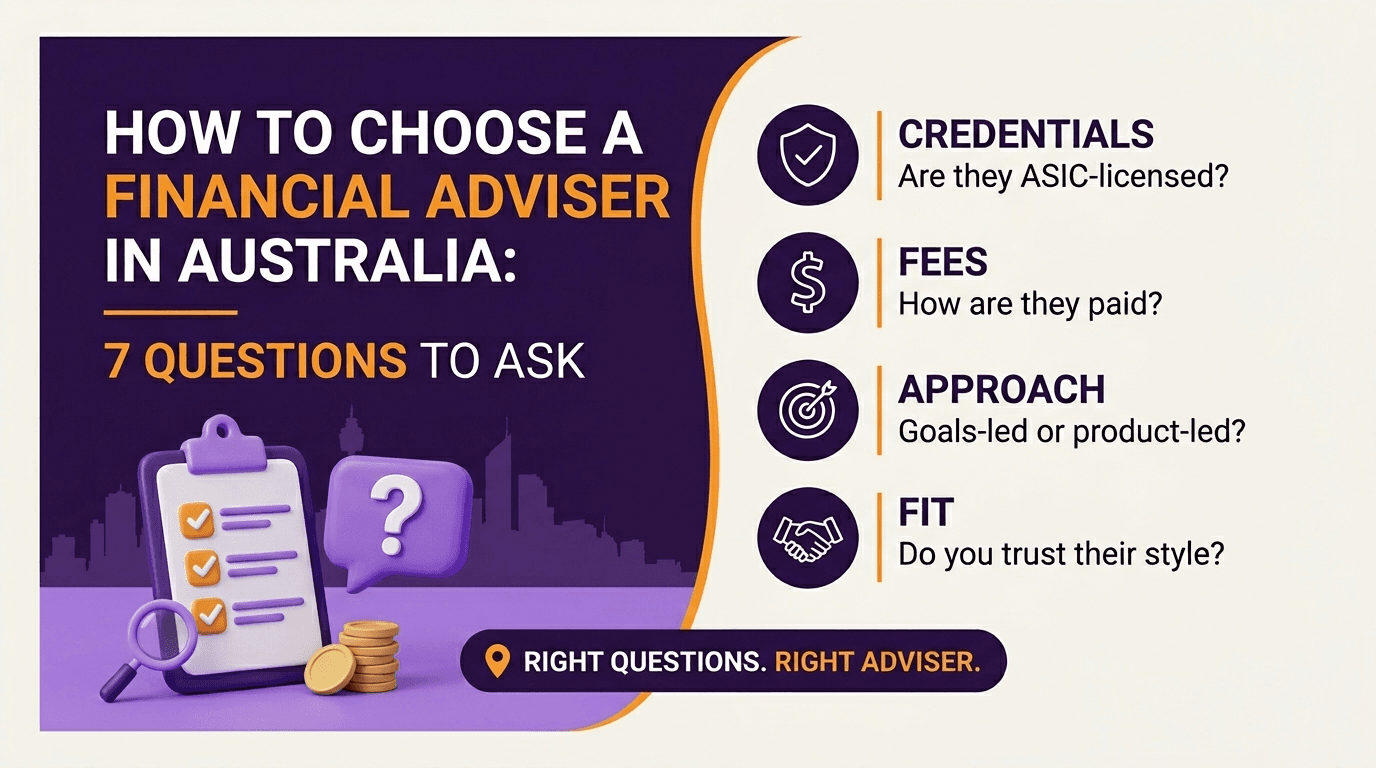
How to Choose a Financial Adviser in Australia: 7 Questions to Ask
Choosing the right financial adviser is one of the highest-leverage decisions an Australian can make. Done well, the right adviser saves tax, accelerates retirement, and prevents expensive mistakes. Done poorly, the consequences can compound for decades.
The challenge is that most Australians have never engaged a financial adviser before. There is no obvious template for what to ask, what to look for, or how to spot the difference between genuine expertise and a polished sales pitch.
This guide outlines the seven essential questions to ask any prospective adviser, what good answers sound like, and the red flags that should send you looking elsewhere.
Quick Answer
Here are the seven questions every Australian should ask a prospective financial adviser:
Are you on the ASIC Financial Advisers Register?
How exactly do you get paid, and what will my total fees be?
What's your areas of expertise and ideal client?
Will you provide a Statement of Advice tailored to my situation?
Who do you work with on tax and estate matters?
What happens if I'm unhappy with your service?
Can I see an example of your written advice?
Bottom line: A quality adviser welcomes these questions. Anyone who deflects or becomes defensive is showing you exactly the wrong signals.
Why the Questions Matter
The Australian financial advice industry has been through significant reform over the past decade. Commission-based selling has largely been replaced by fee-for-service. Advisers must now meet education, ethics, and continuing professional development standards.
Despite these reforms, quality varies enormously. Some advisers operate with deep expertise, transparent pricing, and genuine fiduciary care. Others remain product-focused, fee-opaque, or simply mismatched to client needs.
The seven questions in this guide are designed to do three things:
Verify legitimacy and qualifications
Surface conflicts of interest and fee structures
Test whether the adviser is genuinely suited to your situation
A first meeting is a two-way assessment. The adviser is evaluating whether they can help. You should be evaluating whether they are the right fit.
Bottom line: Your first consultation is an interview, not a sales call. Treat it that way.
Question 1: Are You on the ASIC Financial Advisers Register?
Every legitimate financial adviser in Australia must be listed on the ASIC Financial Advisers Register, accessible at moneysmart.gov.au. The register includes:
Their full legal name and adviser number
Their licensed authorisations (what they can advise on)
Their qualifications and training
Their employment history
Any disciplinary history or banning orders
What to look for in a good answer:
Immediate confirmation that they are listed
Willingness to give you their adviser number directly
No defensiveness about their history or authorisations
What to walk away from:
Vague claims about "industry experience" without registration confirmation
Reluctance to provide their adviser number
Any claim that registration "doesn't apply" to their service
Bottom line: If they are not on the register, they are not licensed. End the meeting.
Question 2: How Exactly Do You Get Paid?
This is the single most revealing question you can ask. The answer tells you almost everything about how the adviser is incentivised and where conflicts may exist.
The main fee structures in Australia today include:
Fee Structure | What It Means | Typical Range (2026) |
Flat fee for advice | Set price for a defined scope of work | $3,500 to $6,000 for a Statement of Advice |
Ongoing service fee | Annual flat fee for continuing advice | $4,000 to $6,000 per year |
Hourly rate | Less common, used for project work | $200 to $500 per hour |
Percentage of assets | Fee based on value of assets managed | 0.5% to 1.5% per year |
Commissions | Payments from product providers | Largely banned, except specific insurance products |
A quality adviser will:
State their fees clearly and in writing
Explain exactly what is and is not included
Disclose any commissions, referral fees, or other indirect payments
Confirm they will obtain your written consent before any insurance commission payment
Bottom line: Fee transparency is non-negotiable. If you cannot get clear answers in the first meeting, you will not get them later either.
Question 3: What Is Your Area of Expertise?
Financial advice is broad. Some advisers specialise in retirees, others in business owners, others in young professionals or expats. A generalist may not be the best fit for a complex situation, and a specialist may not be the best fit for a simple one.
Useful follow-up questions include:
"What proportion of your clients are in a similar situation to mine?"
"What are the most common issues you help clients with?"
"What types of clients do you not work with?"
Strong answers acknowledge boundaries. An adviser who claims expertise across every situation is rarely as expert as the one who admits where their focus genuinely sits.
Bottom line: Specialisation matters. Look for an adviser whose typical client profile resembles yours.
Question 4: Will You Provide a Tailored Statement of Advice?
A Statement of Advice (SOA) is the formal written document outlining recommendations, the reasoning behind them, fees, and risks. Every regulated financial advice engagement in Australia must include one.
The Statement of Advice format is being reformed in 2026 to be shorter and clearer, but the document itself remains a regulatory requirement.
A good adviser will:
Confirm that all recommendations will be provided in writing
Walk you through their typical SOA structure
Explain how they will tailor recommendations to your specific situation, not generic templates
What to walk away from:
Verbal recommendations only with no written document
Cookie-cutter advice that does not reflect your circumstances
Pressure to sign before reviewing the SOA carefully
Bottom line: Written, tailored advice is your protection. Never proceed without it.
Question 5: Who Do You Work With on Tax and Estate Matters?
Quality financial advice does not happen in a silo. The best outcomes typically require coordination between your financial adviser, your accountant, and your estate planning lawyer.
Strong advisers will:
Confirm whether they work with your existing accountant or recommend coordination
Have established relationships with tax and legal professionals if you do not have them
Understand the boundaries of their advice (financial advisers cannot provide tax or legal advice as separate services)
Watch for:
Reluctance to engage with your other professionals
Claims that they handle "everything" without involving specialists
Lack of established referral relationships
Bottom line: Integrated advice produces materially better outcomes than siloed work. Look for an adviser who actively collaborates.
Question 6: What Happens If I Am Unhappy With Your Service?
Every Australian Financial Services Licence holder must have a documented complaints process. This typically involves:
Internal dispute resolution through the firm's compliance process
External review through the Australian Financial Complaints Authority (AFCA) if internal resolution fails
A quality adviser will:
Explain the complaints process clearly without defensiveness
Confirm AFCA membership (mandatory for all AFSL holders)
Discuss their professional indemnity insurance
Watch for:
Discomfort or evasion when complaints are mentioned
No clear internal complaints process
Claims that complaints "have never happened"
Bottom line: A confident adviser welcomes scrutiny. The complaints question reveals professionalism more than almost any other.
Question 7: Can I See an Example of Your Written Advice?
A redacted Statement of Advice from a previous client, with all identifying information removed, gives you a real sense of the quality and depth of the adviser's written work. This question is rarely asked but enormously revealing.
Look for:
Clear writing free of jargon
Strategy explanations, not just product recommendations
Realistic projections with disclosed assumptions
Honest discussion of risks and trade-offs
Watch for:
Boilerplate language with minimal customisation
Heavy product focus with little strategic context
Reluctance to share any sample work
Bottom line: Quality written advice tells you more than any sales pitch. Ask to see real examples.
Practical Examples
Example 1: Sarah, 42, Comparing Two Advisers
Sarah, a Brisbane-based marketing director earning $180,000, met with two advisers before choosing one.
Adviser A quoted a $4,500 flat fee, provided a redacted SOA on request, and explained their fee structure including all commission disclosures. They were on the ASIC register and had professional indemnity insurance documented.
Adviser B quoted a "percentage based" fee they would calculate later, declined to share sample work, and emphasised investment products over strategy. They were on the register but became defensive when Sarah asked about commissions.
Sarah engaged Adviser A. The transparency and structural focus matched her needs as a higher-income professional with property and super complexity.
Example 2: Robert, 58, Selecting a Retirement-Focused Adviser
Robert, planning retirement at 65 with $720,000 in super and an investment property, interviewed three advisers.
His shortlist criteria:
Specialisation in pre-retirees with $500,000 to $2M in super
Established relationships with accountants and estate planning lawyers
Clear fee for Statement of Advice and ongoing review
AFCA membership and documented complaints process
The adviser he selected provided a $5,800 SOA, ongoing advice at $5,000 per year, and active coordination with his accountant on tax matters and with a recommended lawyer on his binding death benefit nominations. Three years in, the relationship has saved him approximately $14,000 per year in tax and increased his projected retirement balance by roughly $180,000.
Common Mistakes Australians Make When Choosing an Adviser
Engaging the first adviser they meet. Compare at least two or three advisers before committing. The first meeting is free, and the comparison is invaluable.
Choosing on personality alone. Likeability matters, but expertise, fee structure, and qualifications matter more. A charming adviser who is wrong for your situation is worse than a slightly less charming one who is right.
Failing to verify ASIC registration. Every Australian should check the ASIC Financial Advisers Register before engaging. It takes 60 seconds and prevents disasters.
Accepting verbal fee quotes. Always get fees in writing before signing anything. Verbal quotes are forgettable. Written quotes are accountable.
Skipping the question about complaints. Most Australians never ask. The answer is one of the most revealing in the entire conversation.
Letting an existing relationship override fit. Just because your bank, accountant, or family member recommends an adviser does not mean they are right for you. Apply the same questions regardless of how the introduction came about.
Engaging before clarifying scope. Be clear with the adviser about what you want help with. Vague engagements produce vague advice.
FAQ
How much does it cost to engage a financial adviser in Australia? A typical Statement of Advice costs between $3,500 and $6,000 in 2026. Ongoing advice typically runs $4,000 to $6,000 per year. Simple single-issue advice can cost as little as $1,500 to $2,500. Complex situations involving SMSFs, business owners, or blended families can cost more.
Should I use my bank's financial adviser? Most major Australian banks have exited financial advice. Where bank-affiliated advice still exists, scrutinise it carefully. The same seven questions apply regardless of whether the adviser is bank-aligned or independent.
What is the difference between a financial adviser and a financial planner? In Australia, the terms are functionally interchangeable. Both are protected terms requiring AFSL licensing, degree-level qualifications, and Continuing Professional Development. Marketing differences aside, the regulatory standards are the same.
Are financial advice fees tax-deductible? Some are. Fees relating to managing existing investments that produce assessable income or for tax planning advice are generally deductible following Taxation Determination TD 2024/7. Initial advice on a new investment is typically not. Always check with your accountant (subject to current ATO rules).
How long does the advice process take? Most engagements run from first meeting to written Statement of Advice over 1 to 3 months. Quality advisers do not rush thorough work. Plan ahead and avoid engaging an adviser the week before a major decision.
What if my adviser leaves the firm? Your relationship is technically with the firm, not the individual adviser. Quality firms have succession planning to ensure continuity. Ask this question before engaging if continuity matters to you.
How do I end a relationship with a financial adviser? Simply notify them in writing that you are terminating ongoing advice. Any ongoing service fees should stop from the agreed date. Your investments and super remain in your name and under your control regardless of the adviser relationship.
Ready to Find the Right Adviser for Your Situation?
Choosing well is worth the effort. Book a free 15-minute consultation with the team at What If Advice and find out whether we are the right fit for your circumstances.
Visit whatifadvice.com.au to book.
General Advice Disclaimer: This information is general in nature and does not take into account your personal financial situation, needs, or objectives. You should consider whether it is appropriate for you and seek personal financial advice before making any decisions.