Looking for specific financial advice?
This blog provides general educational content. For personalized advice tailored to your unique situation, book a free consultation with our team of ASIC-licensed financial advisers.
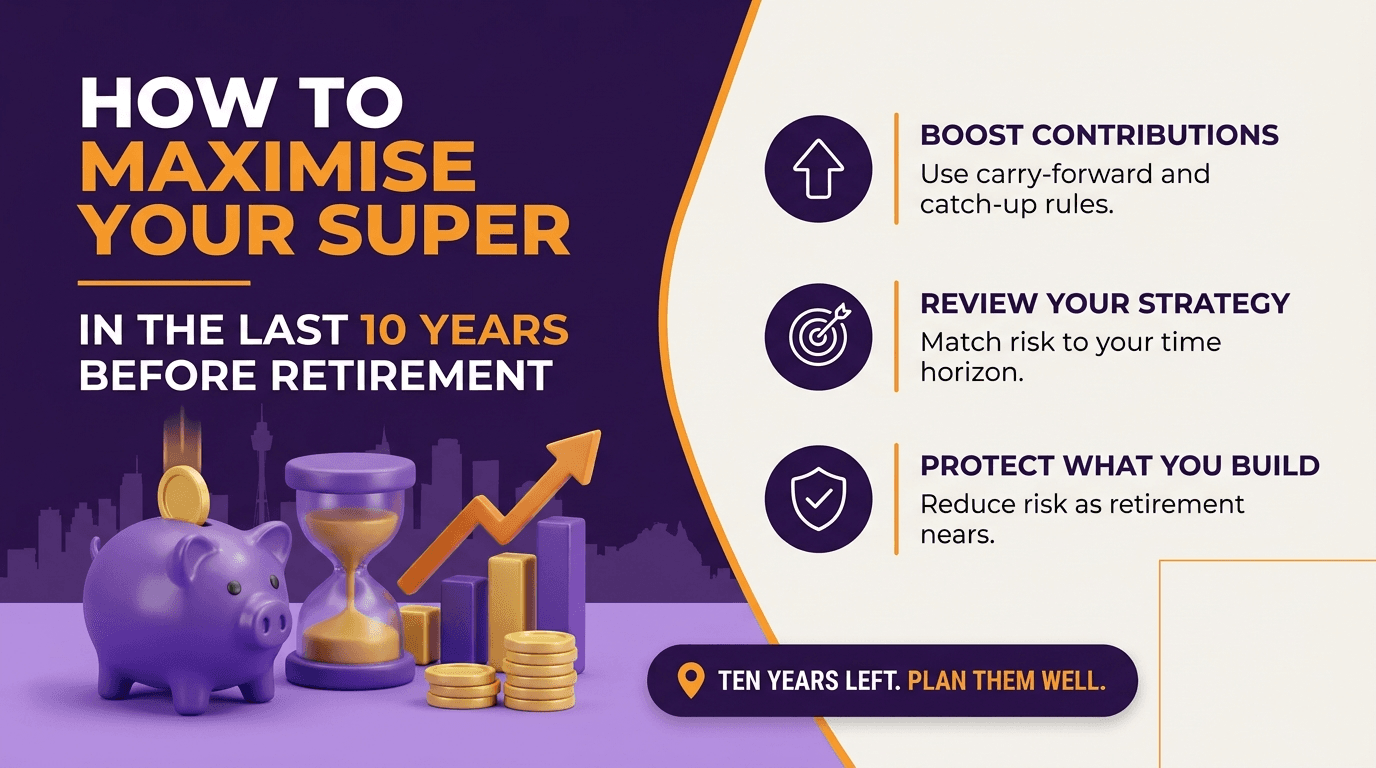
How to Maximise Your Super in the Last 10 Years Before Retirement
The decade before retirement is the highest-leverage planning window most Australians will ever have. Income is typically at its peak, mortgages are reducing, kids are becoming financially independent, and contribution caps still allow meaningful catch-up activity. Decisions made in this window can mean the difference between a comfortable retirement and an anxious one.
The challenge is that many pre-retirees treat this decade like any other. They keep contributions on autopilot, leave investment options on default, and miss strategies that could add hundreds of thousands to their final balance.
This guide outlines the core moves that maximise super in the 10 years before retirement, structured by priority and effectiveness.
Quick Answer
Here are the most important strategies for maximising super in the final decade before retirement:
Maximise concessional contributions every year, including carry-forward where eligible
Use non-concessional contributions to inject after-tax savings, particularly after windfalls or business sales
Consider a transition to retirement (TTR) pension from age 60 to optimise tax
Review your investment option to match your timeline rather than defaulting
Plan downsizer contributions if downsizing the family home from age 55
Address insurance, beneficiaries, and estate planning before they become urgent
Bottom line: The final decade before retirement is where strategy creates the largest dollar impact. The earlier within that decade you act, the better the result.
Why the Last Decade Matters Most
Three factors converge in the 10 years before retirement that make this window uniquely valuable:
Income peaks. Most professionals reach their highest earnings between ages 50 and 60. Higher income means more contribution capacity and bigger tax savings on each contribution.
Compounding remains meaningful. Ten years of growth at 6 to 7% net returns can roughly double a contribution made early in the decade. Late contributions still help, but the gain is smaller.
Strategy choices become irreversible. Decisions made in the last decade often shape retirement income for the next 25 to 30 years. Get them right and the rest follows.
The financial cost of inaction in this window is rarely felt at the time. It shows up later as a smaller balance, a lower retirement income, or a forced compromise on lifestyle.
Bottom line: Time is your most valuable resource at this stage. Treat the decade before retirement as a project, not a default state.
Maximise Concessional Contributions
Concessional contributions include employer Super Guarantee (SG), salary sacrifice, and personal deductible contributions. The cap for 2025-26 is $30,000, rising to $32,500 from 1 July 2026.
The strategy is straightforward but rarely fully executed:
Calculate your current SG contributions for the year
Subtract from the annual cap to find your remaining capacity
Fill that capacity through salary sacrifice or personal deductible contributions
Repeat every year for the full decade
The tax saving compared to your marginal rate is typically:
30% bracket: Approximately 15 cents per dollar saved
37% bracket: Approximately 22 cents per dollar saved
45% bracket: Approximately 30 cents per dollar saved
Over 10 years at the cap, this represents tens of thousands of dollars in tax savings alone, before considering the compounded growth of those contributions inside super.
Bottom line: Maxing concessional contributions every year is the single most effective super strategy for most pre-retirees.
Use Carry-Forward Concessional Contributions
If your total super balance at the previous 30 June was under $500,000, you can use unused concessional cap from up to 5 prior financial years on top of the current year's cap.
Critically, unused cap from 2020-21 expires on 30 June 2026. After that date, those amounts are gone permanently.
For someone in 2026-27 with a balance under $500,000 and full unused caps in prior years, the maximum concessional contribution could be approximately $175,000 in a single year (current year cap of $32,500 plus carry-forward from prior years).
How to check your carry-forward room:
Log into myGov and access the ATO section
Click Super then Information
Find the Carry-forward concessional contributions value
Review unused cap by financial year
Bottom line: The carry-forward window is closing for the oldest year. Pre-retirees with balances under $500,000 should review their position before 30 June 2026.
Make Strategic Non-Concessional Contributions
Non-concessional contributions are after-tax contributions that do not attract a tax deduction. They are particularly useful when you have a windfall (inheritance, business sale, downsizer), surplus savings, or want to top up super outside the concessional system.
Key features in 2026:
The annual cap is $120,000 in 2025-26, rising to $130,000 from 1 July 2026
The bring-forward rule allows up to 3 years of cap in a single year if eligible
From 1 July 2026, the maximum bring-forward contribution rises to $390,000
Eligibility depends on your total super balance at the previous 30 June
For couples, contribution splitting and spouse contributions can also be powerful tools, particularly where one partner has a substantially smaller balance.
Bottom line: Non-concessional contributions are especially valuable for windfalls and pre-retirement top-ups. Watch the bring-forward and total super balance rules carefully.
Consider a Transition to Retirement Strategy
From preservation age (60), you can start a transition to retirement (TTR) pension while still working. Done well, this creates tax efficiency by:
Allowing you to salary sacrifice more aggressively while replacing lost income from the TTR pension
Reducing your personal income tax through the salary sacrifice
Maintaining or increasing your net household income despite redirecting more salary to super
TTR works best when:
You are aged 60 or older
Your marginal tax rate is 30% or higher
Your super balance is large enough for the strategy to make a meaningful difference (typically $300,000+)
You plan to continue working for several years before full retirement
A typical TTR strategy can add $30,000 to $80,000+ to a final super balance over 5 to 7 years, depending on income and contribution levels.
Bottom line: TTR is one of the most under-used strategies in Australian retirement planning. From 60 onward, it deserves serious modelling.
Review Your Investment Option
Most super members remain in the default balanced option indefinitely. For someone in their last decade before retirement, this may or may not be the right choice.
Considerations for investment selection in the final decade:
Investment Style | Typical Asset Mix | Best Suited For |
High growth | 80 to 100% growth assets | 50s with long horizons and high risk tolerance |
Growth | 70 to 85% growth assets | Most pre-retirees aged 50 to 60 |
Balanced | 60 to 75% growth assets | Standard default, suits many but not all |
Conservative | 30 to 50% growth assets | Final 1 to 3 years before retirement, low risk tolerance |
Cash | 0% growth assets | Imminent withdrawal only |
A 50-year-old typically has 25 to 30 years of investment horizon when retirement and post-retirement years are combined. A move to "cash" at 50 effectively ends growth for that period and risks the balance running out in late retirement.
Bottom line: Investment selection should match your timeline, not just your age. Most pre-retirees benefit from growth-oriented options well into their final decade.
Plan Downsizer Contributions
If you are 55 or older and sell your family home, you may be eligible to make a downsizer contribution of up to $300,000 per person ($600,000 per couple) into super.
Key features:
Available from age 55 (no upper age limit)
Does not count toward the non-concessional cap
Does not require meeting a work test
The home must have been owned for at least 10 years
This is one of the most powerful late-stage super strategies for couples downsizing in their 60s, particularly where the family home represents a substantial portion of total wealth.
Bottom line: Downsizer contributions can inject $600,000 into a couple's super in a single transaction. Plan early and verify current eligibility rules.
Practical Examples
Example 1: Anna, 52, Senior Manager Earning $165,000
Anna has $390,000 in super and 13 years to retirement. She has been contributing only at the SG level and has unused carry-forward cap from prior years.
Her strategy:
Maximise concessional contributions of $30,000 in 2025-26, then $32,500 from 2026-27 onward
Use $40,000 of carry-forward concessional cap before the 2020-21 amount expires on 30 June 2026
Switch from balanced to growth investment option, given her 13-year horizon
Implement spouse contribution splitting to balance super between Anna and her partner
Plan a TTR pension at age 60 to optimise tax in her final 5 working years
Modelled outcome: Anna's super reaches approximately $1.05M to $1.15M by age 65, compared to $680,000 on her current trajectory.
Example 2: Greg and Helen, Both 56, Combined Super $640,000
Greg earns $145,000 and Helen earns $85,000. They own their home outright and have 11 years to retirement.
Their strategy:
Both maximise concessional contributions every year for the full decade
Greg uses non-concessional contributions in years he receives bonuses
Helen receives spouse contribution splitting from Greg to balance their super
Both implement a TTR pension at age 60
Plan a downsizer contribution of $400,000 combined when they sell their family home in their late 60s
Modelled outcome: Combined super of approximately $1.6M by age 67, supporting a comfortable retirement well above the ASFA couple benchmark.
Common Mistakes Pre-Retirees Make
Leaving contributions at SG only. Defaulting to employer SG alone wastes the highest-leverage planning window of your working life. Most pre-retirees should be filling the concessional cap every year.
Ignoring carry-forward before it expires. Unused cap from 2020-21 expires on 30 June 2026. Many people with balances under $500,000 are leaving meaningful contribution capacity unused.
Switching to cash at 55. A 55-year-old has 30+ years of investment horizon. Switching to cash creates a near-certain real-terms loss to inflation across that period.
Forgetting binding death benefit nominations. Super does not automatically pass to your estate. Without a valid nomination, the trustee decides distribution.
Not balancing super between partners. Couples often have one partner with significantly more super. Spouse contributions, splitting, and recontribution strategies can balance this and improve overall flexibility.
Holding multiple super accounts. Around 4 million Australians hold two or more accounts, paying duplicate fees. Consolidation takes 10 minutes via myGov.
Engaging an adviser too late. The most valuable strategies require time to compound. Engaging at 64 to plan retirement at 65 forfeits most of the available leverage.
FAQ
How much super should I have 10 years before retirement? For a comfortable retirement target of approximately $630,000 (single) or $730,000 (couple) at age 67, pre-retirees at age 57 should typically have $400,000 to $500,000 (single) or $550,000 to $700,000 (couple) in super to remain on track.
Should I salary sacrifice the maximum every year? For most pre-retirees earning above $80,000, yes, with attention to your concessional cap (currently $30,000, rising to $32,500 from 1 July 2026) and your overall cashflow position. The tax savings are typically substantial.
Is it too late to make a difference if I am 60? No. Even five years of structured contributions, investment review, and TTR strategy can add $100,000 or more to a final balance. The earlier you act, the bigger the result, but late action still matters.
What is the best investment option for someone 5 years from retirement? Most pre-retirees 5 years out benefit from a growth or balanced option, depending on risk tolerance and other assets. Switching entirely to cash typically creates more risk than it removes given likely retirement length.
Can I make catch-up contributions if my balance is over $500,000? The carry-forward concessional contribution rules require your total super balance to be below $500,000 at the previous 30 June. Above that threshold, only the standard annual cap applies.
Are downsizer contributions worth it? For most homeowners 55 and older with substantial home equity and modest super, yes. Downsizer contributions can inject up to $600,000 per couple into super in a tax-effective way without affecting other contribution caps.
What if I am self-employed? Self-employed Australians can make personal deductible contributions up to the concessional cap. The strategies are essentially the same as for employees, but you control the timing and amounts directly.
Ready to Maximise Your Final Decade?
The last 10 years before retirement are the most valuable planning window most Australians will ever have. Book a free 15-minute consultation with the team at What If Advice to discuss what targeted strategy could mean for your final decade.
Visit whatifadvice.com.au to book.
General Advice Disclaimer: This information is general in nature and does not take into account your personal financial situation, needs, or objectives. You should consider whether it is appropriate for you and seek personal financial advice before making any decisions.