Looking for specific financial advice?
This blog provides general educational content. For personalized advice tailored to your unique situation, book a free consultation with our team of ASIC-licensed financial advisers.
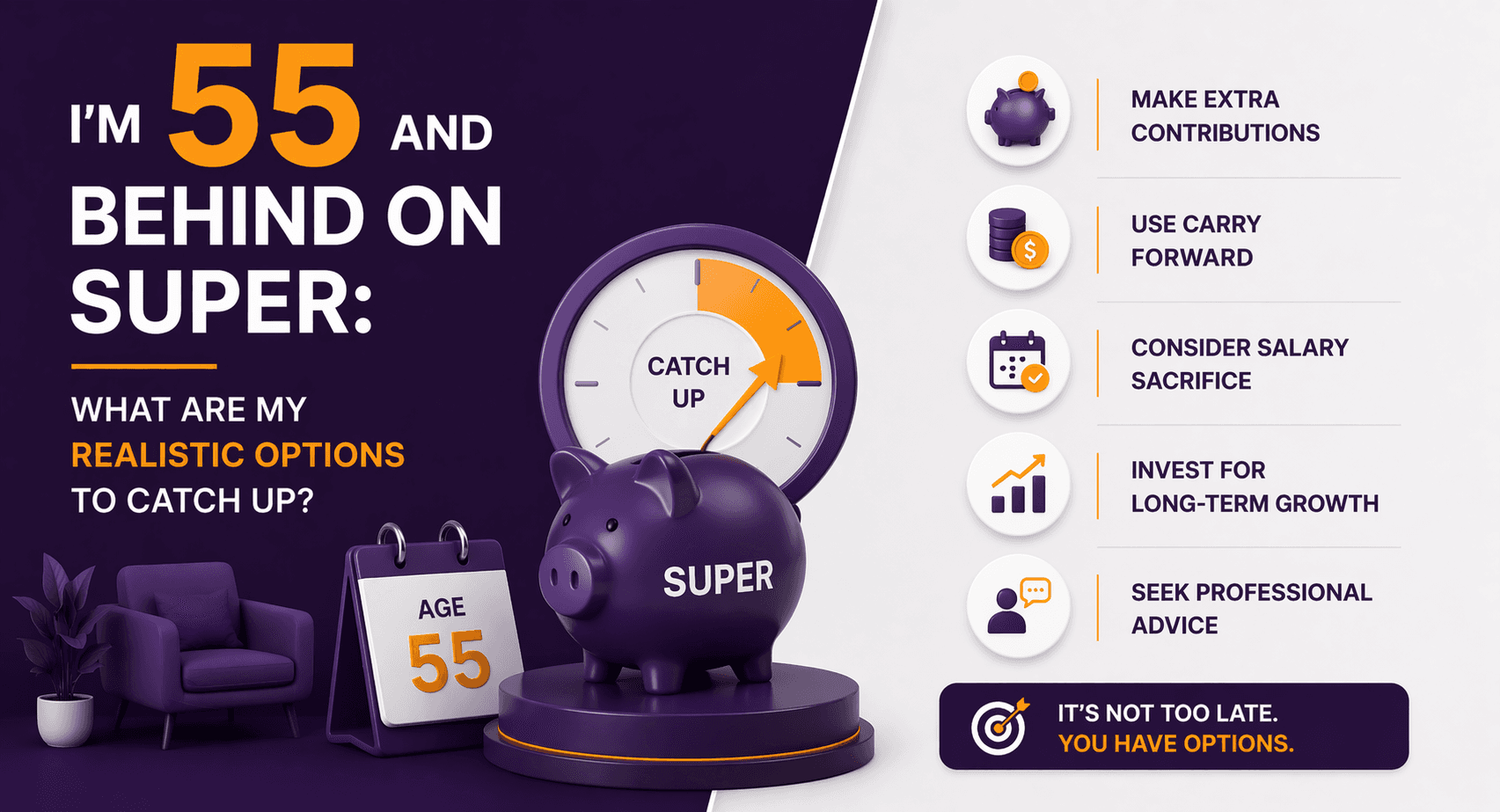
If you’re 55 and looking at your super balance thinking:
“I should have more than this.”
You’re not alone.
Many Australians fall behind on super due to:
career breaks
raising children
business ups and downs
divorce or separation
caring responsibilities
starting late
low employer contributions in earlier decades
The good news?
At 55, you still have time.
Not unlimited time, but enough to meaningfully improve your retirement position if you act strategically.
Let’s walk through your realistic options.
Step One: Define “Behind”
Before panic sets in, clarify:
What super balance do you currently have?
When do you want to retire, 60? 65? Later?
Do you own your home?
Will you qualify for some Age Pension?
“Behind” means different things depending on:
lifestyle goals
retirement age
partner’s super
other assets
For example:
A homeowner planning to retire at 67 may need less than someone renting and retiring at 60.
The first step is modelling your position properly, not comparing yourself to headlines.
Option 1: Maximise Concessional Contributions
This is usually the most powerful catch-up tool.
Concessional contributions include:
employer Super Guarantee
salary sacrifice
personal contributions you claim as a tax deduction
There is an annual concessional cap (check current ATO limits for the year you’re contributing).
Why this works
Concessional contributions:
reduce your taxable income
are taxed at concessional rates inside super
accelerate retirement savings
At 55, even 5–10 strong contribution years can significantly improve outcomes.
Example
If you:
Earn $120,000
Maximise concessional contributions each year
Invest for 7–10 years
The compounding effect can meaningfully shift your retirement balance.
Option 2: Use Carry-Forward Concessional Contributions
If you haven’t fully used your concessional cap in previous years, you may be eligible to carry forward unused amounts (subject to total super balance thresholds and ATO rules).
This is especially useful if:
You’ve had inconsistent income
You’re earning more now
You had years with minimal super contributions
You want to make a larger deductible contribution in a high-income year
For someone at 55, this can be one of the most effective tax-smart catch-up strategies.
Option 3: Delay Retirement Slightly
This is underrated.
Retiring at:
60 vs 63
63 vs 65
65 vs 67
can dramatically improve retirement sustainability.
Why?
More contribution years
More compounding
Fewer retirement years to fund
Better Age Pension positioning
Higher super balance at retirement
Working even part-time for a few extra years can change everything.
Option 4: Transition to Retirement (TTR) Strategy
If you reach preservation age (which is 60 for most Australians born after 1 July 1964), a Transition to Retirement strategy may help.
This can allow you to:
Access part of your super
Continue working
Potentially salary sacrifice more
Smooth income while boosting super
TTR is not automatically a tax miracle, but in the right scenario, it can help optimise final working years.
Option 5: Non-Concessional Contributions (If Affordable)
If you have:
Savings
An inheritance
A property sale
Business profits
You may consider non-concessional contributions (after-tax money), subject to caps and eligibility.
This doesn’t reduce tax today, but it moves money into a concessionally taxed environment.
For some people at 55, this is useful if:
Retirement is 10+ years away
They want long-term growth
They have surplus capital
Option 6: Review Investment Strategy
If you’re 55 and very conservative in super, you may be limiting growth.
While risk management is important, too conservative an allocation can reduce long-term returns.
At 55, you may still have:
10–15 years to retirement
25–35 years of retirement ahead
That’s still a long time horizon.
Your investment mix should reflect:
Risk tolerance
Retirement timeline
Other assets
Emotional comfort with volatility
A review can improve outcomes without increasing contributions.
Option 7: Reduce Debt Before Retirement
Super isn’t the only lever.
If you:
Pay off your mortgage
Reduce personal debt
Lower fixed expenses
You reduce the income you’ll need in retirement.
Owning your home outright can:
Improve Age Pension positioning
Reduce required super balance
Lower stress significantly
Sometimes debt reduction gives more retirement confidence than chasing returns.
Option 8: Plan for Partial Age Pension
If you’re behind on super, the Age Pension becomes more relevant.
Understanding:
Assets test
Income test
How super is assessed
How housing affects eligibility
can help you design a retirement that blends:
Super income
Age Pension
Modest lifestyle expectations
This is realistic planning, not failure.
Option 9: Adjust Retirement Lifestyle Expectations
This isn’t defeat, it’s clarity.
Ask:
Do I need to retire fully at 60?
Would part-time consulting suit me?
Can I phase retirement over 5 years?
What spending truly matters?
Retirement is flexible now.
Many Australians:
Work casually
Contract part-time
Monetise skills
Downsize lifestyle
That flexibility reduces pressure on super.
What Not to Do
1. Panic and withdraw super early
Accessing super early (if eligible) without modelling can hurt long-term security.
2. Take high-risk investment bets
Trying to “double your super quickly” often ends badly.
3. Ignore the problem
Doing nothing guarantees the outcome doesn’t improve.
4. Rely solely on selling your house
Property values and timing aren’t guaranteed.
A Realistic Catch-Up Framework at 55
Here’s a practical sequence:
Step 1: Review current super balance and retirement age target.
Step 2: Maximise concessional contributions (within caps).
Step 3: Check eligibility for carry-forward contributions.
Step 4: Review investment allocation.
Step 5: Consider working slightly longer or phasing retirement.
Step 6: Model Age Pension integration.
Step 7: Review annually.
Small consistent changes over 10 years matter.
Key Takeaways
Being behind at 55 is common, and fixable
Concessional contributions are your strongest lever
Carry-forward rules can be powerful
Delaying retirement even slightly helps significantly
Investment allocation matters
Debt reduction improves retirement confidence
A blended super + Age Pension strategy is realistic
FAQ
1) Is 55 too late to catch up on super?
No. You may still have 10+ contribution years ahead. Strategic action now can significantly improve outcomes.
2) How much should I contribute at 55?
That depends on your income, caps and goals. Many aim to maximise concessional contributions if affordable.
3) Should I invest more aggressively to catch up?
Not necessarily. Increased risk should be balanced with your time horizon and comfort level.
4) What if I can’t afford extra contributions?
Focus on reducing debt, delaying retirement slightly and understanding Age Pension eligibility.
5) Will the Age Pension help if I’m behind?
Possibly. Many Australians with moderate super balances qualify for part pension, which can supplement retirement income.
If you’re 55 and behind on super, the worst move is assuming it’s too late.
You still have:
contribution capacity
compounding years
structural strategies
retirement flexibility
The key is moving from anxiety to structured action.
Want a realistic catch-up plan?
At What If Advice, we help Australians in their 50s model retirement properly, combining super contributions, Age Pension planning and lifestyle design.
Book a Retirement & Super Workshop and build a practical catch-up strategy tailored to your situation.
General Advice Disclaimer
This information is general in nature and does not take into account your personal financial situation, needs, or objectives. You should consider whether it is appropriate for you and seek personal financial advice before making any decisions.