Looking for specific financial advice?
This blog provides general educational content. For personalized advice tailored to your unique situation, book a free consultation with our team of ASIC-licensed financial advisers.
What If You Could Save for Your Kids' School Fees Without Adding a Cent to Your Own Tax Return?
Private school fees, university costs, or even a solid head start into adulthood, most parents fund this from everyday savings or an investment account in their own name, quietly paying tax on the earnings at their own marginal rate every single year, often the highest rate they'll ever pay. Investment bonds (sometimes called insurance bonds) are a purpose-built, tax-advantaged structure specifically designed for exactly this kind of medium-to-long-term savings goal, and most parents have simply never had them explained properly.
TL;DR
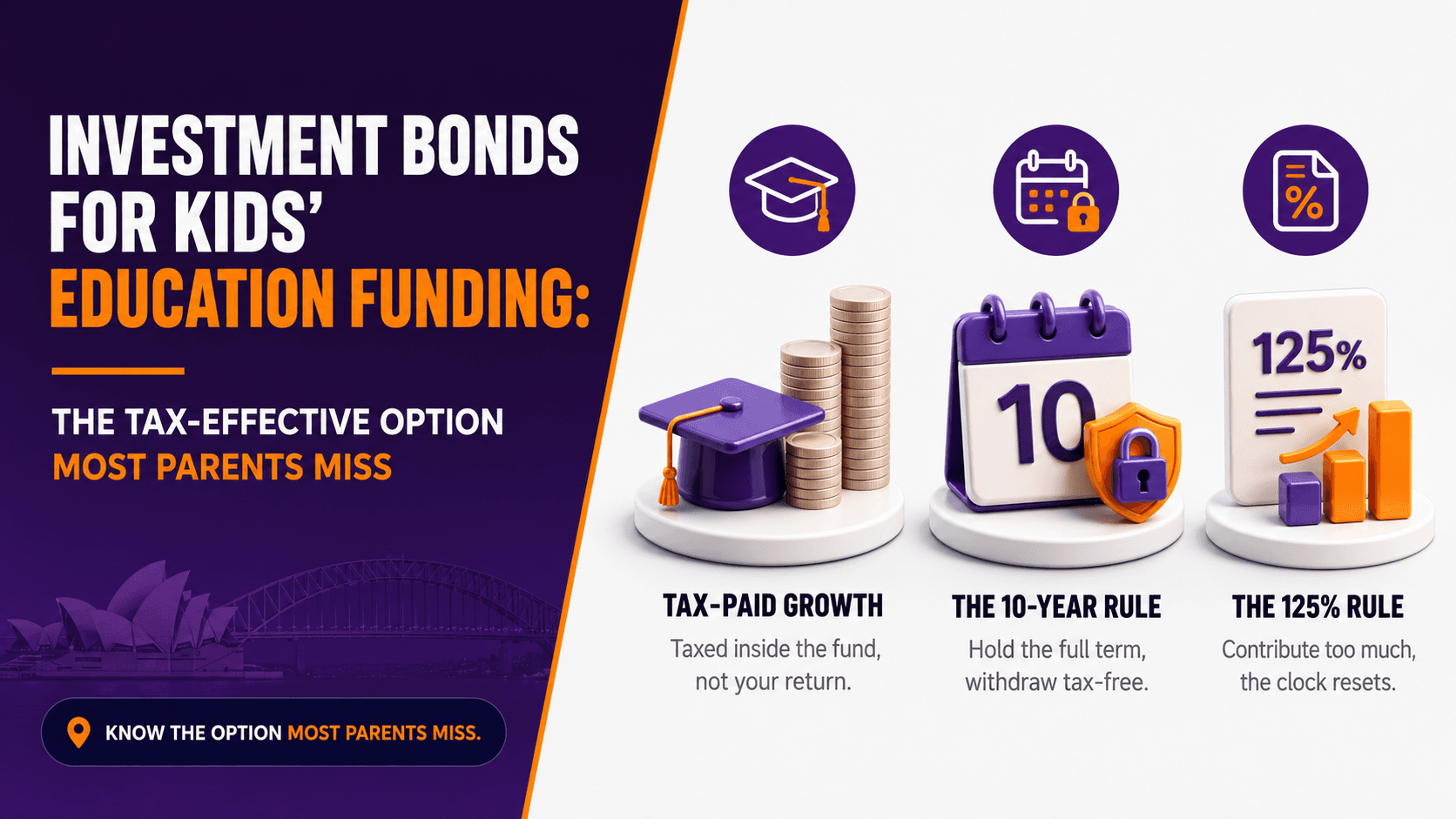
An investment bond is a tax-paid investment structure where the fund manager pays tax on earnings internally at the company tax rate (currently 30%, a rate that can change over time and should be verified before relying on it for planning), rather than the investment income being added to your personal tax return each year.
If held for the full 10-year rule and contribution limits are respected, withdrawals are generally tax-free to you, regardless of your personal marginal tax rate.
The 10-year clock can be reset early if you need to access funds sooner, but doing so may mean some of the growth becomes assessable at your marginal rate with a tax offset for tax already paid inside the bond.
There's a contribution rule (the "125% rule"): each year's contribution can generally be up to 125% of the prior year's contribution without restarting the 10-year clock, which matters for planning regular top-ups.
Investment bonds sit outside your own name for tax purposes, meaning the earnings don't affect your personal taxable income, Medicare Levy Surcharge calculations, or means-tested benefits in the way a personal investment account would.
They can be structured with a child as the eventual beneficial owner, transferring at a nominated age without triggering capital gains tax at that point.
They're not for every timeframe. The tax benefits are specifically built around a 10+ year horizon, making them a poor fit for shorter-term savings goals.
Bottom line: for parents with a genuine 10+ year runway before the money's needed, investment bonds solve a specific tax-drag problem that a standard savings or investment account in a parent's own name doesn't.
Jump to a Section
What an Investment Bond Actually Is
The 10-Year Rule Explained
The 125% Contribution Rule
Investment Bonds vs Other Education Savings Options
Structuring for a Child Beneficiary
Worked Example: Two Families, Two Structures
Common Mistakes
FAQ
What an Investment Bond Actually Is
An investment bond (also called an insurance bond, reflecting its historical origin as a life-insurance-linked product) is an investment structure offered by fund managers where the underlying fund itself pays tax on investment earnings internally, generally at the company tax rate of 30% (current rate, subject to change), rather than the earnings being reported on your personal tax return each year the way a standard managed fund or share portfolio would be. You invest a lump sum (and often make ongoing contributions), the fund grows over time net of that internal tax, and, subject to the rules below, withdrawals can ultimately be received tax-free.
This structure is genuinely different from simply holding an investment in your own name: with a personal investment, you pay tax annually at your own marginal rate on income and realised gains, regardless of whether you touch the money. With an investment bond, the tax is handled internally by the fund, and you generally only need to consider your personal tax position if you withdraw before satisfying the bond's rules.
Not sure whether an investment bond fits your education savings timeline? A free 15-minute chat will clarify it quickly. Call 1800 942 843.
Bottom line: the core advantage is shifting where and how the tax gets paid, inside the fund at a flat rate, rather than on your own tax return at your marginal rate, which matters most for parents in higher tax brackets.
The 10-Year Rule Explained
This is the central mechanic of investment bonds. If the bond is held for 10 full years from the date of the initial investment, and contributions have followed the permitted contribution rule (below), withdrawals, including all the accumulated growth, are generally not required to be included in your assessable income at all. This is because the tax has already effectively been dealt with inside the fund over that period.
If you need to withdraw before the 10-year mark, it doesn't mean total loss of benefit. A portion of the growth may become assessable at your marginal tax rate, but you generally receive a tax offset reflecting the tax already paid inside the fund, reducing double taxation. The exact treatment depends on which year within the 10-year period the withdrawal occurs.
Bottom line: the 10-year rule rewards patience specifically. This product is built for a known, multi-year goal like funding a child's future school or university fees, not for money you might need access to at short notice.
The 125% Contribution Rule
Investment bonds allow ongoing contributions, but there's a specific rule to understand: in any given year, you can generally contribute up to 125% of the previous year's contribution without restarting the 10-year clock. Contribute more than that in a given year, and the 10-year period can reset from that point, delaying when the full tax-free withdrawal treatment applies.
This matters for planning. Parents wanting to make regular top-up contributions (for example, adding to the bond each year as their income grows) need to structure the contribution schedule carefully from the outset, rather than making an oversized one-off top-up later that inadvertently resets the clock.
Planning regular contributions and want the structure set up properly from year one? Email clientservices@whatifadvice.com.au and we'll map out a contribution schedule that actually works with the rules.
Bottom line: the 125% rule rewards planning your contribution schedule in advance. An unplanned lump-sum top-up down the track can cost you years of progress toward the tax-free 10-year milestone.
Investment Bonds vs Other Education Savings Options
Feature | Investment Bond | Personal Investment Account | Family Trust |
Tax treatment | Paid internally at ~30%, tax-free after 10 years | Taxed annually at your marginal rate | Distributed income taxed at beneficiary's marginal rate |
Complexity/cost | Relatively simple to set up | Simple | Requires trust deed, ongoing admin, accounting cost |
Affects personal taxable income | No (if held to term) | Yes, every year | Depends on distribution decisions |
Flexibility to access early | Possible, with partial tax implications | Fully flexible | Depends on trust deed and distribution timing |
Best suited for | Known 10+ year goal, higher personal tax bracket | Shorter timeframes, full flexibility needed | Larger, more complex family wealth structures |
Weighing up which of these three actually fits your family's situation? A free 15-minute chat can help you compare them against your own numbers. Book online or call 1800 942 843.
Bottom line: investment bonds sit in a useful middle ground, meaningfully more tax-effective than a personal account for higher earners, considerably simpler and cheaper than setting up and running a family trust.
Structuring for a Child Beneficiary
Investment bonds can be structured so that ownership (or the benefit of the bond) transfers to a nominated child at a specified age, commonly used so the bond effectively "becomes theirs" at 18, 21, or 25, depending on how it's set up. Because of how the bond's internal tax structure works, this kind of ownership transfer generally doesn't trigger a capital gains tax event at the point of transfer. This reflects current, legislated tax treatment of investment bonds specifically, not a Budget-announced or proposed change, though like any tax rule it's subject to future legislative change and should be verified at the time you're planning a transfer.
This can be a deliberate way to build a savings pool specifically earmarked for a child's education (or broader financial head-start) without it sitting as an asset directly in the parent's name for the full period, while still retaining control over the fund during the child's minority.
Bottom line: this structuring detail is often the deciding factor for parents specifically wanting the fund to end up genuinely "belonging" to the child at a set age, rather than remaining a parental asset indefinitely.
Worked Example: Two Families, Two Structures
(Figures are illustrative only. Actual outcomes depend on investment performance, contribution patterns, and tax rates in force at the relevant time, all of which can change over such a long period.)
Family A, The Okonkwos (personal investment account): Invest $30,000 when their daughter is born, adding $3,000 a year, into a managed fund held in the higher-earning parent's name. Over 15 years, the fund's earnings and realised gains are added to that parent's tax return annually, taxed at their marginal rate (in a higher tax bracket for several of those years), reducing the effective compounding of the fund by a meaningful margin over the period compared to a lower-taxed structure.
Family B, The Hendersons (investment bond): Invest a similar $30,000 initial amount into an investment bond when their son is born, with contributions structured to stay within the 125% rule each year. Tax on earnings is paid inside the fund at the 30% company rate throughout. At the 10-year mark (with the boy now 10, funds continuing to grow toward his later high school and university years), any withdrawal from that point is generally tax-free to the family, regardless of either parent's personal marginal tax rate at the time of withdrawal, which by then may be considerably higher than 30% given career progression.
Bottom line: the structural difference compounds exactly like a fee difference would. A lower, flatter internal tax rate over a decade-plus horizon can meaningfully outperform a personal account taxed annually at a rising marginal rate.
Common Mistakes
Making an oversized top-up contribution without checking the 125% rule. This can inadvertently reset the 10-year clock, delaying the tax-free milestone by years.
Setting up a bond for a short-term goal. The tax advantage is specifically built around the 10-year holding period. Using one for a 3 to 5 year goal misses the point of the structure.
Assuming it works exactly like a managed fund for tax purposes. The internal tax treatment and withdrawal rules are genuinely different and need to be understood before committing.
Not considering who should be the bond owner. Ownership structuring affects who's responsible for decisions and how a later transfer to the child works.
Ignoring the impact of withdrawing early "just in case." Partial early withdrawals can trigger assessable income in the withdrawal year, even with the tax offset. Understand this before assuming full flexibility.
Treating it as a replacement for advice on the broader education funding plan. An investment bond is one tool among several. It works best as part of a considered overall funding strategy, not chosen in isolation.
FAQ
Are investment bonds the same as life insurance bonds? They're closely related. Investment bonds are often structured with a small life insurance component historically, which is part of why they're sometimes called "insurance bonds," though the primary purpose for most buyers today is the investment and tax structure, not life cover.
Can I withdraw from an investment bond before 10 years if I need to? Yes, you retain access to the funds, but withdrawing before the 10-year mark may mean part of the growth becomes assessable income at your marginal tax rate, with an offset for tax already paid inside the fund.
What happens if I stop making contributions partway through? Generally this doesn't cause a problem for the 10-year clock on the original investment and prior contributions. It's specifically making a contribution that exceeds 125% of the prior year's amount that risks resetting the clock, not simply pausing.
Can grandparents contribute to an investment bond for a grandchild? Yes, this is a common use case. Grandparents can establish or contribute to an investment bond intended to benefit a grandchild's education, subject to the same contribution and ownership structuring considerations.
Do investment bonds affect Family Tax Benefit or other means-tested payments? This depends on the specific payment and how it assesses income. Because bond earnings don't appear on the owner's personal tax return in the same way as other investments, the effect can differ from a standard investment account, and is worth checking against your specific circumstances with the relevant agency or an adviser.
Is there a minimum investment amount for an investment bond? This varies by provider, but many have a relatively accessible minimum initial investment, making them available to a broad range of family savings goals, not just very large lump sums.
How do investment bonds compare to a term deposit for education savings? A term deposit offers simplicity and capital certainty but taxes interest annually at your marginal rate with no equivalent 10-year tax benefit. The comparison really comes down to time horizon and your tax position.
Can I have more than one investment bond for different children? Yes, many parents set up a separate bond for each child, which can simplify eventually transferring ownership to the specific child intended to benefit from each one.
What happens to the bond if I (the owner) pass away before the 10 years is up? This depends on how the bond is structured and whether a beneficiary is nominated. Some bonds pass to a nominated beneficiary outside the estate, and specific rules apply, which is worth understanding at setup rather than assuming a default outcome.
Is an investment bond better than just paying extra off the mortgage and using redraw for school fees? It depends on your mortgage interest rate versus the bond's likely investment return and tax treatment, your risk tolerance, and how disciplined you'd be about redraw. This is a genuinely comparative decision worth modelling specifically for your situation.
Ready to See If This Fits Your Timeline?
Ready to see whether an investment bond actually fits your timeline and tax position for funding your kids' education? This is a structure that rewards planning ahead, worth understanding properly before locking in a contribution schedule.
Call us: 1800 942 843
Book online: free 15-minute chat, no cost, no pressure
Still asking what if school fees just come out of whatever's left over each year? A structure built for exactly this goal usually beats winging it.
WIAA has advised 1,000+ clients across our Toowong, Grange, and Melbourne CBD offices, operating under AFSL 528250 as an Authorised Representative of Beryllium Advisers Pty Ltd.
General Advice Disclaimer: This article contains general information only and does not take into account your personal objectives, financial situation, or needs. It does not constitute personal financial or tax advice, and should not be relied upon as such. Tax treatment of investment bonds, including the 10-year rule and 125% contribution rule, is general in nature, subject to legislative change, and should be verified with a financial adviser or tax professional based on your specific circumstances.