Looking for specific financial advice?
This blog provides general educational content. For personalized advice tailored to your unique situation, book a free consultation with our team of ASIC-licensed financial advisers.
What If Your Business's Biggest Asset Walked Out the Door Tomorrow, In an Ambulance?
Every business owner insures the building, the stock, the equipment. Fewer insure the person whose relationships, technical knowledge, or sales ability the business actually runs on, often the owner themselves, or a co-founder, or the one salesperson who holds 40% of the client relationships. If that person dies, becomes disabled, or is diagnosed with a serious illness, the business doesn't just lose a person; it can lose revenue, credit facilities, client confidence, and time to find or train a replacement, all at once. Key person insurance is built specifically for that gap, and it's one of the most under-purchased covers in Australian small business.
TL;DR
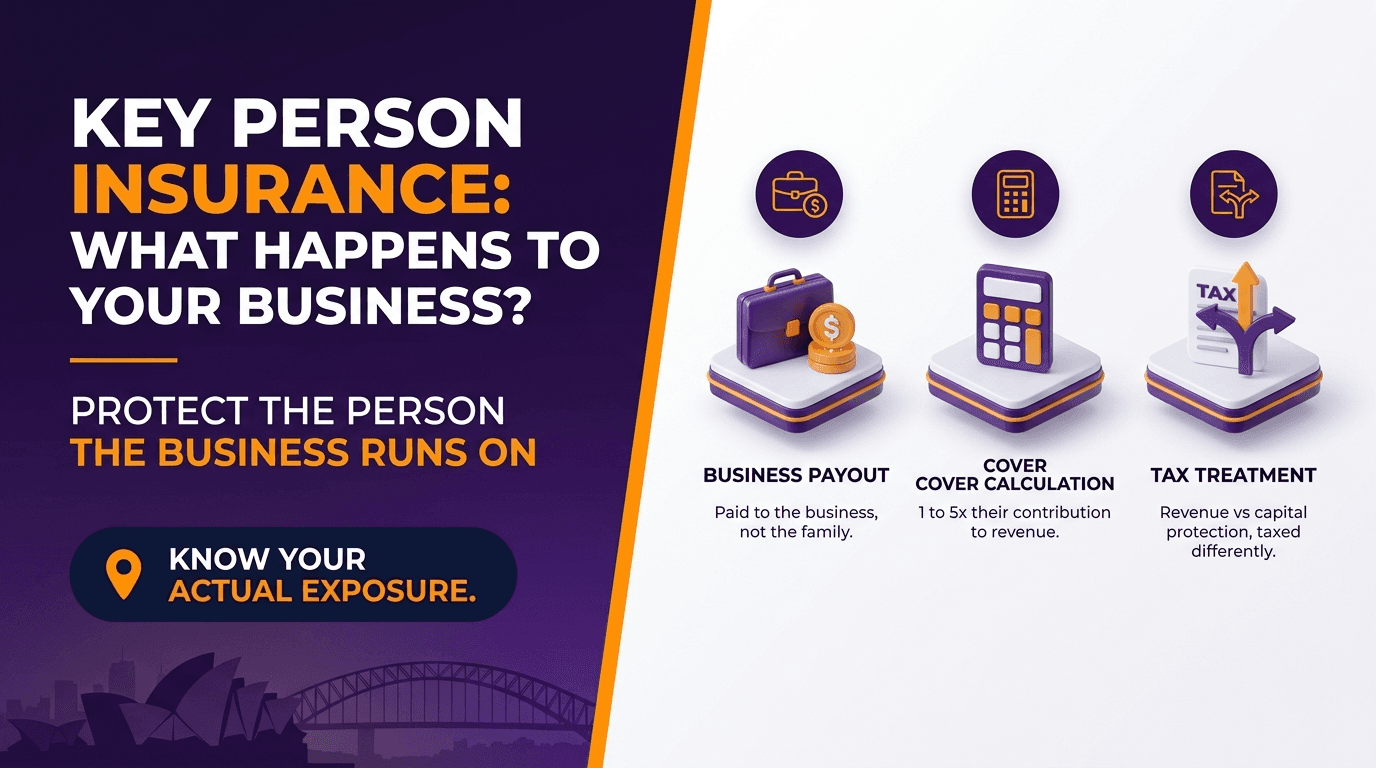
Key person insurance pays the business (not a family member) a lump sum if a critical person dies, becomes totally and permanently disabled, or suffers a critical illness, depending on the cover chosen.
It's designed to cover business impact, not personal/family needs: lost profit, replacement/recruitment costs, or repaying business debt tied to that person.
Calculating the right amount typically uses a multiple of 1 to 5x the key person's contribution to revenue or profit, or a fixed figure tied to specific business debts or costs.
Tax treatment depends on the purpose of the cover: premiums for revenue protection can be tax-deductible with a taxable payout, while capital protection premiums are generally non-deductible with a tax-free payout. Getting this wrong can be expensive.
It's different from buy/sell insurance: key person cover protects business continuity/revenue, buy/sell cover specifically funds the purchase of a departing owner's share.
Ownership and beneficiary structure matters: the business itself typically owns the policy and receives the payout, not the key person's estate.
Premiums are generally cheaper than people expect relative to the financial exposure they cover, but cost still depends on age, health, and the sum insured.
Bottom line: if your business would genuinely struggle, financially, not just emotionally, without a specific person, that's the exact gap key person insurance is built to close.
Jump to a Section
What Key Person Insurance Actually Covers
How Much Cover Do You Actually Need?
Tax Treatment: Revenue vs Capital Protection
Key Person Insurance vs Buy/Sell Insurance
Who Should Be Insured (It's Not Always the Owner)
Worked Example: Two Businesses, One Risk
Common Mistakes
FAQ
What Key Person Insurance Actually Covers
Key person insurance pays a lump sum benefit to the business, not the individual or their family, when a nominated key person dies, becomes totally and permanently disabled (TPD), or is diagnosed with a specified critical illness, depending on which covers are included in the policy. The business, as policy owner and beneficiary, then uses that payout for business purposes: covering a revenue gap, funding recruitment and training of a replacement, repaying business debt that relied on that person's involvement, or reassuring lenders and clients that the business can continue operating.
This is fundamentally different from personal life insurance or income protection, which pays the individual or their family for personal financial needs. Key person cover is entirely about protecting the business's financial position.
Not sure if your business even has a "key person" gap, or who it would actually be? A free 15-minute chat will map it out fast. Call 1800 942 843.
Bottom line: this isn't insurance on a person's life for their family's benefit, it's insurance on a business risk, with the business itself as the one that gets paid.
How Much Cover Do You Actually Need?
There's no single formula, but two common approaches:
Revenue/profit multiple method: insurers or advisers often use a multiple (commonly 1 to 5x) of the key person's contribution to annual revenue or gross profit, reflecting how long it would realistically take to replace their impact.
Specific liability method: insuring a fixed amount tied to a concrete number, such as outstanding business loans personally guaranteed by that person, or the cost of recruiting and training a replacement plus lost productivity during the transition.
Businesses often underestimate this figure because they think about salary replacement rather than the fuller picture: lost sales relationships, delayed projects, lender confidence, and the real-world time it takes to find someone equally capable, often quoted around 6 to 18 months for a genuinely critical role (indicative only, and highly dependent on the role and industry).
Not sure where your business would land on that multiple, or what the right sum insured actually is? A free 15-minute chat can work through the numbers with you. Call 1800 942 843 or email clientservices@whatifadvice.com.au.
Bottom line: sizing the cover around "what would this actually cost the business" rather than "what do we pay them" is where most of the value in the exercise gets found.
Tax Treatment: Revenue vs Capital Protection
This is where key person insurance gets genuinely technical, and where businesses commonly get it wrong without advice. Broadly:
Revenue protection purpose (covering loss of profit/income while a replacement is found): premiums can generally be tax-deductible, but the payout is then generally assessable income to the business.
Capital protection purpose (covering a capital need, like repaying a business loan): premiums are generally not tax-deductible, but the payout can generally be received tax-free.
The purpose has to be genuinely established and documented at the time the policy is taken out. You can't simply pick whichever tax treatment sounds better after a claim is made. Getting the structuring wrong can mean losing a deduction you thought you had, or facing an unexpected tax bill on a payout you assumed was clean.
This is a conversation for your tax adviser and financial adviser together. Email tax@whatifadvice.com.au and we'll help make sure the structure actually matches the purpose.
Bottom line: the tax outcome is determined by how and why the policy was set up, not by what you'd prefer after the fact. Structure it properly from day one.
Key Person Insurance vs Buy/Sell Insurance
These two get bundled together constantly, and while they're related, they solve different problems.
Feature | Key Person Insurance | Buy/Sell Insurance |
Purpose | Protect business revenue/continuity | Fund the purchase of a departing owner's share |
Who's typically insured | Any critical person (owner, partner, key employee) | Business owners/partners specifically |
Trigger event | Death, TPD, or critical illness of key person | Death, TPD, or critical illness of an owner, triggering a buyout |
Payout destination | The business (for operational impact) | Typically directed toward buying the exiting owner's equity |
Common pairing | Sometimes combined in businesses with owner-operators | Usually paired with a formal buy/sell agreement |
Bottom line: if you have business partners, you likely need both. Key person cover for the operational shock, buy/sell cover to actually fund an ownership transition cleanly.
Who Should Be Insured (It's Not Always the Owner)
It's tempting to assume key person insurance is only about insuring "the owner," but the actual key person in a business is whoever's absence would create the biggest financial hole. That's sometimes a senior salesperson holding the client relationships, a technical specialist whose knowledge isn't documented anywhere else, or an operations lead who's the only one who understands how the business actually runs day to day. Larger businesses may have two or three key people worth insuring separately.
Bottom line: "key person" is a financial-impact question, not a job-title question. The exercise is worth doing properly rather than defaulting to whoever's name is on the door.
Worked Example: Two Businesses, One Risk
(Figures below are illustrative worked examples only, not typical or guaranteed outcomes. Actual premiums, payouts, and replacement timeframes depend on individual circumstances, insurer, and underwriting.)
Business A, Harlow Consulting (no key person cover): A boutique consultancy generates 60% of its revenue through relationships held personally by its founder, Rachel. Rachel is diagnosed with a serious illness and is unable to work for eight months. Revenue drops sharply during that period, a key client contract isn't renewed, and the business draws down a line of credit to cover fixed costs. There's no lump sum to soften the gap. The business absorbs the full financial impact directly.
Business B, Ferro Engineering (key person cover in place): A similar-sized engineering firm has $750,000 of key person cover on its lead technical director, Wei, structured for revenue protection with advice from their adviser and accountant. When Wei has a serious health event, the business receives a lump sum payout that funds a contract technical hire for 10 months while Wei recovers, keeps existing projects on track, and avoids drawing on the business's credit facility. The premium cost over the prior three years: roughly $9,000 total in this example, a small fraction of the payout that protected continuity when it mattered.
Bottom line: the premium cost is small and predictable; the exposure it's insuring against is neither. That asymmetry is the entire case for key person cover.
Common Mistakes
Only insuring the business owner, not other genuinely critical staff. The financial impact of losing a top salesperson or technical lead can rival losing an owner.
Underestimating the sum insured by thinking "salary" instead of "business impact." Replacement, recruitment, and lost revenue usually far exceed a person's annual pay.
Getting the revenue vs capital protection structuring wrong. This affects both premium deductibility and whether the payout is taxed. Get it right from the start, not after a claim.
Confusing key person insurance with buy/sell insurance. They solve different problems and a business with multiple owners often needs both, not one instead of the other.
Never reviewing the cover as the business grows. A sum insured set five years ago may badly understate current business value and risk exposure.
Not documenting the purpose of the policy at inception. Tax treatment depends on establishing intent early. Retrofitting a rationale later doesn't hold up.
FAQ
Is key person insurance the same as life insurance? No. Life insurance pays a person's estate or nominated beneficiaries for personal/family purposes; key person insurance pays the business itself for business continuity purposes, even though the underlying policy can sometimes use similar life/TPD/trauma building blocks.
Can a sole trader take out key person insurance on themselves? Not in the usual sense, since a sole trader's business isn't a separate legal entity that can own a policy and receive its own payout. The practical alternative is usually a combination of personal income protection (to replace lost earnings if you can't work) and personal life/TPD cover (to protect dependants and cover business debts you've personally guaranteed), structured with your own financial situation in mind rather than the business's.
Are key person insurance premiums always tax-deductible? No. Deductibility depends on whether the cover is structured for revenue protection or capital protection purposes, and this needs to be established properly with a tax adviser, not assumed either way.
How is the sum insured for key person cover decided? Common methods include a multiple of the key person's contribution to revenue or profit, or a fixed figure tied to specific business debts or replacement costs. There's no single mandated formula.
Does key person insurance cover redundancy or resignation? No. It covers specified insurable events like death, total and permanent disability, or critical illness, not someone simply leaving the business voluntarily.
Can a business insure more than one key person? Yes, and many do. Larger or more specialised businesses often insure two or three individuals whose absence would create a significant financial gap.
Who owns the policy, the business or the key person? Typically the business (or a related trust/company structure) owns the policy and is the beneficiary, since the payout is meant to address the business's financial exposure.
Does key person insurance replace the need for a succession or buy/sell plan? No. It can fund part of a succession plan's financial needs, but it doesn't replace the legal agreements (like a buy/sell agreement) that actually govern what happens to ownership.
How often should key person cover be reviewed? At minimum whenever the business's revenue, structure, or key personnel change materially. An outdated sum insured based on an old, smaller business understates real exposure.
Is key person insurance worth it for a very small business? Often yes, proportionally. Smaller businesses are frequently more concentrated around one or two individuals, meaning the relative impact of losing a key person can be even higher than in a larger, more diversified business.
Ready to Find Your Business's Actual Exposure?
Ready to find out what your business's actual key-person exposure looks like, and whether it's properly covered? This is a fast, practical conversation. Bring the numbers, leave with clarity on the gap and what closing it would cost.
Call us: 1800 942 843
Book online: free 15-minute chat, no cost, no pressure
Still asking what if it never happens? Most business owners insure the building before they insure the person the building's revenue actually depends on.
WIAA has advised 200+ business clients across our Toowong, Grange, and Melbourne CBD offices, operating under AFSL 528250 as an Authorised Representative of Beryllium Advisers Pty Ltd.
General Advice Disclaimer: This article contains general information only and does not take into account your personal objectives, financial situation, or needs. It does not constitute tax or legal advice, and should not be relied upon as such. Tax treatment of key person insurance premiums and payouts depends on individual circumstances and should be verified with a tax professional. Cover types, structuring options, and costs referenced are general guides only and are subject to change.