Looking for specific financial advice?
This blog provides general educational content. For personalized advice tailored to your unique situation, book a free consultation with our team of ASIC-licensed financial advisers.
If you’re shopping for a home loan, you’ve probably asked the question:
“Should I use a mortgage broker or go directly to my bank?”
It’s a smart question, because the choice can affect:
the interest rate you get
the fees you pay
how long approval takes
the range of lenders available
and whether your loan setup fits your long-term plans
The good news: both options can work well, depending on your circumstances.
The key is understanding what each option does best, and what the common pitfalls are, so you can make a confident decision.
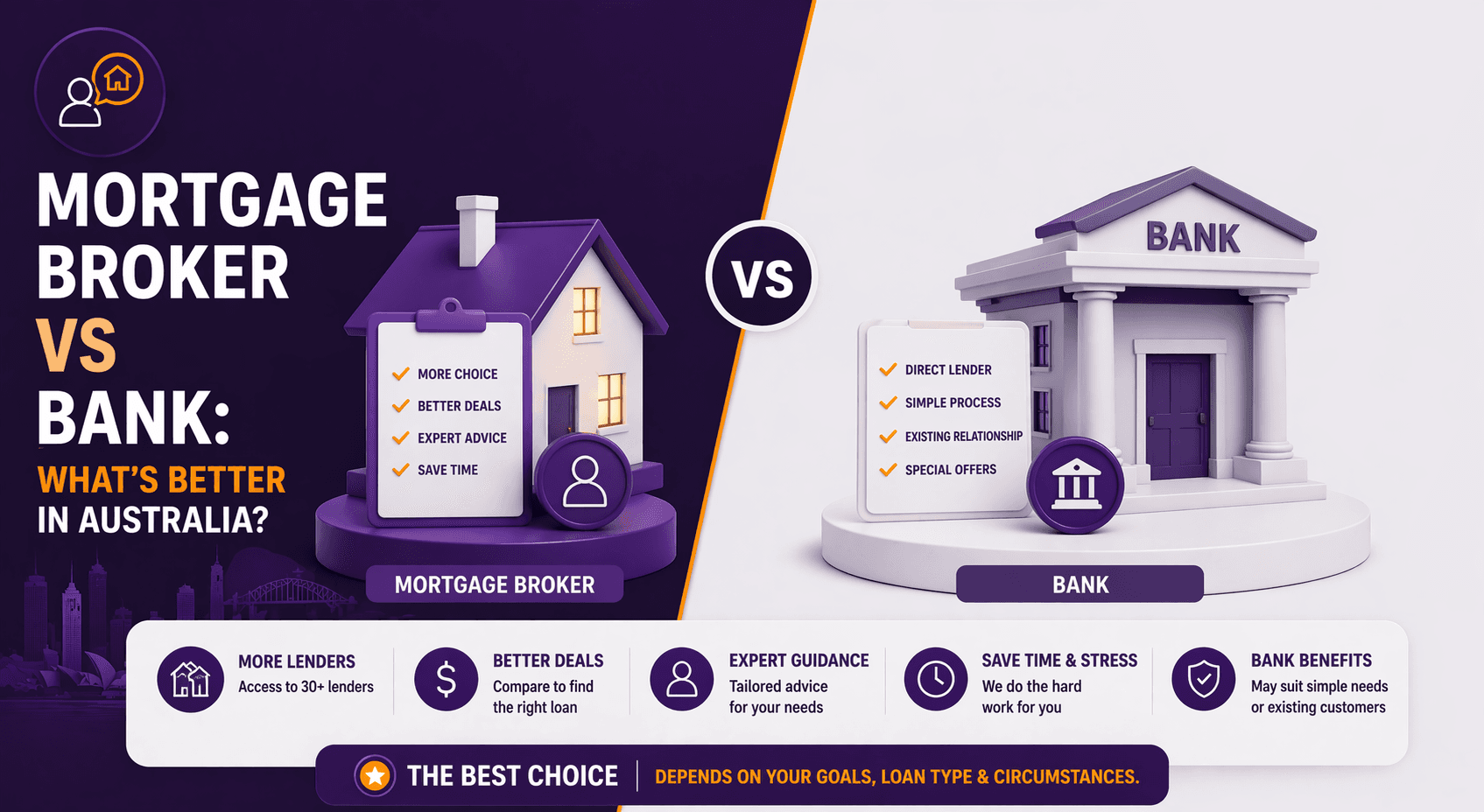
Quick Answer: Broker vs Bank (In Plain English)
A mortgage broker may be better if:
you want access to multiple lenders (not just one bank
your situation is complex (self-employed, variable income, multiple debts)
you want someone to negotiate and compare options for you
you want help with paperwork and lender policies
you want to shop around without doing it yourself
A bank may be better if:
you already bank there and want simplicity
you prefer direct dealing with the lender
your situation is straightforward
your bank offers strong pricing or loyalty benefits
you’re comfortable comparing offers yourself
What Does a Mortgage Broker Do?
A mortgage broker is a licensed professional who helps you:
compare home loan products
choose a lender that matches your needs
prepare and submit your loan application
manage communication with the lender
coordinate approvals and settlement
Most brokers can access a panel of lenders, which can include:
major banks
smaller banks
credit unions
non-bank lenders
specialist lenders
That means brokers can offer you more options than walking into a single bank.
Mortgage brokers must act in your best interests
In Australia, mortgage brokers have a legal obligation known as the Best Interests Duty, which requires them to act in the consumer’s best interests when providing credit assistance.
This is designed to reduce conflicted recommendations, but it doesn’t remove all risk (more on that below).
What Does a Bank Do?
When you go directly to a bank, you’re speaking with a lender who can only offer their own home loan products.
They can still:
give you competitive pricing
assess your borrowing capacity
approve and settle the loan
potentially offer package benefits or relationship pricing
But they won’t compare other lenders for you.
So the bank option is usually:
simple
direct
fast (sometimes)
but less broad in comparison.
The Big Difference: Choice vs Simplicity
Brokers offer choice
Mortgage brokers can compare multiple lenders and loan types, which can be helpful because not all lenders have the same:
interest rates
fees
cashback offers
approval policies
borrowing limits
risk appetite (especially for self-employed borrowers)
Banks offer simplicity
A bank can be easier if you:
already have your income and accounts there
have a straightforward PAYG job
fit cleanly into their lending criteria
don’t want back-and-forth across multiple lenders
Is a Mortgage Broker More Expensive Than Going to a Bank?
This is one of the biggest myths.
In most cases, you don’t pay a mortgage broker directly, the lender pays the broker a commission for introducing the loan. Brokers must disclose their commission structure to clients.
That said, “free” doesn’t mean “no cost”.
It means:
the broker is paid by the lender
and the loan pricing may include that distribution cost built into the lender’s margins
which can create potential conflicts (even with best interests rules)
ASIC has long reviewed broker remuneration and the effect commissions can have on consumer outcomes.
Practical takeaway:
A broker may still help you access a better deal than your bank, but you should understand how they’re paid and ask about alternatives.
Pros and Cons: Mortgage Broker
Pros
1) Access to multiple lenders and loan products
You’re not limited to one bank. Brokers can compare across lenders, which can increase your chance of finding a suitable loan.
2) Helpful if your situation is not “standard”
Brokers can be very useful if you are:
self-employed
casual or contract-based
earning commissions/bonuses
buying an investment property
refinancing with multiple debts
dealing with lower deposits or complex scenarios
3) Less legwork for you
They handle:
paperwork
lender communication
valuation processes
follow-ups
settlement coordination
4) Potentially better negotiation
A good broker can negotiate discounts and structure the loan well; especially if you’re refinancing or comparing multiple lenders.
Cons
1) They may not cover the entire market
Most brokers have a panel of lenders. That panel can be broad, but it might not include every lender or every product in the market.
2) Commission structure can influence behaviour
Brokers are paid commissions by lenders, and ASIC has historically flagged that commission structures can affect recommendations if not controlled properly
Even with Best Interests Duty, it’s worth asking:
why they recommended a certain lender
whether other lenders were considered
what the trade-offs are
3) Quality varies
Some brokers are outstanding, others are transactional. The broker’s skill affects the outcome more than people realise.
Pros and Cons: Going Direct to a Bank
Pros
1) Simple and direct
You deal with the decision-maker and can often move quickly.
2) Relationship benefits
Some banks offer:
discounts for existing customers
package benefits
offset account bundling
easier account linking
3) Certain banks are pushing direct lending
Some big banks are increasing their focus on direct lending channels due to cost pressures around broker commissions.
This can sometimes mean aggressive pricing or offers for direct customers.
Cons
1) You only see one lender’s options
Even if your bank has a good deal, there may be a better deal elsewhere, and you won’t know unless you compare.
2) Bank staff are not comparing the market
They work for the lender, so their job is to place you into their products.
3) Some banks may be stricter than other lenders
You might be declined at one bank even though another lender would approve you (particularly common with self-employed or non-standard income).
Which One Gets You a Better Rate in Australia?
This depends more on your profile than the channel.
A broker might get you a better rate if:
your bank isn’t competitive
you have strong equity and can refinance
you’re eligible for special lender policies
you want to compare smaller lenders and non-banks
Your bank might match or beat a broker offer if:
you have a strong relationship and high-value customer profile
the bank has a strong direct promotion
the bank is competing heavily for refinancing customers
In Australia, many rate comparison platforms track thousands of rates across dozens of providers, and rates can change frequently.
Practical move:
Even if you love your bank, compare at least 2–3 options (either yourself or through a broker).
A Simple “Decision Guide” (Choose Based on Your Situation)
Choose a mortgage broker if you:
want multiple lender comparisons
are self-employed or have complex income
want a structured recommendation
are refinancing and want negotiation
don’t have time to shop around
Choose a bank if you:
have a straightforward PAYG job
already have a strong banking relationship
are confident comparing rates and features yourself
don’t want broker involvement
your bank is offering a strong deal that’s hard to beat
What to Ask Before You Choose a Mortgage Broker
If you’re considering a broker, ask these questions upfront:
1) How many lenders do you have access to?
A broader panel often gives more options.
2) Are there lenders you don’t deal with, and why?
Transparency matters.
3) Why is this loan suitable for me?
A good broker should explain it simply.
4) How are you paid, and what commission do you receive?
Brokers must disclose this.
5) Can you show me 2–3 alternatives?
Seeing comparisons helps you understand trade-offs.
What to Ask Your Bank Before You Sign
If you go direct to your bank, ask:
Can you offer a rate discount?
Are there any package fees?
Is there an offset account?
What are the exit fees or discharge costs?
Is there a cashback offer?
What happens when the fixed rate ends?
Are there limits on extra repayments?
This helps prevent the common trap of signing a loan that looks good today but becomes expensive later.
Key Takeaways
Brokers offer broader lender choice and help with paperwork
Banks offer simplicity and direct access, but only to their own products
Brokers are usually paid by lenders and must disclose commission structures
Brokers have a Best Interests Duty under Australian law
The best option depends on complexity, time, and your desire to compare
Even if you go to your bank, it’s smart to compare at least a few options
FAQ
1) Is a mortgage broker better than a bank in Australia?
Not always. Brokers are often better for choice and complex situations, while banks can be better for simplicity if your situation is straightforward.
2) Do mortgage brokers cost money?
Usually no direct cost to you. They’re paid commission by lenders and must disclose how they’re paid.
3) Do mortgage brokers have to act in my best interests?
Yes. Brokers have a legal Best Interests Duty when providing credit assistance.
4) Can a bank match a broker’s deal?
Often yes; especially if you have strong equity or a good customer relationship. It’s worth asking for a discount.
5) Should I use a broker for refinancing?
Many Australians do this because brokers can compare lenders and negotiate, but it still depends on your needs and whether your broker has access to the right lenders.
So, mortgage broker vs bank: what’s better in Australia?
For most Australians, the best answer is:
Use a broker if you want choice, help, and guidance
Use your bank if you want simplicity and already have a strong deal
The smartest approach is usually to compare both. Even one comparison can save you thousands over the life of a loan, not just from interest rate differences, but from avoiding the wrong structure, fees, and features.
Still asking “what if” about your finances?
That’s exactly where clarity begins.
Whether you’re planning ahead, growing wealth, or simply want confidence in your financial decisions, the advisers at What If Advice can help you turn questions into a clear, personalised plan.
👉 Book a free 15-minute strategy session or get in touch today at
whatifadvice.com.au
General Advice Disclaimer
This information is general in nature and does not take into account your personal financial situation, needs, or objectives. You should consider whether it is appropriate for you and seek personal financial advice before making any decisions.