Looking for specific financial advice?
This blog provides general educational content. For personalized advice tailored to your unique situation, book a free consultation with our team of ASIC-licensed financial advisers.
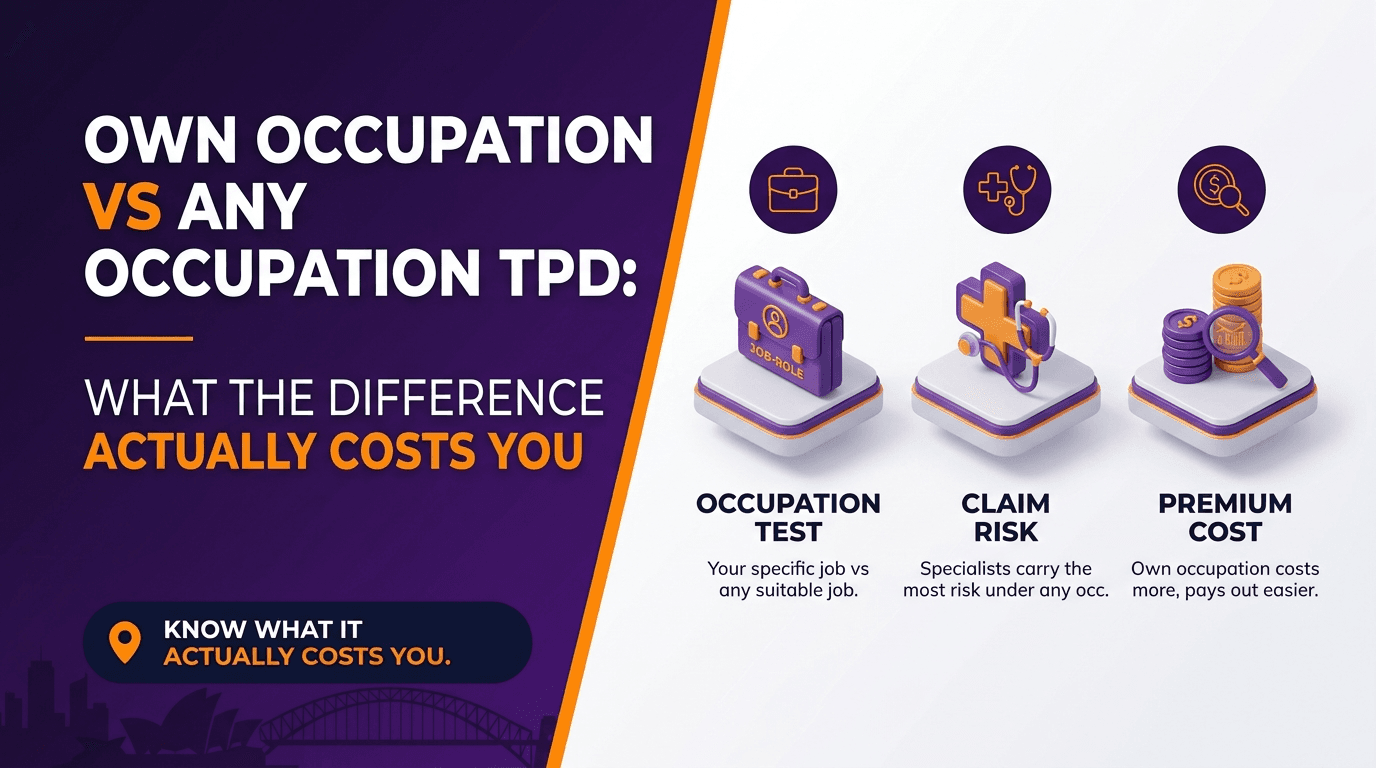
Own Occupation vs Any Occupation TPD: What the Difference Actually Costs You
Two words buried in your insurance policy wording can determine whether a claim pays out or gets knocked back. "Own occupation" and "any occupation" sound like fine print, but they define the entire test your insurer applies if you're ever unable to work again. Get the wrong one for your situation and you could be paying premiums for years for a policy that was never going to help you when you needed it most.
Jump to a Section
What TPD Insurance Actually Covers
Own Occupation vs Any Occupation: The Core Difference
Why Super Funds Almost Only Offer Any Occupation
Which Definition Suits Your Job
Cost Differences Between the Two
Common Mistakes People Make
FAQ
TL;DR: The Key Points
The own occupation versus any occupation distinction is the single biggest factor in whether a Total and Permanent Disability (TPD) claim gets approved, and most people never find out which one they have until they try to claim.
Own occupation TPD pays out if you can't work in your specific job or profession, even if you could technically do other work
Any occupation TPD only pays out if you can't work in any job reasonably suited to your education, training or experience
Cover through superannuation is almost always any occupation, and often has narrower definitions again
Own occupation cover is generally only available outside super, through a retail policy, and costs more
Specialists, surgeons, tradespeople and anyone with a highly specific skill set carry the most risk under any occupation definitions
What TPD Insurance Actually Covers
Total and Permanent Disability insurance pays a lump sum if illness or injury leaves you unable to work again. It's meant to cover the big financial hit of a life-altering event, things like paying off the mortgage, funding modifications to your home, or replacing income long-term where income protection (which only covers a percentage of income for a defined period) runs out.
The lump sum sounds simple. The definition of "unable to work" is where things get complicated, and that definition depends entirely on which occupation test your policy uses.
Own Occupation vs Any Occupation: The Core Difference
Own occupation TPD asks a narrower question: can you still do your job, the one you were trained for and were doing before the disability. A surgeon who loses fine motor control in their hands might never operate again, even if they could theoretically retrain as a medical administrator. Under an own occupation definition, that surgeon likely has a valid claim.
Any occupation TPD asks a much broader question: can you do any job reasonably suited to your education, training or experience, not just your specific one. That same surgeon, under an any occupation definition, might be assessed as capable of a desk-based medical role and have their claim declined, even though they can never operate again.
Feature | Own Occupation | Any Occupation |
Test applied | Can you do your specific job | Can you do any suitable job |
Typically available | Outside super only | Inside or outside super |
Premium cost | Generally higher | Generally lower |
Claim approval bar | Lower (narrower test) | Higher (broader test) |
Best suited to | Specialists, high-skill professionals | Broader, more transferable skill sets |
Ready to figure out which definition your current cover actually uses? Our financial advisers can review your policy and flag any gaps before they become a problem. Call 1800 942 843 or email clientservices@whatifadvice.com.au.
Why Super Funds Almost Only Offer Any Occupation
Most Australians' TPD cover sits inside their superannuation fund, often set up as a default when the account was opened. That default cover is almost always any occupation, and sometimes an even stricter variant called "activities of daily living," which assesses whether you can perform basic tasks like dressing or bathing yourself rather than whether you can work at all.
There's a structural reason for this. TPD cover paid from super must generally satisfy a condition of release, and the superannuation and insurance industries have historically leaned toward broader, more restrictive definitions inside super to manage cost and risk across large member pools. The result is that default super TPD cover is often the cheapest but hardest to claim on.
Which Definition Suits Your Job
Own occupation cover tends to matter most for:
Surgeons, dentists, and other proceduralists reliant on fine motor skills
Musicians and performers
Tradespeople whose entire trade depends on specific physical capability
Airline pilots and others with occupation-specific licensing requirements
Any occupation cover may be adequate for:
Roles with highly transferable skills across industries
Office-based or administrative work
Professions where a disability affecting one function wouldn't prevent broader employment
The general pattern: the more specialised and physically specific your job, the more an any occupation definition works against you.
Work in one of the higher-risk categories above and not sure which definition your current cover actually uses? This is exactly the kind of gap that only becomes obvious at claim time, when there's nothing left to do about it. Call 1800 942 843 or email clientservices@whatifadvice.com.au to get it checked now instead.
Cost Differences Between the Two
Own occupation TPD is priced higher than any occupation TPD because the insurer is accepting a narrower, more claimant-friendly test. In practical terms, expect a noticeable premium difference between the two, though the exact loading varies by insurer, age, occupation category and health rating, so getting a personal comparison matters more than any rule of thumb.
It's also worth noting that default cover inside super is often bundled and cheaper on the surface, but comparing it against a properly underwritten retail policy on a like-for-like basis frequently tells a different story once the definitions are lined up.
Common Mistakes People Make
Assuming default super TPD cover matches your actual occupation risk. Most default cover is set up automatically when a super account is opened, without any reference to what job the member actually does. A surgeon and an office administrator can end up with the identical any occupation definition through the same default fund settings.
Never checking the definition until claim time. The own occupation versus any occupation distinction is invisible in everyday life. It only becomes relevant the moment someone tries to make a claim, which is the worst possible time to discover the policy doesn't match the situation.
Letting cover lapse from a low super balance. TPD cover held through super is funded by premium deductions from the account. Where a balance is low or inactive, premiums can erode it further or the cover can lapse entirely, leaving a gap the member may not notice until it matters.
Not reviewing cover after a job or duties change. Moving into a more specialised or more physically specific role, without reviewing whether the existing TPD definition still fits, can leave someone underinsured for the actual risk their new occupation carries.
FAQ
Can I have both own occupation and any occupation TPD cover?
Yes, though not usually as separate simultaneous policies covering the same event. Some people hold default any occupation cover through super and top up with a retail own occupation policy outside super for additional protection.
Does own occupation cover cost significantly more?
Generally yes, because the insurer's claim exposure is higher under a narrower test. The actual difference depends on your occupation, age and health, so a like-for-like quote is the only way to know for certain.
Can I upgrade my super TPD cover to own occupation?
Not usually within the same super fund, since most super-held TPD is structured as any occupation by default. An own occupation upgrade generally means arranging cover outside super.
What happens to TPD cover if I change jobs or occupations?
Your occupation category may be reassessed, which can affect premiums and, in some cases, definitions. It's worth reviewing cover whenever your job or duties change materially.
Is TPD cover through super automatically cancelled if my balance runs low?
Cover held through super can lapse if there isn't enough balance to cover premiums, which is a separate risk worth checking regardless of which occupation definition applies.
How long does a TPD claim take to be assessed?
TPD claims are typically slower to assess than income protection claims because the insurer needs to establish permanence, that the disability is unlikely to improve, not just that it currently prevents work. Assessment commonly takes several months and can extend longer where medical evidence is contested or additional specialist opinions are required. Building this timeframe into your expectations, and keeping thorough medical documentation from the outset, can help avoid unnecessary delay.
Does TPD insurance cover partial disability?
Standard TPD definitions, whether own occupation or any occupation, generally require total and permanent incapacity, not partial. Some retail policies offer additional partial disability or "own occupation partial" options as an add-on, but this is far less common than full TPD cover and is rarely included in default super cover. If your work involves a real risk of partial rather than total incapacity affecting your income, this is worth raising specifically when reviewing your cover.
What happens if my TPD claim is declined?
A declined claim can generally be reviewed internally by the insurer, escalated to the Australian Financial Complaints Authority (AFCA) if the internal review is unsuccessful, or challenged through legal action in more complex or high-value disputes. Many disputes centre on exactly the own occupation versus any occupation question, whether the insurer's assessment of "suitable" alternative work was reasonable given the person's actual training and experience. Having the original policy definition reviewed by an adviser or specialist before escalating a decline can clarify whether the insurer applied the right test in the first place.
Still asking what if about your cover actually paying out when it matters?
Most Australians assume their TPD cover would pay out if the worst happened. Whether it actually would depends entirely on which definition sits behind the policy, and for most people that's something they've never checked.
The financial advisers at What If Advice can review your existing TPD insurance, whether inside super or through a retail policy, and make sure the definition actually matches how you'd be affected if the worst happened.
Call 1800 942 843 or email clientservices@whatifadvice.com.au to book a review.
What If Advice operates under AFSL 528250.
General Advice Disclaimer: This information is general in nature and does not take into account your personal objectives, financial situation or needs. Before acting on this information, consider its appropriateness and seek personal financial advice from a licensed adviser.