Looking for specific financial advice?
This blog provides general educational content. For personalized advice tailored to your unique situation, book a free consultation with our team of ASIC-licensed financial advisers.
What If Your Redundancy Payout Is Partly Tax-Free, But You Don't Find Out Until After You've Already Spent It the Wrong Way?
Losing a job through redundancy is stressful enough without also getting the tax treatment of the payout wrong. Genuine redundancy payments in Australia receive specific, favourable tax treatment that ordinary income doesn't. A portion is tax-free, and the rest is often taxed concessionally rather than at your full marginal rate. But this treatment depends on the payment genuinely qualifying as a redundancy, and even once the tax side is sorted, what you actually do with a lump sum that's arrived at an emotionally difficult time deserves a clearer head than most people manage under the circumstances.
TL;DR
A genuine redundancy payment receives concessional tax treatment specifically because the job itself has been abolished. This is different from resigning, being dismissed for cause, or reaching a fixed contract's natural end.
Part of a genuine redundancy payout is tax-free, up to a limit based on years of service. Amounts above that limit are generally taxed as an Employment Termination Payment (ETP) at concessional rates, up to a separate cap.
Unused annual leave and long service leave paid out alongside the redundancy are taxed differently again, generally not part of the tax-free redundancy component, and subject to their own specific tax treatment.
Not every termination payment qualifies as a genuine redundancy. The distinction matters significantly for tax purposes, and getting it wrong (in either direction) can create real problems at tax time.
The payout can affect other entitlements, including potential impacts on income support payments if you're not immediately re-employed, which is worth understanding before assuming the full amount is available to spend or invest freely.
What to actually do with the money deserves separate, calmer consideration from the tax treatment. Covering an income gap, debt reduction, and superannuation contributions are common, genuinely different uses worth weighing deliberately.
Timing your next steps, job search, retraining, or even considering early retirement if you're close to it, interacts with how you use the payout, and rushing either decision under financial or emotional pressure often isn't the best outcome.
Bottom line: a redundancy payout is a genuine tax-advantaged opportunity if it's structured and used properly, but only if you understand what you're actually entitled to and don't make big financial decisions in the same week as the news itself.
Jump to a Section
What Actually Counts as a "Genuine Redundancy"
The Tax-Free Component Explained
Employment Termination Payments (ETPs): The Rest of the Payout
Unused Leave: A Different Tax Treatment Again
What to Actually Do With the Money
Worked Example: Two People, Two Approaches
Common Mistakes
FAQ
What Actually Counts as a "Genuine Redundancy"
For tax purposes, a genuine redundancy specifically means the position itself has been abolished, the employer no longer needs anyone to do that job, as distinct from the employee being dismissed for performance or conduct reasons, resigning voluntarily, or reaching the natural end of a fixed-term contract. This distinction matters enormously, because the favourable tax treatment described below is specifically tied to a payment meeting the genuine redundancy definition. A payment that looks similar on the surface but doesn't meet this definition (for example, if the employee is simply being replaced by someone else in a similar role) may not qualify for the same treatment.
There are also some situations that are specifically excluded from genuine redundancy treatment even if a job has ended, such as an employee who's reached a certain retirement-eligible age at the time of termination, or arrangements between related parties that don't reflect an arm's-length redundancy.
Not sure whether your specific payout actually qualifies as a genuine redundancy for tax purposes? A free 15-minute chat can clarify it before you make any decisions. Call 1800 942 843.
Bottom line: the tax benefits described in this piece only apply if the payment genuinely meets the redundancy definition. It's worth confirming this specifically for your situation before assuming the favourable treatment applies.
The Tax-Free Component Explained
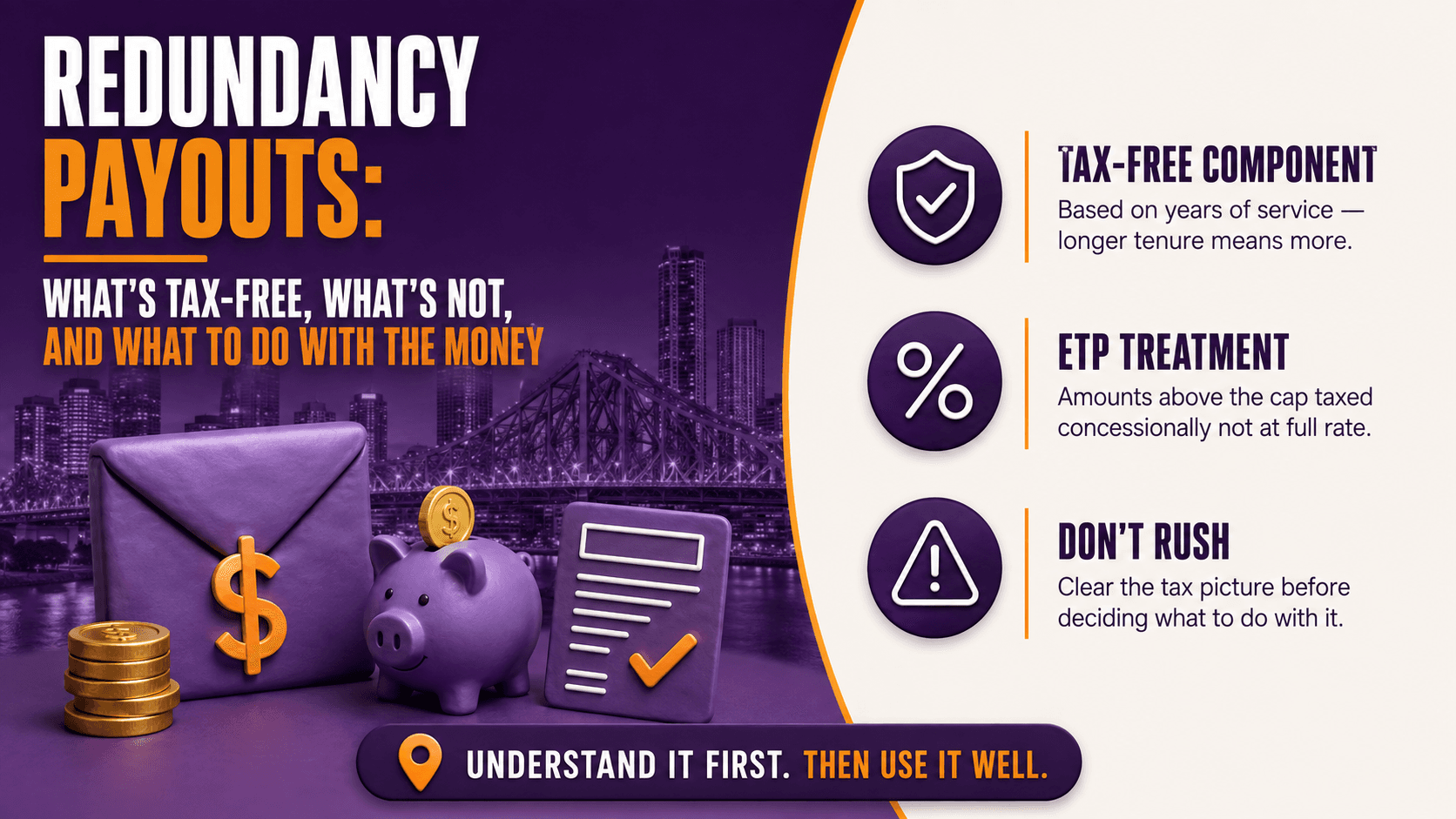
A genuine redundancy payment includes a tax-free component, calculated based on your years of service with that employer, a base amount plus an additional amount for each full year of service, added together to determine how much of the payout is entirely free of tax. This tax-free treatment exists specifically because the payment compensates for the unexpected loss of the job, not because it's ordinary income for services rendered. The specific base and per-year amounts used in this calculation are indexed and change periodically, so confirm the current figures with the ATO or a tax professional rather than relying on a previous year's numbers.
Amounts above this tax-free component don't disappear into ordinary income tax at your full marginal rate either. They generally roll into the Employment Termination Payment treatment described next, which still carries its own concessional tax rate up to a further limit.
Bottom line: the tax-free component is directly tied to how long you worked for that employer. Longer service generally means a larger tax-free slice of the payout, which is worth factoring into how you think about the total amount you're actually receiving after tax.
Employment Termination Payments (ETPs): The Rest of the Payout
Any part of a genuine redundancy payout that exceeds the tax-free component is generally treated as an Employment Termination Payment (ETP), which carries its own concessional tax rate, lower than your ordinary marginal tax rate would apply to the equivalent amount as regular income, up to a specific ETP cap. Amounts above that ETP cap are then taxed at your full marginal rate, meaning very large payouts can end up with a blend of tax-free, concessionally-taxed, and ordinarily-taxed portions within the same payment.
Working out exactly how your payout breaks down across these components? Email clientservices@whatifadvice.com.au and we'll help make sense of the actual numbers on your payment summary.
Bottom line: understanding which part of your payout is tax-free, which part gets the concessional ETP rate, and which part (if any) is taxed at your full marginal rate is the difference between a rough guess and an accurate picture of what you actually have to work with.
Unused Leave: A Different Tax Treatment Again
Payouts for unused annual leave and long service leave accompanying a redundancy are generally treated separately from the redundancy payment itself, with their own specific tax rules that differ from both the tax-free redundancy component and the ETP treatment. This distinction matters because a total termination payout is often a blend of several different components, each taxed differently. Treating the whole lump sum as one uniform amount for tax planning purposes can lead to a meaningfully inaccurate picture of your actual after-tax position.
Bottom line: your final payslip or termination statement is likely combining several genuinely different payment types with different tax treatments. Worth having each component actually explained rather than assuming the whole figure is treated the same way.
What to Actually Do With the Money
Once the tax picture is clear, the practical question becomes what to do with the payout, and this deserves a level head, which is genuinely difficult in the same period as losing a job. Common, worth-considering uses include:
Covering an income gap while job searching or retraining, treating part of the payout as a runway rather than immediately spending or investing all of it.
Reducing high-interest debt, which offers a guaranteed return equal to the interest rate avoided, often exceeding what a cautious investment would achieve over the same period.
Contributing to superannuation, potentially as a concessional contribution (subject to your contribution caps) to gain a tax benefit on part of the amount, though this makes the money inaccessible until retirement, which needs to be weighed against your need for accessible funds during the transition.
Reviewing insurance and financial protections during the gap, since some cover (like income protection or life insurance linked to a former employer) may lapse on termination and need separate arrangement.
Received a payout and not sure how to actually put it to work while you're between roles? A free 15-minute chat can help map out the options calmly, without pressure to decide everything immediately. Call 1800 942 843.
Bottom line: the tax question and the "what do I do with it" question are genuinely separate decisions. Getting the first one right doesn't automatically mean you've made the best choice about how to actually use the money.
Worked Example: Two People, Two Approaches
Person A, Karen (rushed decisions): Karen receives a redundancy payout after many years of service and, in the stressful weeks immediately following the news, makes several quick decisions, paying down her mortgage substantially, without first setting aside a clear income buffer for her job search, and without checking how the payout's different components were actually taxed. Several months into an unexpectedly longer job search than she'd planned for, she finds herself needing to redraw against the mortgage at a less favourable time than if she'd kept a portion accessible from the outset.
Person B, David (paced decisions): David receives a similar payout after a comparable length of service, and deliberately sets aside a portion as an accessible income buffer covering an extended job search period, before considering longer-term uses for the remainder. Once his tax position on the payout is properly clarified, understanding exactly how much was tax-free versus concessionally taxed, he makes a considered decision to direct a portion toward debt reduction and a portion toward superannuation, with a clear buffer remaining untouched for ongoing living costs during the transition.
Bottom line: the practical difference between these two outcomes wasn't the size of the payout. It was the pace and order of decisions made with it, during a period when clear thinking is genuinely harder than usual.
Common Mistakes
Assuming the entire payout is tax-free. Only a specific component, based on years of service, receives tax-free treatment. The rest is generally taxed, just concessionally rather than at full marginal rates in most cases.
Treating unused leave payouts the same as the redundancy component. These have separate, different tax treatments that shouldn't be assumed to match.
Making major financial decisions in the immediate aftermath, before the tax picture is even clear. Understanding what you actually have available after tax should come before deciding how to use it.
Not checking whether the payment genuinely qualifies as a redundancy for tax purposes. Assuming favourable treatment applies without confirming eligibility can lead to an inaccurate picture of the after-tax amount.
Overlooking the impact on other entitlements or income support eligibility. A lump sum payout can affect eligibility for certain payments if there's a gap before re-employment, and this is worth understanding rather than assuming it has no effect.
Locking money away (like into superannuation) without keeping an adequate accessible buffer. Tax efficiency shouldn't come at the cost of having enough accessible funds to comfortably manage the transition period.
FAQ
Is redundancy pay always tax-free? No. Only a specific component, calculated based on years of service, is tax-free; amounts above that are generally taxed concessionally as an Employment Termination Payment, and further amounts above that cap are taxed at your full marginal rate.
Does being made redundant affect my eligibility for income support payments? It can, depending on the size of the payout and how it's assessed. A lump sum payment may affect the timing or amount of income support eligibility, which is worth checking before assuming payments will begin immediately if needed.
What's the difference between redundancy and simply being dismissed? A genuine redundancy specifically means the position itself has been abolished, distinct from a dismissal for performance or conduct reasons. This distinction directly affects the tax treatment of the payment received.
Can I put my entire redundancy payout into superannuation to avoid tax? You can direct a portion into super as a contribution, subject to your relevant contribution caps, but this isn't unlimited, and locking funds into super means they're inaccessible until retirement, which needs to be balanced against your need for accessible funds in the meantime.
Does the tax-free component increase the longer I worked for my employer? Yes. The tax-free component is calculated using a base amount plus an additional amount for each full year of service, meaning longer-serving employees generally receive a larger tax-free portion.
What happens to unused annual leave and long service leave when I'm made redundant? These are generally paid out as part of your final termination pay, but with their own specific tax treatment that's different from both the redundancy tax-free component and the Employment Termination Payment treatment.
Should I use my redundancy payout to pay off my mortgage immediately? It can be a reasonable use of some of the funds, but it's worth ensuring you retain an adequate accessible buffer for the job search or transition period first, rather than committing the full amount before knowing how long that period will take.
Is a redundancy payout considered income for tax return purposes? Yes, it needs to be reported on your tax return, with the different components (tax-free, ETP, unused leave) each reported and treated according to their specific rules.
Can my employer choose not to treat my payment as a genuine redundancy for tax purposes? The classification depends on the actual circumstances of the termination meeting the genuine redundancy definition, not simply on how the employer chooses to label it. This is worth confirming independently if there's any ambiguity.
Is it worth getting financial advice before deciding what to do with a redundancy payout? Generally yes. Between understanding the tax components accurately and making calm, well-paced decisions about how to use the money during a stressful transition, professional guidance often prevents costly early mistakes.
Ready to Get a Clear Picture Before You Decide Anything?
Ready to understand exactly what your redundancy payout means for your tax position, and how to actually put it to work without rushing into decisions? This is exactly the kind of situation where a clear-headed conversation early on makes a real difference.
Call us: 1800 942 843
Financial advice enquiries: clientservices@whatifadvice.com.au
Tax enquiries: tax@whatifadvice.com.au
Book online: free 15-minute chat, no cost, no pressure
Still asking what if you just figure it out as you go? A redundancy payout rewards a clear head and a proper plan. Both are easier with someone helping you think it through.
WIAA has advised 1,000+ clients across our Toowong, Grange, and Melbourne CBD offices, operating under AFSL 528250 as an Authorised Representative of Beryllium Advisers Pty Ltd.
General Advice Disclaimer: This article contains general information only and does not take into account your personal objectives, financial situation, or needs. It does not constitute personal financial or tax advice, and should not be relied upon as such. Redundancy payment tax treatment, including tax-free thresholds and ETP caps, is set by legislation, is indexed and subject to change, and should be verified with a tax professional based on your specific circumstances.