Looking for specific financial advice?
This blog provides general educational content. For personalized advice tailored to your unique situation, book a free consultation with our team of ASIC-licensed financial advisers.
Retained Profits Strategy for Small Businesses in Australia
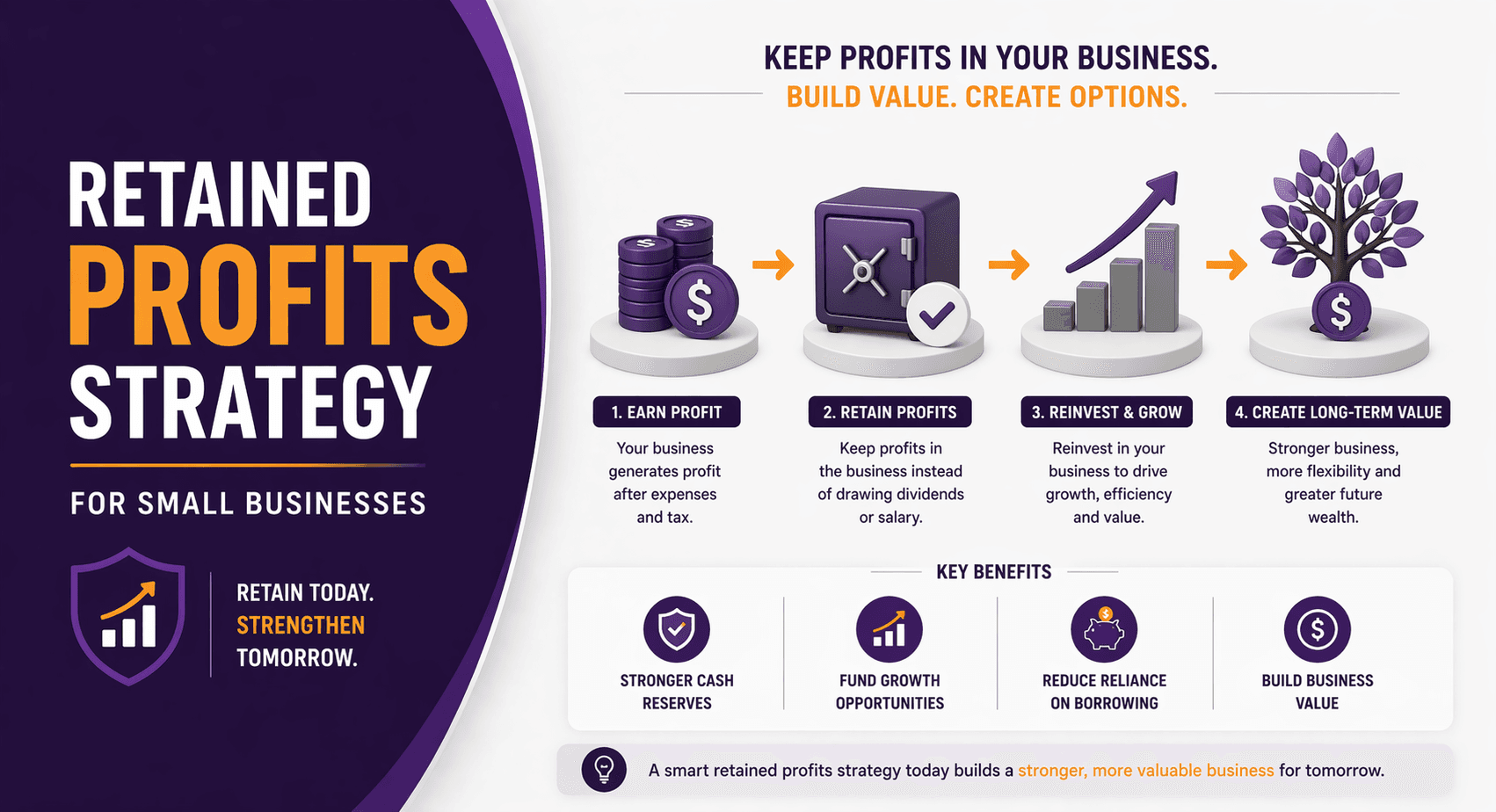
Retaining profits inside your company can be one of the most effective ways to grow your business and manage tax.
But done poorly, it can also:
Trap cash
Create tax inefficiencies
Lead to poor capital decisions
The key is not just retaining profits - it’s using them strategically.
What Are Retained Profits?
Retained profits (or retained earnings) are:
Profits your company keeps instead of distributing to shareholders.
Instead of paying out dividends, the money stays in the business.
Why Retain Profits?
1. Lower Tax Rate Environment
Companies typically pay:
25% company tax rate (for base rate entities, subject to ATO rules)
Compared to:
Individual tax rates up to 45% + Medicare levy
This creates a tax deferral opportunity.
2. Fuel Business Growth
Retained profits can be used for:
Hiring staff
Marketing and lead generation
Equipment or technology upgrades
Expansion into new markets
3. Improve Financial Stability
Holding profits inside the business:
Builds a buffer
Reduces reliance on debt
Improves lender confidence
Retained Profits vs Dividends
Option | Benefit | Risk |
Retain profits | Lower immediate tax | Cash trapped in company |
Pay dividends | Access funds personally | Higher personal tax |
The right approach is rarely all-or-nothing.
Key Strategies for Using Retained Profits
1. Reinvest for Growth
The most obvious use.
Examples:
Spend $50,000 on marketing → generate $200,000 revenue
Invest in systems → reduce costs long-term
This is where retained profits actually earn their keep.
2. Build a Strategic Cash Reserve
Not every dollar needs to be deployed.
A strong reserve helps:
Navigate downturns
Cover tax liabilities
Fund opportunities quickly
Typical approach:
Hold 3–6 months of operating expenses
3. Time Dividend Payments Strategically
Instead of taking profits immediately:
Delay dividends to future years
Pay when your personal tax rate is lower
Example:
High-income year = retain profits
Lower-income year = distribute dividends
4. Use Bucket Company Structures
Common structure:
Trading company = generates profit
Distributes to a “bucket company”
Benefits:
Caps tax at company rate
Allows future distribution planning
Subject to Division 7A and ATO rules.
5. Fund Investments Inside the Company
Retained profits can be used to:
Invest in shares or managed funds
Acquire assets
Diversify income streams
But:
Investment income is still taxable within the company
Example Scenario
Business Owner Earning $200,000 Profit
Option 1: Take All as Income
Taxed at personal rates
Less cash retained
Option 2: Retain $100,000 in Company
Taxed at 25%
Remaining funds used for:
Marketing
Hiring
Expansion
Outcome:
More capital working for the business
Common Mistakes
1. Hoarding Cash Without Purpose
Retaining profits with no strategy:
Leads to stagnation
Reduces return on capital
2. Ignoring Division 7A
Using company funds personally:
Can trigger tax issues
3. No Investment Strategy
Idle cash loses value over time.
4. Over-retention
Keeping too much in the company:
Limits personal wealth building
Strategic Insight: Retained Profits Are a Lever, Not a Goal
Retaining profits is not the objective.
The objective is:
Maximising long-term wealth and business value
That requires:
Balance between reinvestment and extraction
Alignment with personal goals
Ongoing review
When Should You Get Advice?
You should seek advice if:
Your business is consistently profitable
You’re unsure whether to retain or distribute profits
You’re building long-term wealth through your business
You have a trust/company structure
Because the difference between:
“Just leaving money in the business”
and“Strategically deploying retained profits”
…can be massive over time.
FAQs
1. What are retained profits?
Profits kept within a company instead of being paid out to shareholders.
2. Is it better to retain profits or pay dividends?
It depends on your tax position and business goals. Often a combination works best.
3. Are retained profits taxed?
Yes, at the company tax rate (typically 25% for eligible businesses).
4. Can I use retained profits personally?
Not directly. Using company funds personally can trigger Division 7A issues.
5. Should I invest retained profits?
Yes, if aligned with your strategy. Leaving cash idle is generally inefficient.
6. What is a bucket company?
A company used to receive distributions and cap tax at company rates.
7. What is the biggest mistake business owners make?
Retaining profits without a clear strategy.
Not Sure What to Do With Your Profits?
Retaining profits without a strategy can cost you more than you think.
At What If Advice, we help business owners:
Structure profits tax-efficiently
Plan distributions and reinvestment
Align business success with personal wealth
Book a strategy session to make your profits work harder - not just sit there.
Disclaimer
This information is general in nature and does not take into account your personal objectives, financial situation, or needs. You should consider whether it is appropriate for your circumstances and seek professional advice. Taxation laws and ATO rules are subject to change.