Looking for specific financial advice?
This blog provides general educational content. For personalized advice tailored to your unique situation, book a free consultation with our team of ASIC-licensed financial advisers.
Reversionary Pension vs Death Benefit Nomination: What Your Spouse Actually Gets
Most Australians with superannuation have made some sort of nomination about what happens to their super when they die. Many have not reviewed it since they first opened the account. Fewer still understand the practical difference between a reversionary pension and a death benefit nomination, or how that difference plays out for the spouse who is left behind.
The distinction matters considerably more than most people realise. The two mechanisms differ in how quickly a spouse receives income, how the transfer balance cap applies, what happens to pension payments during the period between death and resolution, and what options the surviving spouse has once they inherit. Getting this decision right, or at least understanding what you currently have in place, is a core part of any retirement and estate plan.
This guide explains how each mechanism works, what the surviving spouse actually receives under each approach, where the key differences sit, and how to think about which arrangement suits your circumstances.
TL;DR: The Key Points
Here is the short version before the detail:
A reversionary pension is a nomination made on an income stream (such as an account-based pension) that causes the pension to automatically continue to the surviving spouse on the member's death
A death benefit nomination (binding or non-binding) directs the trustee on how to pay out the super death benefit, which may be as a lump sum or as a new death benefit pension commenced by the trustee
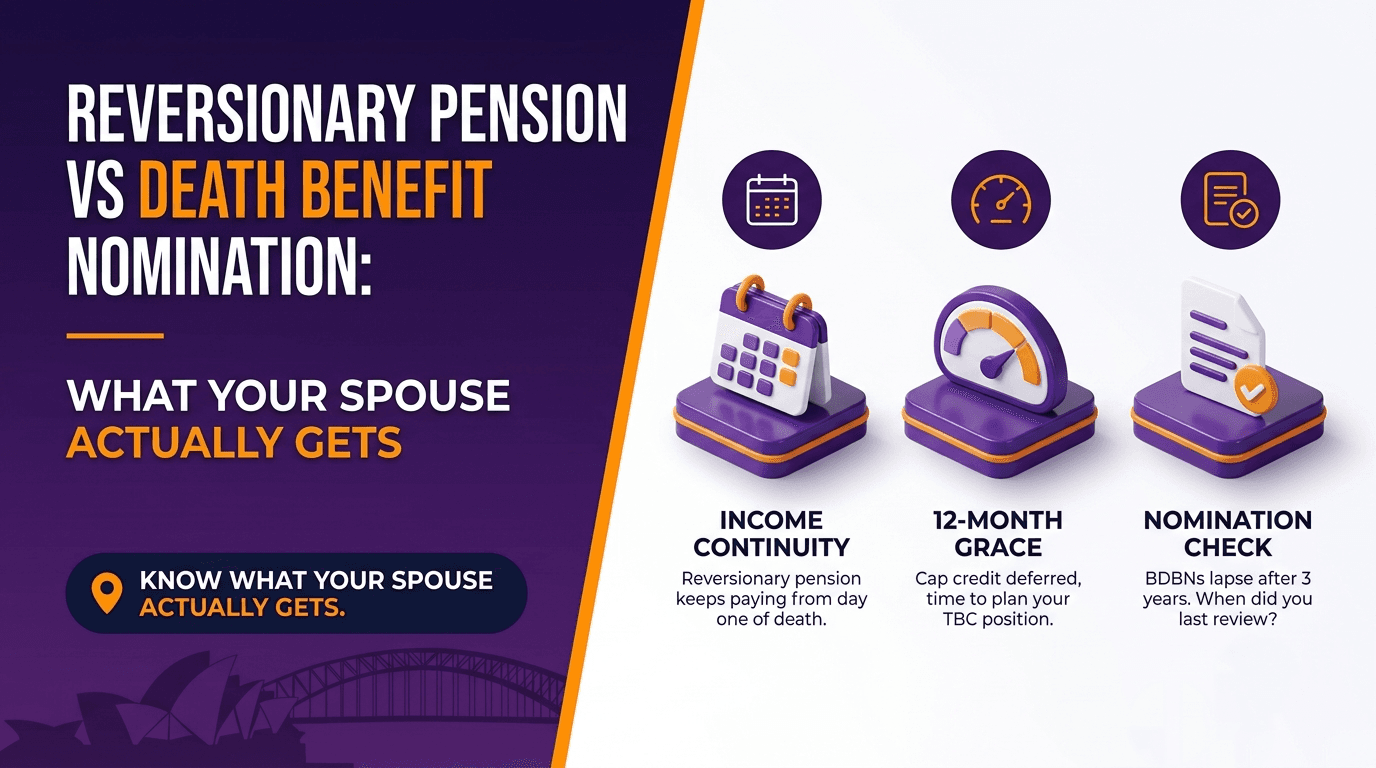
The income continuity difference is significant: a reversionary pension keeps paying to the spouse throughout the administration period; a non-reversionary death benefit may mean no pension income for weeks or months while the trustee resolves the estate
The transfer balance cap timing differs: a reversionary pension credits the surviving spouse's transfer balance cap 12 months after the date of death; a death benefit pension credits it immediately on commencement
The 12-month grace period on the reversionary pension gives the surviving spouse time to plan if their own cap position is close to the limit
A spouse is a tax dependant and receives super death benefits, whether as a lump sum or income stream, generally free of death benefits tax
A binding death benefit nomination lapses after three years unless it is a non-lapsing nomination, and must be reviewed regularly
SMSFs have additional considerations around trustee obligations and conflicts of interest that do not apply in the same way to APRA-regulated funds
Neither mechanism is universally better: the right choice depends on the surviving spouse's own super position, their need for immediate income, their transfer balance cap headroom, and the fund's rules
Jump to a Section
What Is a Reversionary Pension?
What Is a Death Benefit Nomination?
The Critical Difference: Income During the Administration Period
How the Transfer Balance Cap Applies Differently
The 12-Month Grace Period Explained
Tax Treatment for a Surviving Spouse
Centrelink and Age Pension Implications
SMSF Considerations
The Interaction Between Reversionary Pensions and Death Benefit Nominations
Which Arrangement Suits Which Situation?
Common Mistakes People Make
FAQ
What Is a Reversionary Pension?
A reversionary pension is a nomination made on a superannuation income stream, most commonly an account-based pension, that specifies a beneficiary who will automatically receive the pension if the member dies.
When the member dies, the pension does not stop. It does not get paid out as a lump sum and then restructured. It simply continues, with the nominated reversionary beneficiary, almost always the spouse, becoming the new recipient of the ongoing pension payments from the date of the member's death.
Who can be a reversionary beneficiary? A reversionary beneficiary must be a dependant in the superannuation sense. For most account-based pensions, eligible reversionary beneficiaries include:
A spouse or de facto partner
A child under 18
A child aged 18 to 25 who is financially dependent on the member
A child of any age who has a permanent disability
A person in an interdependency relationship with the member
In practice, the reversionary beneficiary is almost always the member's spouse. A reversionary pension to an adult child who is not financially dependent, which describes most adult children, is not permitted.
When is the nomination made? the reversionary nomination is made on the pension itself, either at the time the pension is commenced or by amending an existing pension. It is a feature of the pension document, not a separate estate planning instrument. To add or change a reversionary beneficiary on an existing pension, the member generally needs to complete a nomination form with the fund, and depending on the fund's rules, this may require commencing a new pension.
Only one reversionary beneficiary can be nominated per pension. Where a member wants to direct benefits to multiple people, or to someone other than a spouse, a death benefit nomination is the more flexible tool.
What if the account-based pension your spouse has been drawing from has no reversionary beneficiary nominated? Payments would cease on their death and the balance would need to be resolved through the trustee's death benefit process, potentially leaving you without income during that period.
What Is a Death Benefit Nomination?
A death benefit nomination is an instruction from a member to the trustee of their super fund about who should receive their superannuation death benefit and in what form. Unlike a reversionary pension, which is attached to a specific income stream, a death benefit nomination covers the member's entire super interest.
The three types of nomination:
Non-binding (preferred beneficiary) nomination: the member's instructions are taken into account by the trustee but the trustee retains discretion to pay the benefit differently if circumstances warrant. The trustee will generally follow the nomination but is not legally obliged to do so. This type is common in industry and retail super funds.
Binding death benefit nomination (BDBN): the trustee is legally required to follow the nomination, provided the nomination is valid and current. A BDBN removes trustee discretion. To be valid, a BDBN must typically be witnessed by two adults who are not beneficiaries, be renewed every three years unless it is a non-lapsing nomination, and comply with the fund's trust deed requirements.
Non-lapsing binding death benefit nomination: functions the same as a BDBN but does not expire after three years. Available in some funds. Still requires review when personal circumstances change.
What the death benefit can be paid as: a death benefit to a superannuation dependant (such as a spouse) can be paid in two forms:
As a lump sum: the super balance is paid out as a cash amount
As a death benefit pension: the trustee commences a new income stream for the surviving spouse
A death benefit to a non-dependant (such as an adult child) can only be paid as a lump sum. For a spouse, both options are available, but the choice is made by the trustee based on the nomination and the fund's rules.
Where a nomination directs a lump sum payment to the spouse, the spouse receives the capital but must then manage it outside super. They lose the tax effectiveness of the super environment and the income stream structure.
Where a nomination directs or allows a death benefit pension, the trustee commences a new income stream for the surviving spouse. This is sometimes called a non-reversionary death benefit pension to distinguish it from the automatically continuing reversionary pension.
Bottom line: a death benefit nomination gives the member flexibility to direct who receives their super and in what form, but it requires trustee action to resolve. A reversionary pension bypasses this process for the pension itself by automatically continuing to the nominated spouse.
The Critical Difference: Income During the Administration Period
This is the practical difference that affects a surviving spouse most immediately, and the one most commonly overlooked in estate planning discussions.
With a reversionary pension: the pension continues to pay to the surviving spouse from the date of the member's death. There is no interruption. The administration process of notifying the fund, confirming the death, and updating the account records happens in the background, but the pension payments keep arriving.
For a spouse who relies on those pension payments for their regular living expenses, this continuity is significant. The day after their partner dies, the regular income keeps flowing.
Without a reversionary pension (death benefit nomination): pension payments from the deceased member's account generally stop at the date of death. The trustee must then process the death benefit claim, verify the nomination, assess the beneficiaries, and resolve how the benefit is paid. This administration period can take weeks or months depending on the fund, the complexity of the estate, and whether the nomination is contested or unclear.
During this period, the surviving spouse receives nothing from that super account. If their own income sources are sufficient, this is manageable. If they were relying on the deceased member's pension as a primary income source, this gap can create genuine financial hardship at an already difficult time.
The difference in a couple's typical retirement income scenario:
Situation | Reversionary Pension | Death Benefit Nomination (No Reversionary) |
Day after death | Pension payments continue to spouse | Pension payments cease |
During administration period (weeks to months) | Income continues uninterrupted | No income from deceased's super |
After administration is resolved | Pension continues as before | Trustee commences death benefit pension or pays lump sum |
For couples who rely heavily on one partner's account-based pension, the reversionary pension structure provides a level of financial continuity that a death benefit nomination alone cannot replicate.
Wondering whether your current super setup would leave your spouse without income if you died tomorrow? The financial advisers at What If Advice can review your current pension structure and nomination arrangements. Call 1800 942 843 or email clientservices@whatifadvice.com.au.
How the Transfer Balance Cap Applies Differently
The transfer balance cap (TBC) limits the total amount that can be held in the tax-exempt retirement phase of superannuation. For the 2026-27 financial year, the general transfer balance cap is $2.1 million, up from $2.0 million in 2025-26, subject to current ATO indexation.
When a surviving spouse inherits super, the amount that counts toward their transfer balance cap depends on whether they receive it as a reversionary pension or as a death benefit pension. The timing of the credit is fundamentally different between the two.
Reversionary pension and the transfer balance cap: when a reversionary pension is received, the value is credited to the surviving spouse's transfer balance account. However, the credit is deferred by 12 months from the date of the member's death (or the date the trustee is notified, whichever is later).
During that 12-month period, the pension continues paying to the spouse, but it has not yet been formally counted against their personal transfer balance cap. This gives the surviving spouse a 12-month window to assess their position and take action if needed before the credit hits their cap.
The amount credited to the surviving spouse's TBC is the value of the pension at the date of death, not its value 12 months later, even if the pension has grown during that period.
Death benefit pension and the transfer balance cap: where a spouse receives a death benefit pension, the amount is credited to their transfer balance account when the pension commences, not at the date of death. There is no 12-month grace period. The credit applies immediately on commencement.
Mechanism | When TBC Credit Applies | Grace Period | Amount Credited |
Reversionary pension | 12 months after date of death | Yes, 12 months | Value at date of death |
Death benefit pension | Date pension commences | No | Value at commencement |
Why this timing difference matters: for a surviving spouse who already has their own account-based pension and is close to the transfer balance cap, inheriting a reversionary pension gives them 12 months to manage their position before the credit is formally applied. During that window, they can commute part of their own pension back to accumulation phase to create room for the reversionary pension credit without breaching the cap.
Without the 12-month grace period, as applies with a death benefit pension, the surviving spouse must have sufficient cap headroom at the point the pension commences or face immediate excess transfer balance consequences.
A practical illustration:
Margaret has her own account-based pension valued at $1,000,000. Her husband Robert has an account-based pension with a reversionary nomination to Margaret, valued at $1,200,000 at the date of his death.
Total pension value: $2,200,000. General TBC (2026-27): $2,100,000.
With the reversionary pension, Margaret has 12 months from Robert's death to commute $100,000 from her own pension back to accumulation phase, bringing her total retirement phase balance to $2.1 million before the credit is applied. She receives pension income throughout this period.
Without the 12-month grace period (if it were a death benefit pension commencing immediately), the $100,000 excess would need to be commuted as soon as the death benefit pension commences, with no lead time.
The 12-Month Grace Period Explained
The 12-month grace period on reversionary pensions is one of the most valuable planning features in the superannuation system for couples approaching retirement with combined super balances close to the transfer balance cap.
What happens during the 12 months:
The reversionary pension continues paying to the surviving spouse
The surviving spouse's personal transfer balance account does not yet reflect the reversionary pension credit
The surviving spouse can review their own super position and commute part of their existing pension if needed to create cap headroom
Financial advice during this period is particularly valuable because the decision about how much to commute, and from which fund, has long-term income and tax implications
What happens at the 12-month mark: the reversionary pension value as at the date of death is credited to the surviving spouse's transfer balance account. If their total balance in the retirement phase at that point exceeds their personal transfer balance cap, they will have an excess transfer balance position that requires correction (commutation of some pension back to accumulation or out of super entirely).
The 12-month clock starts from the date of death or the date the trustee is notified, whichever is later. For APRA-regulated funds where notification and processing can occur quickly, this is generally the date of death. For SMSFs, the clock may start from the date the trustee (often the surviving spouse) formally updates the fund's records.
The personal transfer balance cap: each individual's personal TBC is determined by the general TBC in the year they first commence a retirement phase income stream, adjusted for any indexation that occurred after that date. A surviving spouse who commenced their own pension before the current general TBC of $2.1 million may have a lower personal cap. Confirming the personal TBC before the 12-month window closes is part of the planning exercise.
What if your spouse's total retirement phase balance, combining their own pension with the reversionary pension they are about to inherit, exceeds their personal transfer balance cap? The 12-month window is the planning opportunity. Understanding it before it starts is far better than discovering it has closed.
Tax Treatment for a Surviving Spouse
A spouse is a tax dependant for superannuation purposes. This means super death benefits received by a spouse are generally free of death benefits tax, regardless of the components involved and regardless of whether the benefit is received as a lump sum or an income stream.
This is a fundamentally different position from adult children, who pay up to 17% tax on the taxable component of super death benefits they receive.
For a reversionary pension: the pension income received by the surviving spouse is taxed in the same way as any account-based pension income. The tax treatment depends on the spouse's age and the components of the pension:
Where the surviving spouse is aged 60 or over, pension payments from a taxed super fund are generally tax-free
Where the surviving spouse is under 60, pension payments may be partially taxable depending on the fund's tax components
For a death benefit pension: the same treatment applies to the pension income. A death benefit pension received by a spouse is not subject to death benefits tax. The ongoing pension payments are taxed based on the spouse's age and the components of the fund.
For a lump sum: a lump sum death benefit paid to a spouse is free of tax regardless of components. There is no 17% taxable component tax that applies when the benefit passes between spouses.
Bottom line: the tax treatment of super death benefits for a surviving spouse is not a significant differentiating factor between reversionary pensions and death benefit nominations. Both mechanisms deliver the benefit to a tax dependant, and a spouse pays no death benefits tax under either approach. The differences lie in timing, income continuity, and transfer balance cap treatment.
Centrelink and Age Pension Implications
The way the death benefit is structured affects the surviving spouse's Age Pension entitlement through both the income and assets tests.
Reversionary pension and Centrelink: when a member dies, the member's Age Pension ceases (a person cannot receive Age Pension after death). The surviving spouse's own Age Pension entitlement is then reassessed based on their individual circumstances.
For the income test, the reversionary pension payments are assessable income. For the assets test, the reversionary pension's account balance is an assessable asset. The reversal from a couple's assessment to a single person's assessment means the surviving spouse's income and asset thresholds change, which can affect whether they receive full, part, or no Age Pension.
The bereavement period: Services Australia provides a bereavement payment to surviving Age Pension recipients for up to 14 weeks following their partner's death. During this bereavement period, the surviving partner is effectively paid as though the couple arrangement still applies, providing a transition period before the single-person assessment takes effect.
Reversionary pension and the assets test: an account-based pension is an assessable asset under the Age Pension assets test. The full balance of the reversionary pension is included in the assets test from the date it passes to the surviving spouse. Where this pushes the surviving spouse's total assets above the assets test threshold, it can reduce or eliminate their Age Pension entitlement.
This is another scenario where understanding the combined asset position before the event occurs, rather than after, allows for planning rather than reaction.
Death benefit lump sum and Centrelink: where the death benefit is paid as a lump sum, the lump sum becomes part of the surviving spouse's assessable assets. If it is then invested, the investment income and asset value are assessed. If it is used to pay the RAD for an aged care facility, it is removed from the assets test once paid.
Bottom line: the Centrelink impact of inheriting a reversionary pension depends on the surviving spouse's overall asset and income position after the partner's death. For couples where one partner's super is significant relative to the surviving spouse's means, specific Centrelink modelling is part of the planning exercise.
Concerned about how your spouse's Age Pension would be affected by inheriting your super? The financial advisers at What If Advice can model the Centrelink position alongside the pension structure decision. Call 1800 942 843 or email clientservices@whatifadvice.com.au.
SMSF Considerations
For Australians with a Self-Managed Super Fund, reversionary pensions and death benefit nominations work within the same general framework but carry additional layers that do not apply in APRA-regulated funds.
Trustee obligations after death: where a member of an SMSF dies, the fund must continue to comply with its legal obligations. The surviving spouse, if they are a trustee or director of a corporate trustee, continues in that role. The ATO requires that within six months of the member's death (or twelve months in some circumstances), the fund either admits a new member or the surviving spouse continues as a sole member SMSF.
Reversionary pension in an SMSF: a reversionary nomination on an SMSF account-based pension causes the pension to automatically continue to the surviving spouse trustee. The practical effect is that the fund continues operating and the pension payments continue without the trustee needing to make a separate decision about the death benefit. This simplicity is one of the reasons reversionary nominations are commonly used in SMSFs.
Binding death benefit nomination in an SMSF: a BDBN in an SMSF requires the trustee to action the nomination. Where the surviving spouse is the trustee and is also the beneficiary named in the nomination, a conflict of interest exists. The trustee is effectively resolving a death benefit claim in which they are the direct beneficiary. While this is managed in practice through appropriate trust deed provisions and documentation, it is a governance consideration that APRA-regulated funds handle differently through their professional trustee structure.
Rollover from SMSF before death: some couples with SMSFs where one partner's health is declining consider rolling the SMSF balance into an APRA-regulated fund. This removes the SMSF trustee obligation from the surviving spouse and simplifies the estate administration. Whether this makes sense depends on the fund's investment strategy, the balance size, and the ongoing cost comparison between SMSF and APRA-regulated alternatives. Specific advice before this decision is essential.
Pension documentation in SMSFs: for a reversionary pension nomination to be valid in an SMSF, it must be properly documented in the pension commencement documents and reflected in the fund's records. An undocumented reversionary intention does not create a valid reversionary nomination. SMSF trustees should ensure pension documents, trust deeds, and trustee minutes all consistently reflect the reversionary nomination.
The Interaction Between Reversionary Pensions and Death Benefit Nominations
This is an area of genuine complexity that catches many families off guard. A member may have both a reversionary nomination on their pension and a binding death benefit nomination on their account. How do these interact?
The general position: a reversionary pension nomination applies specifically to the pension account and the ongoing income stream. Where a pension has a valid reversionary nomination, the pension generally continues to the reversionary beneficiary, and the death benefit nomination does not override it for that income stream.
However, the interaction depends significantly on:
The terms of the fund's trust deed
Whether the BDBN was made before or after the reversionary nomination
How the fund's rules treat conflicting directions
Whether the BDBN specifically addresses the pension or only the accumulation balance
Accumulation account and pension account: a member who has both an accumulation account and an account-based pension may have a reversionary nomination on the pension and a death benefit nomination covering the accumulation account. The two instruments can operate in parallel without conflict: the reversionary pension continues to the spouse, and the accumulation account is distributed according to the death benefit nomination.
The trust deed is the governing document: in all cases, the fund's trust deed governs how conflicts between reversionary nominations and death benefit nominations are resolved. Without reading the specific trust deed, it is not safe to assume one instrument automatically overrides the other. SMSF trustees in particular should ensure their trust deed is current and that the trustee understands how it handles this interaction.
The practical recommendation: where a member has both a reversionary nomination and a death benefit nomination, both instruments should be reviewed together by a financial adviser and, for SMSFs, by a specialist legal practitioner. The goal is to ensure both instruments are consistent and produce the intended outcome rather than creating ambiguity that a trustee or court must resolve at the worst possible time.
What if your reversionary pension nomination and your binding death benefit nomination are pointing in different directions? The resolution of that conflict, in the absence of clear trust deed guidance, can delay the payment of the death benefit and create legal costs your estate cannot avoid.
Which Arrangement Suits Which Situation?
Neither a reversionary pension nor a death benefit nomination is universally superior. The right arrangement for a couple depends on their specific financial circumstances. These are the scenarios where each tends to work better.
A reversionary pension tends to suit where:
The surviving spouse relies on the pension income for regular living expenses and cannot afford an interruption to payments
The combined super balances of both partners are close to the transfer balance cap, making the 12-month grace period a valuable planning tool
Simplicity of administration is a priority, particularly in an SMSF
The only intended beneficiary is the spouse and there is no desire to direct different portions of the super to different people
A death benefit nomination tends to suit where:
The member wants flexibility to direct the benefit to multiple beneficiaries or to direct different portions to different people
The surviving spouse has significant transfer balance cap headroom and the grace period advantage of a reversionary pension is not needed
The member wants to direct the benefit to the estate and distribute it through the will
The benefit may need to be paid as a lump sum rather than continuing as a pension, perhaps because the surviving spouse does not need an ongoing income stream from super
A combination approach: many comprehensive estate plans use both instruments deliberately. A reversionary nomination on the pension ensures income continuity for the spouse, while a death benefit nomination covers any accumulation account balance and provides clear direction for the residual estate.
Key questions to help determine the right approach:
Does the surviving spouse rely on this pension as a primary income source?
What is the surviving spouse's current transfer balance account position?
Is the only intended beneficiary the spouse, or are there other dependants or estate beneficiaries to consider?
What does the fund's trust deed say about the interaction between the two instruments?
Is the fund an SMSF where trustee obligations are relevant?
Bottom line: the decision between a reversionary pension and a death benefit nomination is not one-size-fits-all. It requires knowing the surviving spouse's transfer balance position, their income needs, the fund's rules, and the broader estate plan. Getting both instruments right together is the goal.
Common Mistakes People Make
Nominating a reversionary beneficiary once and never reviewing it. Life circumstances change. A reversionary nomination made at pension commencement twenty years ago may name a former spouse, a child who has grown past the eligible age, or a person whose financial situation has changed. Reviewing pension nominations as part of a regular estate planning review prevents the nomination from directing the pension to the wrong person.
Assuming a death benefit nomination covers the pension. Many members have a BDBN on their account but do not realise the pension they are drawing may need a separate reversionary nomination to ensure continuity of payments. Checking what is actually documented on the pension, rather than assuming, is the correct starting point.
Not considering the transfer balance cap before setting up the nomination. A reversionary pension on a large account received by a spouse who already has a significant super balance can create excess transfer balance consequences if the 12-month window is not used effectively. Modelling the combined position before death, rather than after, is the only way to plan for it.
Allowing a binding death benefit nomination to lapse. A BDBN that is not renewed every three years (for lapsing nominations) expires and defaults the fund back to trustee discretion. Many families are unaware that their BDBN has lapsed because the renewal reminder was not followed up. Checking the expiry date of a BDBN should be part of every annual financial review.
Having a reversionary pension and a conflicting BDBN without understanding the interaction. Where both instruments exist and point in different directions, the trustee must resolve the conflict under the trust deed. This resolution may not match the member's actual intentions, and the cost of that ambiguity falls on the surviving spouse.
Not updating the nomination after divorce or relationship breakdown. A reversionary nomination to a former spouse, or a BDBN that includes a former spouse, can direct a death benefit to a person the member had no intention of benefiting. Family law changes to super interests on separation do not automatically update super fund nominations. Explicit review and update of all nominations is essential following any relationship breakdown.
Failing to get legal and financial advice when there are competing interests. Where the estate involves adult children, a second spouse, a blended family, or significant assets across multiple structures, the interaction of super nominations, the will, and other estate planning instruments requires careful coordination. Each instrument should be reviewed in the context of the others.
What if your binding death benefit nomination lapsed eighteen months ago and you are not aware of it? The trustee's discretion may not align with your intentions, and your spouse may receive less certainty over the outcome than you assumed.
FAQ
What is a reversionary pension?
A reversionary pension is a nomination made on a superannuation income stream that causes the pension to automatically continue to a nominated beneficiary (almost always a spouse) when the member dies. The pension does not stop or get paid out as a lump sum. It continues, with the reversionary beneficiary receiving the ongoing payments from the date of the member's death. This is the primary feature that distinguishes a reversionary pension from other forms of death benefit arrangement.
What is the difference between a reversionary pension and a death benefit nomination?
A reversionary pension is a feature of a specific income stream and causes that pension to continue automatically to the nominated beneficiary on death. A death benefit nomination is a direction to the trustee about how to pay the member's super death benefit, which may be as a lump sum, a new death benefit pension, or to the estate. The key practical differences are in income continuity during the administration period, the transfer balance cap timing, and the flexibility to direct benefits to multiple beneficiaries.
Does my spouse pay tax on the super they inherit?
A spouse is a tax dependant under superannuation law and receives super death benefits generally free of death benefits tax, whether received as a lump sum or a pension. The ongoing pension income may be taxable or tax-free depending on the spouse's age and the fund's tax components, but the act of inheriting the super itself does not trigger death benefits tax for a spouse. This is in contrast to adult children, who pay up to 17% tax on the taxable component of super death benefits they receive.
What is the transfer balance cap 12-month rule for reversionary pensions?
When a reversionary pension is received by a surviving spouse, the credit to their transfer balance account is deferred by 12 months from the date of death. During those 12 months, the pension pays to the spouse but has not yet formally counted against their cap. This grace period allows the spouse to assess their total transfer balance position and commute part of their own pension if needed to avoid exceeding their personal cap. A death benefit pension received through a nomination does not have this grace period: it credits the surviving spouse's transfer balance account immediately on commencement.
Should I have both a reversionary pension and a death benefit nomination?
In many cases, yes. A reversionary nomination on the pension ensures income continuity and the 12-month transfer balance cap grace period. A death benefit nomination can cover accumulation account balances, provide clear directions for other assets, and nominate alternate beneficiaries if the spouse predeceases the member. The two instruments should be reviewed together to ensure they are consistent and collectively produce the intended outcome under the fund's trust deed.
What happens if I have both and they conflict?
Where a reversionary pension nomination and a death benefit nomination conflict, the fund's trust deed governs how the conflict is resolved. The outcome depends on the specific trust deed and the nature of the conflict. Without clarity, the trustee must make a determination, which may not reflect the member's actual intentions. Where both instruments exist, they should be reviewed by a financial adviser and, for SMSFs, a specialist legal practitioner, to ensure consistency.
How often should I review my nominations?
Binding death benefit nominations that are not non-lapsing expire after three years and must be renewed. Reversionary nominations do not expire but should be reviewed whenever personal circumstances change: on marriage, separation, divorce, the birth of a child, a change in the intended beneficiary's financial dependence, or a significant change in the fund balance. A good practice is to include nomination review as a standing item in an annual financial review.
What happens in an SMSF when a member dies?
The surviving spouse, if they are a trustee or director of the corporate trustee, continues in that role. The fund must either admit a new member or continue as a sole member SMSF within the required timeframe. Where a reversionary pension exists, it continues automatically to the surviving spouse trustee. Where a BDBN exists, the trustee (who may also be the beneficiary) must action it, which creates a governance consideration. SMSF-specific advice on trustee obligations after a member's death is essential.
Can I change my reversionary nomination?
Yes, but the process depends on the fund's rules. Some funds allow reversionary nominations to be amended by completing a new nomination form. Others require the pension to be commuted and recommenced with a new reversionary nomination. Confirming the process with your fund or financial adviser before attempting to change a nomination is important. An attempted change that does not comply with the fund's rules may not be effective.
Does a reversionary pension affect my spouse's Age Pension?
Yes. The reversionary pension balance is an assessable asset under the Age Pension assets test, and the pension payments are assessable income under the income test. The surviving spouse's Age Pension position is reassessed individually after their partner's death. Where the reversionary pension pushes the surviving spouse's assets or income above the relevant thresholds, it can reduce or eliminate their Age Pension entitlement. Services Australia provides a bereavement payment period during which the assessment transitions from couple to individual rates.
Not sure what your spouse would actually receive if you died tomorrow under your current super arrangements?
Most Australians assume their super will pass to their spouse smoothly and simply. Whether it does, and how much income continuity your spouse has during the process, depends on whether you have a reversionary pension, a current binding death benefit nomination, or some combination of both, and whether those instruments are consistent with each other and your fund's trust deed.
The financial advisers at What If Advice work with couples across Brisbane, Melbourne, and virtually across Australia to review super nomination structures, model the transfer balance cap position for both partners, and ensure the estate planning around super achieves what it is intended to achieve.
Call 1800 942 843 or email clientservices@whatifadvice.com.au to book a review.
Still asking what if about what your spouse actually gets? The answer is in your current documentation and your fund's rules. The team at What If Advice can find out for you. AFSL 528250.
General Advice Disclaimer: This information is general in nature and does not take into account your personal financial situation, needs, or objectives. Superannuation estate planning, transfer balance cap rules, binding death benefit nominations, and reversionary pension arrangements are complex and subject to change. The interaction between these instruments depends on your specific fund's trust deed and your personal financial position. You should seek advice from a licensed financial adviser before making any decisions about your super nomination arrangements or estate plan. What If Advice is an Authorised Representative under Beryllium Advisers Pty Ltd, AFSL 528250.