Looking for specific financial advice?
This blog provides general educational content. For personalized advice tailored to your unique situation, book a free consultation with our team of ASIC-licensed financial advisers.
What If Your Super Insurance Hasn't Changed Since the Job You Don't Work Anymore?
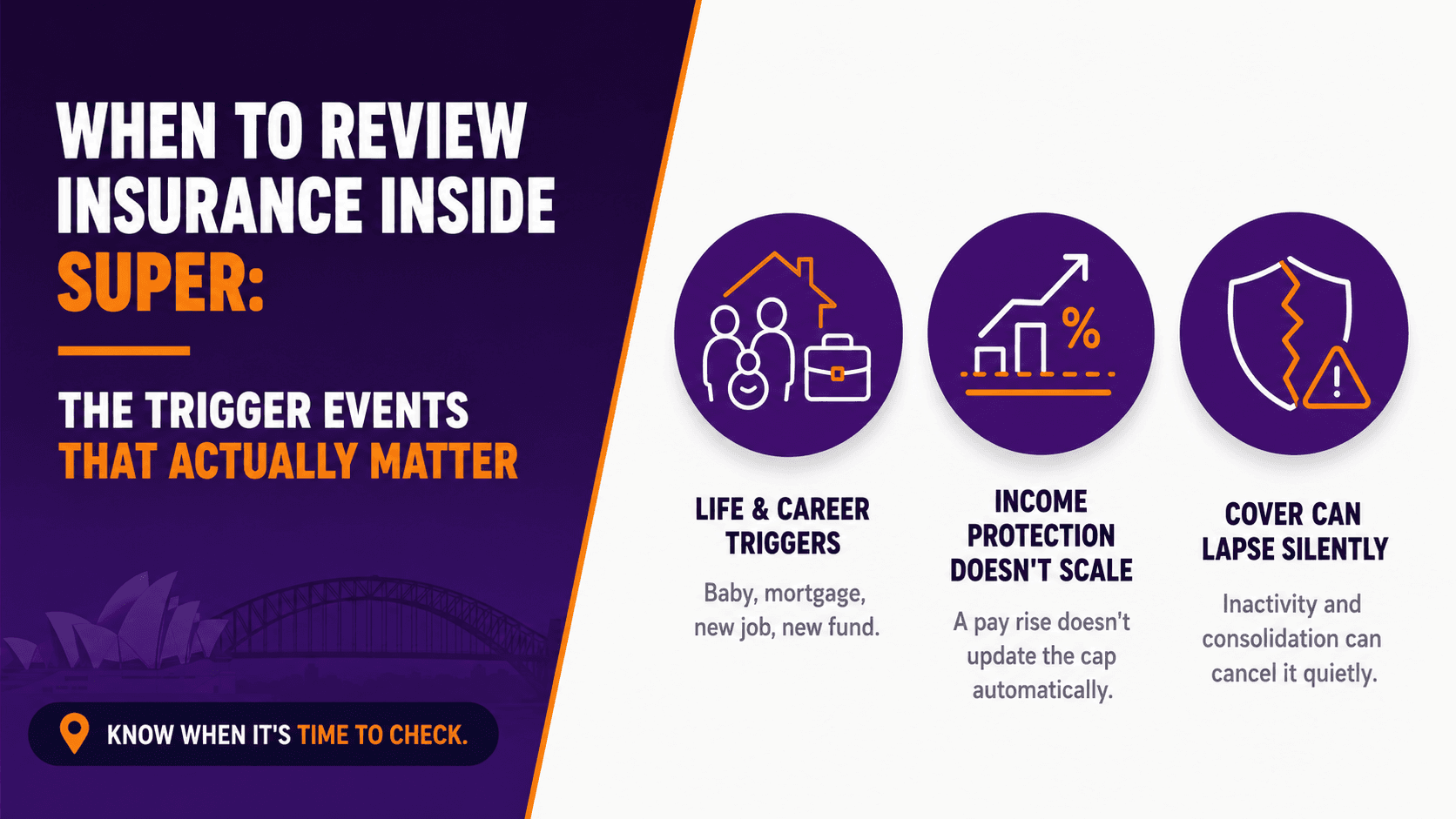
Most Australians set up their super insurance once, usually by accident, when a fund defaulted them into cover at account opening, and never look at it again. The problem isn't that the cover was wrong on day one. It's that life kept moving and the policy didn't. A pay rise, a mortgage, a new baby, a career change, none of these automatically update a group insurance policy sitting quietly inside a super fund. This guide covers the specific moments that should trigger an actual review, not a vague "check it every so often" reminder. For working out how much cover you'd actually need in the first place, our separate needs analysis guide covers that calculation in full, this piece focuses on when to revisit whatever number you land on.
TL;DR
Insurance inside super is generally default group cover, set once and rarely revisited unless something prompts a review.
Trigger events, not the calendar, are the most reliable signal that a review is overdue: income changes, debt changes, family changes, and career or fund changes all shift what the right cover looks like.
Having a baby or taking on a mortgage are two of the most common triggers, since both materially increase what a family would need to replace or pay off.
Changing jobs or funds can silently reduce or reset cover, since new employer default funds don't automatically match what was held previously.
Income protection cover is capped as a percentage of income, so a pay rise without a review can leave a growing gap between what's insured and what's actually earned.
TTR and pension conversions are a commonly missed trigger, since insurance inside an accumulation account often doesn't automatically carry over.
Cover can lapse entirely through low balances, account consolidation, or inactivity rules, sometimes without the member realising until a claim is needed.
Bottom line: super insurance doesn't fail because it was set up wrong, it fails because nobody revisited it when the trigger events that mattered actually happened.
On This Page
Why Default Super Insurance Goes Stale
The Trigger Events That Actually Matter
What Typically Needs to Change at Each Trigger
The Silent Risk: Cover That Lapses Without Notice
Worked Example: A Cover Gap That Built Up Over Six Years
Common Mistakes
FAQ
Why Default Super Insurance Goes Stale
Default insurance inside super is built for administrative simplicity, a flat or formula-based amount of life, TPD, and sometimes income protection cover applied automatically when an account opens. It isn't recalculated when your income rises, your mortgage grows, or you have a second child. Group policies inside super are also periodically renegotiated by the trustee with the insurer, meaning premiums, definitions, and even the amount of default cover itself can change without an individual member doing anything at all.
This creates a specific kind of risk: cover that felt adequate, or was never actually assessed, quietly drifts further from what's needed every year it goes unreviewed. Unlike a personal policy chosen deliberately, default super cover was never built around your specific numbers to begin with.
Worth noting upfront: WIAA doesn't sell general insurance products directly. This guide is about recognising when your existing cover, wherever it's held, needs a fresh look, which you can then take to your fund, an insurer, or a broader conversation with us about your financial position.
Not sure what's actually changed in your super fund's insurance since you joined? A free 15-minute chat with WIAA can pull the current policy details and check them against what's actually happened in your life since. Call 1800 942 843 or book online.
Bottom line: default cover isn't wrong on day one, it's the years of silence afterwards that create the gap.
The Trigger Events That Actually Matter
Rather than reviewing on a fixed schedule that's easy to ignore, the more reliable approach is tying a review to specific events, each of which genuinely changes what adequate cover looks like:
Having a child, new ongoing costs and a new dependent to plan around.
Buying a property or increasing a mortgage, a new or larger debt that would need to be paid off or serviced.
A significant pay rise or income change, particularly relevant for income protection, which is generally capped as a percentage of income.
Changing jobs or super funds, new employer defaults don't automatically replicate previous cover, and consolidating accounts can unintentionally cancel cover.
Starting a Transition to Retirement strategy or converting to a pension account, insurance held inside an accumulation account doesn't always transfer automatically.
Divorce or separation, dependents, debts, and beneficiary nominations can all shift substantially.
Starting a business or becoming self-employed, group cover through an employer's default fund often doesn't apply the same way, or at all.
A health diagnosis or family health event, while this can affect future insurability, it's still worth understanding current cover before anything changes.
Bottom line: each of these events changes either what needs to be covered or whether the existing cover still applies at all, which is exactly why they're the moments worth acting on rather than the anniversary of opening the account.
What Typically Needs to Change at Each Trigger
Different triggers point to different adjustments, not a blanket "increase everything" response:
After having a child: life and TPD cover generally needs to increase to reflect a new dependent and ongoing costs.
After a mortgage increase: life cover should be checked against the new debt figure to confirm the payoff amount still holds.
After a pay rise: income protection specifically needs checking, since it's typically capped around a percentage of income and doesn't adjust automatically.
After a job or fund change: confirm whether default cover exists in the new fund at all, and whether the old fund's cover was cancelled, reduced, or left running as a separate policy.
After a TTR or pension conversion: confirm whether insurance was automatically carried into the new account structure or needs to be separately arranged.
After separation or divorce: review both the cover amount and the binding death benefit nomination, since these are two different things that both need updating.
Working out which specific adjustment applies to your situation is exactly the kind of check a free 15-minute chat covers. Email clientservices@whatifadvice.com.au or book online.
Bottom line: the right response to a trigger event isn't automatic, it's specific to what that event actually changed.
The Silent Risk: Cover That Lapses Without Notice
Beyond cover simply becoming inadequate, there's a separate and more serious risk: cover disappearing entirely without the member realising. This can happen through a few mechanisms specific to super:
Low balance or inactivity rules, where insurance is automatically cancelled on accounts that haven't received a contribution for a defined period, generally around 16 months, unless the member has actively opted to keep it.
Account consolidation, where combining multiple super accounts into one can cancel insurance held in the account that gets closed.
Fund switching, where moving to a new employer's default fund doesn't carry existing cover across, leaving a member who assumes they're covered actually holding nothing.
Bottom line: the worst outcome isn't outdated cover, it's cover that's silently gone entirely, and the only way to catch this is an active check, not an assumption.
Worked Example: A Cover Gap That Built Up Over Six Years
James joined his super fund at 27 with default life and TPD cover of $200,000, set automatically when the account opened. Over the following six years, he received two promotions taking his income from $70,000 to $110,000, bought a property with a $520,000 mortgage, and had his first child. He never reviewed his insurance once during that period, since nothing prompted him to.
At 33, a routine financial review flagged the gap. His $200,000 default cover no longer came close to covering the mortgage alone, let alone income replacement for his now-larger household. Separately, his income protection, capped at a percentage of his original $70,000 salary when the policy was set up, hadn't scaled with his pay rises, meaning a claim would have replaced a percentage of an income figure well below what he was actually earning.
Outcome: James increased life and TPD cover to align with the current mortgage and family situation, and updated his income protection to reflect his current salary. The adjustment came at a higher premium than his original default cover, but closed a gap that, left unreviewed, would have left his family covering a shortfall exactly when they could least afford one.
Bottom line: none of James's cover was ever cancelled or reduced, it simply never kept pace, which is the version of underinsurance that's easiest to miss.
Common Mistakes
Assuming default cover automatically scales with income or life changes. It doesn't, and income protection specifically is vulnerable to this.
Consolidating super accounts without checking what insurance is attached. Closing an account can cancel a policy that was never replicated elsewhere.
Changing jobs and assuming cover carries over. New employer default funds start their own default cover, which may be less than what was previously held.
Treating a TTR or pension conversion as purely a tax and income decision. Insurance held in the accumulation account is easy to overlook in that conversation.
Letting a super account go inactive without realising insurance is at risk of automatic cancellation. Low balance and inactivity rules exist specifically for this scenario.
A missed trigger event is the most common reason cover falls out of step with reality. A free 15-minute chat can check whether any of yours have slipped through. Call 1800 942 843.
FAQ
How often should I review insurance inside my super? Rather than a fixed schedule, the more reliable approach is reviewing after specific trigger events, having a child, a mortgage or income change, a job or fund switch, or a TTR or pension conversion, since these are the moments cover actually needs to change.
Can my super insurance be cancelled without me knowing? Yes, generally through inactivity or low balance rules that automatically cancel cover on accounts without recent contributions, unless the member has actively opted to retain it, or through account consolidation cancelling cover attached to a closed account.
Does income protection inside super automatically increase with my salary? Generally not. It's typically capped as a percentage of income at the time it was set up, and doesn't automatically adjust when income rises, which is why a pay rise is a specific trigger worth reviewing against.
If I change jobs, does my super insurance move with me? Not automatically. A new employer's default super fund generally starts its own default cover, and previous cover isn't carried across unless separately arranged.
Does converting to a Transition to Retirement pension affect my insurance? It can. Insurance held in an accumulation account doesn't always automatically continue once converted to a pension account, so this is worth specifically checking at that point.
Should I update my beneficiary nomination at the same time as reviewing cover? Generally, yes, particularly after events like marriage, divorce, or having children, since a binding death benefit nomination and the cover amount are two separate things that both need attention.
Is it worth reviewing insurance if I haven't had a major life event recently? It can still be worth a periodic check, since group insurance terms and premiums can change on the trustee's side even without anything changing in your own circumstances.
What happens if I don't notice my cover has lapsed until I need to claim? A lapsed policy generally can't be claimed against, which is why an active check after trigger events matters more than assuming cover is still in place.
Does this apply to TPD and income protection, or just life insurance? All three are generally worth checking at trigger events, though the relevant adjustment differs, life and TPD relate more to debt and dependents, while income protection relates specifically to income level.
Can WIAA review my current super insurance for me? Yes, a review of current cover against recent life and career changes is a standard part of a broader financial planning conversation. And if you haven't yet worked out what your cover actually should be, our life insurance needs analysis guide is the natural starting point before or alongside this review.
Ready to Check Whether Your Super Insurance Still Matches Your Life?
If it's been years, or a few major life events, since you last looked at what's actually inside your super policy, there's a good chance it's fallen behind. A free 15-minute chat can check it against where you are now.
Call us: 1800 942 843
Book online: free 15-minute chat, no cost, no pressure
Still asking what if.
WIAA has helped Australians keep their super insurance aligned with real life changes, not just default settings, across Toowong, Grange, and Melbourne CBD. WIAA operates under AFSL 528250 as an Authorised Representative of Beryllium Advisers Pty Ltd.
General Advice Disclaimer: This article contains general information only and does not take into account your personal objectives, financial situation, or needs. It is not personal financial advice and should not be relied upon as such. Insurance terms, premiums, and default cover arrangements vary between super funds and change over time, and should be verified directly with your fund or a qualified adviser. WIAA does not sell general insurance directly.