Looking for specific financial advice?
This blog provides general educational content. For personalized advice tailored to your unique situation, book a free consultation with our team of ASIC-licensed financial advisers.
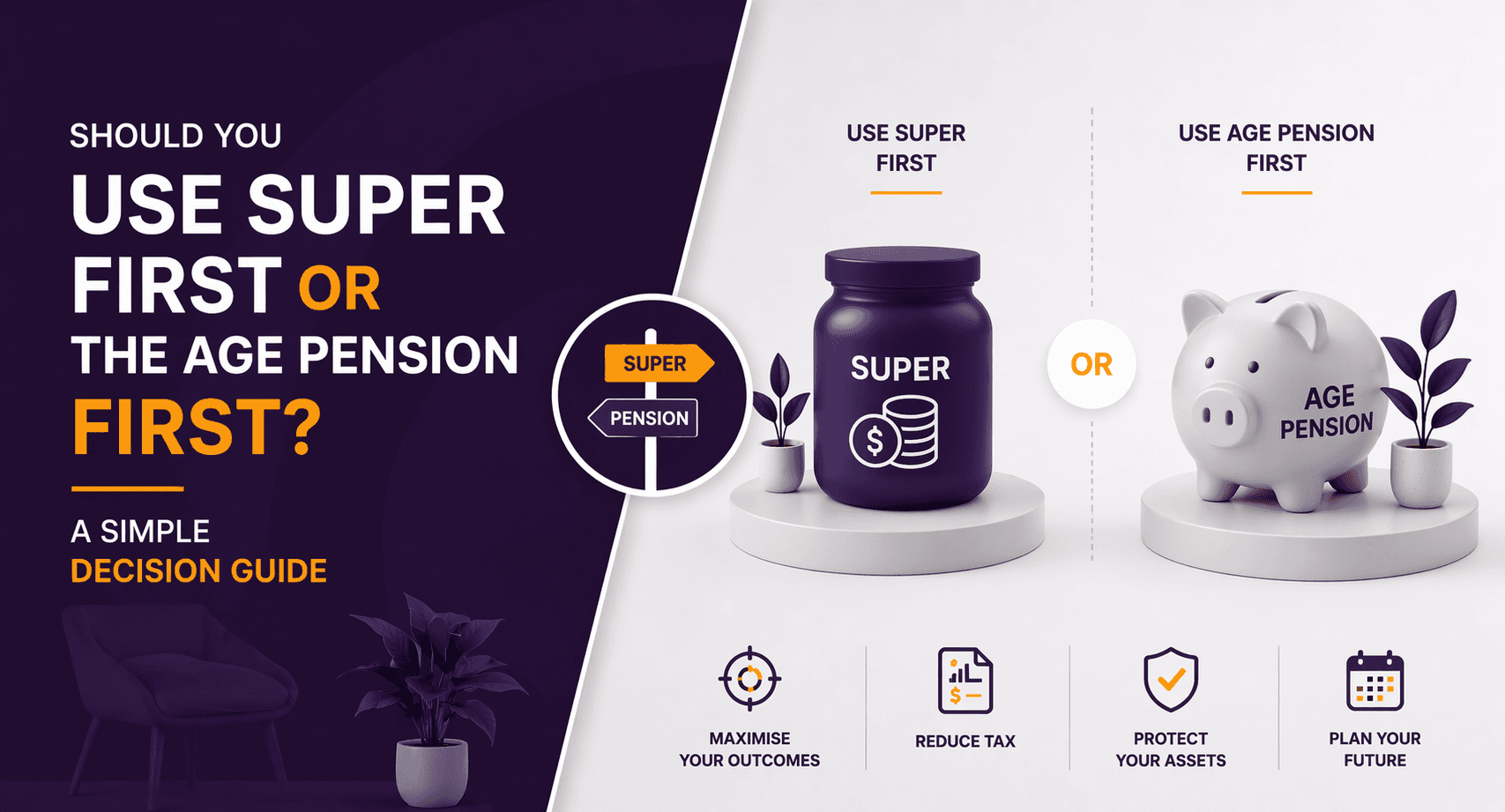
This is one of the most common retirement questions Australians ask:
“Should I use my super first and wait for the Age Pension, or claim the pension straight away?”
It sounds simple. It isn’t.
The Age Pension and super are designed to work together, not as competing options. The smartest strategy usually depends on:
your age
your super balance
whether you own your home
your assets outside super
your spending needs
your life expectancy
your Centrelink eligibility
Let’s break it down clearly.
First: How Super and the Age Pension Actually Work
Superannuation
Super is your own money, built up during your working life. Once you meet a condition of release (such as retirement after preservation age or reaching age 65), you can access it.
Super gives you:
control over drawdowns
flexibility
investment options
potentially tax-free withdrawals depending on age and structure
Age Pension
The Age Pension is a government income support payment.
To qualify, you must:
meet age requirements
satisfy residency rules
pass the assets test and income test
Whichever test produces the lower payment applies.
Importantly:
The Age Pension is means-tested
It reduces as your assets and income increase
It is not automatic, you must apply
The Core Myth: “I’ll Spend My Super First, Then Go on the Pension”
Many people assume:
“I’ll just use up my super first, then the government will step in.”
But the reality is more nuanced.
Because:
The Age Pension reduces gradually as assets rise
You may qualify for a part Age Pension even while holding significant super
Spending super unnecessarily fast can reduce long-term security
In other words, it’s not an “either/or” system.
Option 1: Use Super First (Delay the Age Pension)
This approach means:
You rely primarily on super
You delay applying for the Age Pension
You may become eligible later if assets reduce
When this might make sense
You have a large super balance
Your assets are well above Age Pension thresholds
You want flexibility and independence
You prefer not to deal with Centrelink early
You expect investment growth to outpace spending
Risks of this approach
You might deplete super too quickly
You miss out on pension entitlements you were eligible for
You delay concession benefits (like the Pensioner Concession Card)
You may increase long-term financial pressure
Option 2: Apply for the Age Pension as Soon as Eligible
This approach means:
You apply once you reach Age Pension age
You receive full or part pension (if eligible)
You use super to top up income
When this might make sense
You qualify for full or part pension
Your super balance is moderate
You want to preserve super for longer
You value concession cards and associated benefits
You prefer stable baseline income
Benefits of this approach
Pension supplements your super income
Super may last longer
Reduced anxiety about running out
Access to concession benefits
The Reality: Most Australians Use Both Together
For many retirees, the best strategy is:
Receive part Age Pension
Draw income from super
Adjust drawdown rates over time
Because the Age Pension reduces gradually under the assets test, many people with moderate super balances still qualify for partial payments.
This creates a “blended income” strategy.
Practical Examples
Example 1: Moderate Super, Homeowner
Sarah is 67 and owns her home.
She has $600,000 in super and limited other assets.
She may qualify for a part Age Pension.
Instead of using super alone, she:
Applies for the pension
Receives part payments
Uses super to top up income
Result:
Her super lasts longer
She receives concession benefits
Income feels stable
Example 2: Higher Super Balance
Mark has $1.5 million in super and owns his home.
He is unlikely to qualify for the Age Pension under the assets test.
In this case:
He relies on super
Pension is not part of the strategy
He focuses on investment management and drawdown discipline
Example 3: Assets Near the Threshold
Julie has $850,000 in super and modest savings.
She may qualify for a small part Age Pension depending on thresholds.
In her case:
Applying for the pension could still make sense
Even a small pension amount may provide concession benefits
A blended strategy is often optimal
What About “Using Super to Qualify for the Pension”?
Some retirees consider deliberately spending or restructuring assets to qualify for the Age Pension.
Be careful.
There are:
Gifting rules
Deprivation rules
Look-back periods
Centrelink compliance requirements
Artificially reducing assets without proper planning can create problems.
Retirement planning should focus on lifestyle security, not just qualifying for payments.
Key Factors to Consider in Your Decision
Before choosing whether to rely on super first or pension first, ask:
1) What is my total asset position?
Include:
super
cash
investments
vehicles
contents
(Your home is generally exempt under the assets test.)
2) What income do I actually need?
Separate:
essential spending
discretionary spending
3) How long does my super need to last?
Plan to at least age 90+.
4) What are the tax implications?
Super withdrawals may be tax-free depending on age and structure, but pension eligibility may affect income planning.
5) What benefits come with pension eligibility?
Even a small pension can provide:
concession cards
reduced healthcare costs
utility rebates
Strategic Approach: A Simple Framework
Here’s a practical way to think about it:
Step 1: Apply for Age Pension when eligible
There is generally little downside to checking eligibility once you reach pension age.
Step 2: Use super as a flexible top-up
Let super supplement pension income rather than replace it entirely.
Step 3: Adjust annually
Reassess:
investment returns
spending
Centrelink thresholds
health and lifestyle changes
Retirement planning is not a one-time decision.
Key Takeaways
Super and Age Pension are designed to work together
Many Australians qualify for part pension even with moderate super
Using super alone may reduce long-term security
Applying for Age Pension early (if eligible) often makes sense
Blended strategies usually provide the most stability
The right answer depends on your assets, lifestyle and goals
FAQ
1) Should I spend my super before applying for the Age Pension?
Not necessarily. Many retirees qualify for part pension while still holding super. It’s often better to assess eligibility rather than assume.
2) Can I get the Age Pension if I have super?
Yes. Super is assessed under the assets and income tests, but many people still qualify for part payments.
3) Does owning my home affect the decision?
Yes. The family home is generally exempt from the assets test, which can improve pension eligibility.
4) Is it better to delay claiming the Age Pension?
Sometimes, but often there’s little advantage in delaying if you’re eligible.
5) What’s the safest strategy?
A structured plan that blends super withdrawals with pension entitlements and reviews the strategy annually.
The question isn’t really:
“Super first or pension first?”
It’s:
“How do I combine both to maximise stability and long-term security?”
For many Australians, a blended strategy provides:
predictable income
preserved super
access to concessions
reduced anxiety about running out of money
Want clarity on your retirement income strategy?
At What If Advice, we help Australians model super drawdowns and Age Pension eligibility together, so you can retire with confidence.
Book a Retirement & Super Workshop to get a personalised income plan that works for your situation.
General Advice Disclaimer
This information is general in nature and does not take into account your personal financial situation, needs, or objectives. You should consider whether it is appropriate for you and seek personal financial advice before making any decisions.