Looking for specific financial advice?
This blog provides general educational content. For personalized advice tailored to your unique situation, book a free consultation with our team of ASIC-licensed financial advisers.
What If Your Side Hustle Has Tax Obligations a Regular Job Never Would?
A side hustle feels informal, a few Uber shifts, an Airbnb room, some freelance work picked up through an app. The ATO doesn't see it that way. Gig and sharing economy income is taxable from the first dollar, some of it comes with GST obligations that catch people off guard, and platforms increasingly report earnings directly to the ATO whether the earner declares it or not. This guide covers what actually applies once side income moves from "cash in the bank" to "income the ATO already knows about." For the deeper mechanics of short-stay rental apportionment specifically, our St Kilda guide covers that ground in more depth, this piece focuses on gig income more broadly, including rideshare's specific GST treatment.
TL;DR
All gig and side hustle income is assessable income, regardless of how small, casual, or cash-adjacent it feels, and needs to be declared in full.
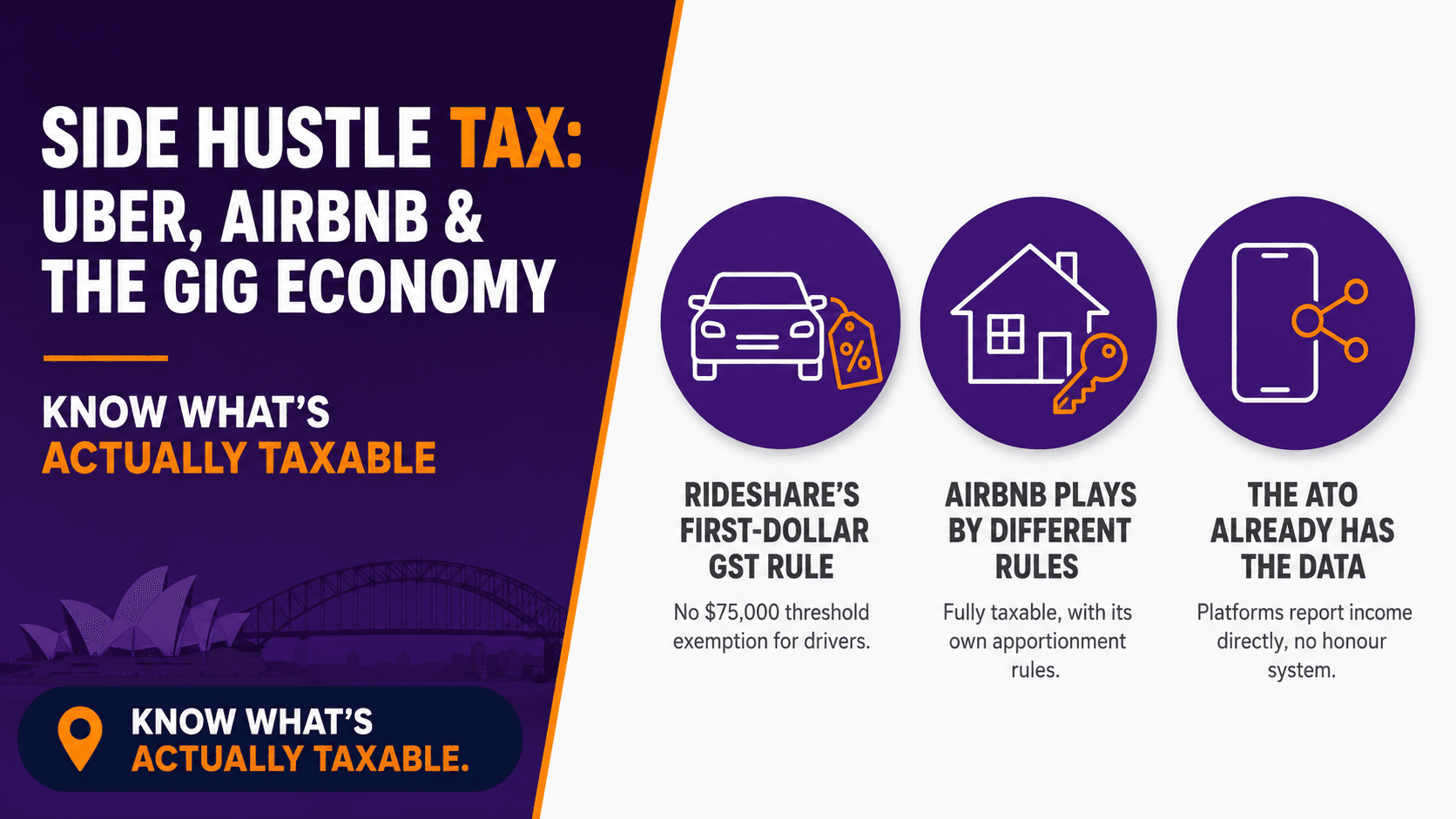
Ride-sourcing (Uber, similar rideshare platforms) has a unique rule: drivers must register for GST from the first dollar earned, with no $75,000 threshold exemption that applies to most other small businesses.
Airbnb and short-stay rental income is generally not subject to the same GST rule as rideshare, but is fully taxable, and comes with its own deduction and CGT considerations tied to the property itself.
An ABN is generally required once gig activity resembles a genuine business rather than a one-off hobby transaction, and most rideshare and delivery platforms require one to sign up at all.
Deductions are available against gig income, including a reasonable proportion of vehicle costs, phone and data, platform fees, and equipment, calculated using the same principles as any other work-related deduction.
The ATO receives data directly from platforms under sharing economy reporting obligations, meaning undeclared platform income is increasingly easy for the ATO to identify independently.
Multiple income streams need to be tracked and declared together, since combining a main job with gig income can push total taxable income into a higher bracket than either income alone would suggest.
Bottom line: gig income isn't a grey area, it's fully assessable, increasingly visible to the ATO through direct platform reporting, and in rideshare's case, comes with a GST obligation most other side hustles don't have.
On This Page
All Gig Income Is Taxable, Full Stop
The Rideshare GST Rule Nobody Expects
Airbnb and Short-Stay Rental: A Different Set of Rules
Do You Need an ABN?
What's Actually Deductible
The ATO Already Knows: Sharing Economy Reporting
Worked Example: A Driver Who Also Rents a Spare Room
Common Mistakes
FAQ
All Gig Income Is Taxable, Full Stop
Income earned through gig platforms, rideshare, food delivery, freelance marketplaces, short-stay rental, or any similar arrangement, is assessable income under Australian tax law, regardless of how the earner personally categorises it. There's no informal exemption for income that feels like a side project rather than a "real" job, and no minimum earning threshold below which it doesn't need to be declared. This applies whether the income is paid directly to a bank account, through a platform's payment system, or even in cash.
Not sure how your specific side income fits into your overall tax position? A free 15-minute chat with WIAA can map it out properly. Call 1800 942 843 or book online.
Bottom line: there's no dollar threshold or informality exception that makes gig income non-taxable, it's assessable from the first dollar earned.
The Rideshare GST Rule Nobody Expects
This is the single most commonly missed rule in gig economy tax. Most small businesses and sole traders only need to register for GST once their turnover exceeds $75,000 annually. Ride-sourcing services, including Uber and similar rideshare platforms, are specifically excluded from this threshold. Drivers are required to register for GST and charge it on fares from the very first dollar earned, regardless of how few hours they drive or how low their total annual turnover is.
This means a driver doing a handful of shifts a month, earning well under $75,000 a year, still has a GST registration and reporting obligation that a freelancer or small consulting side hustle earning the same amount typically wouldn't. This rule catches a significant number of casual and part-time drivers who reasonably assume the standard threshold applies to them.
Bottom line: rideshare driving is treated differently to almost every other side hustle for GST purposes, and assuming the standard $75,000 threshold applies is one of the most common and costly mistakes in this space.
Airbnb and Short-Stay Rental: A Different Set of Rules
Income from renting out a property or spare room through Airbnb or similar platforms is fully taxable, but generally doesn't carry the same first-dollar GST obligation that rideshare does, since residential accommodation is typically treated differently to ride-sourcing under GST rules. What it does bring is a different set of considerations tied to the property itself: deductible expenses generally need to be apportioned between the portion of the property or time period rented out versus used privately, and renting out all or part of a main residence can have implications for the main residence capital gains tax exemption when the property is eventually sold. Our St Kilda guide covers the personal-use apportionment mechanics for short-stay rentals in full detail.
Short-stay rental income interacts with property tax rules in ways that are easy to get wrong, particularly around apportionment and future CGT. A free 15-minute chat can walk through your specific situation. Email tax@whatifadvice.com.au or book online.
Bottom line: Airbnb income skips the rideshare-style GST trap but brings its own complexity around apportionment and the main residence CGT exemption, which is worth verifying against your specific arrangement with a tax professional.
Do You Need an ABN?
Most gig platforms, particularly rideshare and delivery services, require an ABN to sign up at all, since the relationship is generally structured as an independent contractor arrangement rather than employment. For less formal side income, such as occasional freelance work or a one-off sale, whether an ABN is required depends on whether the activity constitutes a genuine business or is closer to a hobby, a distinction that has specific ATO guidance behind it rather than being a matter of personal preference.
Bottom line: if a platform requires an ABN to join, that's a strong signal the income is being treated as business income rather than a casual hobby, regardless of how small the actual earnings are.
What's Actually Deductible
Gig income comes with genuine deductions, calculated using the same underlying principles as any other work-related or business deduction, apportioned to the actual income-producing use:
Vehicle expenses for rideshare and delivery drivers, using either the logbook or cents-per-kilometre method, apportioned to business-use kilometres.
Phone and data costs, apportioned to the work-related percentage of use.
Platform fees and commissions charged by the gig platform itself.
Equipment specific to the activity, such as delivery bags or safety equipment.
A proportion of running costs for Airbnb-style rentals, apportioned to the rented space and time period.
Bottom line: gig income deductions follow the same general apportionment principles as any other work-related claim, they're just easy to overlook when the income itself feels informal.
The ATO Already Knows: Sharing Economy Reporting
Under Australia's sharing economy reporting regime, platforms including rideshare, delivery, and short-stay rental services are required to report transaction data directly to the ATO. This means the ATO frequently already has visibility into gig income independently of what the earner declares, and data-matching against tax returns is an increasingly routine compliance activity. This significantly reduces the practical likelihood that undeclared platform income simply goes unnoticed.
Bottom line: platform income is no longer a self-reported honour system, the ATO generally already has the data before the return is even lodged.
Worked Example: A Driver Who Also Rents a Spare Room
Tom works full-time in an office role earning $75,000, and supplements this with weekend Uber driving, earning $18,000 in fares over the year, plus $6,000 from renting a spare room via Airbnb.
Because Tom drives for a rideshare platform, he's required to register for GST from his very first dollar of driving income, despite $18,000 being well under the standard $75,000 GST threshold, and needs to remit GST on his fares and lodge periodic BAS statements accordingly. His deductible vehicle expenses, calculated using the logbook method at his actual business-use percentage, offset part of his driving income for income tax purposes.
His $6,000 in Airbnb income doesn't carry a GST obligation, but does need apportioned expenses, a percentage of utilities, internet, and a portion of his home insurance, based on the room's floor area and the days it was actually rented.
Combined, Tom's $75,000 salary, $18,000 driving income (less deductions), and $6,000 rental income (less apportioned expenses) are all added together for income tax purposes, potentially pushing part of his combined income into a higher marginal tax bracket than his salary alone would suggest.
(Note the two separate $75,000 figures in this example, Tom's salary and the standard GST turnover threshold, are coincidentally the same number but otherwise unrelated.)
Outcome: Tom has a GST registration and BAS obligation purely because of the rideshare income, an income tax obligation on the combined total from all three income sources, and a set of deductions genuinely available against each, none of which he'd fully accounted for before reviewing it properly.
Bottom line: multiple gig income streams stack together for income tax purposes, and rideshare specifically brings a GST obligation that other side income generally doesn't.
Common Mistakes
Assuming the standard $75,000 GST threshold applies to rideshare driving. It doesn't, ride-sourcing requires GST registration from the first dollar.
Not declaring gig income because it feels informal or was paid in cash. All gig income is fully assessable regardless of how it's received.
Assuming platform income won't be visible to the ATO. Sharing economy reporting obligations mean platforms report transaction data directly.
Forgetting to apportion Airbnb-related expenses correctly. Only the portion attributable to the rented space and period is generally deductible.
Not considering how combined income from a main job and gig income affects the overall tax bracket. Multiple income sources stack together for income tax purposes.
Getting the GST and income tax obligations right on gig income from the start avoids a larger correction down the track. A free 15-minute chat can check your specific setup. Call 1800 942 843.
FAQ
Do I need to declare Uber or Airbnb income if it's just a small side amount? Yes. All gig and side hustle income is assessable regardless of the amount, there's no informal exemption for small or casual earnings.
Why do Uber drivers need to register for GST when other side hustles don't? Ride-sourcing is specifically excluded from the standard $75,000 GST registration threshold that applies to most small businesses, meaning drivers must register from their very first dollar of fare income.
Do I need an ABN to drive for Uber or a similar rideshare platform? Generally, yes, most rideshare platforms require an ABN to sign up, since the arrangement is structured as an independent contractor relationship.
Does Airbnb income have the same GST rule as Uber? Generally not. Short-stay rental income doesn't carry the same first-dollar GST registration requirement that rideshare does, though it's still fully taxable and has its own set of deduction and CGT considerations.
Can I claim vehicle expenses against my rideshare income? Yes, generally using the logbook or cents-per-kilometre method, apportioned to the actual business-use percentage of your driving.
Will the ATO know about my gig income even if I don't declare it? Increasingly, yes. Sharing economy reporting obligations require many platforms to report transaction data directly to the ATO, independent of what's declared in a tax return.
Does renting out a room on Airbnb affect the tax-free status of my main residence? It can. Renting out part of a main residence can affect the main residence capital gains tax exemption on that property when it's eventually sold, which is worth understanding before starting a short-stay rental arrangement.
How does gig income affect my overall tax bracket? It's added to your other income, including a main job's salary, for income tax purposes, which can push combined income into a higher marginal tax bracket than either source alone would suggest.
Do I need to lodge a BAS if I only drive for Uber occasionally? If you're registered for GST, which rideshare requires regardless of how little you drive, you generally need to lodge BAS statements on the applicable reporting cycle.
Can I claim a deduction for platform fees Uber or Airbnb charge me? Yes, generally, platform commissions and fees charged against your gig income are a legitimate deduction against that income.
Ready to Get Your Side Hustle Tax Obligations Sorted?
Gig income comes with its own rules, particularly rideshare's unusual GST requirement, and the ATO increasingly already has the data before you lodge. A free 15-minute chat can make sure everything's accounted for properly.
Call us: 1800 942 843
Email: tax@whatifadvice.com.au
Book online: free 15-minute chat, no cost, no pressure
Still asking what if.
WIAA has helped Australians get their gig and side hustle income properly declared and structured, across Toowong, Grange, and Melbourne CBD. WIAA operates under AFSL 528250 as an Authorised Representative of Beryllium Advisers Pty Ltd.
General Advice Disclaimer: This article contains general information only and does not take into account your personal objectives, financial situation, or needs. It is not personal financial advice or tax advice and should not be relied upon as such. GST thresholds, ABN requirements, and reporting obligations are subject to change and should be verified with the ATO or a registered tax agent for your specific circumstances.