Looking for specific financial advice?
This blog provides general educational content. For personalized advice tailored to your unique situation, book a free consultation with our team of ASIC-licensed financial advisers.
Small Business Tax Planning in Australia: Practical Strategies That Actually Work
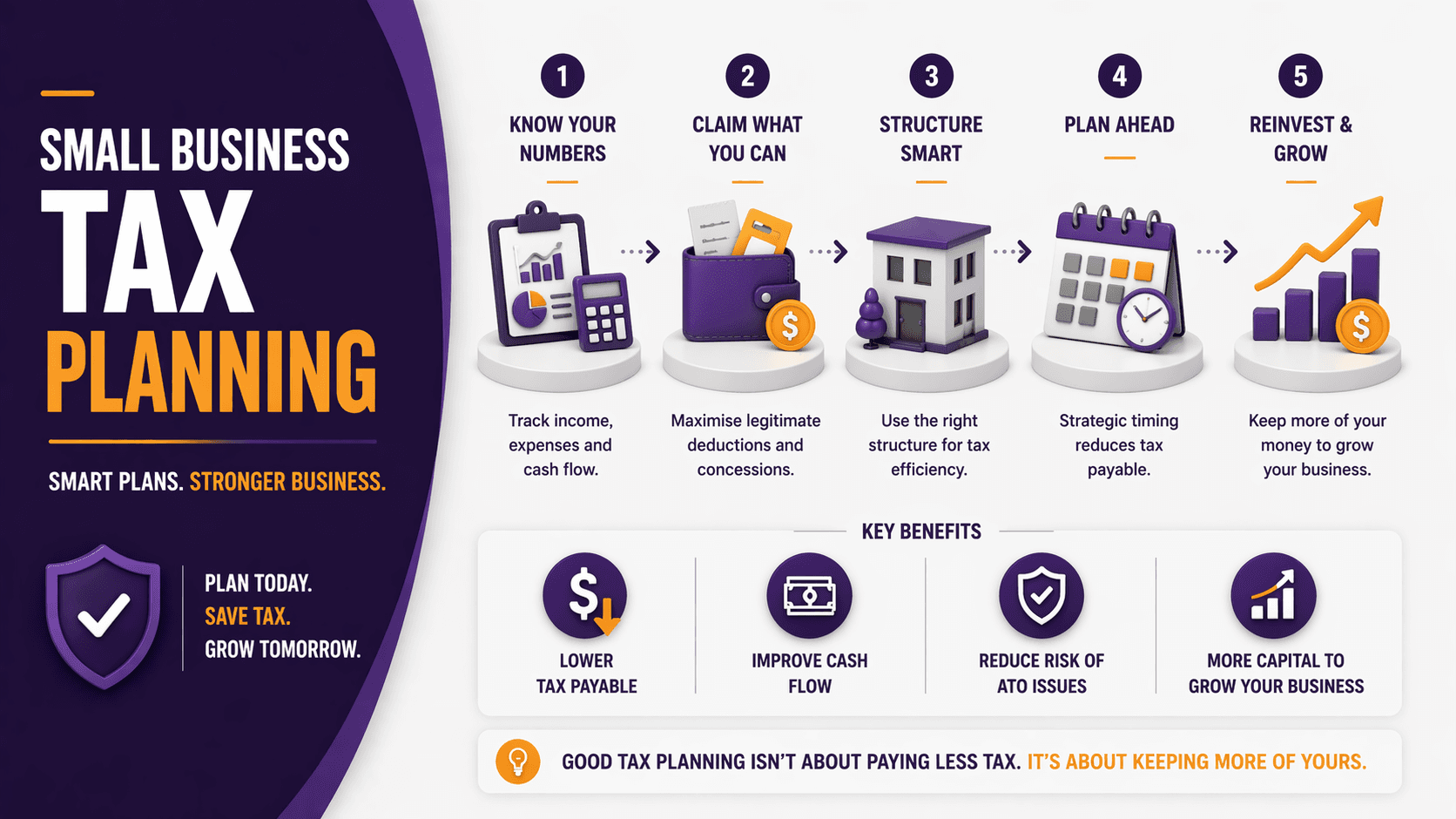
Small business tax planning isn’t about avoiding tax. It’s about paying the right amount, at the right time, in the right structure.
Done properly, it can:
Improve cash flow
Reduce tax legally
Support long-term growth
Done poorly, it usually results in:
Last-minute stress
Missed opportunities
Unexpected tax bills
Here’s how to approach it strategically.
What Is Tax Planning (And What It’s Not)
Tax planning is:
Proactive
Structured
Ongoing throughout the year
It is not:
Scrambling in June
Guessing deductions
Hoping your accountant “fixes it later”
Why Tax Planning Matters for Small Businesses
1. Cash Flow Control
Tax is often your largest expense.
Planning helps you:
Spread liabilities
Avoid surprises
Maintain working capital
2. Lower Overall Tax (Legally)
Using the right strategies:
Timing income and expenses
Choosing the right structure
Accessing concessions
3. Better Business Decisions
When you understand tax:
You make smarter investment decisions
You avoid reactive choices
Key Tax Planning Strategies
1. Timing Income and Expenses
One of the simplest strategies.
Delay income (if appropriate) into next financial year
Bring forward deductible expenses
Example:
Invoice issued 1 July instead of 30 June
Prepay expenses before EOFY
This can shift taxable income between years.
2. Maximise Deductions
Common deductible expenses:
Equipment and tools
Software subscriptions
Professional services
Marketing costs
Also consider:
Instant asset write-off (subject to current ATO rules)
3. Choose the Right Business Structure
Different structures = different tax outcomes.
Structure | Tax Treatment |
Sole trader | Personal tax rates |
Company | Flat tax rate (typically 25%) |
Trust | Flexible income distribution |
Choosing the wrong structure can cost significantly over time.
4. Superannuation Contributions
Super can be a tax-effective strategy.
Contributions may be deductible
Helps build long-term wealth
Be mindful of:
Contribution caps (ATO rules apply)
5. Manage Company Profits Strategically
If operating through a company:
Retain profits at lower tax rate
Distribute dividends strategically
This allows:
Tax deferral
Income smoothing
6. Understand Division 7A Risks
If you take money from your company:
It must be structured properly
Otherwise:
It may be treated as a taxable dividend
7. Review GST and BAS Position
Ensure:
GST is correctly accounted for
BAS lodgements are accurate
Mistakes here can:
Create cash flow issues
Trigger ATO scrutiny
Example Scenario
Small Business Owner (Company Structure)
Profit: $180,000
Without planning:
Full profit taxed
No optimisation
With planning:
$30,000 expenses brought forward
$20,000 super contribution
Remaining profit retained
Outcome:
Lower taxable income
Improved cash flow
Structured growth
End of Financial Year (EOFY) Checklist
Before 30 June:
Review profit position
Bring forward deductible expenses
Assess asset purchases
Finalise super contributions
Review debtor and creditor timing
Check loan accounts (Division 7A)
Confirm BAS and GST position
This is where most opportunities are either captured… or missed.
Common Tax Planning Mistakes
1. Leaving It Until June
By then, your options are limited.
2. Mixing Personal and Business Finances
Creates confusion and compliance risk.
3. Overclaiming or Guessing Deductions
ATO attention is not a business goal.
4. Ignoring Structure
Structure impacts tax more than most realise.
5. No Forward Planning
Tax planning should happen year-round.
Strategic Insight: Tax Planning Is a System, Not an Event
The best businesses:
Don’t just “do tax” once a year
They build tax into their decision-making
This includes:
Forecasting
Quarterly reviews
Ongoing adjustments
When Should You Get Advice?
You should consider professional advice if:
Your business is growing
You’re generating consistent profits
You’re unsure about structure or strategy
You want to reduce tax without risk
Because:
The cost of poor tax planning is usually higher than the cost of advice.
FAQs
1. What is tax planning for small businesses?
It’s the process of legally managing your income, expenses, and structure to reduce tax and improve cash flow.
2. When should I start tax planning?
Ideally at the start of the financial year, with regular reviews throughout.
3. Can I reduce tax legally in Australia?
Yes, through deductions, timing strategies, and structuring — all within ATO rules.
4. What is the most effective tax strategy?
There is no single strategy. It depends on your business structure, income, and goals.
5. Should I operate as a company or sole trader?
It depends on your income level, risk, and long-term plans.
6. What is the instant asset write-off?
A rule allowing eligible businesses to immediately deduct certain asset purchases (subject to ATO thresholds).
7. What is the biggest tax mistake small businesses make?
Leaving tax planning until the end of the financial year.
Disclaimer
This information is general in nature and does not take into account your personal objectives, financial situation, or needs. You should consider whether it is appropriate for your circumstances and seek professional advice. Taxation laws and ATO rules are subject to change.