Looking for specific financial advice?
This blog provides general educational content. For personalized advice tailored to your unique situation, book a free consultation with our team of ASIC-licensed financial advisers.
Can You Buy Property With Your SMSF? Rules, Risks & Strategy
What if you could own the building your business operates from inside your super fund, pay market rent into your own retirement savings instead of a landlord's pocket, and sell it tax-free in retirement? That's the business real property strategy, and it's the most compelling reason many business owners establish an SMSF. But the ATO's rules on SMSF property are strict, specific, and frequently misunderstood. This post serves two distinct readers: business owners considering commercial property through an SMSF (who face a different and more permissive set of rules) and investors considering residential property (who face tighter restrictions and a narrower path to genuine advantage). This guide covers both, including what the ATO allows and prohibits, how LRBAs work, the real costs, and how to know whether the strategy makes sense for your situation.
The reality is more nuanced than the appeal suggests. The ATO permits SMSF property investment but imposes strict rules on what can be purchased, from whom, how it can be used, and how it can be financed. Breaching those rules does not result in a fine. It can result in the entire fund being made non-complying, triggering a tax bill equivalent to 47% of the fund's total assets.
TL;DR: What You Need to Know Before Proceeding
An SMSF can own residential and commercial property, subject to strict ATO rules
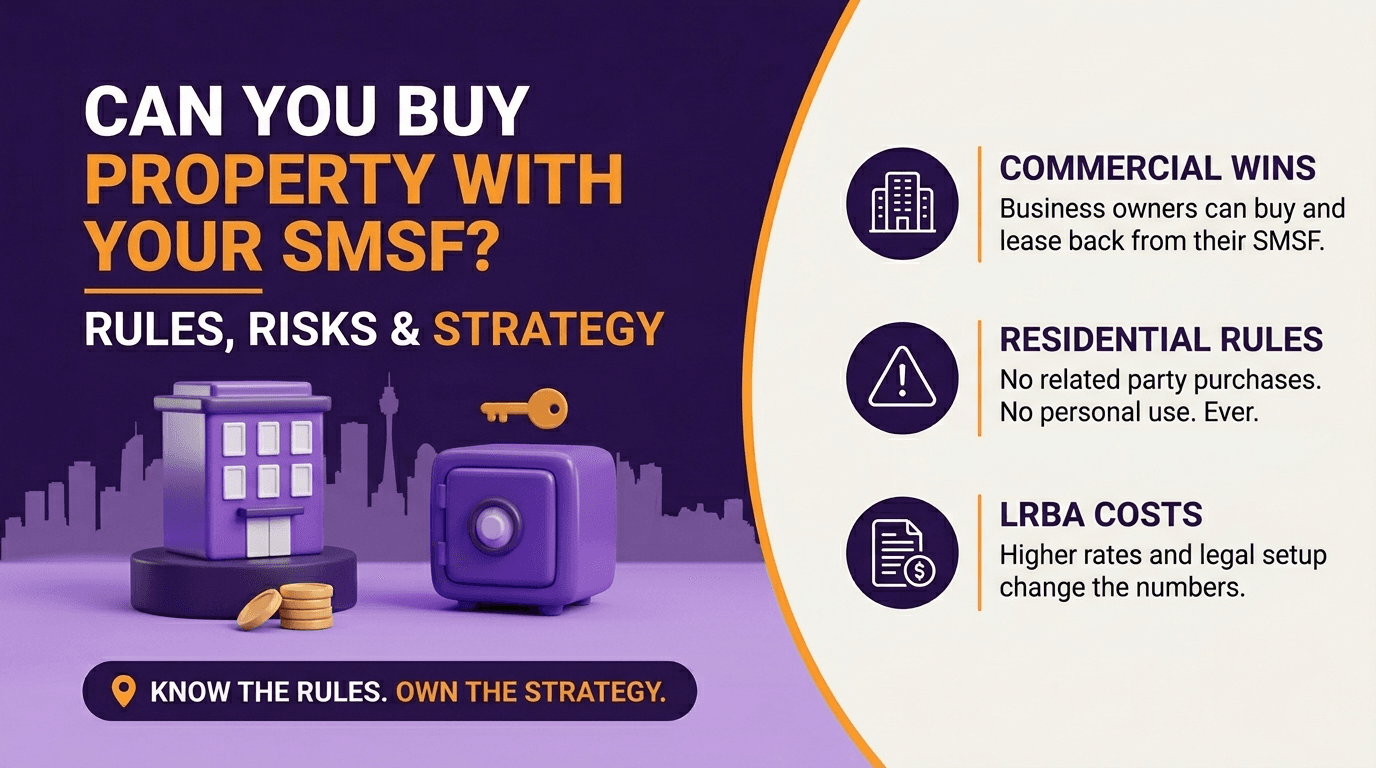
Residential property cannot be purchased from a related party or lived in or rented by a member or their family
Commercial property can be purchased from a related party at market value and leased back to the member's business
Borrowing to purchase property is permitted through a Limited Recourse Borrowing Arrangement (LRBA)
SMSF loan rates currently sit around 6.6% to 6.8% for residential property, higher than standard investment loans (verify current rates with a specialist lender)
Rental income is taxed at 15% in accumulation phase and 0% in pension phase
Around 17.5% of SMSF assets are currently held in residential and commercial property across Australia's 653,000+ SMSFs
Bottom line: SMSF property investment is legal, well-established, and genuinely advantageous in the right circumstances. It is also one of the most heavily regulated and frequently misunderstood investment strategies in Australian superannuation.
Jump to a Section
What an SMSF Can and Cannot Buy
The Rules in One Table
How LRBAs Work: Borrowing to Buy Property in Super
The Business Real Property Strategy — the compelling case for business owners
The Tax Advantages of SMSF Property
The Real Costs: What Most Projections Leave Out
The Most Common Compliance Breaches — read before proceeding
Two SMSF Property Examples: One Case For, One Case Against
Common Mistakes SMSF Property Investors Make
FAQ
Ready to Work Out Whether SMSF Property Is Right for You?
What an SMSF Can and Cannot Buy
The starting point is understanding the ATO's framework for SMSF property ownership. The rules differ significantly between residential and commercial property.
Residential Property
An SMSF can purchase residential property provided it meets all of the following conditions:
The property is purchased at market value from an arm's-length third party (not a related party)
No member of the fund or any related party lives in or rents the property at any point
The property is held solely for the purpose of providing retirement benefits to members (the sole purpose test)
All ongoing management is conducted on commercial terms (market rent, standard lease agreements)
The prohibitions are where most compliance breaches originate. These are not grey areas. What an SMSF cannot do with residential property:
Purchase it from a fund member, their relatives, or associated entities
Allow a member, their family, or any related party to live in or rent it
Use it as a holiday home for trustees or members, even temporarily
Use borrowed funds to make improvements to the property (repairs only, under LRBA rules)
Commercial Property
Commercial property rules are more flexible, and the business real property provisions create one of the most compelling SMSF strategies available.
An SMSF can purchase commercial property and:
Buy it from a related party, including the member personally, provided the transaction occurs at market value and on arm's-length terms
Lease it to the member's own business at market rent
Transfer it into the SMSF as an in-specie contribution from the member (subject to contribution caps and stamp duty considerations)
The business real property exception is the primary reason many business owners establish an SMSF. The ability to purchase the premises from which the business operates, with lease payments flowing into super rather than to a landlord, creates a powerful retirement wealth-building mechanism.
What if the property strategy you've been considering is the one the ATO specifically prohibits, and the one that's actually available to you is even more powerful? Most people researching SMSF property start with residential and discover commercial is where the real strategy lives.
Bottom line: Residential property rules are strict and symmetrical. Commercial property rules allow related-party transactions and business leasing, creating opportunities unavailable in any other super structure.
The Rules in One Table
Rule | Residential Property | Commercial Property |
Can SMSF purchase it? | Yes | Yes |
Purchase from related party? | No | Yes, at market value |
Member can live in it? | No | No |
Related party can rent it? | No | Yes, at market rent |
Member's business can lease it? | No | Yes, at market rent |
Can borrow to buy (LRBA)? | Yes | Yes |
Improvements under LRBA? | No (repairs only) | No (repairs only) |
Transfer in-specie from member? | No | Yes, subject to rules |
Tax on rental income (accumulation) | 15% | 15% |
Tax on rental income (pension phase) | 0% | 0% |
CGT on sale (held 12+ months) | 10% (accumulation) | 10% (accumulation) |
CGT on sale (pension phase) | 0% | 0% |
Bottom line: The rules differ materially between residential and commercial property. Understanding which category applies to your strategy is the essential first step.
How LRBAs Work: Borrowing to Buy Property in Super
A Limited Recourse Borrowing Arrangement is the mechanism by which an SMSF borrows money to purchase a property. The "limited recourse" element means the lender can only claim the specific property as security if the SMSF defaults. Other SMSF assets are protected.
The LRBA structure is more complex than a standard property loan. Each of these requirements creates a compliance obligation that must be maintained for the life of the loan:
A bare trust (holding trust) is established to hold the property while the loan is outstanding. Legal title sits with the bare trustee, not the SMSF, until the loan is fully repaid.
The SMSF makes all loan repayments from fund assets, including contributions and rental income.
The property is a single acquirable asset. The SMSF cannot borrow to buy a portfolio of assets; each loan must relate to a specific, single property.
The loan must be on arm's-length terms. Related-party loans must meet the ATO's safe harbour terms under PCG 2016/5.
No improvements during the loan period. The SMSF can use fund cash for repairs, but cannot use borrowed funds to improve the property or change its fundamental character.
Legal title transfers to the SMSF when the loan is repaid.
LRBA Loan Conditions in 2026
Feature | SMSF Residential Loan | Standard Investment Loan |
Interest rate | ~6.6% to 6.8% | ~5.5% to 6.0% |
Deposit required | 20% to 30% | 10% to 20% |
Lender options | Specialist SMSF lenders, some major banks | Broad market |
Legal setup cost | $2,000 to $5,000 (bare trust) | Nil |
Recourse on default | Property only | Full borrower recourse |
Note: Interest rates change frequently. Always verify current SMSF loan rates with a specialist SMSF lender or mortgage broker before modelling a specific acquisition.
The higher interest rate and deposit requirement of SMSF loans compared to standard investment loans is a frequently underestimated cost in SMSF property modelling.
Bottom line: LRBAs allow SMSFs to leverage property purchases but with higher rates, larger deposits, and significant additional legal and compliance costs compared to personal investment property loans.
The Business Real Property Strategy
If you're a business owner reading this post, this is the section that matters most. The business real property strategy is arguably the single most powerful reason to establish an SMSF, more so than any investment return, fee saving, or tax efficiency argument. The mechanism converts rent you are already paying into retirement wealth.
How it works:
The SMSF purchases the commercial premises the business occupies, either from a third party or from the business owner personally (at market value)
The business leases the premises from the SMSF at market rent
Lease payments flow into the SMSF, building retirement wealth rather than enriching a landlord
The property grows inside a concessionally taxed structure
On retirement, the property can be sold from pension phase with zero CGT (under current rules), or transferred to the member as a lump sum benefit
The tax advantages compound significantly over time:
Lease income taxed at 15% (accumulation phase) versus up to 47% if held personally
Capital growth taxed at 10% (accumulation, held 12+ months) versus up to 23.5% personally (after 50% CGT discount at 47% rate)
In pension phase: 0% tax on both income and capital gains (under current rules)
What if you've been paying $55,000 in commercial rent for 15 years and every dollar of it has gone to someone else's retirement? That's the business real property strategy in a single sentence.
For a business owner paying $60,000 per year in commercial rent, redirecting those payments to their SMSF over 15 years builds approximately $1.4 million in super before investment returns, inside a concessionally taxed structure.
The strategy requires careful management of the transfer balance cap as the fund grows. The 2026 Budget changes to CGT (announced but not yet legislated) should be monitored as they may affect the eventual sale calculation.
Bottom line: The business real property strategy is arguably the most powerful reason for a business owner to establish an SMSF. Lease payments building retirement wealth rather than paying a landlord, in a zero-tax pension phase exit under current rules, is a genuinely compelling long-term strategy.
Own a business and currently paying rent to a third party? The business real property strategy could redirect those payments into your retirement savings. Book a free 15-min chat with WIAA to scope whether the strategy suits your balance, business type, and property situation. Phone 1800 942 843 or email clientservices@whatifadvice.com.au.
The Tax Advantages of SMSF Property
The tax treatment of property inside an SMSF differs materially from personal ownership, and for long-term hold-to-retirement strategies, the advantage is significant.
During Accumulation Phase
Rental income taxed at 15% versus up to 47% personally
Net rental losses stay inside the SMSF (cannot be offset against personal income)
Capital gains taxed at 10% for assets held over 12 months versus up to 23.5% personally (after 50% CGT discount at 47% marginal rate)
During Pension Phase
Rental income: 0% tax
Capital gains on sale: 0% tax (under current rules)
The combination of zero income tax and zero CGT in pension phase is the most tax-effective exit scenario available for any Australian investment asset under current law
The CGT Reset Opportunity
Members transitioning assets from accumulation to pension phase can reset the cost base to market value at the transition date, reducing the eventual CGT liability on gains accrued during accumulation. For long-held properties with substantial unrealised gains, this reset can save tens of thousands in tax.
Note: The 2026 Budget has announced changes to CGT treatment from 2027. These are announced but not yet legislated. Seek current professional advice on the post-2027 position before making decisions that rely on the existing CGT treatment.
Bottom line: The tax advantage of SMSF property ownership over personal ownership is material and compounds over long holding periods, particularly for business owners with commercial property in pension phase.
The Real Costs: What Most SMSF Property Projections Leave Out
SMSF property investment is frequently modelled with optimistic assumptions that omit real costs. A complete picture includes:
Cost Category | Typical Range |
SMSF setup | $1,500 to $3,500 |
LRBA bare trust legal fees | $2,000 to $5,000 |
Annual SMSF running costs | $3,500 to $7,000+ (with property) |
LRBA interest rate premium | 0.6% to 1.0% above standard investment loans |
Higher deposit requirement | 20% to 30% versus 10% to 20% standard |
Property management fees | 7% to 10% of rental income |
Annual property valuation | $300 to $500 (ATO requirement) |
Trustee time commitment | 100+ hours per year |
Winding up if strategy fails | $1,500 to $3,000 |
The LRBA interest rate premium alone on a $500,000 loan at 0.8% above standard investment rates costs approximately $4,000 per year in additional interest. Over a 10-year loan term, this is $40,000 in extra interest before compounding.
Bottom line: SMSF property investment is genuinely advantageous in the right circumstances, but only when the full cost picture is included in the modelling. Projections that omit LRBA rate premiums, running costs, and trustee time consistently overstate the net benefit.
Most SMSF property projections omit the LRBA rate premium, annual running cost increase, bare trust legal fees, and trustee time. WIAA can model the complete cost and tax picture for your specific balance and property before you commit to anything. Book a free 15-min scoping chat: 1800 942 843.
The Most Common Compliance Breaches
This section is not optional reading. The consequences of SMSF property compliance breaches are not fines. They can be the entire fund being made non-complying and taxed at 47% on its total asset base. The ATO's increased data matching in 2025-26 means breaches are increasingly detected. These are the issues that appear most frequently in ATO audits:
Sole purpose test breach. Any personal use of the property by a member, relative, or related party constitutes a potential sole purpose breach. The ATO treats even temporary personal use seriously.
Related party residential purchase. Purchasing residential property from a member, relative, or associate is prohibited. This is one of the most frequently identified breaches in ATO SMSF audits.
Improvements under an LRBA. Using borrowed funds to improve (not repair) a property under an LRBA is a compliance breach. The distinction between a repair and an improvement is often misunderstood.
Non-arm's-length income (NALI). Leasing a property to a related party at below-market rent triggers NALI rules, which tax the relevant income at 47% rather than 15%.
Incorrect property valuations. The ATO requires annual market-based valuations for SMSF property assets. Using purchase price or outdated estimates in fund accounts is a recurring compliance issue.
Late annual return lodgement. Late lodgement is the most common trigger for deeper ATO scrutiny of an SMSF, including its property investments.
In-house asset rule breaches. Leasing assets to related parties can trigger the in-house asset rules if not structured correctly. Total in-house assets cannot exceed 5% of the fund's total assets.
Bottom line: SMSF property compliance is demanding and active. The ATO's increased data matching means errors are increasingly likely to be detected. Professional management of the fund is essential, not optional.
Two SMSF Property Examples: One Case For, One Case Against
Example 1: Robert — SMSF Property Works
Robert runs a medical practice from leased premises paying $55,000 per year in rent. His SMSF has a combined balance of $780,000 with his wife Sandra. The premises are valued at $650,000.
Their strategy:
The SMSF purchases the premises from the current landlord (not a related party in this case) for $650,000
They use $200,000 in SMSF cash as the deposit (approximately 31%) and borrow $450,000 through an LRBA at approximately 6.7%
The practice leases the premises from the SMSF at $55,000 per year (market rent confirmed by independent valuation)
Annual LRBA interest at 6.7%: approximately $30,150
Annual net rental income after interest and running costs: approximately $12,000
Rental income taxed at 15% inside SMSF: tax of approximately $1,800 versus $25,850 if held personally at 47%
Over 15 years, lease payments of $55,000 per year build approximately $825,000 in total payments into the SMSF. The property is projected to grow to approximately $1.1 million. On sale in pension phase under current rules, CGT is zero. The total retirement benefit of the strategy, compared to continuing to rent from a third party, is estimated at well over $500,000 in additional retirement wealth.
Example 2: Karen and David — SMSF Property Doesn't Work
Karen and David have an SMSF with $620,000. They want to purchase a residential investment property valued at $750,000 through the SMSF using an LRBA.
Their analysis:
SMSF deposit of 25%: $187,500
LRBA of $562,500 at approximately 6.75%: annual interest of $37,969
Estimated rental income: $32,000 per year
Pre-interest rental shortfall: $5,969 per year (the property is negatively geared inside the SMSF)
The rental loss stays inside the SMSF and cannot offset Karen and David's personal income
Annual SMSF running costs with property: approximately $5,500
The deposit of $187,500 represents 30% of the SMSF's total assets, concentrating the fund significantly in a single illiquid asset
Their adviser flags several concerns: the fund is now heavily concentrated in one asset, the negative cashflow inside the SMSF reduces the fund's ability to make contributions or meet other obligations, and the LRBA interest rate premium adds approximately $7,000 per year compared to a standard investment loan outside super.
Karen and David decide to purchase the property in their personal names instead, accessing standard investment loan rates, preserving the negative gearing salary offset (for properties acquired before the 2026 Budget cutoff), and keeping the SMSF's liquidity intact for other investment opportunities. The right structure for Karen and David is not the right structure for every investor. The SMSF property decision should always be modelled against the personal name alternative before committing.
Common Mistakes SMSF Property Investors Make
Allowing related parties to use residential property. Even a single weekend of personal use by a member or family member constitutes a potential sole purpose breach. No exceptions.
Using borrowed funds to improve the property. Renovations that improve rather than repair the property cannot be funded through the LRBA. Many trustees do not understand this distinction until after the breach has occurred.
Paying below-market rent on business leases. The lease between the SMSF and the member's business must be at market rent evidenced by an independent valuation. Any discount triggers NALI rules and 47% tax on the discounted amount.
Concentrating the entire fund in a single property. Many SMSF property purchases represent 40% to 60% of the fund's total assets, violating diversification requirements and creating liquidity risk if the fund needs to meet pension payments or unexpected costs.
Not getting an annual property valuation. The ATO requires market-based valuations for all SMSF property assets annually. Using outdated figures is a compliance risk that regularly surfaces in ATO audits.
Modelling the strategy without the full cost picture. LRBA rate premiums, running cost increases for property-holding funds, bare trust legal fees, and trustee time are consistently omitted from promoter projections.
Establishing an SMSF for property investment at insufficient balance. The combination of SMSF setup, LRBA legal costs, higher deposit requirements, and ongoing running costs makes SMSF property investment economically unviable below approximately $300,000 to $400,000 in combined member balances.
FAQ
Can I live in a property owned by my SMSF?
No. Under no circumstances can a fund member or any related party live in a residential property owned by the SMSF. This prohibition applies regardless of whether the property is purchased outright or through an LRBA. Breach of this rule constitutes a sole purpose test violation with severe consequences.
Can I transfer my existing investment property into my SMSF?
It depends on the property type. Residential investment property cannot be transferred from a related party into an SMSF under any circumstances. Commercial property and business real property can be transferred via an in-specie contribution or sale at market value, with stamp duty applying in most states. If you own commercial premises used by your business, this transfer is worth modelling professionally before proceeding.
What is the minimum SMSF balance to make property investment worthwhile?
There is no legal minimum, but most professional advisers recommend at least $300,000 to $400,000 in combined member balances before SMSF property investment becomes cost-competitive, and $500,000 or more is more commonly recommended. Below those levels, the combination of SMSF setup costs, LRBA legal fees, higher deposit requirements, and ongoing running costs typically produces a worse outcome than a standard investment property loan in personal names.
Can my SMSF buy a commercial property I already own?
Yes, provided the transaction is at market value, documented with an independent valuation, and conducted on arm's-length terms. This in-specie transfer or sale is one of the legitimate ways for a business owner to move business premises into their SMSF. Stamp duty applies in most states.
Can my business rent a property owned by my SMSF?
Yes. A member's business can lease commercial property from the SMSF at market rent. This is the cornerstone of the business real property strategy. The rent must be independently verified as market value and the lease must be on standard commercial terms.
What happens if my SMSF breaches the property rules?
Depending on the severity and nature of the breach, consequences range from administrative penalties to fund disqualification to the fund being made non-complying, which triggers a 47% tax on the fund's entire asset base. The ATO's audit activity on SMSF property has increased significantly in 2025-26.
Can my SMSF renovate a property it owns?
Yes, but with significant restrictions under an LRBA. Repairs that restore the property to its original condition are permitted. Improvements that change the fundamental character of the property or add significant value cannot be funded through borrowed LRBA funds. Improvements funded from the SMSF's own cash reserves may be permissible but require professional advice.
How is CGT calculated when my SMSF sells a property?
In accumulation phase, the capital gain is taxed at 10% for assets held more than 12 months. In pension phase, the capital gain is tax-free under current rules. For assets transitioning from accumulation to pension phase, the cost base can be reset to market value at the transition date, reducing the eventual CGT liability. Note that 2026 Budget changes to CGT treatment are announced but not yet legislated.
Do I need a financial adviser to buy property in an SMSF?
You are not legally required to use a financial adviser. However, given the complexity of LRBA structures, the compliance obligations, the concentration risk of a single property, and the severe consequences of non-compliance, professional advice is strongly recommended. The ATO itself recommends advice before establishing an SMSF for property investment.
Ready to Work Out Whether SMSF Property Is Right for You?
SMSF property investment is one of the most powerful strategies available to Australian business owners and investors at the right balance and with the right reasons. It is also one of the most heavily regulated. Getting professional advice before proceeding is not optional. It's the difference between a strategy that builds retirement wealth and one that costs 47% of your fund.
Still asking what if about SMSF property? The answer depends on whether you're a business owner or an investor, your balance, and your specific situation. Let's work through it.
Two ways to start:
Business owner considering commercial property: book a free 15-min chat at 1800 942 843 or email clientservices@whatifadvice.com.au to scope the business real property strategy for your situation.
Investor considering residential property through an SMSF: book a free 15-min chat to model the full cost picture against a standard investment loan. The comparison is not always what it appears.
WIAA's registered tax agents and financial advisers work with SMSF trustees across Australia, with offices in Brisbane and Melbourne. AFSL 528250.
General Advice Disclaimer: This information is general in nature and does not take into account your personal financial situation, needs, or objectives. You should consider whether it is appropriate for you and seek personal financial advice before making any decisions. SMSF property rules, LRBA requirements, and CGT treatment are subject to change. The 2026 Budget CGT changes referenced are announced but not yet legislated. Always verify current rules with a licensed financial adviser and registered tax agent before making any SMSF investment decisions. What If Advice is an Authorised Representative under Beryllium Advisers Pty Ltd, AFSL 528250.