Looking for specific financial advice?
This blog provides general educational content. For personalized advice tailored to your unique situation, book a free consultation with our team of ASIC-licensed financial advisers.
An SMSF puts you in control of your retirement savings. You choose the investments, manage the structure, and set the strategy. What it does not do is manage itself, and the costs of running one are the first thing any serious candidate needs to understand before committing.
This guide covers every cost category from one-off setup fees through to mandatory annual obligations, the expenses most people underestimate, and the balance threshold where an SMSF starts to genuinely compete with industry and retail alternatives. The SMSF decision touches both financial planning and tax, so if you are working through this with a professional, make sure they hold both a financial planning licence and registered tax agent status. What If Advice holds both.
This is general information only. Your individual costs will depend on your fund's structure, the complexity of your investments, and the providers you engage.
Jump to a Section
What Does It Actually Cost to Set Up an SMSF in 2026?
SMSF Annual Running Costs: What You Pay Every Year
SMSF Year One Costs: What to Budget for Your First 12 Months
What Balance Makes an SMSF Cost-Effective? The Threshold Explained
Hidden SMSF Costs That Catch Trustees by Surprise
SMSF vs Industry Fund Costs: How the Numbers Compare
2026 SMSF Legislative Changes: What the LRBA Ban and Division 296 Mean for Your Costs
Is an SMSF Worth the Cost? Key Questions to Answer Before You Commit
Meet David and Karen
Frequently Asked Questions
What Does It Actually Cost to Set Up an SMSF in 2026?
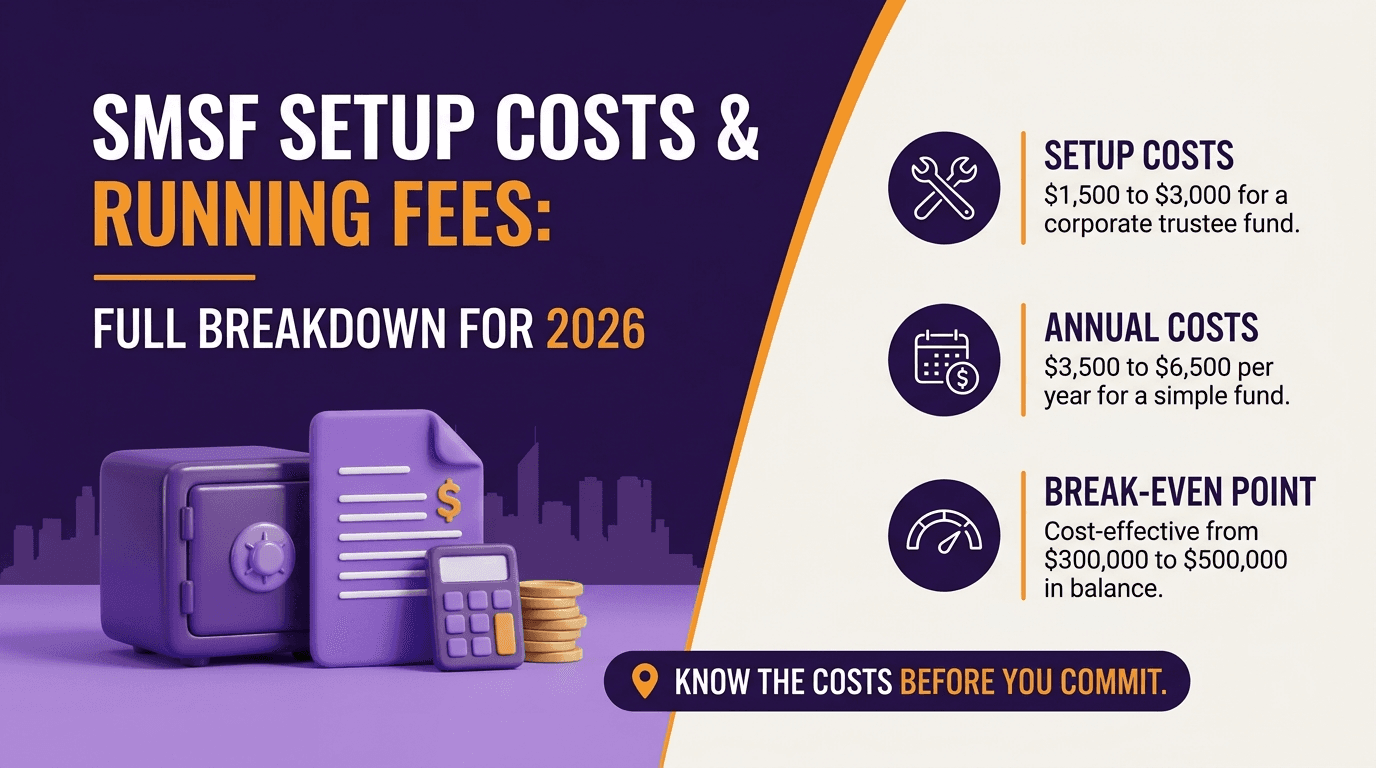
Setting up an SMSF involves a series of one-off costs to establish the legal structure, register the fund with the ATO, and get it operational. Most professional setups fall between $1,000 and $3,500 all in, though the range is wide depending on the trustee structure you choose and the level of service you engage.
Here is what drives that figure.
Trust deed preparation: $500 to $1,500
The trust deed is the founding legal document of your fund. It governs how the fund operates, member entitlements, and trustee powers. It must be prepared by a professional. Cheap online deeds exist, but a poorly drafted deed can create compliance problems that cost far more to resolve than the original saving.
ATO registration (ABN and TFN): no cost, but allow time
Registering the fund with the ATO, including obtaining an ABN and TFN for the fund, is free. Processing typically takes one to three weeks from lodgement. This cannot be skipped or deferred.
Corporate trustee setup (ASIC registration): approximately $611 upfront
This is the most consequential structural decision you will make at setup. A corporate trustee means a special-purpose company acts as trustee on behalf of members, rather than the members acting as individual trustees in their own names.
The corporate structure costs more upfront due to the ASIC incorporation fee, currently approximately $611 and indexed annually. But it delivers meaningful long-term advantages: cleaner asset ownership, simpler administration when members join or leave, better protection of personal assets, and smoother succession planning. Most SMSF specialists strongly recommend the corporate structure for these reasons.
Individual trustees avoid the upfront ASIC fee but take on more administrative complexity over time, particularly if the fund's membership ever changes.
Professional setup service fee: $800 to $2,500
This covers the end-to-end work of establishing your fund, including trust deed preparation, ATO registration, opening the bank account, setting up the initial investment strategy documentation, and in most cases assisting with the rollover from your existing fund. The range reflects differences in service level and provider type. Document-only online services sit at the lower end. Full-service setups from specialist accountants or SMSF administrators sit higher and typically include ongoing support.
Total one-off setup cost: $1,000 to $3,500
For a corporate trustee setup with professional assistance, most people land between $1,500 and $3,000. If you also engage a licensed financial adviser to formally assess whether an SMSF is appropriate for your situation, add $1,500 to $3,500 on top of that, depending on the scope of the advice.
Note that initial setup costs are generally treated as capital expenses and are not immediately tax-deductible to the fund.
SMSF Annual Running Costs: What You Pay Every Year
This is where the real financial commitment lives. An SMSF cannot sit idle. Every year, the fund must meet a set of mandatory compliance obligations regardless of investment activity.
ATO supervisory levy: $259 per year
A fixed annual fee paid to the ATO to fund SMSF regulation. Non-negotiable and applies to every active fund.
Independent audit: $400 to $900 per year
Every SMSF must be independently audited each year before lodging its annual return. This is a legal requirement under the Superannuation Industry (Supervision) Act 1993 and covers both the financial statements and compliance with superannuation law. Based on ATO data, the median SMSF audit fee sits around the $550 mark. Funds with more complex investments, particularly direct property or limited recourse borrowing arrangements, tend to push toward the higher end of the range.
ASIC annual review fee (corporate trustee): approximately $63 per year
If you have a corporate trustee, this is the fee to keep the trustee company registered with ASIC. It is lower for special-purpose companies that act solely as SMSF trustees.
Accounting and tax return preparation: $1,500 to $3,500 per year
Your SMSF must lodge an SMSF Annual Return each year, which requires preparation of financial statements, a tax calculation, and member benefit statements. A fund with simple investments, such as listed shares and cash, will sit toward the lower end. A fund holding direct property, unlisted assets, or borrowing arrangements will sit significantly higher. This is the largest variable in your annual cost structure and the one most sensitive to the complexity of what the fund holds.
Administration software or platform: $150 to $2,000 per year
Many trustees and their accountants use SMSF administration platforms to streamline compliance, reporting, and record-keeping. Some accountants include this in their annual fee. Others charge it separately. If your fund is simple, this cost can be minimal. If your fund is complex, purpose-built software pays for itself in reduced accounting time.
Financial planning and investment advice: $2,000 to $5,000 or more per year
This is the cost most commonly omitted from SMSF cost comparisons, and it is one of the most important. Ongoing financial advice covering investment strategy, contribution planning, tax optimisation, and transition to pension is not mandatory, but for most trustees it represents significant value. Funds that operate without any ongoing adviser engagement tend to accumulate costly blind spots over time.
Total annual running costs: approximately $3,500 to $6,500 for a straightforward fund
Based on ATO data, total administration and operating expenses across the SMSF sector averaged approximately $7,400 per fund, with the median sitting at $4,400. Funds with property, borrowing arrangements, or complex investment structures regularly exceed $10,000 per year once all professional fees are included.
SMSF Year One Costs: What to Budget for Your First 12 Months
Year one carries higher costs than subsequent years because setup costs stack on top of the first year's running expenses, and new funds are required to pay the ATO supervisory levy upfront for the first year.
A realistic year-one estimate for a corporate trustee fund with professional setup and standard administration:
Cost Item | Estimated Range |
Professional setup fee (corporate trustee) | $1,500 to $3,000 |
ASIC incorporation fee | $611 |
ATO supervisory levy (year one, paid upfront) | $259 |
Independent audit | $400 to $900 |
Accounting and tax return | $1,500 to $3,500 |
Administration software | $150 to $600 |
Year one total (excluding advice fees) | $4,420 to $8,870 |
If you also engage a financial adviser to assess suitability and structure the fund's strategy, add $1,500 to $3,500 to that figure.
What Balance Makes an SMSF Cost-Effective? The Threshold Explained
Because most SMSF costs are fixed rather than percentage-based, the cost per dollar of assets decreases as the balance grows. At low balances, a fixed annual cost of $4,000 to $6,000 represents a significant drag on returns. At higher balances, the same fixed cost is a small fraction of the fund's total assets.
What if the cost of getting the structure wrong over twenty years is ten times the cost of getting advice at setup? That is the framing worth applying here, because the balance threshold question is not just about fees. It is about whether the structure is right for your situation at all.
Most financial experts and regulators, including ASIC, suggest a minimum starting balance of around $200,000, the point where SMSF running costs generally become competitive with those of a traditional industry or retail fund. In practice, many advisers now put the comfortable threshold closer to $300,000 to $500,000, particularly for funds with complex investments or where financial advice fees are factored in.
ATO annual statistics show that 41 per cent of SMSFs hold assets between $200,001 and $1 million, accounting for 15 per cent of total SMSF assets. The average SMSF balance sits well above the minimum threshold, which partly reflects the self-selection of Australians who choose this structure.
For couples pooling their superannuation into a single fund, the cost-effectiveness threshold is easier to reach, since the fixed annual costs are shared across a combined balance.
Wondering whether your balance and goals make an SMSF worth it?
The What If Advice team includes both licensed financial advisers and registered tax agents who work with clients considering the SMSF structure across Brisbane and Melbourne. Email clientservices@whatifadvice.com.au to start the conversation.
Hidden SMSF Costs That Catch Trustees by Surprise
The headline setup and annual running costs are predictable. The following costs are not always front of mind, and they catch trustees by surprise more often than they should.
Insurance gaps when leaving an existing fund
Most industry and retail super funds provide default life insurance and total and permanent disability cover as part of membership. When you roll your balance into an SMSF, that default cover lapses. Sourcing equivalent cover outside super, or arranging life insurance through the SMSF, involves additional cost and often requires underwriting. Many SMSF trustees go without adequate cover simply because the transition process did not flag it.
Investment-specific compliance costs
Direct property inside an SMSF brings its own compliance layer: annual valuations, potential CGT considerations on disposal, and if borrowing is involved, the cost of establishing and maintaining the borrowing structure. A fund holding unlisted assets, overseas investments, or related-party assets also tends to generate higher audit and accounting fees.
Costs of fixing early mistakes
The ATO takes trustee responsibilities seriously. Compliance breaches, even unintentional ones, can attract penalties and require remediation work that sits entirely outside normal annual costs. Getting the setup right with professional assistance is significantly cheaper than getting it wrong and fixing it later.
Winding up costs: $1,500 to $3,000
Closing an SMSF is not a simple process. It requires a final independent audit, a final tax return lodgement, and the rollover or distribution of all fund assets. The total cost of winding up a straightforward fund typically falls between $1,500 and $3,000. If the fund holds property or complex assets, the cost is higher. This is a cost that most people do not think about when they set up, but it is a real consideration in the overall lifecycle cost of the structure.
SMSF vs Industry Fund Costs: How the Numbers Compare
The cost comparison between an SMSF and an industry fund depends almost entirely on balance size. The major industry funds charge around $370 to $385 per year in total fees on a $50,000 balance, roughly 0.75 per cent annually. As balances grow, many industry funds maintain similar dollar-fee levels through flat administration fees plus a percentage-based investment fee.
For an SMSF, the annual cost is largely fixed regardless of balance. The table below shows how that plays out across different balance levels.
SMSF Balance | Est. Annual SMSF Cost | SMSF Cost as % of Assets | Approx. Industry Fund Cost % |
$100,000 | $4,000 to $6,000 | 4.0% to 6.0% | ~0.75% |
$200,000 | $4,000 to $6,000 | 2.0% to 3.0% | ~0.65% |
$300,000 | $4,500 to $6,500 | 1.5% to 2.2% | ~0.60% |
$500,000 | $4,500 to $6,500 | 0.9% to 1.3% | ~0.55% |
$750,000 | $5,000 to $7,500 | 0.67% to 1.0% | ~0.50% |
$1,000,000+ | $5,000 to $8,000 | 0.5% or less | ~0.45% |
Below the $200,000 to $300,000 threshold, the numbers rarely work in the SMSF's favour on cost alone. Above $500,000, and particularly where the fund can access investment opportunities unavailable in a standard industry fund, the comparison becomes more favourable.
2026 SMSF Legislative Changes: What the LRBA Ban and Division 296 Mean for Your Costs
Residential property LRBA ban: now law
Legislation passed in 2026 prohibiting SMSFs from entering new limited recourse borrowing arrangements for residential property, effective later that year. Existing residential LRBAs established before the ban are fully grandfathered and unaffected. Commercial property LRBAs remain available, provided the property meets the definition of business real property under the SIS Act.
This change significantly alters the strategy case for anyone who was considering an SMSF primarily to borrow and invest in residential property. That strategy is now closed for new arrangements. It does not affect SMSFs using other investment strategies, nor does it affect the tax treatment of existing SMSF investments.
Division 296 tax: effective 1 July 2026
An additional 15 per cent tax now applies to earnings on superannuation balances above $3 million. For the overwhelming majority of SMSF members, this threshold is not reached. For those approaching it, the SMSF structure's flexibility around timing of contributions and asset positioning becomes more relevant, not less. The SMSF's flexibility around asset timing and contribution structure can partially offset the additional tax for those affected, but this is territory that requires specialist advice, not a set-and-forget approach.
Both changes reinforce why taking advice from a registered tax agent and a licensed financial adviser before establishing or significantly changing an SMSF structure is important. The What If Advice team includes both.
Is an SMSF Worth the Cost? Key Questions to Answer Before You Commit
Most people who set up an SMSF because it seemed like a good idea, and later wind it up, could have answered a few questions differently at the start. Before committing to the structure, these are the questions worth sitting with.
Do you have enough to make the costs work? Below $200,000 to $300,000, the annual costs of running an SMSF are almost always a higher percentage drag on your returns than a well-run industry fund. Unless you have a very specific investment goal that requires the SMSF structure, the numbers rarely justify it at low balances.
Do you have the time to manage it? Being a trustee is a legal responsibility, not a passive role. You are accountable for investment decisions, record-keeping, compliance, and ensuring the fund meets all ATO requirements each year. The fund's accountant and adviser carry out much of the technical work, but the legal accountability sits with you.
Is your investment goal actually achievable in an industry fund? What if your industry fund can already achieve most of what you think you need an SMSF for? Many Australians assume an SMSF is necessary to hold direct shares, ETFs, or managed funds. Most large industry funds offer direct investment options that achieve similar outcomes without the compliance overhead. Direct property and business real property are the clearest cases where an SMSF structure adds genuine value that a standard fund cannot replicate.
Have you accounted for the full lifecycle cost? Setup, annual running costs, and eventual wind-up costs together represent the true cost of the structure over its life. Run the numbers across a realistic timeframe before comparing to the alternative.
Meet David and Karen
David is 54 and runs a small construction business in Brisbane. He and his wife Karen have a combined super balance of $680,000, split across three different funds accumulated from previous employers. David wants to use their SMSF to purchase the commercial premises his business currently leases. The strategy, known as business real property, is one of the clearest legitimate use cases for the SMSF structure, and it is still fully available following the 2026 legislative changes.
For David and Karen, the SMSF structure makes sense, but only if it is set up correctly. The commercial property acquisition requires a specialist LRBA structure, a bare trust, and a lender who will finance the arrangement. The fund's investment strategy needs to document the rationale for the property acquisition. And the related-party lease to David's business needs to be on arm's-length commercial terms, or it risks breaching the sole purpose test.
This is exactly the work the What If Advice team does with clients in David and Karen's situation across Brisbane and Melbourne: structuring the LRBA correctly, ensuring the lease terms hold up under scrutiny, and documenting the investment strategy so the fund's compliance position is clear from day one. Working with a team that holds both a financial planning licence and registered tax agent status is not just convenient in a situation like this. It is how you avoid compliance breaches that can dwarf the cost of professional advice.
Still asking what if about your finances? If you are exploring whether an SMSF is the right structure for your situation, email clientservices@whatifadvice.com.au or join us at our next Retire Ready Roundtable at whatifadvice.com.au/workshops.
Frequently Asked Questions
How much does it cost to set up an SMSF in Australia in 2026?
Most professional setups with a corporate trustee fall between $1,500 and $3,000 for the establishment work, plus the ASIC incorporation fee of approximately $611. If you engage a financial adviser to formally assess suitability, add $1,500 to $3,500 on top. Bare-minimum document-only services are available for less, but the risks of inadequate setup support tend to show up later at audit or compliance review time.
What are the ongoing annual costs of running an SMSF?
A straightforward SMSF typically costs $3,500 to $6,500 per year to run, covering the ATO supervisory levy, independent audit, accounting and tax return preparation, and ASIC annual review fee for a corporate trustee. Funds with property, borrowing arrangements, or complex assets can exceed $10,000 per year once all professional fees are included.
What is the minimum balance to justify an SMSF?
Most financial planners and regulators suggest a minimum of $200,000 to $300,000, which is the level at which SMSF annual running costs generally become competitive with fees in an industry or retail fund. Many advisers now put the practical threshold closer to $300,000 to $500,000 when financial advice fees are included.
Are SMSF running costs tax-deductible?
Most ongoing costs, including accounting fees, audit fees, the ATO supervisory levy, and administration costs, are generally deductible to the fund. Initial setup costs are treated as capital expenses and are not immediately deductible. Confirm the specific treatment of your fund's expenses with a registered tax agent.
Can I use my existing super to pay SMSF setup costs?
You can pay setup costs personally and then reimburse yourself from the fund once it has received its first rollover and has cash available. This reimbursement should happen promptly. If it is left too long, the ATO may treat the unreimbursed amount as a personal contribution to the fund, which affects your contribution caps. This is one of several timing issues that specialist guidance at setup helps you avoid.
Can my SMSF still borrow to buy property in 2026?
New limited recourse borrowing arrangements for residential property are no longer available following legislation passed in 2026. Existing residential LRBAs established before the ban are fully grandfathered. Commercial property LRBAs, for property meeting the definition of business real property, are unaffected. SMSFs can still purchase residential property outright using cash, without borrowing.
Do I need a financial adviser to set up an SMSF?
You are not legally required to obtain financial advice before setting up an SMSF. However, only a licensed financial adviser can provide personal advice on whether the structure is appropriate for your circumstances. For anyone considering an SMSF as part of a broader retirement strategy, that assessment is worth having. The cost of advice is generally small relative to the consequences of the wrong structure decision over a twenty-year investment horizon.
What does it cost to wind up an SMSF?
Winding up a straightforward SMSF typically costs $1,500 to $3,000 and requires a final independent audit, a final annual return, and the rollover or distribution of all assets. Funds holding property or complex assets cost more to wind up. This is a real cost that forms part of the total lifecycle cost of the structure.
What happens to my super insurance when I set up an SMSF?
When you roll your existing super into an SMSF, any default insurance cover held through your previous fund lapses. You will need to arrange replacement cover either through the SMSF itself or personally outside super. This often involves underwriting and additional cost, and it is one of the most commonly overlooked steps in the transition process.
Can I set up an SMSF with my spouse?
Yes. An SMSF can have up to six members, and a joint fund with your spouse is one of the most common structures. Pooling balances into a single fund makes the fixed annual running costs more cost-effective, and a joint structure opens up additional planning opportunities around contribution splitting, estate planning, and coordinating your retirement timelines.
This article contains general information only and does not constitute personal financial or taxation advice. Your personal objectives, financial situation, and needs have not been taken into account. Before making any decision about an SMSF or superannuation structure, consider whether this information is appropriate for your circumstances and seek advice from a qualified financial adviser and registered tax agent. What If Advice operates under Beryllium Advisers Pty Ltd, AFSL 528250, and is a registered tax agent.