Looking for specific financial advice?
This blog provides general educational content. For personalized advice tailored to your unique situation, book a free consultation with our team of ASIC-licensed financial advisers.
The single most common mistake Australians make when comparing SMSFs to industry funds is treating it as a question about control or investment options. Those things matter, but they are secondary. The first question is a simple one: at your balance, which structure actually costs less?
The answer is not the same for everyone, and it changes significantly depending on where you sit on the balance spectrum. This post works through the real numbers at four common balance points, using published fee data from the major industry funds and typical SMSF running costs from current market rates. What If Advice operates as both a licensed financial advice practice under AFSL 528250 and a registered tax agent — the SMSF decision sits squarely across both disciplines.
A few things to establish before the numbers: SMSF costs are largely fixed regardless of balance. Industry fund costs are largely percentage-based, which means they scale with your balance. That structural difference is what drives the entire comparison, and understanding it is more useful than any single figure.
This is general information only. Your specific costs will depend on which fund and investment option you are in, the complexity of your SMSF, and the professional providers you use.
The Short Version
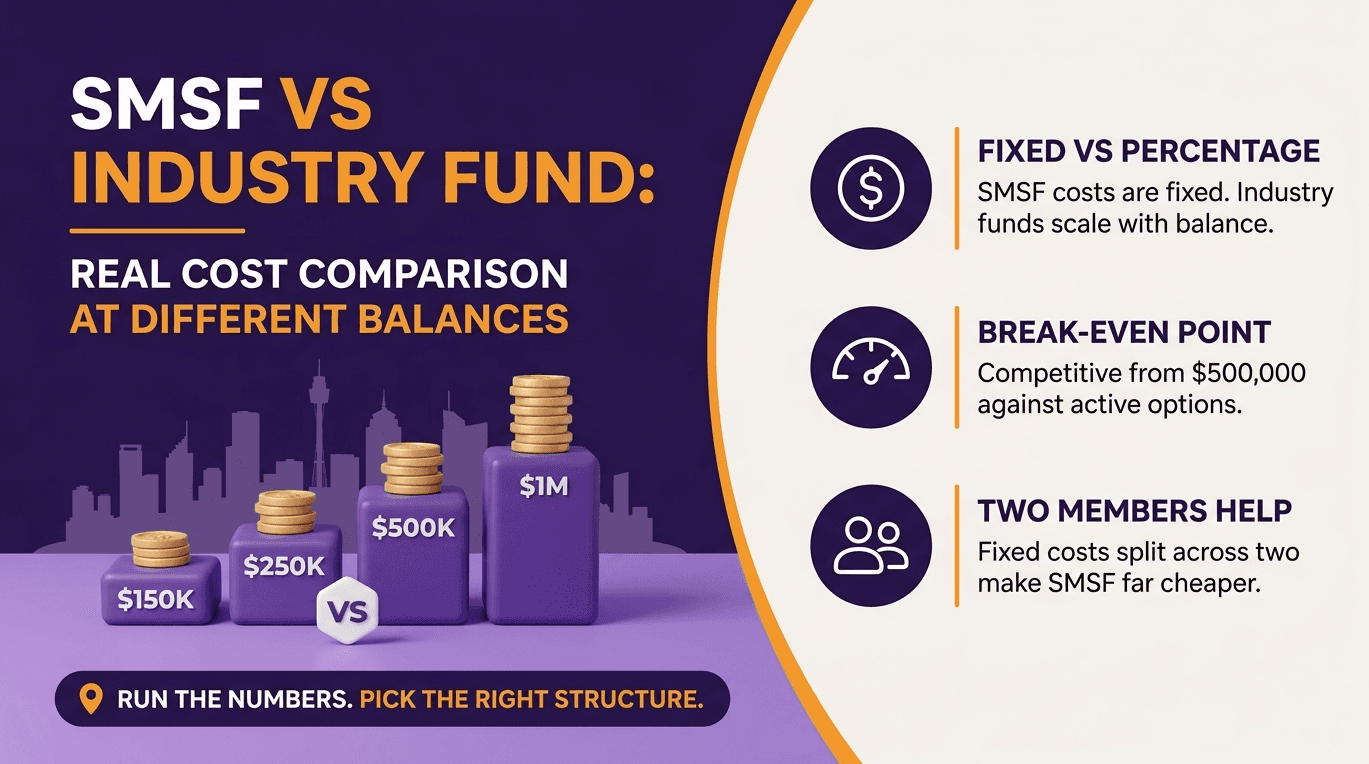
SMSF costs are largely fixed. Industry fund costs scale with your balance. That one structural difference drives everything.
At $150,000: an SMSF costs three to four times more than an actively managed fund. Very hard to justify.
At $250,000: the gap narrows. Still materially more expensive. Justifiable only with a specific investment goal.
At $500,000: genuinely competitive against actively managed options. This is the realistic consideration threshold.
At $1,000,000: often cheaper than an actively managed fund. The cost question largely resolves itself.
Against a low-cost indexed option, an SMSF rarely wins on fees at any balance.
Bottom line: There is no single break-even. It shifts depending on your balance, your fund, your investment option, and whether you are one member or two.
Jump to a Section
How Industry Fund Fees Actually Work
How SMSF Fees Actually Work
SMSF vs Industry Fund Fees: The Real Numbers at Four Balance Points
What SMSF Fee Comparisons Usually Leave Out
What Balance Makes an SMSF Cost-Effective? The Honest Answer
Meet Linda and Mark
Frequently Asked Questions
Ready to Run the Numbers on Your Specific Situation?
How Industry Fund Fees Actually Work
Industry funds typically charge a combination of a fixed weekly or annual administration fee plus a percentage-based investment fee. The investment fee varies by option and is where the bulk of the cost sits at larger balances.
Looking at the major funds in 2026:
AustralianSuper charges a flat administration fee of $1 per week plus 0.10 per cent per annum of your account balance. On a $500,000 balance, that is $52 in fixed fees plus $500 in investment fees, totalling approximately $552 per year on the balanced option, before any additional investment costs or insurance premiums.
Australian Retirement Trust charges a $1.50 per week administration fee plus approximately 0.39 per cent per annum on its Balanced option, totalling around $371 per year at a $50,000 balance. At larger balances, the investment fee percentage dominates and total costs scale accordingly.
At a $500,000 balance, Hostplus Indexed Growth costs approximately $219 per year, representing 0.04 per cent of the balance. By comparison, the median actively managed growth fund at the same balance costs 0.81 per cent, or around $4,050 per year.
That range, from around $200 per year for a low-cost indexed option to $4,000 per year or more for an actively managed fund at a $500,000 balance, tells you something important: the industry fund you are in, and the investment option you choose within it, matters as much as the fund type itself. Not all industry funds are equally cheap.
For this comparison, we use two benchmarks: a low-cost indexed industry fund option (approximately 0.04 to 0.10 per cent total fees) and a typical actively managed balanced option (approximately 0.60 to 0.85 per cent total fees). Both are realistic representations of what Australians actually pay in the industry fund sector.
Bottom line: The industry fund sector label tells you less than you think. The fund you are in and the investment option you choose within it determine your actual cost. A cheap indexed option and an expensive active option inside the same sector can differ by $3,000 to $4,000 per year at a $500,000 balance.
How SMSF Fees Actually Work
SMSF costs are structured differently. Most of the annual cost is fixed in dollar terms and does not change as the balance grows. What changes is what that fixed cost represents as a percentage of assets.
A typical straightforward SMSF, meaning one holding listed shares, ETFs, and cash with no property or borrowing, costs between $3,500 and $5,500 per year in mandatory compliance and administration. That covers accounting and tax return preparation, the independent annual audit, the ATO supervisory levy of $259, and the ASIC annual review fee for a corporate trustee of approximately $63.
A fund with greater complexity, including direct property, unlisted assets, or ongoing financial advice, costs more. A realistic range for a well-run SMSF including all professional fees sits between $4,500 and $7,000 per year for most trustees.
Based on ATO data for 2023-24, average annual operating expenses for SMSFs were approximately $7,150, with a median of $4,400.
For this comparison, we use $4,500 as the low end of a realistic SMSF annual cost for a straightforward fund, and $6,000 as a mid-range figure that includes financial advice.
Bottom line: Most SMSF costs are fixed regardless of what your balance does. That is the entire reason balance is the only variable that matters in this comparison.
SMSF vs Industry Fund Fees: The Real Numbers at Four Balance Points
The tables below show estimated annual costs in dollar terms for both structures. Industry fund costs use the AustralianSuper Balanced option as the representative actively managed benchmark and a low-cost indexed option at approximately 0.10 per cent total fees as the low benchmark. SMSF costs use $4,500 (simple fund, no advice) and $6,000 (includes ongoing financial advice) as the two comparison points.
All figures are approximate and for illustrative purposes only. Your actual costs will vary.
At $150,000
Structure | Estimated Annual Cost | Effective Fee Rate |
Industry fund (indexed option) | $150 to $230 | 0.10 to 0.15% |
Industry fund (balanced active) | $900 to $1,275 | 0.60 to 0.85% |
SMSF (simple, no advice) | $4,500 | 3.00% |
SMSF (with advice) | $6,000 | 4.00% |
Bottom line: At $150,000 the comparison is not close. Even against the most expensive actively managed industry fund option, an SMSF costs three to four times more as a percentage of assets. At this balance, an SMSF is very difficult to justify on cost grounds alone unless there is a compelling investment-specific reason that simply cannot be replicated inside an industry fund.
At $250,000
Structure | Estimated Annual Cost | Effective Fee Rate |
Industry fund (indexed option) | $250 to $375 | 0.10 to 0.15% |
Industry fund (balanced active) | $1,500 to $2,125 | 0.60 to 0.85% |
SMSF (simple, no advice) | $4,500 | 1.80% |
SMSF (with advice) | $6,000 | 2.40% |
What if the reason to set up an SMSF at this balance has nothing to do with fees, and everything to do with an investment your industry fund simply cannot hold?
Bottom line: At $250,000 the gap narrows but an SMSF is still materially more expensive than an indexed industry fund. Against a typical actively managed fund, the SMSF cost is two to three times higher. The decision at this balance almost always rests on a specific investment goal rather than cost efficiency.
At $500,000
Structure | Estimated Annual Cost | Effective Fee Rate |
Industry fund (indexed option) | $500 to $750 | 0.10 to 0.15% |
Industry fund (balanced active) | $3,000 to $4,250 | 0.60 to 0.85% |
SMSF (simple, no advice) | $4,500 | 0.90% |
SMSF (with advice) | $6,000 | 1.20% |
Bottom line: At $500,000 an SMSF becomes genuinely competitive against actively managed industry fund options. Against a low-cost indexed option it still costs more. This is why $500,000 is the most commonly cited threshold for serious SMSF consideration, not because the numbers are perfect, but because they stop being obviously wrong.
At $500,000, the SMSF question becomes worth modelling properly.
The What If Advice team includes both licensed financial advisers and registered tax agents who can run the real numbers for your specific balance, fund, and investment goals. Email clientservices@whatifadvice.com.au or call 1800 942 843.
At $1,000,000
Structure | Estimated Annual Cost | Effective Fee Rate |
Industry fund (indexed option) | $1,000 to $1,500 | 0.10 to 0.15% |
Industry fund (balanced active) | $6,000 to $8,500 | 0.60 to 0.85% |
SMSF (simple, no advice) | $4,500 to $5,500 | 0.45 to 0.55% |
SMSF (with advice) | $6,000 to $7,500 | 0.60 to 0.75% |
Bottom line: At $1,000,000 an SMSF is clearly competitive against actively managed industry fund options, and in many cases cheaper. Against a low-cost indexed option the gap has narrowed considerably. At this balance, the cost question largely resolves itself. The more relevant considerations become investment flexibility, tax strategy, estate planning, and the value of the control the structure provides.
What SMSF Fee Comparisons Usually Leave Out
Fees are the starting point. They are not the whole answer. These five factors sit outside the tables and each one can shift the real comparison.
What if the fee comparison is only half the question, and the other half is what the structure lets you do that a standard fund never could?
Tax drag inside industry funds
Industry funds are pooled structures. Tax is calculated and paid at the fund level, not at the individual member level. This means CGT events triggered by other members' redemptions can affect your after-tax return even if you have not sold anything. SMSFs are individual structures where tax is calculated on the fund's actual transactions, which in some circumstances produces a better after-tax outcome. This tax efficiency factor can contribute to the SMSF cost crossover point arriving at a lower balance than fee comparisons alone would suggest.
The time cost of trusteeship
ASIC MoneySmart estimates that the average SMSF trustee commits more than 100 hours per year to running their fund. For someone who values their time, that is a real cost that sits entirely outside the fee comparison. For someone who is retired and engaged, it may not register as a cost at all.
Insurance
Members who roll out of an industry fund into an SMSF typically lose their default group life and TPD insurance. Sourcing equivalent cover through the SMSF or via a personal policy is often more expensive and requires underwriting. This cost is rarely included in SMSF fee comparisons but is a genuine additional expense for many trustees.
Investment access
The fee comparison is irrelevant if the investment you want to hold, such as a commercial property or business real property, is only available inside an SMSF. In that case, the question is not which structure is cheaper but whether the investment justifies the additional cost. For many business owners and property investors, it does.
Couples and multi-member funds
One of the least-discussed advantages of an SMSF is that the fixed annual cost covers the entire fund, regardless of how many members it has. A couple with a combined balance of $500,000 effectively splits the fixed SMSF cost across two accounts. Two members each paying effectively $2,250 per year in fund costs rather than $4,500 makes the SMSF look considerably more competitive at the $250,000 individual balance point.
Bottom line: The fee comparison is necessary but not sufficient. Time cost, insurance replacement, and tax drag all shift the real comparison in ways that pure fee tables cannot capture. Factor all of them in before deciding.
What Balance Makes an SMSF Cost-Effective? The Honest Answer
There is no single break-even balance that applies to everyone. It depends on which industry fund and investment option you are comparing against, how complex your SMSF is, whether you are comparing one member or two, and whether tax efficiency factors are included.
What the data consistently shows is this: below $200,000 to $250,000, an SMSF is almost never justified on cost grounds. Between $250,000 and $500,000, it can be justified but only with a compelling investment-specific reason. Above $500,000, particularly in a two-member fund and against actively managed industry fund options, the numbers start to genuinely compete. Above $750,000 to $1,000,000, for an engaged trustee with a clear investment strategy, the SMSF is often the better financial structure.
The break-even is not a fixed number. It is a range that shifts depending on the specific comparison.
Bottom line: Below $250,000, the numbers almost never work. Between $250,000 and $500,000, they can work with a compelling reason. Above $500,000 in a two-member fund against an actively managed option, they often do. The break-even is a range, not a number.
Not sure where your balance and goals sit in this comparison?
A conversation with the What If Advice team costs nothing and gives you a personalised read on whether the SMSF structure makes financial sense for your situation. Email clientservices@whatifadvice.com.au or join us at our next Retire Ready Roundtable at whatifadvice.com.au/workshops.
Meet Linda and Mark
Linda is 53 and Mark is 55. They have a combined super balance of $480,000, split roughly evenly between two industry funds where they have both been members for over a decade. They are in balanced options and paying approximately 0.75 per cent in total fees, or around $3,600 per year combined.
They are considering an SMSF primarily because Mark wants to purchase the small commercial office from which his consulting business operates. The business currently pays market-rate rent to a third-party landlord. Holding it inside an SMSF would mean the rental income is taxed at 15 per cent inside the fund, and a future sale of the property in pension phase could be free of CGT.
Their combined SMSF running costs on a $480,000 balance would be around $4,500 to $5,500 per year, versus $3,600 currently. The difference is approximately $900 to $1,900 per year in higher fees.
Whether that cost premium is justified comes down to one question: does the CGT exemption on the commercial property sale in pension phase, compounded over twelve years of accumulation, outweigh $900 to $1,900 per year in additional running costs? For most clients in Linda and Mark's position, the answer is yes, but only if the property strategy is structured correctly from day one. Modelling that outcome is exactly the work a financial adviser and registered tax agent do together, and getting it right at this stage has a compounding impact that makes professional advice worth considerably more than it costs.
The What If Advice team works with clients like Linda and Mark across Brisbane and Melbourne. If you are weighing up whether an SMSF makes financial sense for your situation, email clientservices@whatifadvice.com.au or join us at whatifadvice.com.au/workshops.
Frequently Asked Questions
At what balance does an SMSF become cheaper than an industry fund?
There is no single answer, as it depends on which fund and investment option you are comparing against, and how many members your SMSF has. As a general guide, most financial advisers and research place the realistic cost-competitive threshold between $500,000 and $750,000 for a single-member fund against a typical actively managed industry fund option. Against a low-cost indexed option, the SMSF rarely wins on fees alone at any balance.
Are industry fund fees going up as my balance grows?
Yes, for percentage-based investment fees. If your investment fee is 0.70 per cent and your balance grows from $300,000 to $600,000, your dollar cost doubles even though the percentage stays the same. SMSF fees, by contrast, are largely fixed and do not scale with your balance.
Does a two-member SMSF change the cost comparison?
Significantly. The fixed annual cost of running an SMSF covers the entire fund regardless of member count. Two members splitting a $5,000 annual cost across a $600,000 combined balance each pay an effective fee of around 0.83 per cent, which is competitive with many actively managed industry fund options.
Is a low-cost indexed industry fund always cheaper than an SMSF?
In dollar terms at most balances, yes. The cheapest indexed options in major industry funds charge 0.04 to 0.15 per cent per year, which is difficult for any SMSF to match on fees alone. The reason people choose an SMSF over a low-cost index option is almost always investment flexibility, not fee savings.
Should I switch to an SMSF to save on fees?
Rarely, on fees alone. The only scenario where an SMSF is likely to be cheaper in pure fee terms is against an actively managed industry fund at a balance above $500,000 to $750,000. If your current fund is a low-cost indexed option and you are primarily motivated by fees, an SMSF is unlikely to be the answer.
What costs are typically missing from SMSF fee comparisons?
The most commonly omitted costs are the trustee's time, the cost of sourcing insurance to replace the default cover lost when leaving an industry fund, and the cost of financial advice. Including these can add $2,000 to $5,000 or more to the SMSF side of any comparison.
Can I compare my specific fund's fees against SMSF costs?
Yes. The ATO's free YourSuper comparison tool at ato.gov.au/yoursuper shows all MySuper products ranked by seven-year net return and annual fees in dollar terms at your specific balance level. This gives you a personalised starting point for any comparison.
Does the Division 296 tax on balances above $3 million change the SMSF cost comparison?
For the small number of trustees approaching or above the $3 million threshold, Division 296 adds a 15 per cent tax on earnings attributable to the balance above that level. This does not fundamentally change the fee comparison at most balance points, but it does make the SMSF structure's flexibility around asset timing and contribution planning more relevant, not less. If you are approaching the threshold, the conversation shifts from "which structure is cheaper" to "which structure gives me more control over managing the tax."
Is it worth switching from an actively managed industry fund to a low-cost indexed option instead of setting up an SMSF?
For many Australians, yes, and it is the comparison that should happen before the SMSF question even arises. Switching from a 0.80 per cent actively managed option to a 0.10 per cent indexed option at a $500,000 balance saves approximately $3,500 per year with no change in structure, no compliance overhead, and no trustee responsibility. If the primary motivation is cost, that switch is almost always more effective than setting up an SMSF at most balance levels.
Ready to Run the Numbers on Your Specific Situation?
The right answer on SMSF versus industry fund is not a general verdict. It is a calculation that depends on your balance, your current fund, your investment goals, and whether you are one member or two.
Still asking what if about your super structure? The answer depends on your numbers, not a general verdict.
Two ways to get a personalised read:
Email clientservices@whatifadvice.com.au with your current balance, fund, and what you are hoping the SMSF structure would let you do, and the team will give you an initial assessment.
Call 1800 942 843 to speak with a financial adviser or registered tax agent directly.
What If Advice has worked with 1,000+ Australians across Brisbane, Melbourne, and virtually across Australia. AFSL 528250.
This article contains general information only and does not constitute personal financial or taxation advice. Your personal objectives, financial situation, and needs have not been taken into account. Before making any decisions about superannuation structure, seek advice from a qualified financial adviser and registered tax agent. What If Advice operates under Beryllium Advisers Pty Ltd, AFSL 528250, and is a registered tax agent.