Looking for specific financial advice?
This blog provides general educational content. For personalized advice tailored to your unique situation, book a free consultation with our team of ASIC-licensed financial advisers.
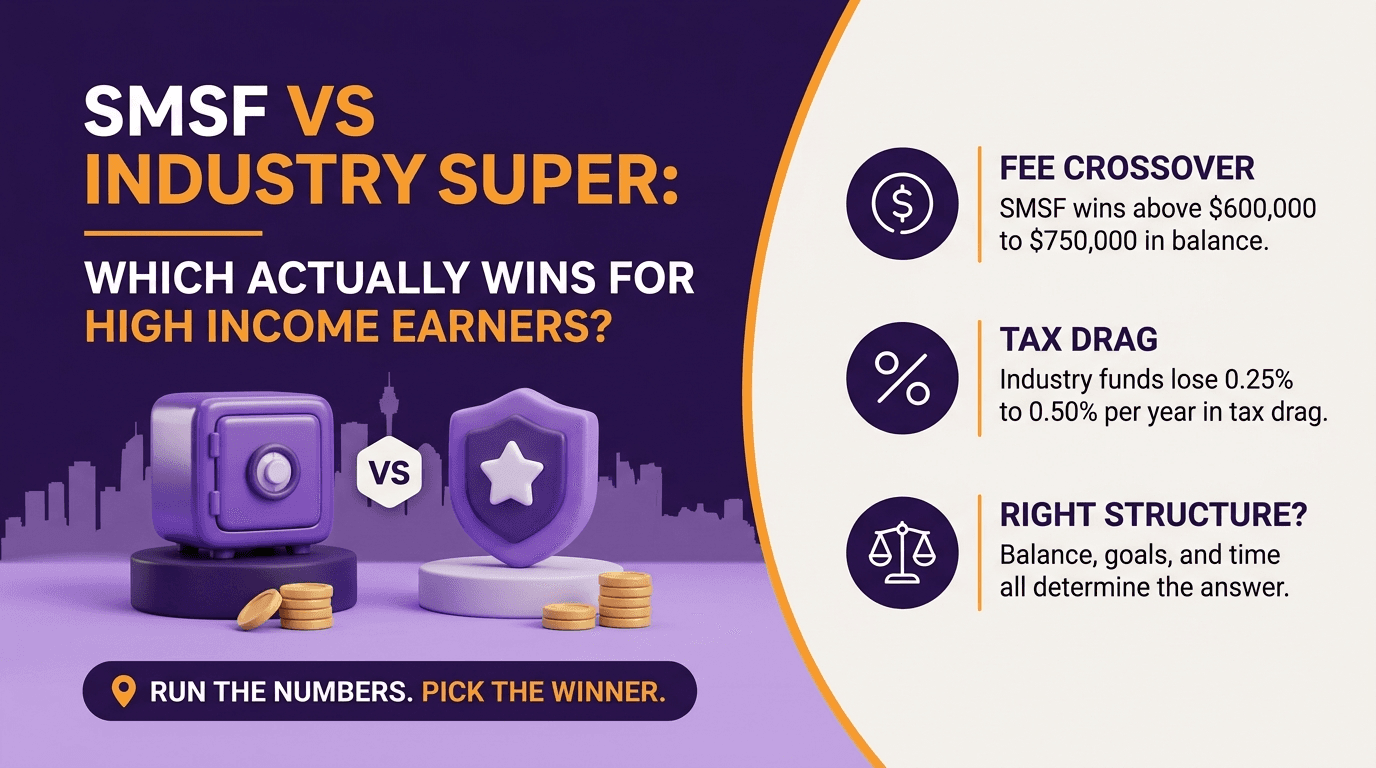
SMSF vs Industry Super: Which Actually Wins for High Income Earners?
What if your industry super fund is costing you $7,000 a year in fees you don't need to pay, and that's before you count the tax drag? This post is for high income earners with $500K or more in super who are weighing whether an SMSF actually makes financial sense, not just whether they want more control. The honest framing: the answer is not "SMSFs always win," and any comparison that says so is selling something. This guide runs the actual numbers.
The question of whether to move from an industry fund to a self-managed super fund is one of the most consequential super decisions a high income earner will make. Get it right and the structure genuinely outperforms on fees, tax efficiency, and long-term wealth building. Get it wrong and you pay more in running costs, carry more compliance risk, and spend 100 hours a year on administration that a professional fund would handle for you.
This guide compares SMSFs and industry super funds specifically through the lens of high income earners, where the balance levels, tax rates, and investment complexity make the decision more nuanced than for the average Australian member.
TL;DR: The Data-Driven Answer
Industry funds charge 0.5% to 0.8% of balance annually for MySuper products, making them cost-effective at lower balances but increasingly expensive as balances grow
SMSFs charge fixed costs of $2,500 to $7,000+ per year, becoming cost-competitive above approximately $500,000 to $750,000
Well-managed SMSFs have historically outperformed industry fund balanced options by approximately 1.1% per annum over the long term, largely driven by lower fee drag and tax efficiency
Industry funds carry a tax drag of 0.25% to 0.50% per annum due to their pooled structure triggering CGT at the fund level
Division 296 tax on balances above $3 million applies to both structures equally as an individual liability, but SMSFs offer materially more planning flexibility in managing it
High income earners with balances above $750,000, specific investment goals, or complex tax situations are the strongest candidates for an SMSF
Bottom line: The SMSF wins on fee efficiency and tax control at higher balances. The industry fund wins on simplicity, built-in insurance, and cost efficiency at lower balances. The crossover point for most high income earners sits between $500,000 and $750,000 in total super balance.
Jump to a Section
The Fee Comparison: Where the Maths Actually Lands
The Tax Efficiency Advantage: The Number Most Comparisons Miss
Division 296 and SMSFs: The 2026 Planning Consideration
Performance: Do SMSFs Actually Outperform?
The Industry Fund Advantages That Still Matter
The Decision Framework: When Each Structure Wins
Two Examples: When SMSF Wins and When It Doesn't
Common Mistakes High Income Earners Make
FAQ
Ready to Find Out Which Structure Is Right for Your Balance?
The Fee Comparison: Where the Maths Actually Lands
The fee comparison is the starting point for any SMSF versus industry fund analysis. The structure of fees differs fundamentally between the two models.
Industry funds charge primarily percentage-based fees, which scale with the member's balance. Most quality MySuper products charge between 0.5% and 0.8% per annum in combined administration and investment fees.
SMSFs charge primarily fixed fees, which do not scale with balance. Annual running costs for a simple SMSF (excluding investment and advice fees) sit at approximately $2,500 to $5,400. For complex funds with property, this rises to $7,000 to $15,000+.
The cost crossover comparison at current 2026 fee levels:
Balance | Industry Fund (0.65%) | SMSF (Simple, $4,000) | SMSF Cost Advantage |
$200,000 | $1,300 | $4,000 | Industry fund wins by $2,700 |
$400,000 | $2,600 | $4,000 | Industry fund wins by $1,400 |
$600,000 | $3,900 | $4,000 | Approximately equal |
$750,000 | $4,875 | $4,500 | SMSF wins by $375 |
$1,000,000 | $6,500 | $5,000 | SMSF wins by $1,500 |
$1,500,000 | $9,750 | $5,500 | SMSF wins by $4,250 |
$2,000,000 | $13,000 | $6,000 | SMSF wins by $7,000 |
At $2,000,000 in super, the fee difference alone is approximately $7,000 per year in favour of the SMSF. Compounded over 10 years at 7% net return, a $7,000 annual saving represents approximately $97,000 in additional retirement wealth.
What if you've been paying $7,000 more than you need to in super fees for the past five years, and the difference between the two structures is one decision? For a $1.5M balance, the fee saving alone over 15 years at 7% net return is approximately $175,000 in additional retirement wealth.
Bottom line: The fee crossover point sits between $600,000 and $750,000 for most straightforward comparisons. Above that level, the SMSF's fixed cost structure produces a growing annual cost advantage as balances increase.
Want to see the fee comparison at your actual balance? WIAA's advisers can model the fee and tax drag comparison for your specific industry fund and balance in a 30-min conversation. Book a free 15-min scoping chat at 1800 942 843 or email clientservices@whatifadvice.com.au.
The Tax Efficiency Advantage: The Number Most Comparisons Miss
Fee comparison alone understates the SMSF advantage for high income earners at significant balances. The tax structure difference is at least as important as the fee difference.
The Tax Drag Problem in Industry Funds
Industry funds are pooled investment structures. When one member withdraws money, the fund may need to sell assets to meet that redemption, triggering capital gains tax at the fund level. That tax reduces the net return for all members, including those who did not sell anything.
This is called tax drag, and credible estimates put it at 0.25% to 0.50% per annum for equity-based options in industry funds.
For a $1,000,000 balance, a 0.25% tax drag costs approximately $2,500 per year in foregone after-tax returns compared to an SMSF holding the same assets. At 0.50%, the cost is $5,000 per year.
The SMSF Tax Control Advantage
An SMSF is its own separate taxpaying structure. Capital gains tax is paid only when the SMSF actually sells an asset, not when other members sell. An SMSF avoids tax drag entirely. The mechanism is straightforward:
Hold high-growth assets until the member reaches retirement phase, where earnings and gains are tax-free
Time asset sales to coincide with lower-income years or the pension phase where no tax applies
Utilise the CGT discount by holding assets for more than 12 months (under current law)
Implement pension-phase transfers that reset the cost base effectively
The cumulative benefit of this tax control over a 15 to 20 year investment horizon is substantial, often exceeding the fee advantage in dollar terms.
Bottom line: The SMSF's tax efficiency advantage of 0.25% to 0.50% per annum from reduced tax drag adds meaningfully to the fee advantage for high income earners at higher balances.
Division 296 and SMSFs: The 2026 Planning Consideration
From 2026, Division 296 tax imposes an additional 15% tax on earnings attributable to the portion of total super balances above $3 million. This applies equally to SMSFs and industry funds as an individual liability, not a fund-level tax.
Where the structures differ is in the flexibility to manage and minimise the Division 296 liability. SMSFs provide meaningfully more planning options:
Timing asset realisations to manage the measured increase in total super balance
Utilising the CGT reset to market value as at 30 June 2026 for assets transitioning from accumulation to pension phase before Division 296 calculations apply
Structuring investment strategy to manage the composition of assessable earnings year to year
Splitting contributions between spouses to keep individual balances below the $3 million threshold
Industry funds are managed at the fund level. Individual members cannot control the timing of asset sales, income recognition, or the fund's CGT position relative to their specific situation.
For high income earners with balances approaching or above $3 million, the SMSF's planning flexibility in managing Division 296 represents a genuine structural advantage that is absent in industry funds.
Bottom line: Division 296 applies equally to both structures as an individual liability. The SMSF provides meaningfully more flexibility to plan around it. For affected balances, this is a material structural advantage.
Performance: Do SMSFs Actually Outperform?
This is the most hotly debated question in the SMSF versus industry fund comparison. Here is what the aggregate data shows:
Well-managed SMSFs with balances above $500,000 have historically outperformed industry fund balanced options by approximately 1.1% per annum over the long term
SMSFs with balances below $500,000 have on average produced lower after-tax returns than industry funds, primarily due to fee drag
SMSF performance varies significantly based on asset allocation, with SMSFs holding higher equity concentrations generally outperforming balanced industry fund options in strong markets
The honest conclusion: a well-managed SMSF at sufficient balance with a competent trustee and clear investment strategy outperforms a typical industry fund over the long term. A poorly managed SMSF, or one at insufficient balance, typically underperforms.
Industry funds benefit from APRA's annual MySuper performance test, which creates external accountability and removes consistently underperforming funds from the market. SMSFs have no equivalent external accountability mechanism. Trustee capability is the sole driver of investment outcomes.
For high income earners who are financially literate, genuinely engaged with their investment strategy, and operating at suitable balances, the performance data supports the SMSF case. For those who would prefer to set and forget, the industry fund's professional management and external accountability is often the better outcome.
Bottom line: SMSFs outperform industry funds for engaged, high-balance investors over the long term. They underperform for passive investors at lower balances. The difference sits with trustee capability and balance level, not the structure itself.
The Industry Fund Advantages That Still Matter
A balanced comparison acknowledges where industry funds genuinely win, even for high income earners.
Built-In Insurance
When a member leaves an industry fund for an SMSF, default life insurance and TPD cover typically lapses. Sourcing equivalent cover outside super is often more expensive, and the process requires active management. For high income earners with significant dependants and mortgage obligations, the insurance transition requires careful planning and immediate action on establishment.
APRA Oversight and Performance Accountability
The annual APRA MySuper performance test provides independent performance accountability that SMSFs lack entirely. Industry funds that consistently underperform must notify members and are eventually removed from the market. This external discipline protects passive investors. It is absent in the SMSF environment, where trustee decisions are the sole accountability mechanism.
Simplicity and Time
Industry funds require minimal member involvement. An SMSF requires more than 100 hours per year in trustee responsibilities. For high income earners whose time has significant economic value, this is a real cost in the comparison. Note: trustees who outsource administration to a specialist SMSF administrator can reduce the active time commitment substantially, though the trustee responsibility and liability remain personal.
Employer Contribution Simplicity
Many employers pay contributions directly to a nominated fund. Redirecting employer contributions to an SMSF is possible but requires the employer to be set up correctly. This is a practical consideration for employees whose employer SG is the primary contribution source.
What if an SMSF is genuinely not the right answer for your situation right now, but is the right answer in three years when your balance crosses $1.2 million and you have a specific investment goal? The decision isn't binary and it isn't permanent.
Bottom line: Industry funds win on simplicity, insurance, and time efficiency. These advantages matter more for some high income earners than others, depending on their circumstances and preferences.
The Decision Framework: When Each Structure Wins
This is the most useful section in the post for making an actual decision. Run down each row and identify where your situation sits. The balance of rows where "SMSF wins" versus "Industry fund wins" tells you which structure is more likely to suit. If you're genuinely split, the balance threshold is usually the deciding factor.
Factor | SMSF Wins | Industry Fund Wins |
Balance | Above $750,000 | Below $500,000 |
Investment goals | Direct property, business real property, specific strategy | Diversified managed portfolio |
Tax position | High marginal rate, large unrealised gains, Division 296 exposure | Standard accumulation, no special tax considerations |
Time and interest | Genuinely engaged, financially literate, 100+ hours available | Prefer professional management, limited time |
Estate planning | Complex family situation, large balance, specific beneficiary needs | Standard estate planning needs |
Insurance needs | Self-sourcing cover is practical and affordable | Reliant on default group cover |
Compliance appetite | Comfortable with trustee obligations and ATO reporting | Prefer APRA-regulated simplicity |
Bottom line: The SMSF case strengthens as balance increases, investment goals become more specific, and the investor becomes more engaged. The industry fund case strengthens at lower balances, with passive investors, and where insurance and simplicity are priorities.
Not sure which column your situation falls in? The balance threshold and investment goal rows are usually the most decisive. Book a free 15-min chat with WIAA's super advisers to map your position against the framework: 1800 942 843 or book online.
Two Examples: When SMSF Wins and When It Doesn't
Example 1: Margaret, 52 — SMSF Wins
Margaret is a hospital specialist earning $295,000. She has $1.1 million in an industry fund (balanced option), owns an investment property in her personal name, and wants to purchase a commercial property for her medical practice.
The SMSF case for Margaret:
Balance of $1.1 million is well above the cost-effectiveness threshold
Annual fee saving at $5,000 SMSF cost versus $7,150 (0.65% on $1.1M) in the industry fund: approximately $2,150 per year
The commercial property purchase within the SMSF is a specific, legitimate investment reason that cannot be replicated in the industry fund
Lease payments of $55,000 per year flowing into the SMSF rather than to a landlord
Tax drag saving at 0.35%: approximately $3,850 per year
Division 296 planning flexibility as her balance grows toward $3 million over the next decade
Estate planning flexibility for a complex family situation
Margaret establishes an SMSF with a corporate trustee, rolls over her industry fund balance, and purchases the commercial property. The combined fee and tax efficiency advantage is approximately $6,000 per year before the property lease income is counted.
Example 2: David and Lisa, Both 45 — Industry Fund Wins
David earns $175,000 and Lisa earns $130,000. Their combined super of $820,000 sits in two separate industry funds. They have no specific investment goals beyond standard diversified growth and are both genuinely busy professionals with limited time.
The industry fund case for David and Lisa:
Combined balance of $820,000 is above the cost-effectiveness threshold, but the fee saving at $5,500 SMSF cost versus approximately $5,330 (0.65% combined) is minimal at approximately $170 per year
Neither has a specific investment goal that requires an SMSF
Both have limited time for trustee responsibilities given demanding careers
Their industry fund insurance cover would lapse on transition, requiring active replacement
The 100+ hour annual time commitment would represent approximately $25,000 in foregone professional time value
Recommendation: remain in industry funds, but review the investment options within each fund, consider whether consolidation into a single fund is appropriate, and revisit the SMSF question when their combined balance reaches $1.2 million to $1.5 million and they are closer to retirement. The right structure for them today is not the right structure permanently. It's the right structure at their current balance and life stage.
Common Mistakes High Income Earners Make
Establishing an SMSF for control alone without a specific investment reason. Control is not sufficient justification at any balance level. A specific, legitimate investment goal is the correct starting point.
Not replacing insurance on exit from the industry fund. Life and TPD cover must be replaced before or immediately upon SMSF establishment. Many high income earners delay this and are temporarily uninsured.
Treating the accountant as the trustee. Trustees are personally responsible for compliance regardless of who manages the administration. Passive trustees create compliance risk and personal liability exposure.
Not modelling the time cost. 100+ hours per year at a professional's effective hourly rate is a real economic cost. Many SMSF comparisons omit it entirely, producing a misleading picture of the net advantage.
Underestimating Division 296 complexity. The flexibility SMSFs provide in managing Division 296 is only valuable if the trustee has the expertise and adviser support to use it effectively.
Switching without comparing after-tax, after-fee, after-time returns. The correct comparison is net of all costs including time, not gross performance or fee in isolation.
Not reviewing the decision periodically. The right structure at $600,000 may not be the right structure at $1.5 million. The comparison should be revisited every 3 to 5 years as balances, goals, and circumstances evolve.
FAQ
At what balance does an SMSF become better than an industry fund?
The fee crossover point sits between $600,000 and $750,000 for a straightforward comparison. When tax drag (0.25% to 0.50% per annum) is added, the effective crossover moves lower, to approximately $400,000 to $500,000 for financially engaged investors with specific investment goals.
Do SMSFs actually outperform industry super funds?
Well-managed SMSFs with balances above $500,000 have historically outperformed industry fund balanced options by approximately 1.1% per annum over the long term. SMSFs below $500,000 have on average underperformed industry funds after fees. Trustee capability and balance level are the key determinants.
Does Division 296 affect SMSFs differently from industry funds?
The tax itself applies equally to both structures as an individual liability on balances above $3 million. However, SMSFs provide significantly more flexibility in timing asset realisations, structuring earnings, and managing the measured balance increase that determines the Division 296 liability.
Can I use an SMSF to buy property in Australia?
Yes, subject to strict ATO rules. Residential investment property can be purchased but the property cannot be acquired from a related party and no member or related party can live in it. Commercial property is also permitted and is often more flexible. Business real property used by the member's own business can be purchased from a related party and leased back at market rates, which is one of the most compelling reasons business owners establish an SMSF.
What happens to my SMSF if I can no longer manage it?
If a trustee loses capacity, the fund requires another trustee to step in, either an existing co-trustee or a new individual appointed under a power of attorney. Corporate trustee structures handle succession more cleanly than individual trustee arrangements. Planning for trustee succession and incapacity is an important step when establishing an SMSF, particularly for members in their 50s and 60s.
Can I have both an SMSF and an industry fund?
Yes. Some high income earners maintain an industry fund for insurance, employer contributions, and diversification while running an SMSF for specific investments such as direct property or business real property.
What is tax drag and does it affect industry funds?
Tax drag arises when a pooled fund sells assets to meet redemptions from other members, triggering CGT that reduces returns for all members. Estimates put it at 0.25% to 0.50% per annum for equity-based industry fund options. SMSFs avoid this because CGT is only triggered when the SMSF itself sells assets.
Will I lose my insurance if I switch to an SMSF?
Yes. Default life insurance and TPD cover typically lapses when you leave an industry fund. Life and TPD cover must be sourced separately, usually at a higher premium than the group rates available through a large fund. This transition must be planned carefully before rolling over.
Should I get advice before establishing an SMSF?
Yes, without qualification. The ATO recommends professional advice before establishing an SMSF, and given the compliance obligations, personal liability exposure, and the cost of getting the decision wrong, this is not optional guidance.
Ready to Find Out Which Structure Is Right for Your Balance?
The SMSF versus industry fund decision is one of the highest-leverage super decisions a high income earner makes. The right answer depends on your balance, your investment goals, your time, and your tax position, not a generic recommendation.
Still asking what if about your super structure? The maths is more straightforward than most people think once you run the actual numbers.
Two ways to start:
Free 15-min chat to model both options against your specific balance and goals: call 1800 942 843 or book online.
Email clientservices@whatifadvice.com.au with your current super balance and industry fund and we'll give you an initial read on where the crossover sits for your situation.
WIAA has advised 1,000+ Australians on super structure and financial planning, with offices in Brisbane and Melbourne and virtual advice Australia-wide. AFSL 528250.
General Advice Disclaimer: This information is general in nature and does not take into account your personal financial situation, needs, or objectives. You should consider whether it is appropriate for you and seek personal financial advice before making any decisions. SMSF rules, performance data, and ATO compliance requirements are subject to change. Past performance of any super structure is not a reliable indicator of future performance. Always seek specific professional advice before making decisions about your superannuation structure. What If Advice is an Authorised Representative under Beryllium Advisers Pty Ltd, AFSL 528250.