Looking for specific financial advice?
This blog provides general educational content. For personalized advice tailored to your unique situation, book a free consultation with our team of ASIC-licensed financial advisers.
What If You Could Get a Tax Offset Just for Topping Up Your Partner's Super?
Most super strategies revolve around reducing your own tax by contributing to your own account. The spouse contribution tax offset works differently: it rewards contributing to someone else's super, specifically a lower-income or non-working spouse, with a tax offset that goes to the contributing partner, not the one receiving the contribution. It's a small but genuinely useful mechanic that gets mentioned in passing across a lot of couples' super planning, without often being explained properly on its own.
TL;DR
The spouse contribution tax offset rewards contributing after-tax money into a lower-income or non-working spouse's super account.
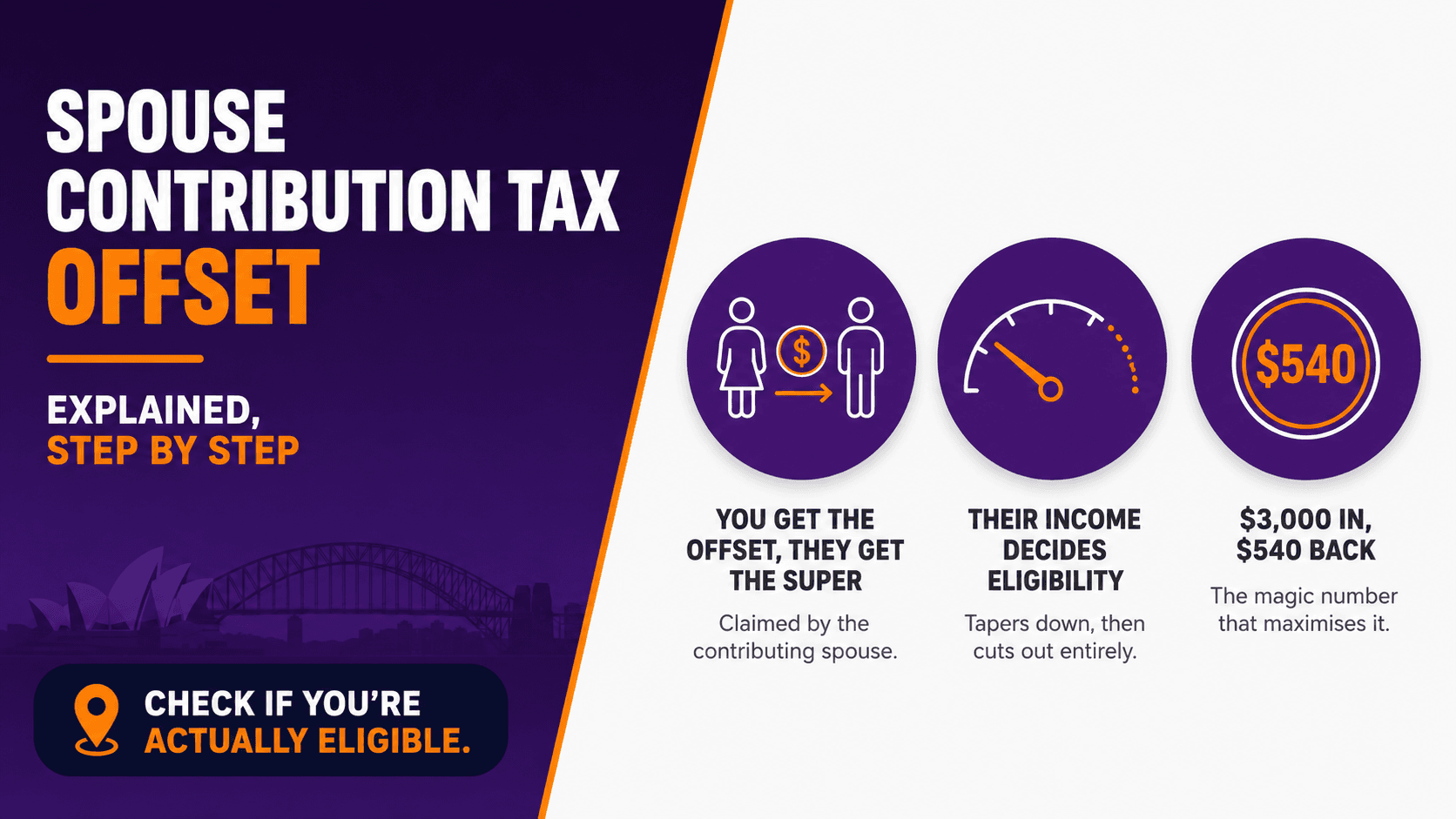
The maximum offset is $540, available where the contributing spouse contributes $3,000 and the receiving spouse's income sits at or below the lower threshold.
The offset tapers down as the receiving spouse's income rises, and cuts out entirely once their income reaches the upper threshold.
The offset rate is 18% of the eligible contribution amount, up to the $3,000 cap, meaning contributing less than $3,000 produces a proportionally smaller offset.
The receiving spouse's super balance and contribution caps still apply, this doesn't create extra room beyond their existing non-concessional cap.
This is a genuinely separate strategy from contribution splitting, which moves existing concessional contributions between spouses rather than involving new after-tax money.
The offset is claimed by the contributing spouse in their own tax return, not the spouse whose account received the contribution.
Bottom line: this is one of the few super strategies that directly rewards the giver with a tax offset for helping someone else's retirement balance, provided both spouses' circumstances fit within the specific income and contribution thresholds.
On This Page
How the Offset Actually Works
The Income Thresholds That Determine the Offset
Calculating the Offset Amount
Spouse Contributions vs Contribution Splitting
Who Typically Benefits Most
Worked Example: Two Contribution Amounts, Two Outcomes
Common Mistakes
FAQ
How the Offset Actually Works
The spouse contribution tax offset applies when one spouse makes an after-tax (non-concessional) contribution into their partner's super account, where that partner has low or no income. The contributing spouse can claim a tax offset in their own return, a direct dollar-for-dollar reduction in tax payable, up to a maximum of $540. The mechanic exists to encourage couples to build up superannuation for a partner who may have limited working income, commonly due to caring for children, working part-time, or being out of the workforce entirely.
Importantly, this is a tax offset, not a contribution itself, meaning it's claimed by the person making the contribution against their own tax liability, based on money they've already contributed into their spouse's account.
Not sure whether your household's income split makes you eligible for this offset? A free 15-minute chat with WIAA can check the numbers. Call 1800 942 843 or book online.
Bottom line: the offset rewards the contributing spouse directly, reducing their own tax bill for having topped up their partner's super with after-tax money.
The Income Thresholds That Determine the Offset
Eligibility and the offset amount depend entirely on the receiving spouse's income, not the contributing spouse's income:
If the receiving spouse's income is at or below the lower threshold, the full offset is potentially available, up to the $540 maximum.
Between the lower and upper thresholds, the available offset tapers down progressively as the receiving spouse's income rises.
Once the receiving spouse's income reaches the upper threshold, no offset is available at all, regardless of how much is contributed.
These specific dollar thresholds are set by legislation and should be verified directly with the ATO or a registered tax agent for the current financial year, since income thresholds of this kind are periodically reviewed and can change.
Bottom line: the offset isn't based on the household's combined income or the contributing spouse's income, it's determined entirely by how much the receiving spouse personally earns.
Calculating the Offset Amount
The offset is calculated as 18% of the eligible contribution amount, up to a maximum eligible contribution of $3,000. This means:
Contributing the full $3,000 (where the receiving spouse's income sits at or below the lower threshold) produces the maximum $540 offset (18% of $3,000).
Contributing less than $3,000 produces a proportionally smaller offset, calculated at the same 18% rate.
Contributing more than $3,000 doesn't increase the offset beyond the $540 cap, the excess contribution simply doesn't attract additional offset, though it may still count toward the receiving spouse's own non-concessional contribution cap.
Working out the exact contribution amount that maximises this offset for your specific situation is a quick calculation worth getting right. A free 15-minute chat can run it for you. Email clientservices@whatifadvice.com.au or book online.
Bottom line: $3,000 is the magic number for maximising the offset, contributing more doesn't increase the tax benefit, and contributing less reduces it proportionally.
Spouse Contributions vs Contribution Splitting
These two strategies are often mentioned together but work in genuinely different ways:
Spouse contributions (this offset) involve new after-tax money contributed directly into a lower-income spouse's super account, attracting a tax offset for the contributing spouse.
Contribution splitting involves moving a portion of existing concessional contributions (like employer super guarantee or salary sacrifice) from one spouse's account into the other's, generally used to balance super account balances over time, and doesn't involve new money or this specific tax offset.
Both can be relevant for couples looking to balance superannuation between them, but they operate on different mechanics, one involves fresh contributions and an offset, the other involves reallocating contributions that have already been made.
Bottom line: don't confuse the two, spouse contributions bring new money and a tax offset, contribution splitting reallocates money that's already been contributed, with no offset attached.
Who Typically Benefits Most
This strategy tends to suit couples where one partner has significantly lower or no income, commonly during parental leave, part-time work arrangements, or periods out of the workforce, and the other partner has sufficient after-tax funds available to contribute. It's also relevant for couples specifically trying to build up a lower-balance spouse's super ahead of retirement, or manage superannuation more evenly between two transfer balance caps in retirement planning.
Bottom line: the offset is most valuable in households with a genuine income gap between partners, where boosting the lower-earning spouse's super also comes with a direct tax benefit for the household.
Worked Example: Two Contribution Amounts, Two Outcomes
Tom's wife Lily is on parental leave with no personal income this financial year, comfortably below the lower income threshold for this offset.
Scenario A: Tom contributes $3,000 into Lily's super account. Since Lily's income is below the lower threshold and the contribution meets the $3,000 cap for this offset, Tom is eligible to claim the maximum offset of $540 against his own tax payable.
Scenario B: Tom instead contributes $1,500 into Lily's super account. At the same 18% rate, Tom's offset is calculated on the smaller contribution amount, producing an offset of $270, exactly half of the maximum, reflecting the smaller contribution made.
Outcome: the same eligible spouse and the same 18% rate produced a very different tax benefit purely based on how much Tom actually contributed, with $3,000 being the specific figure that unlocks the full $540 offset.
Bottom line: hitting the $3,000 contribution figure is what actually maximises this offset, contributing less is still worthwhile but produces a proportionally smaller benefit.
Common Mistakes
Assuming the offset is based on household or contributing spouse income. It's the receiving spouse's income that determines eligibility and the taper.
Contributing more than $3,000 expecting a larger offset. The offset caps at $540 regardless of how much beyond $3,000 is contributed.
Confusing spouse contributions with contribution splitting. These are genuinely different mechanics with different rules and different money involved.
Not checking the receiving spouse's contribution caps. The contribution still counts toward their own non-concessional cap, even though it's the contributing spouse who claims the offset.
Assuming the thresholds are fixed indefinitely. Income thresholds for this offset are set by legislation and can be reviewed, so current figures should always be verified before relying on them.
A relatively small, easily overlooked offset like this is exactly the kind of detail worth checking in a broader super strategy review. A free 15-minute chat can confirm it's being used properly. Call 1800 942 843.
FAQ
Who claims the spouse contribution tax offset, me or my spouse? The contributing spouse claims the offset in their own tax return, based on the after-tax contribution they made into their partner's super account.
What's the maximum spouse contribution tax offset available? The maximum is $540, calculated as 18% of a $3,000 contribution, available where the receiving spouse's income sits at or below the lower eligibility threshold.
Does my spouse's income affect whether I can claim this offset? Yes, entirely. The offset is based on the receiving spouse's income, not the contributing spouse's income or the household's combined income.
What happens if I contribute more than $3,000 to my spouse's super? The offset itself caps at $540 regardless of contributions above $3,000, though the additional contribution still counts toward your spouse's own non-concessional contribution cap.
Is this the same as contribution splitting between spouses? No, contribution splitting reallocates existing concessional contributions between spouses, while this offset involves new after-tax money and a specific tax offset for the contributor, they're different mechanics.
Can I claim this offset if my spouse has some income, just not a lot? Potentially, yes, the offset tapers down progressively as the receiving spouse's income rises between the lower and upper thresholds, rather than being all-or-nothing at every income level.
Does my spouse need to be legally married to me to be eligible? Eligibility generally extends to de facto relationships as well as marriage, though the specific definition of "spouse" for this purpose should be confirmed against current ATO guidance.
Do I need to do anything special to notify my super fund about this contribution? Generally, the contribution itself is made directly to the spouse's fund, and the offset is then claimed by the contributing spouse in their own tax return, rather than requiring special notification to the fund.
Can I use this offset every year? Generally, yes, provided the eligibility criteria are met each year, since it's based on that year's contribution and the receiving spouse's income for that year.
Is this offset worth using if my spouse's income is close to the upper threshold? It depends on exactly where their income sits, since the offset tapers down and eventually cuts out entirely, it's worth calculating the specific eligible amount rather than assuming it applies in full.
Ready to Check If You're Eligible for This Offset?
If your household has a genuine income gap between partners, this is a small but real tax benefit that's easy to miss. A free 15-minute chat can check your eligibility and run the numbers.
Call us: 1800 942 843
Book online: free 15-minute chat, no cost, no pressure
Still asking what if.
WIAA has helped Australian couples make the most of super strategies designed for two, not just one, across Toowong, Grange, and Melbourne CBD. WIAA operates under AFSL 528250 as an Authorised Representative of Beryllium Advisers Pty Ltd.
General Advice Disclaimer: This article contains general information only and does not take into account your personal objectives, financial situation, or needs. It is not personal financial advice or tax advice and should not be relied upon as such. Income thresholds, offset rates, and contribution caps referenced are subject to change and should be verified with the ATO or a registered tax agent for the current financial year before acting.