Looking for specific financial advice?
This blog provides general educational content. For personalized advice tailored to your unique situation, book a free consultation with our team of ASIC-licensed financial advisers.
What If You Survived a Heart Attack, But Your Finances Didn't?
Medical advances mean more Australians survive conditions that used to be fatal: heart attacks, strokes, many cancers. Survival is the good news. The financial reality afterward is often the part nobody plans for, reduced work capacity during recovery, out-of-pocket medical costs not covered by Medicare or private health insurance, home modifications, and months (sometimes years) of income disruption that doesn't necessarily meet the strict definition of "totally and permanently disabled." Trauma insurance, also called critical illness insurance, is built specifically for that gap between "still alive" and "still financially fine."
TL;DR
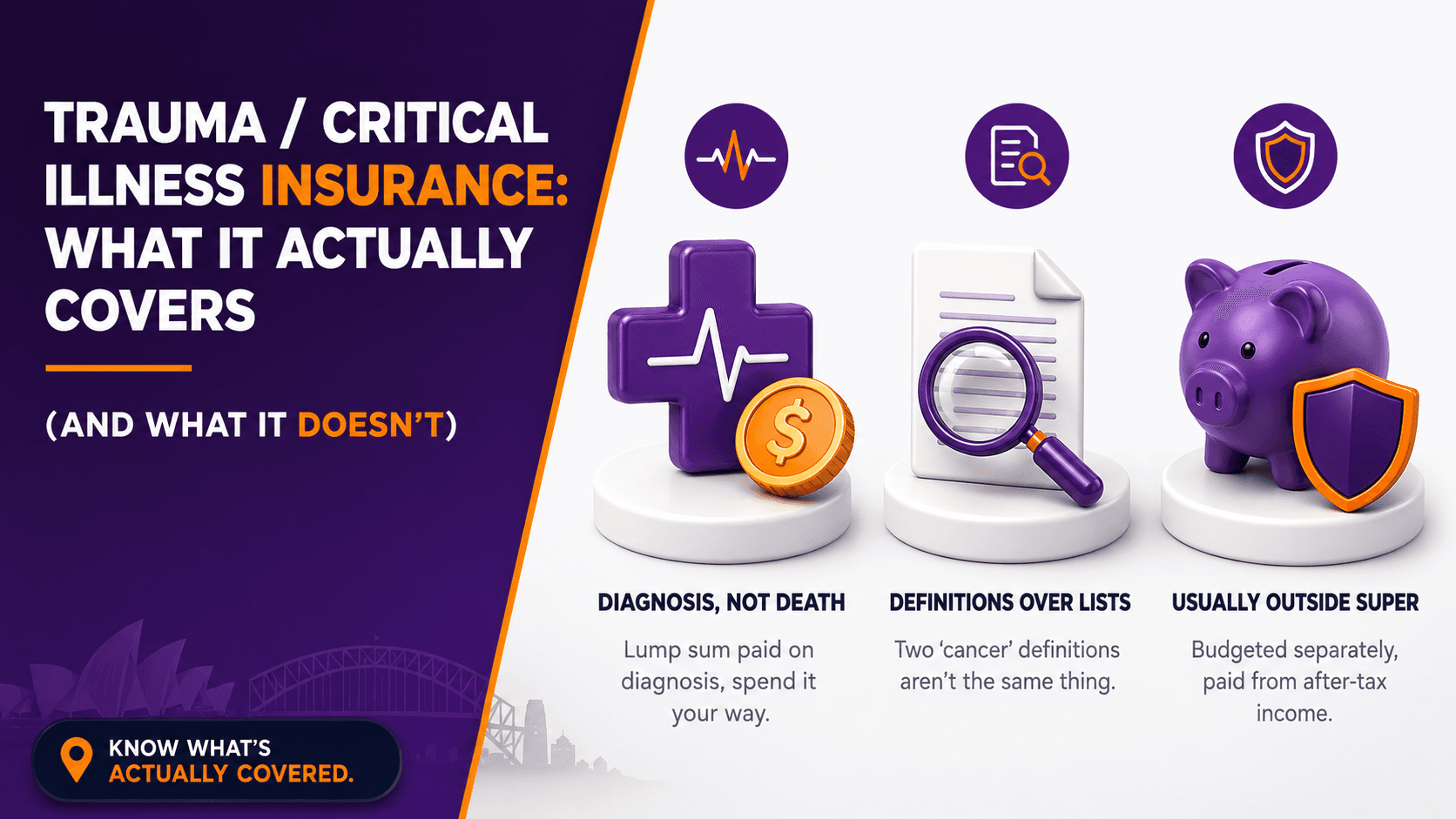
Trauma insurance pays a lump sum if you're diagnosed with a specified serious illness or injury (cancer, heart attack, stroke, and others are common core conditions). It's not about death, it's about survival with impact.
Payout is generally unrestricted, you decide how to use it: medical costs, paying down debt, income replacement during recovery, home modifications, whatever the situation actually needs.
It's different from income protection (which pays an ongoing monthly benefit if you can't work) and different from TPD (which requires permanent, not just serious, incapacity).
Policies vary significantly between insurers in which conditions are covered and how strictly they're defined. Two "cancer" definitions are not automatically the same, and this is where claims disputes happen.
Trauma insurance is generally not available inside superannuation in the same way life and TPD cover often are, due to superannuation's "condition of release" rules. This affects how it's usually structured and paid for.
Premiums are not tax-deductible for standalone personal trauma cover, and the payout is generally tax-free to the individual.
Cost depends heavily on age, health, sum insured, and whether it's standalone or bundled with life insurance. Bundled policies can reduce the payout on one benefit if the other is claimed, which is a structuring detail worth understanding upfront.
Bottom line: trauma insurance exists for the financially disruptive middle ground between "minor illness, back to work in a week" and "permanently unable to work," which is where a lot of serious diagnoses actually land.
Jump to a Section
What Trauma Insurance Actually Pays Out For
Trauma vs Income Protection vs TPD
Why Definitions Matter More Than the Condition List
Why It's Usually Held Outside Super
How Much Cover Do You Actually Need?
Worked Example: Two Diagnoses, Two Outcomes
Common Mistakes
FAQ
What Trauma Insurance Actually Pays Out For
Trauma (critical illness) insurance pays a lump sum on diagnosis of a specified serious medical condition, commonly including cancer, heart attack, stroke, and a defined list of other conditions that varies between insurers (often ranging from around 10 up to 40+ specified conditions depending on the policy). The trigger is diagnosis meeting the policy's specific definition, not death, and not necessarily permanent incapacity. This is what makes it distinct from both life insurance and TPD cover.
Crucially, the payout is a lump sum with no restriction on how it's spent. Some people use it for medical costs not covered elsewhere, others use it to pay down a mortgage to reduce financial pressure during reduced work capacity, others use it purely as an income buffer while recovering. There's no requirement to justify the spend to the insurer.
Not sure what conditions your current cover (if any) actually includes? A free 15-minute chat with our team will walk through your policy in plain English. Call 1800 942 843.
Bottom line: trauma insurance is triggered by the diagnosis itself, not by whether you can still work or how long you're expected to survive, and once paid, the money is yours to use however the situation actually calls for.
Trauma vs Income Protection vs TPD
These three get confused constantly because they can all respond to a serious illness, but they're built for different situations.
Feature | Trauma/Critical Illness | Income Protection | TPD |
Trigger | Diagnosis of a specified condition | Inability to work due to illness/injury (temporary or long-term) | Permanent inability to work in any/own occupation |
Payout type | Lump sum | Ongoing monthly benefit (typically up to 75% of income) | Lump sum |
Severity required | Meets specific diagnosis definition | Any illness/injury preventing work, doesn't need to be "serious" | Permanent, not temporary |
Common use | Medical costs, debt reduction, flexible recovery buffer | Ongoing living expenses while off work | Major lifestyle/financial restructuring after permanent incapacity |
Bottom line: many people assume one of these covers "serious illness" broadly. In reality they're three different tools for three different stages and severities of impact, and a well-structured portfolio often includes more than one.
Why Definitions Matter More Than the Condition List
This is the single biggest source of claim disputes and disappointment with trauma insurance: not all "cancer" or "heart attack" definitions are the same across insurers. Policies specify precise clinical criteria for each condition, for example, some cancer definitions exclude very early-stage or low-grade cancers that don't meet a severity threshold, and some heart attack definitions require specific biomarker or diagnostic evidence, not just a clinical diagnosis by a treating doctor.
This means two policies that both list "cancer" as a covered condition can produce very different claim outcomes for the same diagnosis, depending on how tightly or generously each insurer has defined it. Reading (or having an adviser review) the actual Product Disclosure Statement definitions matters far more than comparing headline condition-count lists between insurers.
Not sure how your actual policy defines its covered conditions, versus what the marketing brochure implies? A free 15-minute chat with our team can walk through your PDS in plain English. Call 1800 942 843 or email clientservices@whatifadvice.com.au.
Bottom line: "does this policy cover cancer" is the wrong question. "How does this specific policy define a claimable cancer diagnosis" is the one that actually determines whether you'd be paid.
Why It's Usually Held Outside Super
Unlike life insurance and TPD, trauma insurance is generally not held inside superannuation, or is only available in limited standalone forms through super. This is largely because superannuation payouts are governed by "conditions of release" rules designed around retirement, death, or permanent incapacity. A trauma diagnosis (like surviving cancer treatment and returning to work) doesn't necessarily meet those release conditions, creating a mismatch between when the insurance event happens and when super rules would actually let the money out.
As a result, trauma cover is most commonly held as a standalone personal policy, paid for with after-tax income rather than deducted from super contributions, which affects both affordability and how it should be budgeted for compared to super-held life/TPD cover.
If your existing life and TPD cover sits inside super, your trauma cover situation might be a genuine gap worth checking. Email clientservices@whatifadvice.com.au and we'll take a look.
Bottom line: because trauma cover usually can't hide inside your super contributions the way life/TPD sometimes can, it needs to be budgeted for explicitly, out of pocket, as its own line item.
How Much Cover Do You Actually Need?
There's no fixed formula, but a useful starting framework considers:
Outstanding debt: enough to clear or substantially reduce a mortgage or other major debt, removing financial pressure during recovery.
Income gap during recovery: enough to cover living expenses for a realistic recovery period (often 6 to 24 months depending on the condition) beyond what income protection alone would provide.
Anticipated out-of-pocket medical costs: treatment, specialists, and any gaps not covered by Medicare or private health insurance.
Lifestyle adjustment costs: home modifications, altered work capacity, or reduced hours on return to work.
Bottom line: sizing trauma cover around "what would actually need to happen financially if this diagnosis landed on me next year" produces a far more useful number than picking a round figure that sounds sensible.
Worked Example: Two Diagnoses, Two Outcomes
(Figures are illustrative only. Actual premiums and payouts depend on age, health, insurer, and sum insured at time of application.)
Case A, Priya (no trauma cover): Priya, 42, is diagnosed with breast cancer. She has income protection, which begins paying a monthly benefit after a waiting period, replacing roughly 75% of her income, but out-of-pocket costs for specialists, a particular treatment not fully covered by her health fund, and reduced household income during an extended recovery create real financial strain. She draws down savings and puts some costs on a credit card.
Case B, Daniel (trauma cover in place): Daniel, 44, has $250,000 of standalone trauma cover alongside his income protection, costing him roughly $780 a year in premiums at the time it was set up. When he's diagnosed with a heart condition meeting his policy's definition, he receives the full lump sum shortly after diagnosis is confirmed. He uses part of it to cover a specialist treatment gap, part to reduce his mortgage repayments during reduced work hours, and keeps the remainder as a buffer, all without touching savings or taking on new debt.
Bottom line: income protection and trauma cover solve different parts of the same problem. One replaces ongoing income, the other provides a flexible lump sum for everything income protection doesn't reach.
Common Mistakes
Assuming all trauma policies cover the same conditions the same way. Definitions vary significantly between insurers. The fine print determines the real coverage, not the marketing list.
Not understanding bundled vs standalone structures. Some policies reduce (or "accelerate") a linked life insurance benefit when a trauma claim is paid. Check whether your cover is standalone or bundled, and what that means for the total benefit remaining afterward.
Assuming trauma cover sits inside super like life/TPD often does. It usually doesn't, which means it needs a separate spot in the household budget.
Underestimating the sum insured by only thinking about medical bills. Income disruption and lifestyle adjustment costs are often the bigger real-world expense.
Never reviewing cover as circumstances change. A mortgage that's grown, or a new dependent, can make an old sum insured inadequate.
Confusing trauma cover with income protection and assuming one makes the other redundant. They typically work best together, not as substitutes.
FAQ
Is trauma insurance the same as critical illness insurance? Yes. "Trauma insurance" and "critical illness insurance" are generally used interchangeably in the Australian market to describe the same type of lump sum cover.
Does trauma insurance pay out even if I fully recover and return to work? Yes. The trigger is the diagnosis meeting the policy definition, not ongoing incapacity, so a full recovery doesn't affect entitlement to a payout already triggered.
Can I hold trauma insurance inside my superannuation fund? Generally not in the same way as life or TPD cover, due to superannuation's conditions of release. It's usually held as a standalone policy outside super, though structures vary and are worth checking with an adviser.
Are trauma insurance premiums tax-deductible? No, generally not for standalone personal trauma cover, but the payout is typically received tax-free, which is the trade-off.
What conditions are typically covered by trauma insurance? Core conditions across most policies usually include cancer, heart attack, and stroke, with additional conditions varying by insurer, but the specific clinical definition of each condition matters more than whether it appears on the list.
Is trauma insurance worth it if I already have income protection? Often yes. They cover different gaps: income protection replaces ongoing income, while trauma cover provides a flexible lump sum for costs and pressures income protection alone doesn't address.
Does trauma insurance cover mental health conditions? Coverage varies significantly by insurer and policy. Some include specific mental health-related conditions under strict definitions, others don't, so this needs to be checked policy by policy rather than assumed.
What happens if I've had a serious illness before applying for trauma cover? Pre-existing conditions can affect eligibility, premiums, or result in specific exclusions. This needs to be disclosed accurately during the application, and outcomes vary by insurer and condition.
How long is the waiting period before a trauma claim can be paid? This varies by insurer and policy, and by the specific condition being claimed. Waiting periods should be checked in the Product Disclosure Statement rather than assumed to be uniform.
Can self-employed people get trauma insurance? Yes. Self-employed individuals can generally apply for trauma cover, though income verification and underwriting can look different than for employees, and it's often paired thoughtfully with income protection given the lack of employer sick leave.
Ready to Check Your Actual Cover?
Ready to find out whether your current cover actually protects you the way you think it does, or where the real gaps are? A quick look at what you've already got, compared to what a serious diagnosis would actually cost you, often reveals more than people expect.
Call us: 1800 942 843
Book online: free 15-minute chat, no cost, no pressure
Still asking what if it's never you? Trauma insurance isn't betting that it will be. It's making sure survival doesn't come with a financial sentence attached.
WIAA has advised 1,000+ clients across our Toowong, Grange, and Melbourne CBD offices, operating under AFSL 528250 as an Authorised Representative of Beryllium Advisers Pty Ltd.
General Advice Disclaimer: This article contains general information only and does not take into account your personal objectives, financial situation, or needs. It does not constitute personal financial advice, and should not be relied upon as such. Insurance product features, definitions, and exclusions vary significantly between insurers and policies and should be verified against the relevant Product Disclosure Statement. Tax treatment referenced is a general guide only and is subject to change.