Looking for specific financial advice?
This blog provides general educational content. For personalized advice tailored to your unique situation, book a free consultation with our team of ASIC-licensed financial advisers.
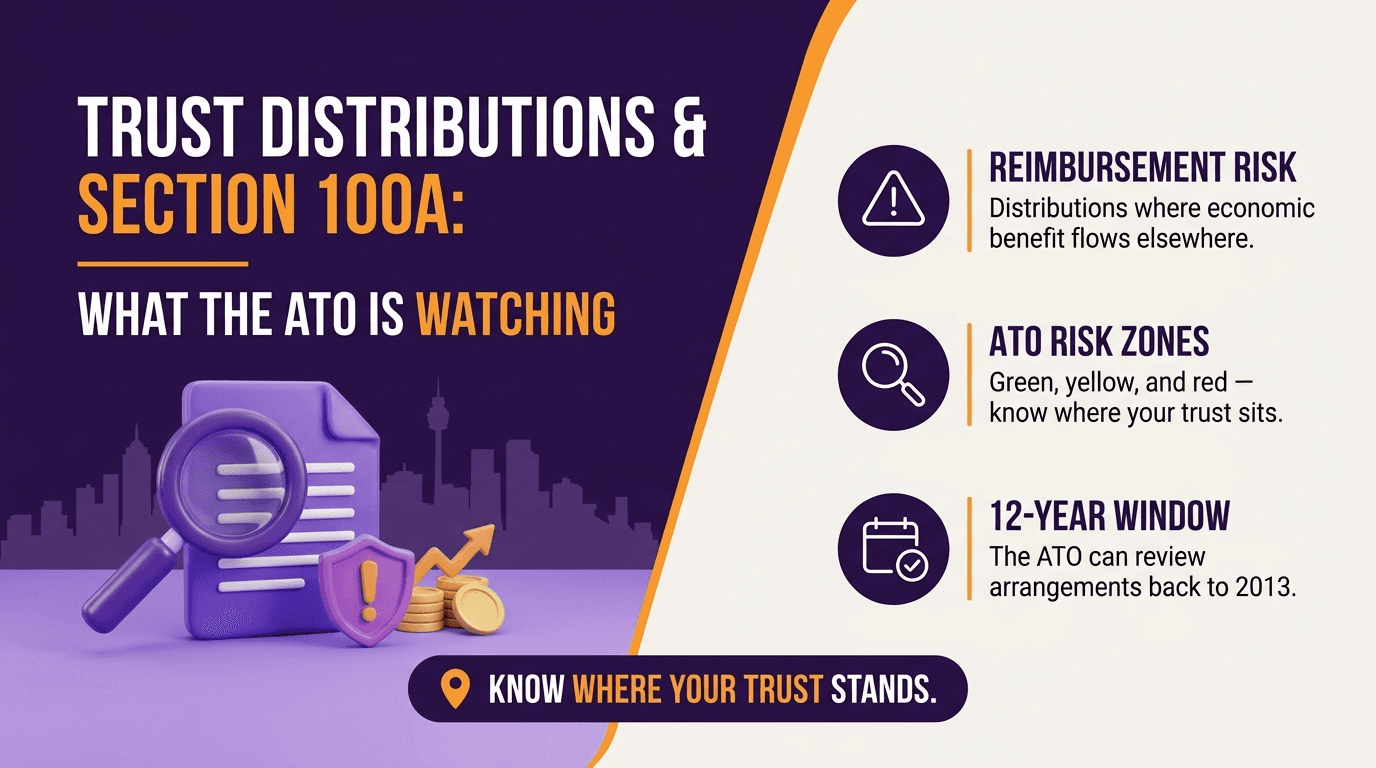
Trust Distributions and Section 100A: What the ATO Is Watching
Family trusts have been a cornerstone of Australian tax planning for decades. The ability to distribute income to lower-taxed beneficiaries each year is one of the primary reasons families and business owners use discretionary trusts. That flexibility is legitimate and Parliament built it into the law deliberately.
Section 100A of the Income Tax Assessment Act 1936 is the provision that defines where legitimate flexibility ends and arrangements the ATO considers unacceptable begin. It has existed since 1979. What has changed significantly in recent years is how actively the ATO is enforcing it and how broadly they interpret it.
In 2022, the ATO released a revised taxation ruling and a practical compliance guideline that substantially updated their position on Section 100A. Many arrangements that trustees had treated as routine family trust planning now sit in zones the ATO considers medium or high risk. Some sit in territory the ATO considers clearly problematic.
This guide explains what Section 100A is, what triggers it, what the ATO's current guidance says, and what trustees and their advisers should be reviewing now.
TL;DR: The Key Points
Here is the short version before you get into the detail:
Section 100A is an existing anti-avoidance provision targeting trust distributions where the economic benefit of the distribution is redirected away from the beneficiary to someone else
If Section 100A applies, the beneficiary's entitlement is treated as never having arisen and the trustee is assessed at the top marginal rate of 47%
The key concept is a reimbursement agreement: an arrangement, formal or informal, where a beneficiary becomes entitled to trust income but the benefit flows to a different person
The critical exception is ordinary family or commercial dealing: arrangements that arise genuinely in the ordinary course of family life or commerce are excluded
The ATO's 2022 guidance (TR 2022/4 and PCG 2022/2) significantly expanded their position on what arrangements they consider high risk
Distributions to adult children on low incomes where little or no money actually reaches them are a primary ATO concern
Distributions to a corporate beneficiary where funds are then made available to a controlling individual are treated as high risk
The ATO can amend assessments up to 12 years after the relevant year for arrangements involving Section 100A
Trustee resolutions, documentation, and genuine economic benefit to beneficiaries are now more important than ever
Jump to a Section
What Is Section 100A?
What Is a Reimbursement Agreement?
The Ordinary Family or Commercial Dealing Exception
The ATO's 2022 Guidance: Risk Zones Explained
Common Arrangements the ATO Considers High Risk
Unpaid Present Entitlements and the Interaction with Division 7A
What Happens If Section 100A Applies?
What Trustees Should Be Doing Now
FAQ
What Is Section 100A?
Section 100A was introduced in 1979 to prevent a specific type of arrangement: one where a trust distributes income to a beneficiary on a low tax rate, but the actual economic benefit of that distribution is redirected to a higher-taxed person who would have paid significantly more tax if the income had been distributed to them directly.
The mismatch is the problem. The beneficiary gets the tax liability. Someone else gets the money. The net effect is that the family or business pays tax at a low rate on income that actually benefited someone taxed at a high rate. That is the arrangement Section 100A was designed to dismantle.
For most of its history, Section 100A was applied narrowly. From around 2014 onward, the ATO began auditing trust distributions more aggressively. The 2022 guidance made clear that the ATO's interpretation of Section 100A is broader than many advisers and trustees had assumed.
The consequence of Section 100A applying is significant. The beneficiary's entitlement to the distribution is treated as if it never arose. The trustee is assessed on the relevant amount at 47%, the top marginal rate, rather than the beneficiary's lower marginal rate. In other words, the tax outcome is the worst possible one: the higher tax that the arrangement was designed to avoid, plus interest and potentially penalties.
Bottom line: Section 100A is not a new risk. It is an existing law that the ATO is now enforcing with considerably more resources, broader guidance, and a 12-year amendment window.
What Is a Reimbursement Agreement?
The core concept in Section 100A is the reimbursement agreement. This is the mechanism through which the provision is triggered.
A reimbursement agreement exists where:
A beneficiary becomes presently entitled to trust income, and
As part of that entitlement or in connection with it, there is an agreement, arrangement, or understanding that the beneficiary will not actually receive the benefit of the distribution, or will receive it in a reduced form, or will provide some benefit to another person in connection with the distribution
The agreement does not need to be in writing. It does not need to be formal. An informal understanding between family members that a distribution will be made to a low-income beneficiary but the money will stay in the family business or be directed to someone else is sufficient to constitute a reimbursement agreement if the ATO can establish it existed.
This is where many trustees are caught off guard. The arrangement does not look like an avoidance scheme from the inside. It looks like normal family financial management. The daughter gets a $40,000 distribution. The money goes into the family account. The parents use it for household expenses. Nobody thought of it as a reimbursement agreement.
The ATO increasingly thinks of it differently.
What if an arrangement that has run in your trust for a decade is being viewed by the ATO as a reimbursement agreement? Section 100A's 12-year amendment window means the risk is not limited to recent years.
The Ordinary Family or Commercial Dealing Exception
Section 100A contains an explicit exception. A reimbursement agreement is not caught by Section 100A if it arises in the course of ordinary family or commercial dealings.
This exception is the primary battleground in Section 100A disputes and the most important concept for trustees to understand.
The ATO's guidance on what qualifies as ordinary family or commercial dealing includes examples such as:
A distribution to a spouse who uses the funds for general household or family expenses, where the funds genuinely flow to them or are used in ways consistent with a normal family financial arrangement
A distribution to a beneficiary who reinvests the money in a manner consistent with their own financial interests
A distribution that creates an unpaid present entitlement where the trust genuinely uses the funds in an arm's length commercial capacity
What the exception does not cover, in the ATO's view:
Arrangements where distributions are made to low-income beneficiaries primarily or solely to achieve a tax outcome, with no genuine benefit flowing to them
Circular arrangements where money effectively returns to the controlling individual or entity
Arrangements that serve no purpose other than tax reduction
The ordinary family dealing exception is not a blanket exemption for family trust distributions. It is a fact-specific question about the nature and purpose of each arrangement. The ATO's position is that the exception should be interpreted narrowly, and recent case law has broadly supported that position.
Bottom line: The ordinary family dealing exception is real and available, but it requires genuine substance. An arrangement structured purely to minimise tax with no genuine economic benefit to the beneficiary is unlikely to satisfy it.
The ATO's 2022 Guidance: Risk Zones Explained
In February 2022, the ATO released Taxation Ruling TR 2022/4 and Practical Compliance Guideline PCG 2022/2. Together these documents represent the most significant update to the ATO's Section 100A position in the provision's history and caught many trustees and advisers by surprise.
PCG 2022/2 introduced a colour-coded risk framework for common trust distribution arrangements. The risk zones are:
Risk Zone | Indicator | ATO Approach |
Green | Low risk arrangements where the ordinary family dealing exception clearly applies | ATO will not allocate compliance resources to review |
Blue | Arrangements prior to 1 July 2014 that have not changed | ATO will not pursue for pre-2014 years only |
Yellow | Medium risk arrangements requiring more scrutiny | ATO may review, trustees should have documentation ready |
Red | High risk arrangements that the ATO is likely to investigate | ATO will actively pursue |
Green zone examples (low risk):
A distribution to an adult beneficiary who genuinely receives and uses the funds for their own purposes, with no arrangement to redirect them
A distribution to a spouse who uses the funds jointly with the other spouse for family living expenses where this reflects normal family financial behaviour
A distribution that creates an unpaid present entitlement where the funds are genuinely used by the trust on arm's length commercial terms
Red zone examples (high risk):
A distribution to a low-rate beneficiary (such as an adult child or a company) where the funds are then directed back to a higher-rate individual through loans, payments, or other arrangements
A distribution to an adult child who receives nothing or a token amount, with the economic benefit retained by the parents
Circular arrangements where distributions are made to a beneficiary who immediately pays the same amount to another person, such as a parent, under an informal arrangement
The 2022 guidance made clear that many arrangements previously treated as routine are now explicitly in the yellow or red zone. The ATO was not creating new law in 2022. They were stating, more precisely than ever before, how they intended to apply law that had always existed.
Common Arrangements the ATO Considers High Risk
Based on the ATO's guidance and its compliance activity, the following arrangements are currently receiving significant scrutiny.
Distributions to adult children on low incomes. This is the most commonly audited arrangement. A discretionary trust makes a distribution to an adult child, often a university student or someone in early career earning little income, to take advantage of their low marginal rate or unused tax-free threshold. The child receives little or nothing. The parents use the money.
The ATO's position is that where there is any arrangement, formal or informal, under which the adult child does not actually receive the economic benefit of the distribution, Section 100A may apply.
What makes this arrangement legitimate: the adult child actually receives the money and uses it for their own genuine purposes.
What makes it a reimbursement agreement: the money goes into a family account, is used by the parents, or the child has an informal understanding that they will not receive it.
Distributions to a corporate beneficiary with funds redirected to individuals. Distributing trust income to a corporate beneficiary at the corporate tax rate (25% for base rate entities or 30% for others) is a common and generally legitimate strategy. The problem arises when the funds do not genuinely remain in the company and are instead made available to the controlling individual through loans or other mechanisms.
Where the ATO can establish that the distribution to the company and the subsequent access by the individual were part of a connected arrangement, Section 100A becomes a risk alongside the Division 7A issues that such arrangements also create.
Unpaid present entitlements left in the trust. Where a beneficiary becomes entitled to trust income but does not receive payment, the entitlement sits as an unpaid present entitlement (UPE) on the trust's books. The ATO has historically treated certain UPEs, particularly those owed to corporate beneficiaries, as creating Division 7A loan obligations. The Bendel decision in the Full Federal Court in 2025 found that UPEs owed to a corporate beneficiary are not loans for Division 7A purposes, which altered the compliance landscape for those arrangements. The ATO sought special leave to appeal this decision to the High Court. This area remains in flux and specific advice is essential.
Where a UPE is owed to an individual beneficiary and the funds remain in the trust, Section 100A may apply if the circumstances suggest the beneficiary never genuinely had access to the economic benefit.
Circular arrangements. Any arrangement where a beneficiary receives a distribution and then pays an equivalent amount back to another party, whether through rent, services, loans, or other transactions, is likely to attract Section 100A scrutiny if the structure of the arrangement suggests it was designed to move the tax liability without moving the economic benefit.
Not sure whether your current trust distribution arrangements fall into a red or yellow zone? The registered tax agents at What If Advice can review your trust structure and distribution history and give you a clear picture of where you stand. Call 1800 942 843 or email tax@whatifadvice.com.au.
Unpaid Present Entitlements and the Interaction with Division 7A
The relationship between Section 100A and Division 7A is a significant area of complexity for trustees of trusts with corporate beneficiaries.
Division 7A treats certain payments, loans, and other benefits from a private company to shareholders or their associates as unfranked dividends, triggering income tax at the recipient's marginal rate. Where a trust has distributed income to a corporate beneficiary and the funds are then accessed by the trust's controlling individual through the company, Division 7A can apply to characterise those payments as dividends.
The Bendel decision (Commissioner of Taxation v Bendel, Full Federal Court, 2025) found that a UPE owed by a trust to a corporate beneficiary is not a loan for Division 7A purposes. This represented a departure from the ATO's longstanding position and has significant implications for historical trust arrangements with corporate beneficiaries. The ATO sought High Court special leave to appeal this decision. Until the High Court's position is clear, this area carries significant uncertainty and arrangements that relied on the Bendel outcome should be reviewed with specific professional advice.
Regardless of the Bendel outcome, the Section 100A question is separate. Even if a UPE is not a Division 7A loan, the ATO can still ask whether the distribution that created the UPE was part of a reimbursement agreement.
Bottom line: The interaction between Section 100A, Division 7A, and UPEs is genuinely complex. These are not questions to navigate without a registered tax agent who specialises in trust taxation.
What Happens If Section 100A Applies?
The consequences of Section 100A applying to a trust distribution are severe.
The beneficiary's entitlement is void. The distribution is treated as if it never arose. The beneficiary is not assessed on the income.
The trustee is assessed instead. The amount that was distributed to the beneficiary is assessed to the trustee at 47%, the top marginal rate. There is no discount, no tax-free threshold, and no concessional treatment.
Interest applies. The ATO charges interest on the shortfall from the original due date of the tax, not from the date of the assessment. On a large trust distribution over multiple years, the interest component can be substantial.
Penalties may apply. Where the ATO considers the arrangement was entered into recklessly or with intentional disregard for the law, significant penalties can apply on top of the primary tax and interest.
The amendment period is 12 years. Standard income tax amendments can generally be made within 2 to 4 years. For arrangements involving Section 100A, the ATO has 12 years from the date the original assessment was made. This means arrangements from as recently as 2013 can still be reviewed and assessed today. Historical arrangements that would otherwise be outside the normal amendment window remain vulnerable.
Worried an arrangement your trust has been running for years could be sitting in exactly this exposure? A review before the ATO initiates one is the difference between a manageable conversation and a 12-year interest bill. Call 1800 942 843 or email tax@whatifadvice.com.au.
What Trustees Should Be Doing Now
The ATO's 2022 guidance and ongoing compliance activity means trustees cannot treat trust distribution decisions as administrative formalities. Several practical steps reduce both risk and exposure.
Review current distribution arrangements against the PCG 2022/2 risk zones. Identify whether any current arrangements sit in the yellow or red zones and what documentation or restructuring would move them into green.
Ensure beneficiaries genuinely receive the economic benefit of their distributions. Where a distribution is made to a family member, the funds should genuinely flow to them and be used for their own purposes. Informal understandings that redirect the funds should be identified and addressed.
Get trustee resolutions completed before 30 June. Section 100A aside, trust distributions must be resolved before the end of the financial year to create a valid present entitlement in that year. Backdated resolutions are a separate compliance risk.
Document the rationale for distribution decisions. A contemporaneous record of why the trustee resolved to distribute to particular beneficiaries, and in what proportions, provides evidence that the decision had genuine commercial or family rationale rather than being purely tax-driven.
Review historical arrangements in light of the 12-year window. If your trust has been making distributions to low-income beneficiaries who received little economic benefit, the 12-year amendment period means the risk is not limited to recent years.
Review UPE positions in light of Bendel and Division 7A uncertainty. If your trust has outstanding UPEs to a corporate beneficiary, seek specific advice on how the current state of the law applies to your arrangements.
Seek specific professional advice before 30 June. Trust distributions, Section 100A, and Division 7A interact in ways that make self-assessment genuinely risky, and trustee resolutions cannot be made retrospectively once the financial year ends.
Working through this list and want a second set of eyes on where you actually stand? The registered tax agents at What If Advice can turn this checklist into an actual review of your trust before the next resolution deadline. Call 1800 942 843 or email tax@whatifadvice.com.au.
FAQ
What is Section 100A in simple terms?
Section 100A is a tax law that applies where a trust distributes income to a beneficiary on a low tax rate, but the economic benefit of that distribution is actually received by someone else. If the ATO can establish this arrangement exists, the distribution is unwound and the trustee is assessed at the top marginal rate of 47% on the amount.
Does Section 100A apply to all trust distributions?
No. It applies only where there is a reimbursement agreement: an arrangement, formal or informal, under which the beneficiary does not genuinely receive the economic benefit of the distribution. Distributions where the beneficiary actually receives and uses the funds for their own purposes, in a way consistent with ordinary family or commercial dealings, are not caught.
What is the ordinary family dealing exception?
This is the exception that removes arrangements from Section 100A. Where a distribution arises in the ordinary course of family or commercial dealings, it is not a reimbursement agreement regardless of the tax outcome. The ATO interprets this exception narrowly. An arrangement must have genuine commercial or family substance beyond the tax benefit to qualify.
Can Section 100A apply to historical distributions?
Yes. The ATO has a 12-year amendment period for arrangements involving Section 100A. Distributions made as far back as 2013 can still be assessed today. This extended window is one of the most significant risk factors for trusts that have run aggressive distribution strategies for many years.
What did the ATO's 2022 guidance change?
TR 2022/4 updated the ATO's detailed position on what constitutes a reimbursement agreement and what qualifies as ordinary family dealing. PCG 2022/2 introduced a risk framework categorising common trust arrangements into green, blue, yellow, and red zones. Together the guidance made clear that many arrangements previously treated as routine family trust planning are now within the ATO's active compliance focus.
Are distributions to adult children always risky?
Not always, but they are always scrutinised. Where an adult child genuinely receives the distribution and uses it for their own purposes with no arrangement to redirect it, the ordinary family dealing exception is likely to apply. Where the distribution is made to take advantage of the child's low tax rate but the money stays in the family pool and is used by the parents, the ATO's position is that a reimbursement agreement exists.
If my adult child spends their trust distribution on their own university fees, does Section 100A apply?
Generally, no. This is a useful grounding example against the higher-drama scenarios above. If the money is genuinely paid to the child and they use it for their own purposes, including their own education costs, living expenses, or savings, this is consistent with ordinary family dealing and the beneficiary is genuinely receiving the economic benefit. The risk arises specifically where the money does not reach the child at all, or reaches them only to be redirected back to the parents. A distribution followed by the beneficiary spending it on themselves is the pattern the exception was designed to protect.
Does Section 100A apply to distributions to a corporate beneficiary?
It can. Distributing trust income to a corporate beneficiary at the corporate tax rate is a common and generally legitimate strategy. Where the distribution to the company is part of a broader arrangement under which the funds are redirected to a controlling individual, Section 100A may apply alongside Division 7A. Each arrangement must be assessed on its specific facts.
What is the penalty if Section 100A applies?
The primary consequence is tax assessed at 47% on the relevant amount, plus interest running from the original due date of the tax. Penalties depend on the ATO's view of culpability: a failure to take reasonable care attracts a 25% shortfall penalty, recklessness attracts 50%, and intentional disregard attracts 75%. The combined effect of tax, interest, and penalties on a significant trust distribution can substantially exceed the original tax benefit the arrangement produced.
What should I do if I think my trust's historical distributions might be affected?
Seek specific advice from a registered tax agent before the ATO contacts you. The ATO's voluntary disclosure process can reduce penalties for taxpayers who come forward before an audit commences. Waiting until the ATO initiates a review reduces or eliminates access to that benefit. A review of your historical distribution arrangements, UPE positions, and current trustee resolution practice is the right starting point.
Is your trust's distribution strategy consistent with the ATO's current position?
Section 100A is not a theoretical risk. The ATO has been auditing trust distributions actively since the 2022 guidance, and the 12-year amendment window means exposure is not limited to recent years. Getting a clear picture of where your arrangements sit, before the ATO does, is the lowest-risk approach.
The registered tax agents at What If Advice work with business owners and families across Brisbane and Melbourne to review trust structures, assess Section 100A exposure, and ensure trustee resolutions and distribution practices are defensible.
Call 1800 942 843 or email tax@whatifadvice.com.au to book a review.
Still asking what if about your trust's compliance position? That question is worth answering now, with your actual arrangements on the table. The team at What If Advice can help you work out where you stand.
General Advice Disclaimer: This information is general in nature and does not take into account your personal financial situation, needs, or objectives. Tax laws and ATO interpretations are complex and subject to change. The Bendel decision and associated High Court proceedings remain unresolved at the time of publication. You should seek advice from a registered tax agent before making any decisions about your trust's distribution strategy or compliance position. What If Advice Accounting Pty Ltd is a registered tax agent.