Looking for specific financial advice?
This blog provides general educational content. For personalized advice tailored to your unique situation, book a free consultation with our team of ASIC-licensed financial advisers.
Most articles about SMSFs are about starting one. This one is about knowing when to stop.
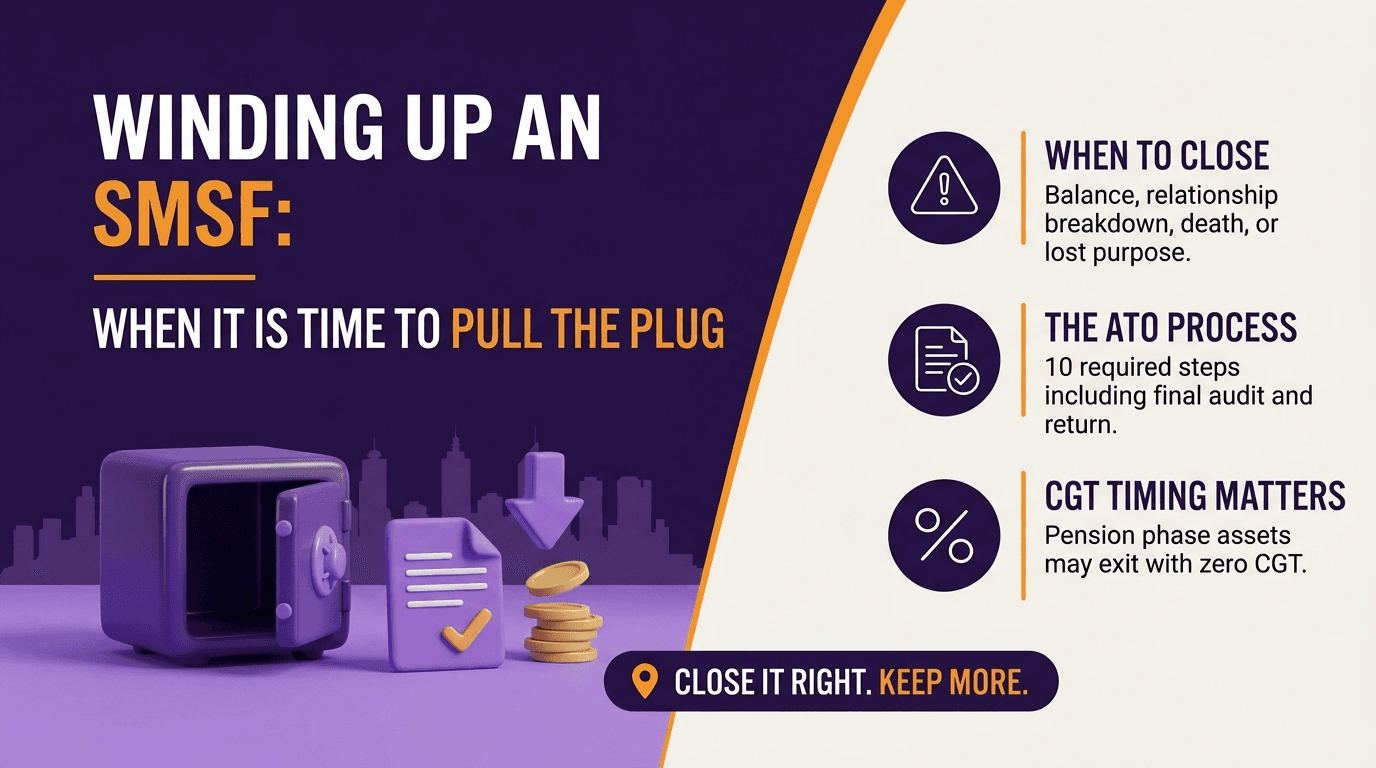
Winding up a self-managed super fund is not complicated in principle, but it is easy to get wrong in practice. The process involves a final audit, a final tax return, the disposal or transfer of every asset the fund holds, and formal notification to the ATO. Done well, it is a clean transition. Done poorly, it leaves compliance obligations unmet, capital losses wasted, and in some cases, penalties you could have avoided entirely.
This guide covers the genuine triggers for winding up, the step-by-step process the ATO requires, the costs involved, and the tax considerations that can materially affect what your members actually walk away with. The wind-up process sits across both financial planning and tax disciplines, and What If Advice operates as both a licensed financial advice practice and a registered tax agent. Whether you are facing this decision now or want to be prepared for when the time comes, understanding it clearly is part of responsible trusteeship.
This is general information only. Winding up an SMSF involves complex tax, compliance, and superannuation law obligations. Seek advice from a registered tax agent and a licensed financial adviser before making any decisions.
Jump to a Secti
When to Wind Up an SMSF: The Six Most Common Triggers
How to Wind Up an SMSF: The ATO's Required Process Step by Step
What Does It Cost to Wind Up an SMSF?
SMSF Wind-Up Tax Traps: CGT, Death Benefits, and Unused Losses
Where Does Your Super Go After You Wind Up an SMSF?
SMSF Wind-Up Alternatives: Is Restructuring an Option?
Peter and Jill: Why Timing the SMSF Wind-Up Right Matters
Frequently Asked Questions
When to Wind Up an SMSF: The Six Most Common Triggers
An SMSF is wound up when it no longer makes sense to keep it running. That can happen for practical reasons, financial reasons, or reasons that are entirely outside your control.
The balance has dropped below the cost-effective threshold
What if the fund that built your wealth is now quietly costing you more than it should? Many SMSF costs are a fixed dollar amount while public super funds often calculate at least some of their costs as a percentage of a member's balance. Costs that felt very manageable when the fund held $1 million can feel significantly heavier when it has dropped to $300,000. A market downturn, regular pension drawdowns over many years, aged care costs, or simply the passage of time can erode a fund's balance to the point where the fixed annual costs no longer make financial sense relative to what a member would pay in an industry or retail alternative.
Relationship breakdown
Disputes between trustees as a result of relationship breakdown, differing opinions on how the fund should be run, or trustees acting in bad faith are among the most common reasons an SMSF is wound up. When two people set up a fund together and their relationship ends, the fund often cannot survive the split in its current form. The trust deed, the investment strategy, and the trustee agreement all assume a degree of cooperation that may no longer exist. In some cases the fund can be restructured to continue with a single member. In others, winding up is the only workable outcome.
Death of a member or trustee
The death of a member or trustee does not automatically wind up a fund, but it frequently triggers the process. Where there is only one member, their legal personal representative is required to pay out all benefits in accordance with the trust deed and any death benefit nomination. Where a fund has multiple members and the remaining members do not wish to continue, or the remaining member falls below the structural requirements of the fund, winding up becomes necessary. Estate planning considerations around the tax treatment of death benefits paid to adult non-dependants can also make winding up before death a deliberate and tax-effective strategy in some circumstances.
Loss of capacity to manage the fund
Being an SMSF trustee is a legal responsibility that requires active engagement. A change in personal circumstances, such as an inability to effectively manage the fund due to lack of time, permanent incapacity, or failing health, is a legitimate and common reason to wind up. A trustee who can no longer fulfil their obligations is exposing the fund to compliance risk. The earlier this is recognised and acted on, the cleaner the outcome.
The original investment strategy has run its course
Many SMSFs are established around a specific investment goal: purchasing a commercial property, holding a particular business real property, or executing a strategy that requires the flexibility the SMSF structure provides. When that asset is sold, the strategy that justified the structure often disappears with it. If the remaining assets and balance do not justify the ongoing cost, winding up is the logical conclusion.
Compliance action by the ATO
Serious breaches of superannuation law that attract compliance action from the ATO can also force a wind-up. It is important to understand that winding up a fund that is under compliance scrutiny does not extinguish the trustees' obligations. Outstanding compliance issues must still be resolved, and attempting to wind up a fund to escape ATO attention is not a strategy.
How to Wind Up an SMSF: The ATO's Required Process Step by Step
The ATO sets out a formal process for winding up an SMSF. There is no shortcut and no unofficial path. Every step must be completed correctly, in order. The following steps apply to every SMSF wind-up regardless of the fund's size, complexity, or reason for closure.
Step 1: Check the trust deed
Your fund's trust deed may contain specific requirements about the wind-up process, including whether you must sell all assets rather than transferring ownership to members. Read it before you do anything else. Trustees who skip this step sometimes create problems that complicate the process significantly.
Step 2: All trustees must agree
Document the decision to wind up in the meeting minutes and ensure all trustees sign the agreement. Electronic signatures are acceptable. This is not a formality. If trustees cannot agree, the wind-up cannot proceed cleanly, and the dispute may require legal resolution.
Step 3: End any pensions
If the fund is paying retirement phase pensions to any member, those pensions must be formally commuted before the fund can be wound up. Pensions must be brought up to date before they are commuted. If fully commuting a pension, a pro-rata minimum pension payment for the year must be paid first. The commutation must also be reported to the ATO via a Transfer Balance Account Report. Getting this step wrong can result in double-counting of pension balances in the ATO's system, which creates unnecessary tax complications for the member.
Step 4: Sell or transfer all assets
Every asset held by the fund must be either sold on market or transferred to members at market value. Assets cannot be transferred below market value, even to members who are also related parties. An in-specie transfer, where an asset is transferred in its existing form rather than sold for cash, is available in some circumstances, but the trust deed must permit it and the transfer must be properly documented.
Step 5: Pay all outstanding expenses and tax liabilities
You must pay any outstanding expenses and tax liabilities before closing. You cannot close your fund if there are credit or debit balances remaining on the accounts. This includes any final accounting fees, the ATO supervisory levy for the final year, and any tax owing on the fund's final return.
Step 6: Pay out or roll over member benefits
Each member's remaining balance is either paid out of the superannuation system as a lump sum, where the member meets a condition of release, or rolled over to another complying super fund via SuperStream. If rolling over to another SMSF, the receiving fund must be verified through the SMSF Verification Service first.
Step 7: Final independent audit
It is mandatory to engage an approved SMSF auditor to examine the fund's financial statements and compliance with superannuation law prior to lodging the final SMSF annual return. This audit covers the full wind-up year. It cannot be skipped or deferred.
Step 8: Lodge the final SMSF annual return
The final annual return must be lodged with the ATO once the audit is complete. This is what formally closes the fund's record with the ATO. The return must indicate that the fund has wound up.
Step 9: Notify the ATO within 28 days
You must notify the ATO within 28 days of the fund being wound up. The ATO will then cancel the fund's ABN and send confirmation that the fund's record has been closed. Do not close the fund's bank account until after this confirmation is received, particularly if a tax refund is expected.
Step 10: Keep the records
Depending on the type of record, retention requirements may be a minimum of five or ten years. The fund's records do not disappear when the fund closes. Trustees remain responsible for keeping them accessible.
The wind-up process has more moving parts than most trustees expect.
The What If Advice team includes registered tax agents and licensed financial advisers who manage SMSF wind-ups across Brisbane and Melbourne. Email clientservices@whatifadvice.com.au to talk through your situation.
What Does It Cost to Wind Up an SMSF?
Winding up a straightforward SMSF with liquid assets and no outstanding compliance issues typically costs between $1,500 and $3,000. That figure covers the final year's accounting and tax return preparation, the final independent audit, and the professional time involved in coordinating the asset disposal and rollover process.
Funds with more complex affairs cost more. Direct property requires a formal valuation and conveyancing. Unlisted assets can be difficult to value for the final audit. Outstanding compliance issues add professional time and potentially penalty remediation costs on top of the standard wind-up fees.
One cost that catches trustees by surprise is the CGT exposure that can arise when assets are sold as part of the wind-up. If assets have been held over a long period, a capital gain event is triggered upon disposal where the SMSF is in accumulation phase. A net capital gain at wind-up will produce a tax liability that reduces the members' overall benefit.
Capital losses that have accumulated inside the fund and have not been used against gains also present a problem at wind-up. Any residual capital losses not utilised during the wind-up process will be wasted. They cannot be transferred to members or carried across to another fund. The timing and sequencing of asset sales before the wind-up, while the fund is still operational, can in some cases be used to manage this more effectively. This is a planning conversation worth having with a registered tax agent well before the wind-up date.
SMSF Wind-Up Tax Traps: CGT, Death Benefits, and Unused Losses
What if the timing of your wind-up is the single biggest financial decision left inside the fund? Wind-up timing and the tax consequences of asset disposal are the two areas where professional advice pays for itself most clearly.
CGT in accumulation versus pension phase
If the fund, or a portion of it, is in pension phase at the time of wind-up, capital gains on assets sold may be exempt from CGT under the earnings tax exemption that applies to pension-phase assets. A fund in full pension phase pays no tax on earnings, including capital gains. A fund in accumulation phase pays 15 per cent on earnings and 10 per cent on gains on assets held more than twelve months. The distinction matters significantly where the fund holds assets with large embedded gains.
Death benefit tax on non-dependants
Where a wind-up is being considered in the context of estate planning, the tax treatment of death benefits paid to adult non-dependants, typically adult children, is worth understanding carefully. The tax rate on a death benefit classified as a taxable component is at least 15 per cent. An adult child inheriting a parent's $1 million death benefit that is entirely a taxable component would face a tax liability of at least $150,000. In the right circumstances, a parent might choose to withdraw their super and wind up the SMSF before death to manage this outcome. This is not a simple decision and should not be made without specific advice on the member's circumstances, age, and health.
Unused tax losses
Both capital losses and carried-forward income tax losses inside the fund are lost at wind-up if they have not been used. Where the fund has significant unused losses, planning the timing of asset disposals before wind-up to realise gains that can be offset is worth discussing with a registered tax agent.
Where Does Your Super Go After You Wind Up an SMSF?
Once the fund is wound up, each member's benefit goes one of two directions. If the member has met a condition of release, such as reaching age 60 and retiring, they can take their benefit as a lump sum payment, fully or partially outside the superannuation system. If they have not met a condition of release, the benefit must be rolled over to a complying super fund, typically an industry or retail fund.
Most Australians who wind up an SMSF and are not yet ready to fully access their super roll their balance into a large industry fund. The transition from SMSF to industry fund is operationally straightforward via SuperStream, though the timing around insurance reinstatement, investment selection, and pension phase product options in the receiving fund is worth thinking through before initiating the rollover.
SMSF Wind-Up Alternatives: Is Restructuring an Option?
Not every situation that prompts a wind-up conversation actually requires one. Before committing to closure, it is worth considering whether restructuring the fund is a viable alternative.
A fund with two members where one wants to exit can sometimes be converted to a single-member fund rather than wound up, provided the remaining member is willing to take on full trustee responsibility and the fund's balance still justifies the ongoing costs. A change to the trustee structure, such as moving from individual trustees to a corporate trustee, can also resolve some of the administrative problems that make trustees feel the fund has become unmanageable.
What cannot be done is reactivate a fund after it has been formally wound up. Once closure is confirmed by the ATO, it is permanent. If former members later decide they want to return to the SMSF structure, a new fund must be established from scratch, including a new trust deed, new ATO registration, and new setup costs. If you are unsure whether your circumstances genuinely require a wind-up or whether restructuring is a viable alternative, resolve that question with professional guidance before committing to closure.
Peter and Jill: Why Timing the SMSF Wind-Up Right Matters
Peter is 71 and Jill is 68. They have run their SMSF for fourteen years, originally established to hold their commercial investment property and a share portfolio. Three years ago, they sold the commercial property and rolled the proceeds into the fund's share portfolio, which now sits at approximately $620,000.
Their annual running costs have remained steady at around $5,500 per year, representing close to 0.9 per cent of their balance, and climbing as a percentage because they are drawing down a pension. Peter has early-stage cognitive decline, and managing the trustee obligations, previously shared evenly between them, now falls almost entirely on Jill.
The original reason for the SMSF is gone. The balance, while still meaningful, is in a range where industry fund fees would be considerably lower as a percentage. And the compliance responsibility is becoming a burden rather than a benefit.
For Peter and Jill, winding up is the right call. But the timing and sequencing of the asset disposal matters significantly. Their share portfolio has large embedded capital gains. With the fund still partly in accumulation phase, a poorly timed wind-up could crystallise a CGT liability that materially reduces what they both walk away with. Getting the timing right, and potentially commuting Peter's accumulation interests to pension phase before disposal, is exactly the work that requires a registered tax agent and a licensed financial adviser working from the same plan.
Still asking what if about your SMSF? The What If Advice team includes both. If you are in a situation like Peter and Jill's, or wondering whether your SMSF still makes sense for where you are now, email clientservices@whatifadvice.com.au or join us at our next Retire Ready Roundtable at whatifadvice.com.au/workshops.
Frequently Asked Questions
How long does it take to wind up an SMSF?
For a fund with straightforward investments and no outstanding compliance issues, the process typically takes three to six months from the decision to wind up through to ATO confirmation of closure. Funds holding direct property or complex assets take longer, as asset sales, valuations, and conveyancing add time to the process.
Do I need a professional to wind up my SMSF?
While it is technically possible to wind up an SMSF without professional help, the process involves a mandatory independent audit, a final annual return, CGT calculations on asset disposals, and SuperStream rollovers. Most trustees engage an accountant and in many cases a financial adviser to manage the process. The cost of professional assistance is typically far less than the cost of getting it wrong.
What happens to my SMSF insurance when I wind up?
Any life insurance or total and permanent disability cover held inside the SMSF does not automatically transfer to a new fund. If you are rolling your balance into an industry or retail fund, you will need to arrange cover in the new fund or hold equivalent cover personally. This is worth addressing before the rollover is completed to avoid a gap in coverage.
Can I transfer SMSF assets directly to myself instead of selling them?
In some circumstances, yes. An in-specie transfer, where an asset is transferred to a member in its existing form, is available if the fund's trust deed permits it and the transfer is made at market value. This can be useful for assets like shares where a forced sale may not be desirable. Listed shares are more straightforward than property or unlisted assets for in-specie transfers.
What happens to unused capital losses in my SMSF at wind-up?
Unused capital losses inside the fund cannot be transferred to members or carried over to another fund. They are lost at wind-up. Where the fund has significant accumulated capital losses, careful planning of the timing of asset disposals before the wind-up date can allow those losses to be used against realised gains, reducing the fund's final tax liability.
What if my SMSF cannot afford to pay the final audit and accounting fees?
This situation occasionally occurs where the fund's investments have performed poorly and assets are insufficient to cover final compliance costs. The ATO provides guidance and some assistance for trustees in this position. If you find yourself in this situation, contact the ATO directly and seek professional advice before attempting to proceed independently.
What is the difference between winding up and simply leaving the SMSF dormant?
An SMSF cannot be left dormant. Annual compliance obligations, including the independent audit and the annual return, continue regardless of whether the fund is actively investing. A fund that stops lodging returns accumulates penalties. If the fund no longer serves a purpose, the correct path is to wind it up formally, not to stop engaging with it.
Can I wind up my SMSF if it has a limited recourse borrowing arrangement?
Yes, but the LRBA must be fully discharged before the fund can be wound up. The loan must be repaid, the asset transferred out of the bare trust and into the fund, and then dealt with as part of the standard asset disposal process. If the LRBA is for residential property, the 2026 legislative changes do not affect existing arrangements, but the wind-up sequence still needs to be carefully managed to avoid compliance issues. Seek specialist advice before proceeding.
Do I need to tell my industry fund I am coming before I roll over from an SMSF?
It is strongly advisable to contact the receiving fund before initiating the rollover. You will need to confirm that the fund can accept a SuperStream rollover from an SMSF, check whether there are any insurance or membership requirements to satisfy first, and understand the timeline for the transfer. Some funds require you to be a member before they can accept a rollover, which may involve opening the account and making a nominal contribution first. Getting this sequence right avoids delays and potential gaps in insurance cover.
This article contains general information only and does not constitute personal financial or taxation advice. Your personal objectives, financial situation, and needs have not been taken into account. Before making any decisions about winding up an SMSF or superannuation structure, seek advice from a qualified financial adviser and registered tax agent. What If Advice operates under Beryllium Advisers Pty Ltd, AFSL 528250, and is a registered tax agent.